CPT code 48152: Whipple procedure without pancreatojejunostomy
CPT code 48152: Official description and procedure overview CPT code 48152 descr...

Last Updated: Nov 13, 2026
99071 is the CPT code for educational supplies, such as books, tapes, and pamphlets, that the physician provides for the patient's education at cost. The charge equals what the practice paid for the item, backed by a receipt.
That constraint trips up practices that assume they can charge retail or add a handling fee. Any amount above documented cost is a common cause of denial or recoupment. Medicare bundles 99071 into other services, so only some commercial plans pay it separately.
Let Pabau's smart automation suggest the right codes, reduce claim denials, and keep your practice compliant—effortlessly.
Automate repetitive tasks and focus on what matters most—your patients.
Reduce coding errors and ensure compliance with the latest regulations.
Clean claims, fewer denials, and faster reimbursements.
Powerful insights and reporting to help your practice thrive.
HIPAA compliant SOC 2 certified GDPR-compliant Trusted by 4,000+ clinics worldwide

CPT code 99071 reports educational supplies such as books, tapes, and pamphlets that the physician provides, billed at the physician’s cost with no markup.
Medicare lists 99071 with status indicator B, so it is bundled into other fee schedule services and never paid separately.
Medicare beneficiaries cannot be billed for the materials, and an ABN does not create a route to charge them.
Commercial and Medicaid coverage varies by plan, so verify the payer’s policy before the item changes hands.
Document the item, its delivery to the patient, its purchase cost, and its clinical relevance in the encounter record.
CPT code 99071 reports educational supplies, such as books, tapes, and pamphlets, that the physician provides for the patient’s education. The American Medical Association (AMA) publishes it in the Current Procedural Terminology (CPT) code set. The charge equals the physician’s cost for the item, and Medicare never pays it separately.
Official descriptor: “Educational supplies, such as books, tapes, and pamphlets, provided by the physician for the patient’s education at cost to physician.”
The code sits in the Special Services, Procedures and Reports range (99000-99091) of the CPT Medicine section. That range covers supplies, materials, and administrative services that fall outside procedure-specific code families. Specifically, 99071 covers tangible educational items only.
Two conditions apply at once. First, the physician supplies the materials, rather than the patient sourcing them. Second, the charge equals what the physician paid for them.
CPT code 99071 covers tangible educational materials that the physician buys and hands to the patient during or after an encounter. Indeed, the descriptor’s examples (books, tapes, and pamphlets) set the category as physical items with an educational purpose. In short, the charge is the physician’s acquisition cost, with no service component added.
What 99071 includes:
What 99071 excludes:
The CPT descriptor itself lists no exclusions. However, most payers treat these as outside 99071:
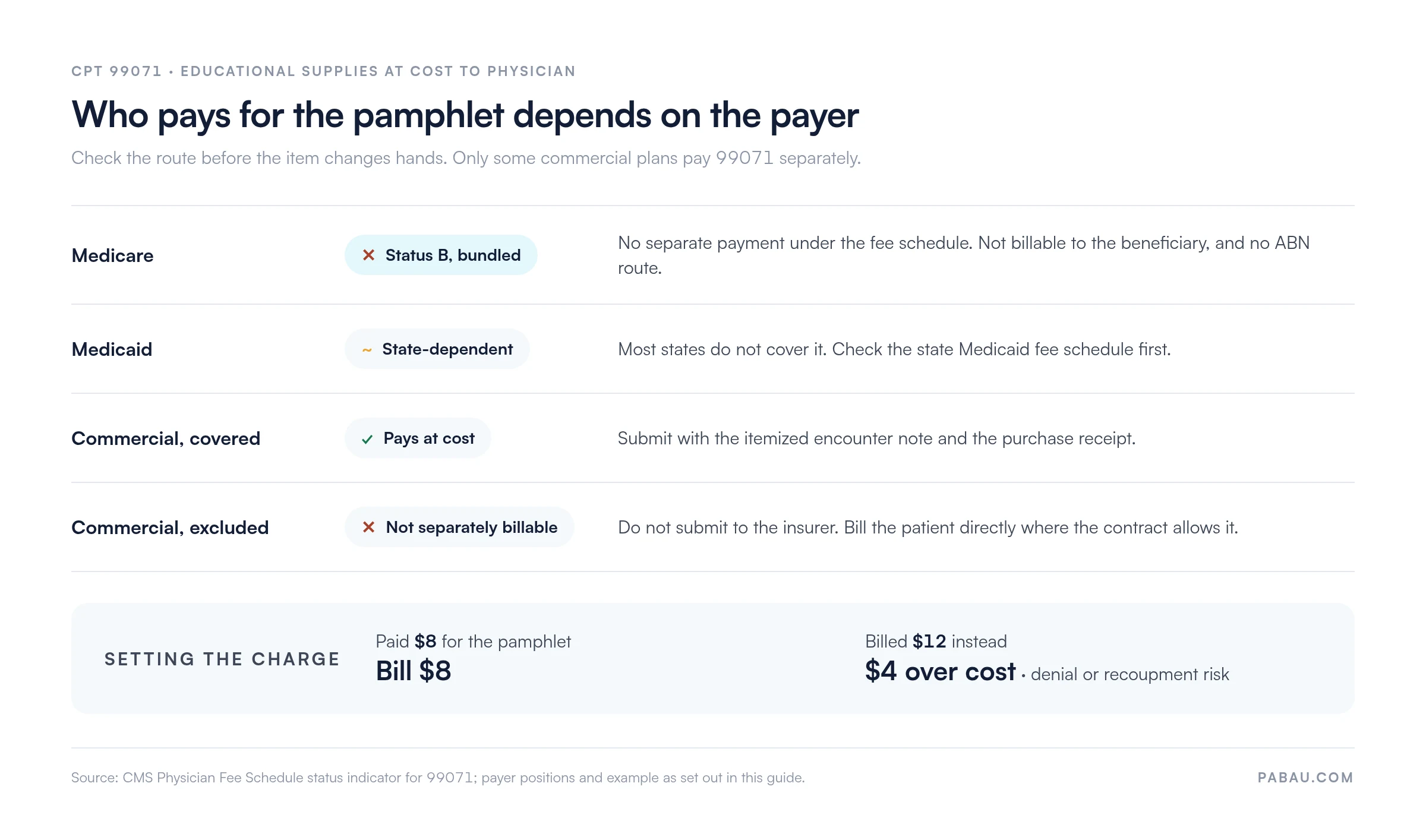
The “at cost to physician” phrase sets both the floor and the ceiling of the charge. For example, bill $12 for a pamphlet bought for $8, and the extra $4 can trigger a denial or a recoupment demand on audit.
CPT code 99070 reports supplies and materials provided over and above those usually included with the office visit. In contrast, CPT code 99071 reports educational supplies specifically. Payers treat the two differently. As a result, the wrong choice flags the claim for review.
The practical test is what the item does. If it teaches the patient something (a disease management workbook, a post-op instruction pamphlet, a medication adherence booklet), bill 99071. Otherwise, if it is a clinical supply used in or around the procedure, bill 99070. Finally, when in doubt, record the item’s educational purpose in the encounter note.
The teaching time around a workbook is a separate service from the workbook itself. When a nonphysician educator takes five to eight patients through a standardized curriculum, that time goes on procedure code 98962.
Pull the purchase receipt for every educational item before you bill CPT code 99071. The dollar amount on the claim must match the receipt. If your charge entry has no cost prompt, add a note field that records the item name and purchase price before the claim is queued.
Place of service (POS) is a major billing variable for CPT code 99071. The code fits the office-based encounter, and most payers that cover it only reimburse it under POS 11 (Office).
Billed from a facility setting such as POS 21 (Inpatient Hospital), POS 22 (Outpatient Hospital), or POS 23 (Emergency Room), the claim typically denies. Facility payment already accounts for supplies and incidental materials in the facility’s own billing. Therefore, charging them again on the physician’s claim creates double-billing exposure.
AAPC guidance confirms that coding for 990xx supply codes depends heavily on POS. However, verify each payer’s policy, because some commercial insurers take positions that differ from the general rule.
Documentation for CPT code 99071 is more demanding than for most miscellaneous codes, because the charge must reconcile to a verifiable purchase. As a result, a single missing element gives the payer grounds to deny or recoup.
A complete documentation set for 99071 has four elements. Capturing all four at the point of care, rather than rebuilding them after a denial, is what medical billing compliance looks like for this code.
In fact, practices that treat documentation as a post-claim task tend to fail audits on this code. Therefore, build the four elements into a charge-entry checklist. Staff then capture them when the material is handed over, not days later in the claim queue.
Medicare lists CPT code 99071 with status indicator B on the Medicare Physician Fee Schedule. Status B means the code is bundled into payment for other services, so Medicare never pays it separately. In addition, the materials cannot be billed to the beneficiary either, and an Advance Beneficiary Notice (ABN) opens no route to charge them.
Commercial payer coverage varies considerably. Some plans pay 99071 at the physician’s cost when documentation is complete. In contrast, others exclude it under “supplies not separately billable” language in their contracts. Therefore, verify each payer’s policy before you bill rather than waiting for a denial.
Use the CMS Physician Fee Schedule search tool to check the status indicator for 99071. In short, status B means the code is bundled, with no separate payment. The chart below sets the four payer routes side by side, with the at-cost rule that governs every charge.
CPT code 99071 has no separately payable RVU-based rate on the Medicare fee schedule. Instead, the charge is the physician’s acquisition cost for the materials. The billable amount therefore changes with each purchase and is documented per claim, not stored as a fixed fee.
Follow these steps to calculate the charge for 99071:
Where commercial payers cover 99071, the allowable typically mirrors or slightly discounts the submitted charge. Consequently, payers have little room to reduce it, since the charge is already at cost.
Look up 99071 in the CMS Physician Fee Schedule search before you bill Medicare. Status indicator B means the code is bundled, so a Medicare claim line for it will not pay. Recheck at each annual fee schedule update, since status indicators can change.
CPT code 99071 denials cluster around five predictable causes, and each one points to its fix. In fact, most can be prevented at charge capture rather than worked in the appeals queue. Good denial management workflows start with spotting which pattern drives your rejections.
The denial codes in medical billing that come with each rejection point to the fastest fix. Indeed, the CARC on the ERA tells you which kind of denial it is. CO-96 marks a non-covered charge, CO-16 missing information or a billing error, and CO-97 a service included in another service’s payment.
Report CPT code 99071 on a CMS-1500 using the standard conventions, with one difference. Specifically, the charge in Box 24F must equal the documented physician cost, not a fee schedule amount.
Practices on Pabau, the practice management platform we build, can send 99071 claims electronically through the Claim.MD clearinghouse. Claim.MD submits CMS-1500 claims to thousands of US payers, shows claim status, and flags denied claims for rework.
CPT code 99071 sits in a group of miscellaneous service codes that coders often meet together. In short, knowing the full 990xx group prevents miscoding and points to the right code for each billing scenario.
In contrast, forms work follows a different logic from supplies. When the physician completes a detailed insurance form beyond the usual medical records, check 99080 rather than any supply code.
Most 99071 problems start before the claim exists. The item, its cost, and its clinical reason have to reach the record when the pamphlet is handed over. Overall, a charge-entry checklist covers that step, whichever system the practice runs.
Treat 99071 as one step in revenue cycle management, from charge capture through payment posting. Indeed, a low-value code like this one only pays where the documentation is already in place when the claim goes out.
Pabau’s claims management software takes over once the claim is built. Specifically, through Claim.MD it submits CMS-1500 claims, shows each claim’s status, and flags denied claims for rework. When the electronic remittance advice (ERA) arrives, Pabau matches it to the claim, so a denied 99071 line stands out for follow-up.
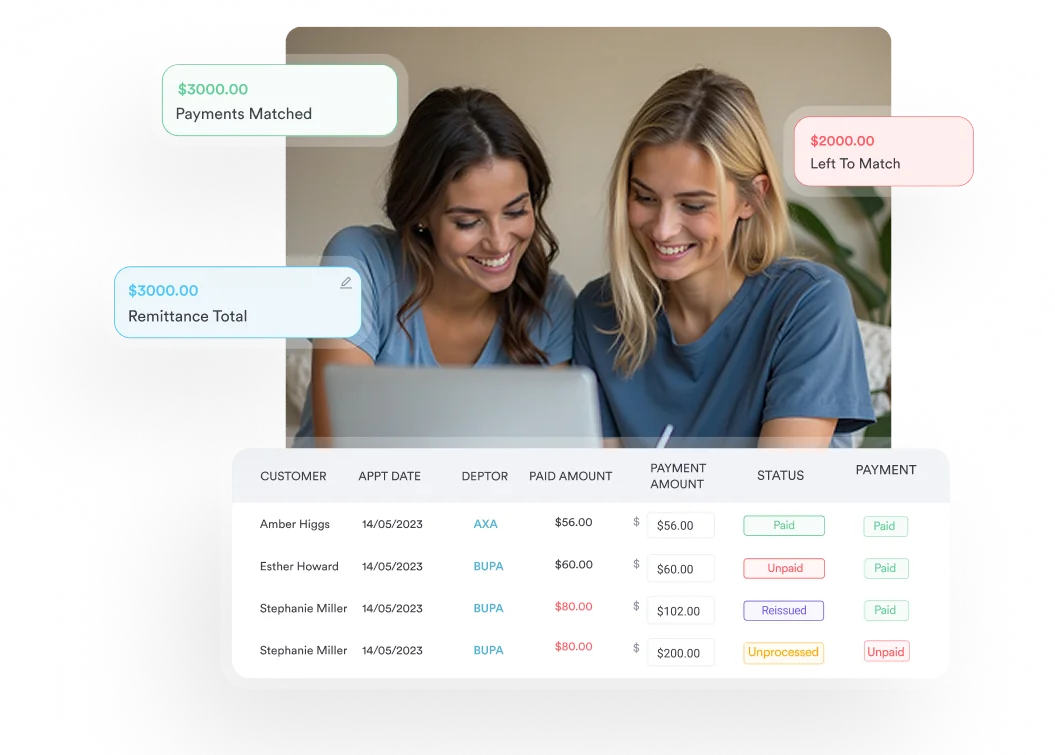

Pabau’s claims management submits CMS-1500 claims through Claim.MD, shows claim status, and flags denied claims for rework. Your team sees which 99071 lines need attention before they age.

CPT code 99071 recovers what the practice spent on patient education materials, at cost and no higher. Medicare bundles it, so the claims worth sending go to commercial plans that cover the code.
Check the payer before the pamphlet leaves the room, keep the receipt with the encounter note, and bill at cost. However, where the payer excludes the code, decide up front whether the practice absorbs the cost or the contract lets you bill the patient.
A clean claim process helps covered claims pay on first submission, and ERA matching shows which 99071 lines came back denied. Book a demo to see how Pabau tracks supply claims from submission to payment.

Need to understand how clearinghouse submission works for miscellaneous codes? Our Claim.MD clearinghouse guide explains how electronic claim routing, payer enrollment, and real-time eligibility checks work together.
Want to see how ERA remittances connect to denial resolution? Electronic remittance advice explained covers how to read ERA files and act on CARC denial codes from payers.
Looking to verify insurance eligibility before distributing educational materials? Insurance eligibility verification workflows reduce coverage-related denials before the encounter even begins.
CPT code 99071 covers educational supplies, such as books, tapes, and pamphlets, that the physician provides to a patient for their education. The charge is the physician’s purchase cost. The code does not cover physician services, digital content, or any amount above the documented purchase price.
CPT 99070 reports supplies and materials over and above those usually included with the office visit, such as dressings or splints. CPT 99071 reports educational supplies such as books, pamphlets, and instructional tapes. Only the 99071 descriptor limits the charge to the physician’s cost. Use 99071 when the item’s main purpose is patient education.
Most payers that cover CPT code 99071 pay it only in an office setting (POS 11). Claims from inpatient (POS 21) or outpatient hospital (POS 22) settings are routinely denied, because facility payment already covers incidental supplies. Telehealth encounters do not support 99071, since the code requires physical delivery of the materials.
Five causes come up most often. They are a charge above documented cost, a facility place of service, missing itemized documentation, payer non-coverage, and bundling into the same-day E/M service. The CARC on the ERA names the specific cause, which decides the correct fix.