CCSD Code B2710: Radical mastectomy including block dissection
CCSD Code B2710: Definition and clinical scope CCSD Code B2710 is the UK private...

Last Updated: Nov 13, 2026
93980 is the CPT code for a duplex scan of arterial inflow and venous outflow of penile vessels, reported as a complete study. "Complete" means both the cavernosal arteries and the venous drainage were evaluated, usually after an intracavernosal vasoactive injection.
Its companion code, 93981, covers a follow-up or limited study of the same vessels. This guide covers the official descriptor, modifier rules, ICD-10 pairings, Medicare reimbursement, documentation requirements, and NCCI bundling rules.
Let Pabau's smart automation suggest the right codes, reduce claim denials, and keep your practice compliant—effortlessly.
Automate repetitive tasks and focus on what matters most—your patients.
Reduce coding errors and ensure compliance with the latest regulations.
Clean claims, fewer denials, and faster reimbursements.
Powerful insights and reporting to help your practice thrive.
HIPAA compliant SOC 2 certified GDPR-compliant Trusted by 4,000+ clinics worldwide

CPT Code 93980 is a complete duplex scan of penile arterial inflow and venous outflow. CPT 93981 covers a follow-up or limited study of the same vessels.
Modifier 50 does not apply, because 93980 already reports the whole penile vascular study as one service.
Archived spectral Doppler waveforms belong in the record, and audited claims without them are routinely denied.
Pabau’s claims management software checks eligibility, tracks prior authorizations on the case, and submits 93980 claims through the Claim.MD clearinghouse.
CPT Code 93980 is the code for a duplex scan of arterial inflow and venous outflow of penile vessels, reported as a complete study. AAPC’s duplex scan coding guidance defines a complete study as one that evaluates all major inflow and outflow vessels of the organ. Like every CPT descriptor, the wording belongs to the American Medical Association (AMA).
“Duplex” means B-mode (gray-scale) imaging combined with spectral Doppler waveform analysis, so the scan captures anatomy and blood-flow velocity together. “Complete” refers to vessel coverage. The cavernosal arteries that feed the penis and the veins that drain it are both assessed in one study.
The code sits in the noninvasive vascular diagnostic studies section of the CPT code set (93880-93998). Its neighbors include 93970 (duplex scan of extremity veins) and 93925 (lower extremity arterial duplex).
It is ordered almost exclusively for men with symptoms of vasculogenic erectile dysfunction where non-invasive testing has not established the vascular cause.
The official AMA descriptor for 93980 reads: Duplex scan of arterial inflow and venous outflow of penile vessels; complete study.
“Complete” means both vessel systems were studied, the arterial inflow and the venous outflow. The descriptor says nothing about left and right sides, so laterality never enters the coding decision.
The procedure follows a standardized clinical protocol. Understanding each step helps coders document the encounter correctly and defend the claim if a payer requests records.
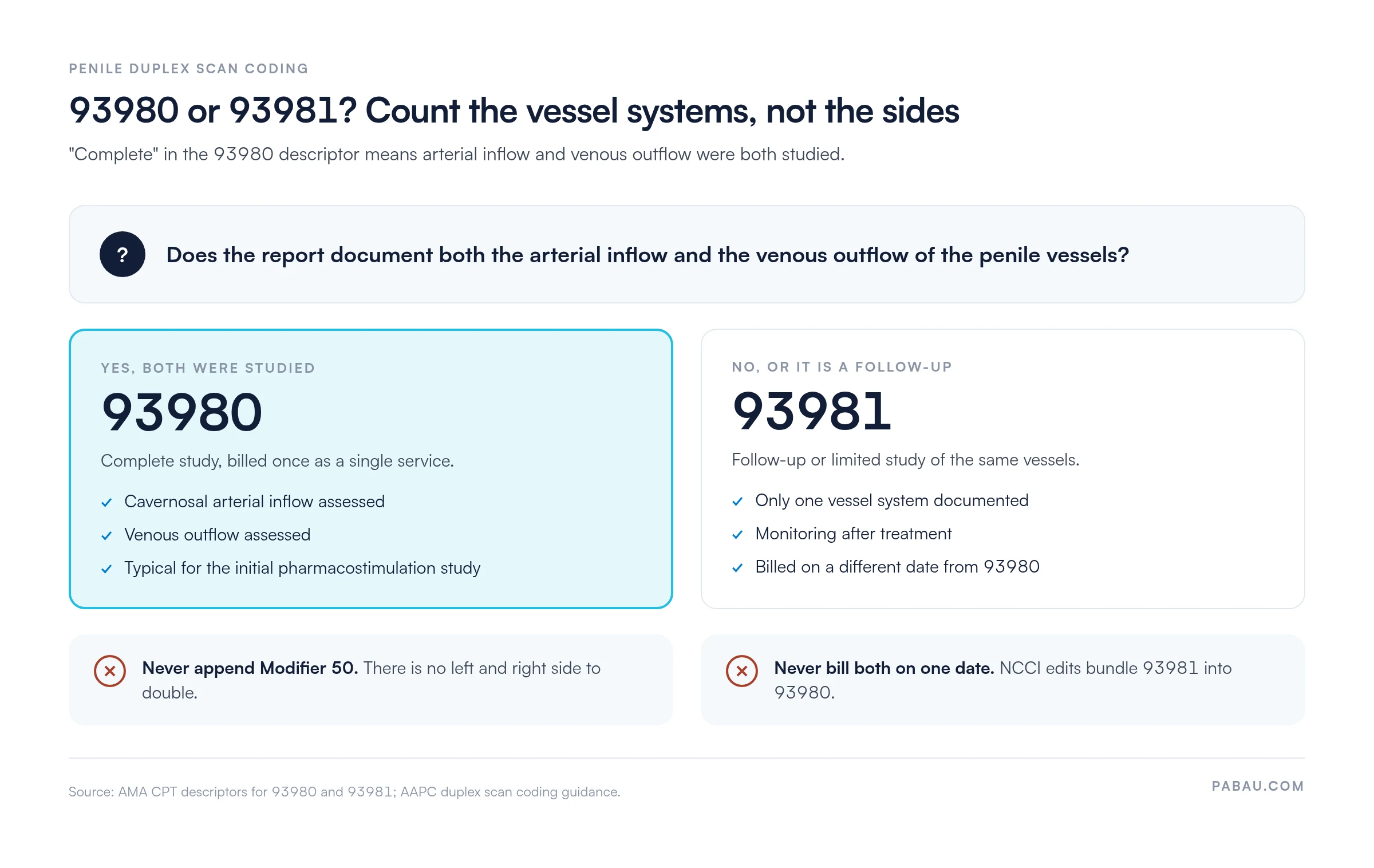
93980 and 93981 form a pair, and mixing them up is one of the most common billing errors in this code family. 93980 covers the complete study of arterial inflow and venous outflow.
93981 covers a follow-up or limited study of the same vessels, such as one that documents only one vessel system. They cannot be billed on the same date of service under NCCI edits.
One common error is billing 93981 for the post-injection series as a separate “follow-up” after the complete study. NCCI edits bundle the two on the same encounter date, so use 93980 alone for the full pharmacostimulation study. The chart below sets out which code the documentation supports.
Payers audit ICD-10-to-CPT alignment aggressively on this code. The ICD-10 diagnosis must reflect a clinically documented vascular etiology, not simply an unspecified symptom. The most defensible pairings come from the N52 and N48 code families. N52.01 leads, and N52.9 fits an initial workup before the arterial cause is confirmed.
When the indication is Peyronie’s disease or priapism, some MACs want documentation that the scan was needed to plan treatment. Confirming an already-known diagnosis may not be enough. Check the applicable Local Coverage Determination (LCD) for your MAC before submitting.
Before submitting, run a CPT-to-ICD-10 crosswalk check for each 93980 claim. N52.01 (erectile dysfunction due to arterial insufficiency) produces the fewest medical necessity denials because it directly names the vascular etiology the duplex scan is measuring. Reserve N52.9 for initial workup encounters where arterial insufficiency has not yet been confirmed.
Five modifier scenarios come up on 93980. Getting the modifier wrong is the second most common denial trigger on this code, behind missing ICD-10 alignment.
The Modifier 50 error deserves emphasis. 93980 has no left and right side to double, because it already reports arterial inflow and venous outflow as one complete study. Appending -50 asks the payer for 150% of the allowed amount, as though two separate procedures had been performed. Most payers deny the claim or start a recoupment request when they catch it on audit.
Medicare covers 93980 as medically necessary for evaluating vasculogenic erectile dysfunction, in line with MAC Local Coverage Determinations. Coverage usually follows failed conservative treatment, such as oral PDE5 inhibitors.
Dollar amounts change every year with the Medicare Physician Fee Schedule (MPFS) and vary by geographic adjustment (GPCI). Use the CMS Physician Fee Schedule lookup tool for the current rate in your locality. A figure printed in a coding guide goes out of date.
The reimbursement structure splits into three components depending on the billing scenario:
Medicare Advantage plans and Medicaid managed care organizations often have prior authorization requirements that original Medicare does not impose. Commercial payer policies vary further, so check each payer’s current benefits grid before assuming original Medicare rules apply.
Pabau, the practice management platform we build, runs eligibility checks and electronic claims through the Claim.MD clearinghouse. Your team can confirm coverage and authorization status before the patient arrives.
Inadequate documentation is the root cause of most successful post-payment audits for 93980. A clean claim submission depends on the patient record holding each of the following before the claim is filed:
93980 has a narrow set of denial patterns. Knowing the CARC (Claim Adjustment Reason Code) behind each one shortens the appeal cycle. The table below maps the most common failure modes to their fixes. Our list of common denial codes explains the CARCs payers use on other procedure families too.
Effective denial management workflows for 93980 start before submission. A claim scrubber that checks NCCI edits, validates ICD-10 pairing, and flags missing modifier logic catches most of these failures before they become write-offs.
Original Medicare (Parts A and B) does not currently require prior authorization for CPT 93980, provided the claim is supported by an appropriate LCD-covered indication. The practical challenge is that original Medicare is a minority of the payer mix for most urology and vascular practices.
Run insurance eligibility verification for each patient before scheduling the study, and confirm the plan’s authorization rules at the same time. A typical prior authorization submission for 93980 includes:
Turnaround times for authorization decisions range from 24 hours (urgent/expedited) to 10-14 business days for routine requests, depending on the payer. Denied authorizations can be appealed with peer-to-peer review. Document the appeals process and outcome in the patient record.
The National Correct Coding Initiative (NCCI) governs which codes may not be billed together without documented justification. For 93980, the most critical rule is the prohibition on same-date billing with 93981.
Beyond that, related vascular ultrasound codes from the 93970 family may trigger NCCI edits if billed in the same session. Each one needs Modifier 59 and clear documentation of a distinct service.
93980 is a global code. With no modifier appended, it covers the technical component (equipment, technician) and the professional component (interpretation).
Billing 93980 globally and then billing the interpretation separately is an unbundling violation. Our primer on medical billing fundamentals explains how global and split billing work across procedure families.
Verify NCCI edit tables quarterly: CMS updates them four times per year. A code pair with no edit in Q1 may be bundled by Q3. Subscribe to CMS NCCI update notifications, or use a clearinghouse that pushes edit updates automatically. Your 93980 billing rules then stay current without a manual review every quarter.
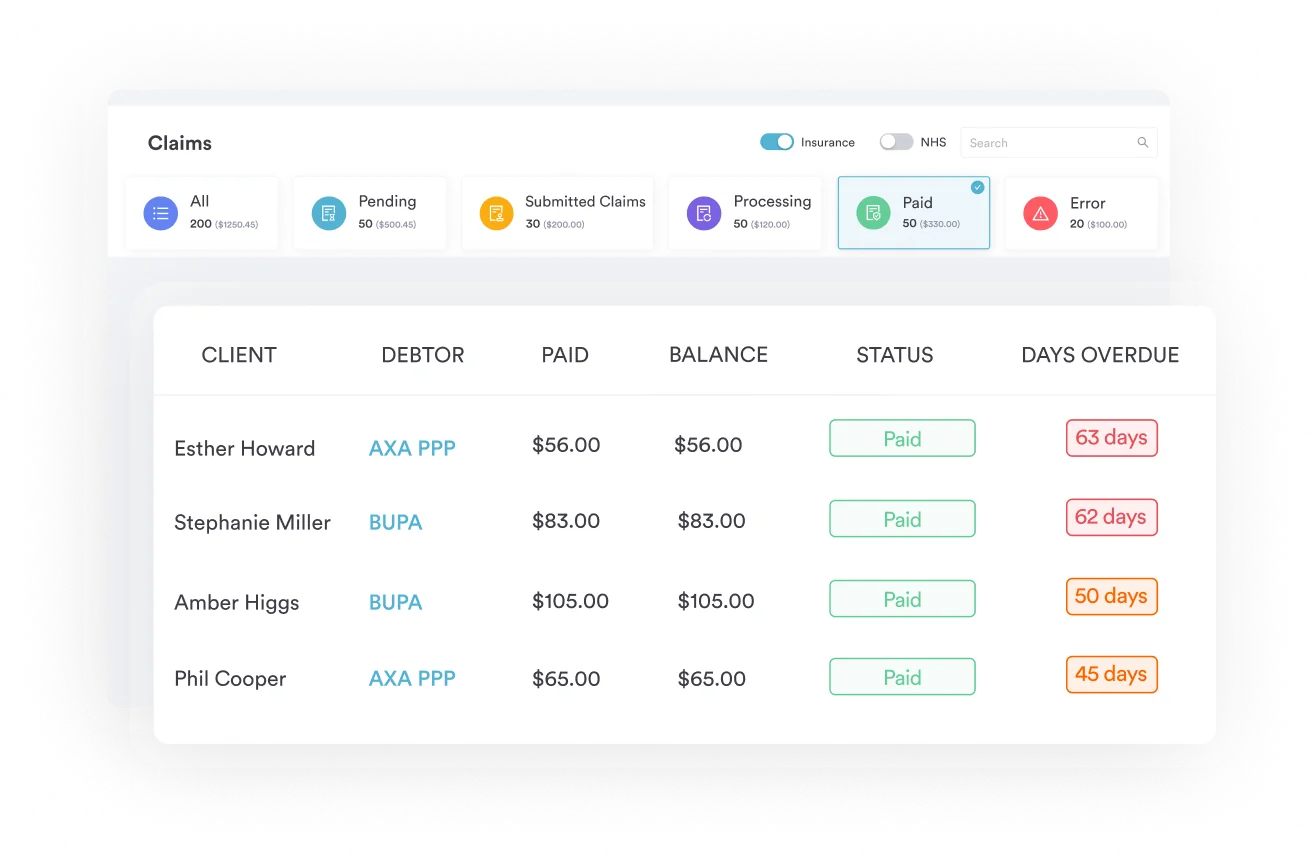
In many urology and vascular practices, the injection record sits in one system and the claim gets built in another. A biller then re-keys the drug, the dose and the diagnosis, and that is where 93980 claims pick up errors. Pabau’s urology billing software keeps the clinical record, the authorization and the claim on the same patient file.
For 93980, that covers the steps where most denials start:
The details a payer asks for on audit are captured once, during the study, and carried into the claim without a second round of typing. Your billing team spends its time on exceptions instead of chasing paperwork.

Pabau checks patient eligibility, tracks prior authorizations on the case, and submits penile duplex claims through the Claim.MD clearinghouse. Remittances post back against the same patient record.

The descriptor decides this code. A 93980 claim needs a report that documents both the arterial inflow and the venous outflow, and anything less belongs on 93981. Once “complete” is read as vessel coverage rather than sides, Modifier 50 drops out of the question.
What remains is record-keeping at the point of care: the injection agent and dose, the timed velocity series, and archived waveforms. Capture them during the study, and an auditor has little left to question. Book a demo to see how Pabau carries penile duplex documentation straight into a clean 93980 claim.

Want to see what a clean claim looks like before it leaves your practice? Clean claim submission best practices outlines the documentation and edit standards that maximize first-pass acceptance rates.
Billing a duplex scan of abdominal, pelvic or scrotal vessels? CPT code 93975 applies the same complete-study rule to visceral vascular duplex scans.
CPT Code 93980 covers a complete duplex scan of arterial inflow and venous outflow of the penile vessels. It combines B-mode ultrasound imaging with spectral Doppler waveform analysis to evaluate blood flow. It is used mainly to investigate the vascular cause of erectile dysfunction, with velocity readings taken before and after an intracavernosal injection.
93980 is the complete study of arterial inflow and venous outflow, used for initial evaluation. 93981 is a follow-up or limited study of the same vessels. NCCI edits prohibit billing both codes on the same date of service. Use 93980 for the full pharmacostimulation encounter, and 93981 only for a separately documented follow-up or limited study on a different date.
Yes, Medicare covers 93980 as medically necessary for vasculogenic erectile dysfunction evaluation when conservative therapies have failed, subject to each MAC’s Local Coverage Determination. Original Medicare does not require prior authorization, but Medicare Advantage plans and commercial insurers often do. Verify coverage and auth requirements for each patient’s specific plan.
The strongest pairings are N52.01 (erectile dysfunction due to arterial insufficiency) and N52.9 (male erectile dysfunction, unspecified). For Peyronie’s disease, use N48.6; for priapism evaluation, use N48.30. Payers audit ICD-10-to-CPT alignment aggressively on this code, so the diagnosis must reflect a documented vascular indication.
Original Medicare does not require prior authorization for 93980, but Medicare Advantage plans, Medicaid managed care organizations, and many commercial payers do. Submit clinical notes documenting the ED diagnosis, failed conservative therapy, and physician attestation of medical necessity with any authorization request.
No. 93980 already reports arterial inflow and venous outflow of the penile vessels as one complete study, so there is no second side to bill. Appending Modifier 50 asks the payer for 150% of the allowed amount, which leads to a denial or a recoupment request.
Five reasons account for most denials: a missing or mismatched ICD-10 code, an undocumented vasoactive injection, and Modifier 50 appended in error. The other two are waveform images that were never archived, and 93980 and 93981 billed on the same date. Address all five at the front end by building documentation checklists into the clinical workflow.
The AAPC Codify CPT lookup provides code descriptors, relative value units, and crosswalk data for 93980 and its companion codes. For current Medicare reimbursement rates, always cross-reference against the CMS Physician Fee Schedule lookup tool for your locality and year.