

CPT code 48152: Whipple procedure without pancreatojejunostomy
CPT code 48152: Official description and procedure overview CPT code 48152 descr...

Last Updated: Nov 13, 2026
92555 is the CPT code for speech audiometry threshold. It reports the speech recognition threshold, the softest level at which a patient repeats half of a list of two-syllable spondee words. The result is recorded in dB HL for each ear.
Bill it alone only when the threshold is the whole test. Word recognition in the same session makes the claim 92556, and comprehensive audiometry makes it 92557. Medicare needs a physician order unless an audiologist bills under direct access with modifier AB.
Let Pabau's smart automation suggest the right codes, reduce claim denials, and keep your practice compliant—effortlessly.
Automate repetitive tasks and focus on what matters most—your patients.
Reduce coding errors and ensure compliance with the latest regulations.
Clean claims, fewer denials, and faster reimbursements.
Powerful insights and reporting to help your practice thrive.
HIPAA compliant SOC 2 certified GDPR-compliant Trusted by 4,000+ clinics worldwide

CPT code 92555 covers speech recognition threshold (SRT) testing only. Adding word recognition scoring turns the claim into 92556.
92555 is never billed on the same date as 92556 or 92557, because both codes already include the threshold.
Medicare covers 92555 as a diagnostic test with a physician order, or under audiologist direct access with modifier AB once every 12 months.
Routine hearing exams are excluded from Medicare under Section 1862(a)(7) of the Social Security Act.
A missing order and a same-day bundling edit are the two leading denial triggers on 92555 claims.
Pabau’s claims management software checks eligibility and submits audiology claims through the Claim.MD clearinghouse.
CPT code 92555 is the procedure code for speech audiometry threshold testing. ASHA’s Medicare coding rules give its descriptor as Speech audiometry threshold, and the code finds the speech recognition threshold (SRT).
That is the softest level at which a patient correctly repeats 50% of spondaic words. Spondees are two-syllable words with equal stress, such as “baseball” or “hotdog.”
The SRT result is recorded as a decibel (dB HL) value per ear. It cross-checks the pure-tone average from separate testing (92553), which is its own billable procedure.
It also sets the presentation level for word recognition testing. When word recognition runs in the same session, the claim line becomes 92556, which already includes the threshold.
These four adjacent audiology codes confuse coders most when they appear on the same date of service. Each describes a different test package. Both 92556 and 92557 contain the speech threshold, so 92555 can never sit beside either one on a claim.
The decision comes down to which tests appear on the audiogram for that date. The table below maps each combination to the claim line it produces.
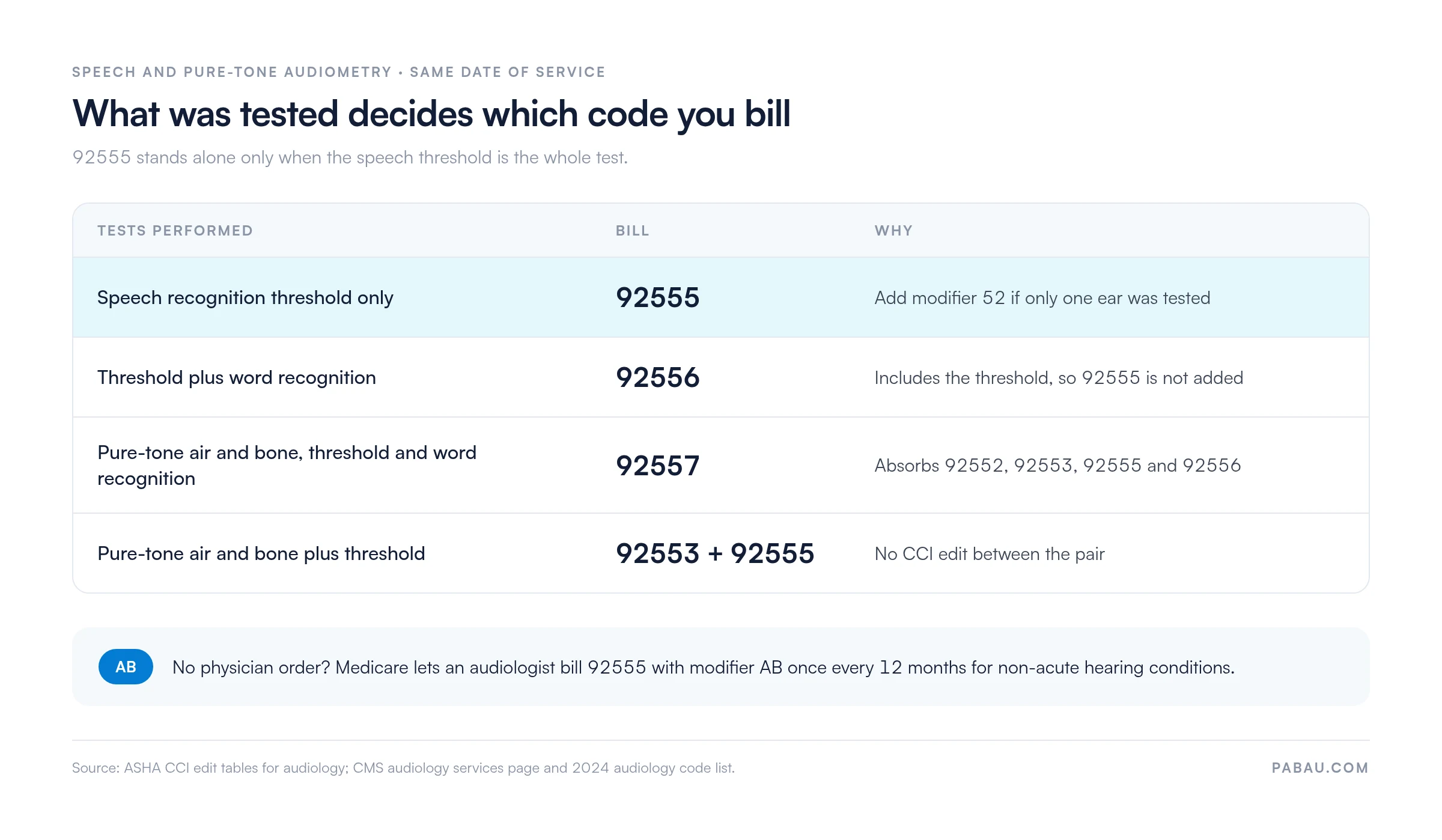
Use AAPC Codify to verify the current NCCI column indicators before submitting claims that combine audiology codes. CCI edits update quarterly, and the column status can change.
Absent or incomplete documentation is the most common reason 92555 claims are denied on audit. Every element below must appear in the medical record before the claim is submitted. Submitting a clean claim starts with complete documentation, not claim formatting.
MAC Local Coverage Determinations (LCDs) add jurisdiction-specific requirements. Noridian, CGS, Palmetto, and other MACs publish their own audiology LCDs. Always check your MAC’s current LCD before billing, because requirements vary by region.
Medicare Part B covers CPT code 92555 when a physician or NPP orders the test to evaluate a specific medical condition. Under CMS’s audiology direct access rule, an audiologist can also bill it without an order, with modifier AB, once every 12 months.
Routine hearing exams are excluded under Social Security Act Section 1862(a)(7), so the diagnostic-versus-routine distinction decides most coverage questions.
Always verify the current rate using the CMS Physician Fee Schedule lookup tool. Rates change each January and vary by MAC locality. Publishing a specific dollar figure without citing the current year and locality creates compliance risk.
Before billing 92555 for a Medicare patient, confirm which route the visit took. With an order, it must name a medical condition requiring audiological evaluation, such as progressive hearing loss or tinnitus. An order that says ‘hearing test for annual physical’ will not support medical necessity. Without an order, the visit qualifies only as direct access with modifier AB, and only for a non-acute hearing complaint.
Medicare generally does not require prior authorization for CPT 92555 when the test evaluates a documented medical condition. Commercial plans are a different matter.
Running insurance eligibility verification at the time of scheduling surfaces prior auth requirements before the patient arrives. A PA denial after the test is far harder to overturn than a PA request submitted beforehand.
Four modifiers come up on 92555 claims, and one of them is often applied where it should not be. Using the wrong one, or omitting a required one, is a consistent denial trigger.
Confirm your MAC’s specific modifier guidance. Some MACs publish audiology billing articles that clarify when Modifier 52 is required versus when documentation alone suffices for a unilateral test.
Most 92555 denials fall into five categories, and each one has a clear corrective action. Structured denial management workflows catch these before they reach secondary review.
See our guide to denial codes for the CARC and RARC codes that accompany these rejections on EOBs.
The National Correct Coding Initiative (NCCI) sets the bundling relationships between 92555 and its neighbors. Under current CCI edits, 92555 is a column-two component of both 92556 and 92557. Each of those codes already pays for SRT testing, so billing 92555 beside either one duplicates the service.
Key NCCI rules for the audiology code family:
CCI edits are updated quarterly. ASHA’s CCI edit tables list the audiology pairs and whether a modifier can bypass each one. Verify the current column indicators against the CMS NCCI edits page and the NCCI Policy Manual before each billing cycle.
A complete 92555 billing workflow runs in seven steps. Medical billing fundamentals apply throughout, while audiology-specific rules govern steps one, four, and five.
The diagnosis code paired with CPT code 92555 must support medical necessity. For Medicare, a screening encounter code alone (Z01.10) is typically insufficient without a documented pathology.
Sometimes a visit documents both a screening encounter and a pathology. List the specific pathology code (H90.x, H91.x) as the primary diagnosis, so it anchors medical necessity.
Run a CPT-to-ICD-10 crosswalk check before billing 92555 for Medicare patients whose only documented diagnosis is Z01.10. If the audiogram or clinical notes also reflect a specific finding, bill the finding code as primary. A claim denied for medical necessity on a Z01.10-only basis cannot be resubmitted with a different diagnosis code after the fact without a clinical amendment.
In many audiology practices, the order, the audiogram, and the claim live in three different places. The coder sees a claim line, not the test sheet. So a 92555 that should have been a 92556 goes out unchanged, and a missing order surfaces only when the denial arrives.
Pabau’s claims management software keeps the referral, the test results, and the claim on the same patient record. Eligibility checks run before the visit, so a Medicare Advantage plan that wants prior authorization shows up before the patient sits in the booth.
Claims go out through Claim.MD, and remittances post back against the same record. A denial for a missing order or a bundling edit then shows up as a claim status your billing team can work. It no longer waits for month-end reconciliation.

Pabau checks eligibility before the visit, submits claims through the Claim.MD clearinghouse, and posts remittances against the patient record. See it working for an audiology or ENT practice.

92555 is one of the simplest audiology codes to bill, as long as the claim matches the test. Word recognition in the same session makes the claim line 92556. Add pure-tone air and bone testing and it becomes 92557. Billing 92555 beside either one gets denied, and no modifier fixes it.
The order question is narrower than it used to be. A physician order still covers most Medicare visits, but an audiologist can see a patient once a year without one, under modifier AB.
Check which route each visit took before you code it. Book a demo to see how Pabau keeps the order, the audiogram, and the claim on one patient record.

Need a clearinghouse that handles audiology claim validation? Understanding medical claims clearinghouses explains how 837P routing and ERA remittance processing work for outpatient audiology practices.
Seeing repeat denials across your billing codes? Revenue cycle management fundamentals covers the full workflow from eligibility to payment posting and where audiology practices lose the most revenue.
Looking for the billing rules on a related audiology code? Medical billing compliance guidance outlines documentation standards, payer audit triggers, and corrective action steps for outpatient practices.
CPT code 92555 covers speech audiometry threshold testing, which determines a patient’s speech recognition threshold (SRT). That is the softest decibel level at which the patient correctly identifies 50% of spoken spondaic words. It does not include word recognition scoring (92556) or pure-tone audiometry (92553).
CPT 92553 covers pure-tone audiometry (air and bone conduction thresholds measured with tones), while 92555 covers speech audiometry threshold testing using spoken spondaic words. They measure different auditory functions and can be billed together on the same date without a bundling conflict.
Yes. Medicare Part B covers CPT code 92555 when a physician orders it to evaluate a specific condition such as hearing loss or tinnitus. An audiologist can also bill it without an order, with modifier AB, once every 12 months for a non-acute hearing condition. Routine hearing exams are excluded under Section 1862(a)(7) of the Social Security Act.
No. CPT 92557 is a comprehensive audiometry bundle that already includes SRT testing (92555) and word recognition scoring (92556). Billing 92555 separately on the same date as 92557 triggers an NCCI bundling edit, and the claim will be denied. Bill 92557 alone when comprehensive testing was performed.
No. CPT 92556 is speech audiometry threshold with speech recognition, so it already includes the threshold that 92555 reports. The CCI edit between the two cannot be bypassed with a modifier. Bill 92556 alone when both the threshold and word recognition were tested.
Traditional Medicare Part B does not require prior authorization for CPT 92555 when it evaluates a diagnosed medical condition. Medicare Advantage plans and commercial insurers vary by contract and plan year. Verify prior auth requirements through the payer portal or provider line before scheduling the test.
The national average non-facility Medicare reimbursement for CPT 92555 is approximately $20 to $35. The exact rate varies by MAC locality and changes each January. Use the CMS Physician Fee Schedule lookup tool, with your locality and the current calendar year, for the precise figure.



