HCPCS Code E0188: Foam mattress overlay billing guide
HCPCS code E0188: official descriptor and code details HCPCS code E0188 is the L...

Last Updated: Oct 29, 2026
92082 is the CPT code for an intermediate visual field examination, unilateral or bilateral, with interpretation and report. It fits a Goldmann test plotting at least 2 isopters, or a semiquantitative, automated suprathreshold screening program. The AMA's named examples of the latter are the Humphrey suprathreshold automatic diagnostic test and Octopus program 33.
CPT code 92082 sits between limited perimetry (92081) and extended threshold perimetry (92083). The program run and documented decides the level, so a Humphrey 24-2 or 30-2 SITA threshold test is 92083. Bill one unit per test, whether one eye or both are tested, and only one perimetry code per day.
Let Pabau's smart automation suggest the right codes, reduce claim denials, and keep your practice compliant—effortlessly.
Automate repetitive tasks and focus on what matters most—your patients.
Reduce coding errors and ensure compliance with the latest regulations.
Clean claims, fewer denials, and faster reimbursements.
Powerful insights and reporting to help your practice thrive.
HIPAA compliant SOC 2 certified GDPR-compliant Trusted by 4,000+ clinics worldwide

CPT code 92082 covers an intermediate visual field examination, unilateral or bilateral, with interpretation and report.
It fits a Goldmann test plotting at least two isopters, or a semiquantitative automated suprathreshold screening program such as Octopus program 33.
Quantitative threshold tests, including the Humphrey 24-2 and 30-2 SITA programs, bill as 92083, not 92082.
Code from the program named in the record. Bill a single unit of one perimetry code per day, whether one eye or both were tested.
Medicare coverage is set by each MAC, such as First Coast’s billing and coding article A57637, which supports LCD L33766.
CPT code 92082 is the AMA code for an intermediate visual field examination of one or both eyes, with interpretation and report.
The descriptor gives two routes to it. One is a kinetic Goldmann test that plots at least two isopters. The other is a semiquantitative, automated suprathreshold screening program, such as the Humphrey suprathreshold automatic diagnostic test or Octopus program 33.
In plain clinical terms, a 92082 automated test checks each point against a preset stimulus and records it as seen or missed. It does not measure the threshold sensitivity at each point. That measurement is quantitative threshold perimetry, which is an extended examination and bills as 92083.
The Humphrey 24-2 and 30-2 SITA programs that glaucoma practices run routinely are threshold tests, so they are 92083, not 92082.
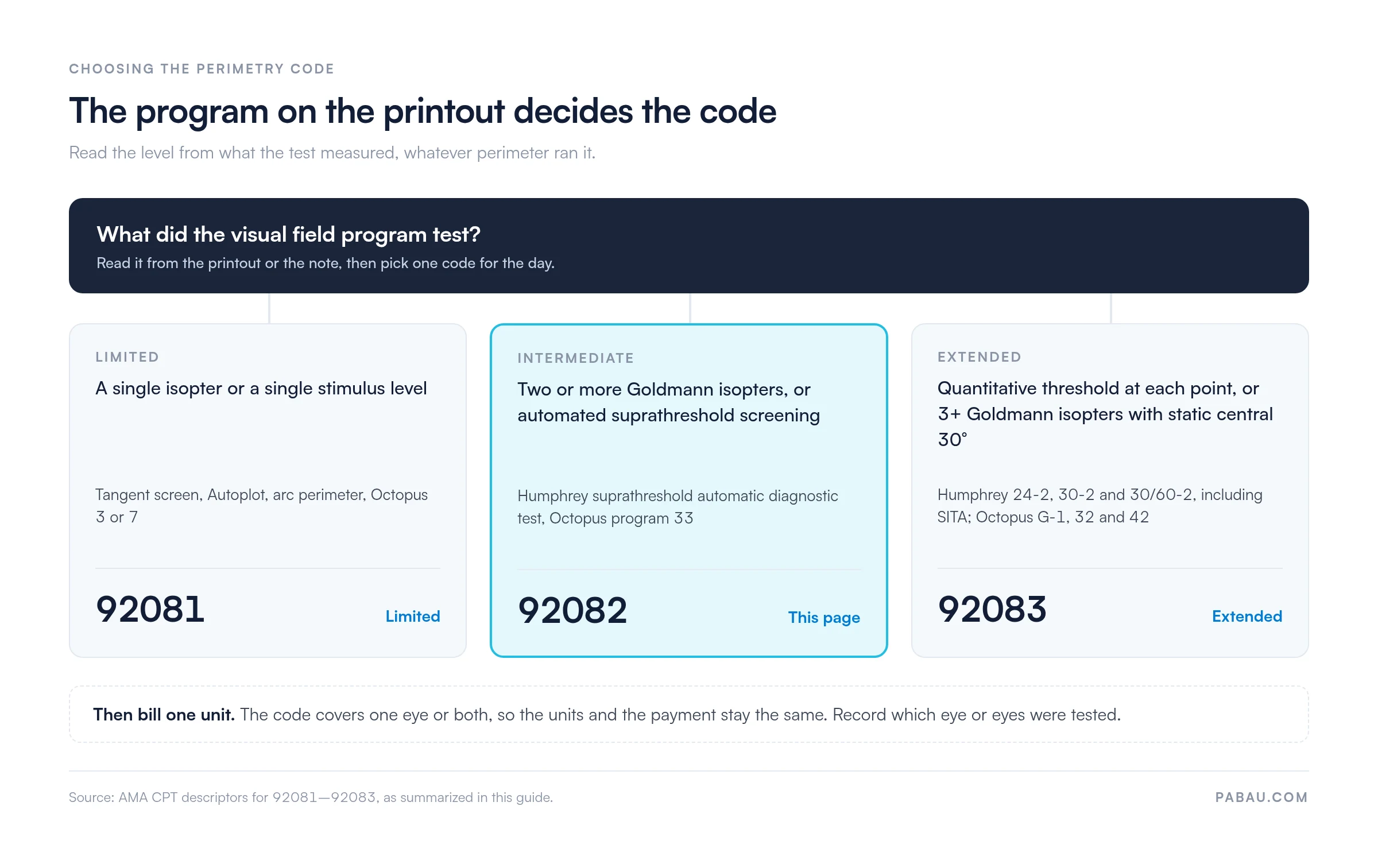
The three perimetry codes step up from a single-level test to full quantitative threshold mapping. The code follows the program run and documented, whichever perimeter model ran it and whatever the diagnosis.
Treating 92082 as a safe default for routine threshold fields is a costly mistake. A SITA threshold test billed as 92082 is miscoded, and downcoding it does not protect the claim in an audit.
Key distinction: 92082 is a screening-level test, while 92083 is a measuring test. A 24-2 or 30-2 SITA Standard or SITA Fast program measures threshold at every point, so it is extended perimetry (92083). A suprathreshold screening program on the same Humphrey analyzer is intermediate perimetry (92082).
If the record does not name the program run, the payer cannot match the claim to a code. That claim may then be denied for insufficient documentation. The decision comes down to one question, shown below: what did the program measure?
Medical necessity for CPT code 92082 must be supported by a covered diagnosis. Each MAC lists those diagnoses in its own billing and coding article, such as First Coast’s A57637. Billing without a linked ICD-10 code from that list is the fastest route to a medical-necessity denial.
Always use the most specific ICD-10-CM code available. H40.1131 (primary open-angle glaucoma, bilateral, mild stage) makes a stronger medical necessity case than H40.9, which leaves the glaucoma type unspecified. It also makes a request for more documentation less likely.
Medicare coverage for visual field examinations, including CPT code 92082, is set locally by each Medicare Administrative Contractor (MAC). First Coast Service Options, for example, publishes LCD L33766 with a supporting billing and coding article, A57637. A57637 is not a national policy, and it binds only claims in First Coast’s jurisdiction.
Provisions to check in your MAC’s policy:
First Coast covers Florida, Puerto Rico and the US Virgin Islands. Outside that region, read your own MAC’s LCD and billing and coding article, because covered diagnoses and frequency rules differ between contractors.
Medicare reimburses CPT code 92082 under the Physician Fee Schedule using a relative value unit (RVU) formula. Rates vary by geography through the Geographic Practice Cost Index (GPCI). The national rate below multiplies 1.42 total RVUs by the 2026 non-qualifying APM conversion factor of $33.4009. For your locality, use the CMS MPFS lookup tool or an RVU calculator.
Commercial payer rates vary widely, typically ranging from Medicare-equivalent to 150-200% of Medicare rates depending on the contract. Pabau, the practice management platform we build, sends 92082 claims to payers through the Claim.MD clearinghouse. Remittances then post back, so the team can compare each payment against the expected rate.
Run a quarterly audit comparing your expected 92082 reimbursement with what each payer paid. A commercial contract that keeps paying below the Medicare rate is worth renegotiating at renewal.
Modifier selection for CPT code 92082 depends on two questions. Was the service reduced? Was it billed alongside other ophthalmology codes on the same date of service? The number of eyes tested changes neither the modifier nor the units.
The 92082 descriptor reads unilateral or bilateral, so one unit covers the test whether one eye or both are examined. Bill a single unit either way, and the payment does not change with the number of eyes. RT, LT and modifier 50 are not expected on this code. Record which eye or eyes were tested in the note instead.
A paid 92082 claim rests on six elements in the medical record. Leave one out and the claim invites a records request or a denial.
Payers auditing 92082 claims focus heavily on the physician interpretation note. A printout in the chart without a signed interpretation note is the most common documentation failure for this code.
Each 92082 denial below maps to a cause and a fix. The list draws on the medical billing denial codes that ophthalmology practices see most.
Denial management workflows log every denial by reason code, payer and CPT code. Over a quarter, that log shows which step in the 92082 process keeps failing.
Ophthalmology and optometry encounters frequently include multiple diagnostic procedures. Knowing which codes can go on the same date of service as CPT code 92082 avoids both missed revenue and compliance risk. So does knowing which NCCI edits may block a pairing.
Verify current NCCI edit pairings through the AAPC code lookup or directly in the CMS NCCI edit tables before billing 92082 alongside comprehensive evaluation codes. NCCI edits are updated quarterly, and the combinations that require modifier -59 can change between periods.
A clean 92082 claim follows a consistent workflow from order to submission. The steps below also map to the medical billing workflows that apply across the ophthalmology revenue cycle.
Set up a pre-submission checklist in your EHR or practice management system. It should catch any 92082 claim missing a covered ICD-10 code, a signed interpretation, or a documented reason for a repeat test. Fixing these clears the denial reasons in the table above before the claim leaves the practice.
In many practices, the perimetry printout sits in one system and the interpretation in another. The claim is then keyed by hand from both. That split is where a threshold test gets billed as 92082, or the signed interpretation goes missing.
Pabau keeps the visual field record, the physician interpretation and the diagnosis on the same patient file. The claim is pre-filled from the data already on that record, then submitted and tracked through Claim.MD. Your coder still chooses the code, but checks it against one complete record rather than three partial ones.

Pabau keeps the test record, the signed interpretation and the diagnosis on one patient file. It then pre-fills the claim from that record and tracks it through Claim.MD.

The 92082 decision gets made in the testing room, when the technician picks the program. If your routine glaucoma fields are SITA threshold programs, they belong under 92083, and coding them as 92082 is an error. Reserve 92082 for suprathreshold screening programs and two-isopter Goldmann tests, and make the program name part of every record.
Repeat fields need a documented clinical change behind them, so write that reason into the note on the day. Once the program fixes the code, the rest is submitting a clean claim: a covered diagnosis, a signed interpretation and a single unit. Book a demo to see how Pabau keeps visual field records and claims together for ophthalmology practices.

Is the test a SITA threshold field? CPT code 92083 covers extended threshold perimetry, the code most glaucoma fields belong under.
Billing OCT alongside the field test? CPT code 92133 explains optic nerve imaging, the test most often paired with 92082 in glaucoma workups.
Want to track denial trends across all your ophthalmology codes? Denial management in healthcare covers the workflow and metrics practices use to close the denial loop.
Need guidance on how Medicare clearinghouse submissions work? Claim.MD clearinghouse overview explains how electronic claims reach payers and what happens when they are rejected.
Looking for a reference on billing code structures and payer edits? Medical billing compliance outlines the documentation and submission standards that keep ophthalmology practices audit-ready.
CPT code 92082 covers an intermediate visual field examination, unilateral or bilateral, with physician interpretation and report. It applies to a Goldmann test plotting at least two isopters, or to a semiquantitative automated suprathreshold screening program. Examples are the Humphrey suprathreshold automatic diagnostic test and Octopus program 33.
92081 is limited perimetry, such as a tangent screen or a single-stimulus-level automated test. 92082 is intermediate perimetry: two Goldmann isopters or an automated suprathreshold screening program. 92083 is extended perimetry, meaning quantitative threshold testing such as the Humphrey 24-2, 30-2 or 30/60-2 SITA programs. Select the code from the program run, and bill only one per day.
Covered diagnoses come from your MAC’s billing and coding article, such as First Coast’s A57637. They typically include open-angle glaucoma (H40.10-H40.9), glaucoma suspect (H40.00-H40.069) and disorders of the optic nerve (H47.00-H47.099). Visual field defects (H53.40-H53.489) and neurological causes such as benign intracranial hypertension (G93.2) also appear.
The medical record must name the ordering provider and the clinical indication, with a covered ICD-10 code. It must show the date, the eye or eyes tested, and the equipment and named program or isopters used. It also needs a physician-signed interpretation that references the printout. A technician printout without that interpretation does not meet the requirement.