HCPCS code V5259: Digital binaural ITC hearing aid billing
HCPCS code V5259 reports a digital ITC hearing aid pair HCPCS code V5259 reports...

Last Updated: Oct 22, 2026
92018 is the CPT code for a complete ophthalmological examination and evaluation under general anesthesia, with or without manipulation of the globe. It is used when a patient, most often a young child, cannot tolerate a full eye exam while awake.
Its counterpart, CPT 92019, covers a limited exam under anesthesia. Most claim problems come from billing 92018 with eye surgery in the same anesthesia session. National Correct Coding Initiative (NCCI) rules treat that exam as part of the surgery.
Let Pabau's smart automation suggest the right codes, reduce claim denials, and keep your practice compliant—effortlessly.
Automate repetitive tasks and focus on what matters most—your patients.
Reduce coding errors and ensure compliance with the latest regulations.
Clean claims, fewer denials, and faster reimbursements.
Powerful insights and reporting to help your practice thrive.
HIPAA compliant SOC 2 certified GDPR-compliant Trusted by 4,000+ clinics worldwide

CPT code 92018 bills a complete eye exam performed under general anesthesia, usually for a child or a patient who cannot cooperate while awake.
CPT 92019 is the limited version of the same exam, so a practice bills one level or the other for a session, never both.
The CY2026 national Medicare payment for 92018 is about $113, from 3.39 total RVUs, and CMS sets no office rate for it.
NCCI treats the exam as part of any eye surgery done under the same anesthesia, unless the exam stands as a separate, documented service.
The record has to show why anesthesia was needed, what was examined in each eye, and what was decided.
CPT code 92018 is a complete eye exam performed under general anesthesia, usually called an exam under anesthesia, or EUA. The American Medical Association (AMA) descriptor has three parts.
The ophthalmologist examines both eyes while the patient is asleep, often in a hospital operating room or surgery center. Typical work includes intraocular pressure, corneal measurements, a cycloplegic refraction, and a dilated retinal exam. The globe may be moved to test passive range of motion or to bring hidden structures into view.
The code sits in the Special Ophthalmological Services section of CPT, alongside its limited counterpart 92019. It is not an evaluation and management service, so new and established patient status plays no part in choosing it.
If you are looking for the comprehensive office exam for a new patient, that is CPT 92004. Our guide to CPT code 92004 covers it and its established-patient pair, 92014.
Payers accept an EUA when an adequate exam cannot be done with the patient awake. The record has to explain why, because anesthesia carries its own risk. The usual reasons fall into a short list.
Some health plans spell this out in their clinical policies. An Envolve Vision policy, for example, limits EUA coverage to patients who cannot tolerate a conscious exam. It also rules it out when the risks of anesthesia outweigh the need for the exam.
The two codes share a descriptor up to the last word. CPT 92018 ends in “complete” and CPT 92019 ends in “limited.” CPT does not list the elements each level requires, so the documented scope of the exam decides the code.
When the plan was a complete exam and it had to stop early, bill 92019 for what was done. A limited code already exists for the reduced service, so modifier -52 on 92018 is the wrong fix.
An EUA claim has to prove that the exam needed anesthesia and that it was complete. Record each element below in the operative or procedure note.
Build these fields into the EUA note template, so a note cannot close with one missing. A complete note keeps the downstream medical billing workflow clean and makes an appeal far easier to win.
The diagnosis on an EUA claim has to name the eye condition, not the routine reason for a checkup. Where the reason for anesthesia is a developmental condition, add it as a secondary diagnosis. Check billing compliance requirements against your payer policy before you submit.
Routine eye exam codes (Z01.00, Z01.01) do not support an EUA. Unspecified laterality codes also invite denials, because the note should always say which eye has the condition.
The CMS CY2026 relative value file (RVU26D) gives CPT 92018 a work relative value unit (RVU) of 2.44 and 3.39 total RVUs. At the $33.4009 conversion factor, that pays about $113.23 nationally, before the locality adjustment.
The NA flag means CMS sets no office rate for this code, which fits a service performed in an operating room. The facility bills its own charge for the room, and the anesthesia provider bills separately, usually with anesthesia code 00148. Check your locality figure with the CMS Physician Fee Schedule lookup tool.
Most EUA patients are children, so Medicaid, CHIP, and commercial plans pay far more of these claims than Medicare. Their rates and prior authorization rules vary widely. Confirm authorization when the case is scheduled, since many plans review the medical necessity of general anesthesia before the date.
CPT 92018 has a global period of XXX in the CMS fee schedule, meaning the global surgery concept does not apply. The exam carries no pre-operative or post-operative days of its own.
Bundling is a separate question, governed by the National Correct Coding Initiative (NCCI). The NCCI Policy Manual, Chapter VIII states that 92018 and 92019 are generally not separately reportable with eye surgery. Examining the eye under anesthesia for another eye procedure is integral to that procedure.
The manual also allows an exception for an uncooperative child or severe eye trauma. When an adequate exam was impossible without anesthesia, the EUA may be billed with modifier 59 or XU.
The three questions run in a fixed order, and the answer to each one decides the line on the claim.
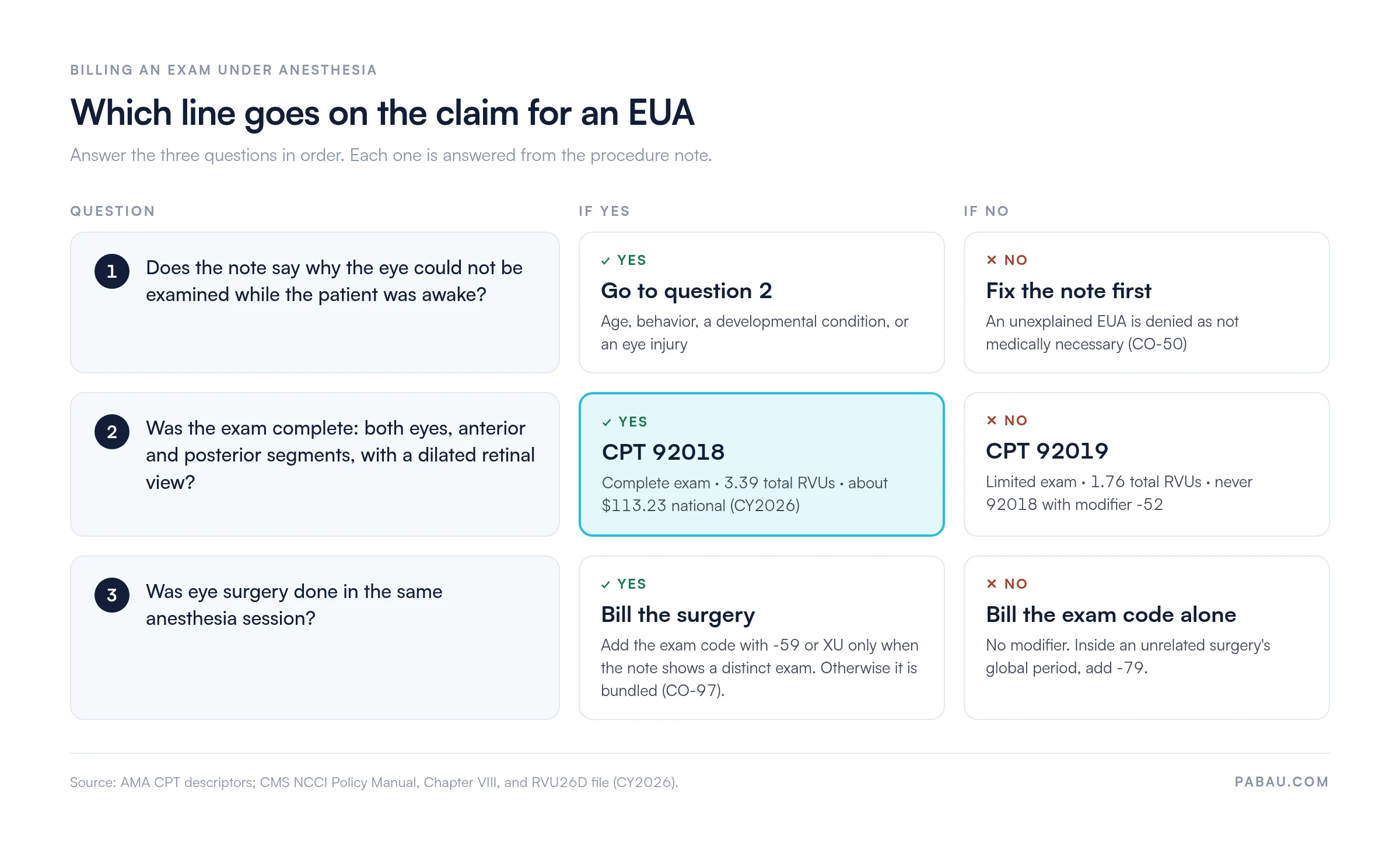
A short list of modifiers covers almost every EUA claim. Most denials come from using one of them on the wrong line, or from using none at all.
Pull every 92018 claim billed with -59 or XU in the last quarter. Check that each note states why the exam could not be done awake. A note that only lists findings will not survive a review of the modifier.
EUA denials follow a few patterns, and most trace back to the note or the modifier. Strong denial management workflows start with knowing which errors to catch before the claim leaves. The table pairs each one with its usual claim adjustment reason code (CARC).
Our guide to medical billing denial codes breaks down each CARC and remittance advice remark code (RARC). When an appeal is needed, submitting a clean claim with the full EUA note attached shortens the rework cycle.
Pediatric ophthalmology practices often work an EUA claim three times. The surgeon dictates the note, a coder decides on the modifier, and the biller chases authorization after the case is already booked.
Pabau, the practice management and billing platform we build, keeps those steps in one record. The procedure note template prompts for the reason for anesthesia and each segment of the exam. Pabau’s claims management software then scrubs each claim for missing or invalid details before it goes out.
Claims are sent through the Claim.MD clearinghouse, which reaches thousands of US payers and checks eligibility before the visit. Remittances post back to the claim, so your team can see which EUA denials repeat.

Pabau scrubs each ophthalmology claim for missing or invalid details before it leaves the practice. See how it fits your pediatric eye workflow.

CPT 92018 is a narrow code with a clear test. It pays only when the patient could not be examined awake and the note proves it. Most lost revenue comes from billing it beside surgery in the same session without that proof.
Start with your next scheduled EUA. Make sure the note template asks why anesthesia is needed, and that the coder decides between 92018 and 92019 from the documented scope. Book a demo to see how Pabau checks ophthalmology claims before they reach the payer.

Want to understand how electronic claim submission works? Claim.MD clearinghouse overview explains how real-time eligibility verification and 837P submission reduce denial rates.
Exploring denial management strategies? Revenue cycle management guide walks through the full claims lifecycle from charge capture to payment posting.
CPT code 92018 covers a complete ophthalmological examination and evaluation under general anesthesia. It includes manipulation of the globe where needed for the exam. It is used when a patient, usually a young child, cannot tolerate a full eye exam while awake.
CPT 92018 is a complete exam under general anesthesia, and CPT 92019 is a limited one. A complete exam assesses both eyes in full, including a dilated retinal view. A limited exam is narrower, such as a pressure check. Only one of the two is billed for a session.
The CY2026 national Medicare payment for CPT 92018 is about $113.23. That is 3.39 total RVUs multiplied by the $33.4009 conversion factor. CMS lists no office rate, and your locality adjustment moves the figure up or down.
CPT 92018 has a global period of XXX, so the global surgery concept does not apply. The exam has no pre-operative or post-operative days. Bundling with same-session eye surgery is a separate NCCI rule.
Usually not. NCCI treats an exam under anesthesia as part of eye surgery done in the same session. It may be billed with modifier 59 or XU when an adequate exam was impossible without anesthesia and the note shows a distinct exam.
Patients who cannot be examined while awake need one. That includes infants and young children, patients with developmental or behavioral conditions, and patients with severe eye trauma. Children with congenital glaucoma or retinoblastoma often need repeated exams under anesthesia.