



CCSD code G5100: Bypass of duodenum billing guide
CCSD code G5100 bills a bypass that leaves the duodenum in place CCSD code G5100...

Last Updated: Oct 16, 2026

CPT code 90836 covers 38 to 52 minutes of psychotherapy delivered on the same date as an evaluation and management service.
It never bills on its own. A primary E/M code such as 99213 or 99214 must appear on the same claim.
Medicare bars time-based E/M selection when a psychotherapy add-on is reported, so the E/M level rests on medical decision-making.
Recorded start and stop times, therapy content written apart from the E/M note, and medical necessity keep the add-on payable.
Practice management software like Pabau supports the documentation and electronic claim submission behind paired psychotherapy visits.
CPT code 90836 covers 38 to 52 minutes of psychotherapy delivered in the same visit as an evaluation and management (E/M) service. It is an add-on code, so it never travels alone. A primary E/M code has to sit beside it on the same claim, for the same date.
That one rule drives most 90836 denials. The rest usually trace back to a note that blends the therapy into the medical visit. Bill it cleanly and the add-on pays on top of the primary visit.
What follows covers the time rules, E/M pairing, documentation, 2026 Medicare pay, modifiers and the costliest errors.
The plus symbol beside 90836 in the American Medical Association’s CPT code set marks it as an add-on. Payers read it as an extension of a medical visit, not as a therapy session in its own right. That single fact controls how the claim is built.
Three add-on codes behave this way. 90833 covers 16 to 37 minutes of psychotherapy, 90836 covers 38 to 52, and 90838 covers 53 or more. None of them clears a claim edit without a primary E/M code filed for the same day.
One row breaks the pattern. 90837 is standalone psychotherapy of 53 minutes or more, reported when no E/M service happens that day. That fork gets its own section further down.
Count the psychotherapy segment, not the appointment. The medical work and the therapy work run on two separate clocks, and only the second one decides which add-on code you report.
Take a 60-minute integrated visit. Medication review, a side-effect check and a brief exam run 13 minutes. Psychotherapy fills the other 47. That visit bills as an E/M plus 90836, and the note has to show both clocks.
Most psychiatrists run the E/M first and the therapy second. Marking the moment the visit changes gear takes one line, and it settles any later question about the split.
Only a provider who can bill an E/M service can bill 90836. Psychotherapy training on its own is not enough, because the add-on hangs off a medical visit that somebody has to own.
Credentialing varies more than scope does. A nurse practitioner cleared for 90836 by one commercial plan may not be cleared by the next. Settle it at the payer level before the first claim goes out, not after the first denial.
The E/M code is the claim’s primary line and 90836 rides on top of it. Established patients usually pair with 99213, 99214 or 99215. New patients pair with 99204 or 99205.
CPT 99214 is the workhorse of the group. It fits the moderate-complexity established patient, which is what a medication-plus-therapy visit usually looks like.
Then comes the rule that catches experienced coders. When a psychotherapy add-on is on the claim, Medicare does not let time drive the E/M level.
Its billing and coding article for psychiatry and psychology services, A57480, states it directly. Choose the E/M on medical decision-making, and leave every therapy minute with the add-on.
The chart has to show two services documented separately inside one encounter. An auditor who cannot see where the E/M ends and the therapy begins denies the add-on, often at pre-payment review.
One shortcut undoes all of it. A therapy note that says “see above” folds the two services back into one, and the add-on falls with it.
Medicare’s national non-facility rate for 90836 sits at approximately $83 in 2026. That figure comes from the code’s total non-facility RVU of 2.49 and a conversion factor near $33.40.
Treat it as a working estimate rather than a pinned lookup value. The paired E/M code is reimbursed separately, on top.
Your locality moves the number. The geographic practice cost index adjusts each component. Run the code through the CMS Physician Fee Schedule lookup tool for the rate your practice will see.
Medicaid is the weak spot. Some state programs pay add-on psychotherapy codes alongside an E/M, some ask for prior authorization, and some do not cover them at all.
Read your state billing manual before 90836 goes on a Medicaid claim.
An in-office 90836 usually needs no modifier at all. Two situations change that. One is a telehealth visit. The other is a payer that wants the E/M flagged as separately identifiable.
The GT row is where older billing guides go wrong. CMS retired GT for Medicare Part B professional claims in 2018, and it now belongs to Critical Access Hospital Method II institutional billing. Putting it on a professional psychotherapy claim dates the claim by eight years.
Professional telehealth claims identify the setting through the place of service code instead. POS 02 covers telehealth delivered outside the patient’s home, and POS 10 covers telehealth at home.
Check current CMS telehealth guidance and each commercial payer’s own policy before you submit, because plenty of plans still run their own rules.
No single step here is hard. The trouble is that four elements have to line up at once: two codes, one date, one time threshold and two blocks of documentation. This is the path a clean claim takes.
Run an eligibility check before the first 90836 claim goes to a new payer. Confirm the plan covers add-on psychotherapy codes, and find out whether prior authorization applies. Two minutes of checking beats an appeal three weeks later.
Denials on this code repeat themselves. Six mistakes account for most of them, and each has a fix that costs nothing to apply.
When the same code keeps bouncing, pull the last 90 days of 90836 claims and sort the rejections by reason. The remittance codes tell you which of the six you have, and our medical billing denial codes reference explains what each one means.
Ask one question. Did anyone bill an E/M service for this patient on this date? If yes, the therapy is an add-on and 90836 is in play. If no, and the session ran 53 minutes or longer, 90837 is your code.
Getting this backwards costs money in both directions. Reporting 90837 on a day when an E/M also happened misrepresents the visit and invites recoupment. Reporting 90836 with no E/M on the claim simply fails the edit.
All three add-ons need a same-day E/M. Only the length of the therapy segment separates them, which makes accurate timing the whole game. The bands sit end to end, with no space between them.
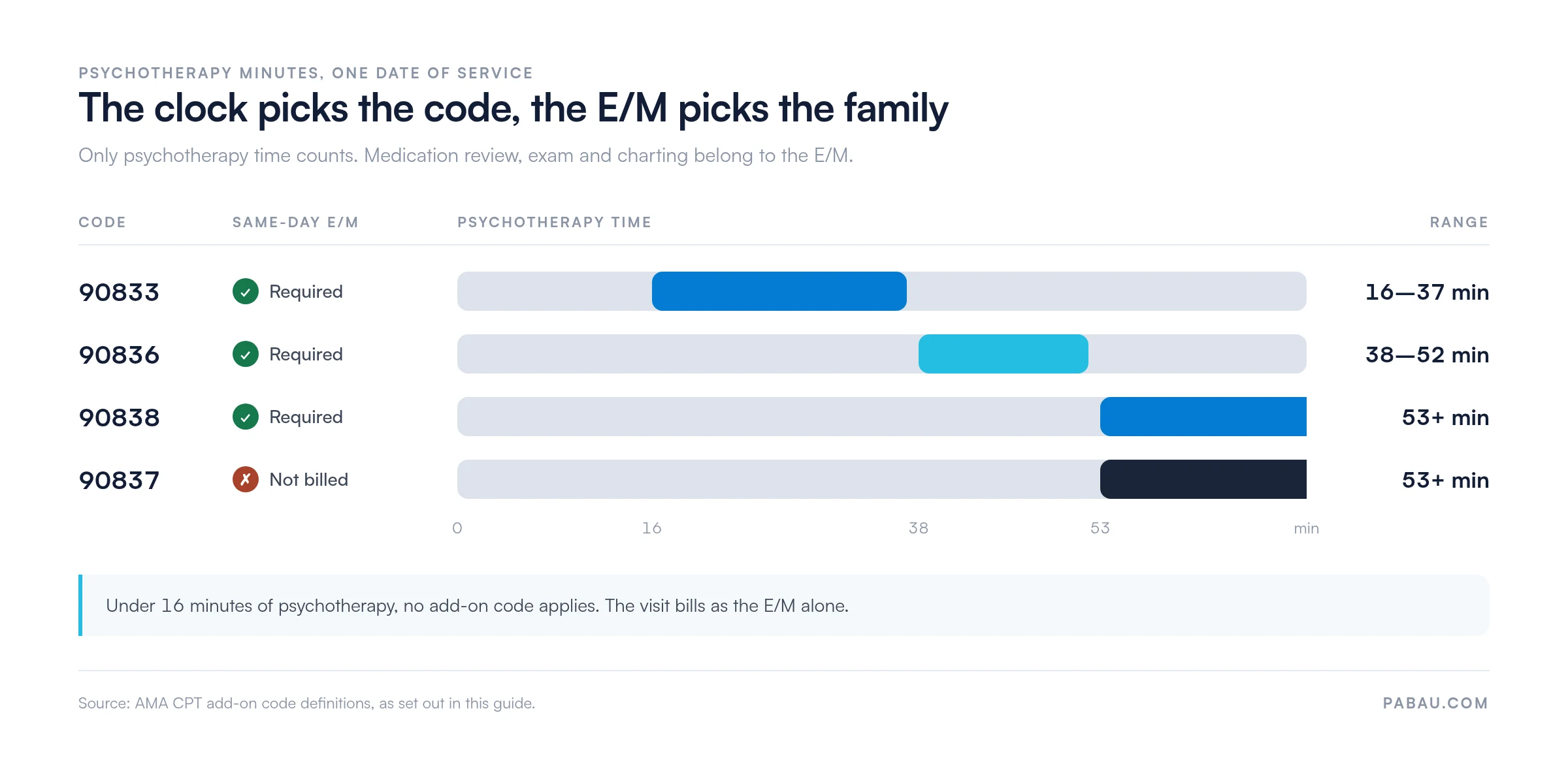
Undercoding is the quiet problem in this family. A practice billing far more 90833 than 90836 is usually recording therapist time loosely, not running shorter sessions. Medication review rarely fills more than 15 minutes of a 60-minute integrated appointment. The other 45 sit squarely in 90836 territory, and 90833 gives that work away.
Full descriptor text for each code in the add-on family sits in the AAPC CPT code lookup. It is worth a check whenever a payer questions the tier you chose.
Most practices assemble a 90836 claim in two places. The therapy note lives in the chart. The codes get keyed into a billing system afterward, often by somebody who was not in the room. Time fields get skipped and the add-on goes out thin.
Practice management software like Pabau closes that distance. Notes, coded services and the claim sit in one patient record, so the E/M and the add-on leave together with their documentation attached.
Pabau’s claims management software submits electronically through Claim.MD, our US clearinghouse partner, and posts the remittance back against the same visit.
Coding stays a human job. Nobody picks the E/M level or the add-on tier for you, and no software counts your therapy minutes.
What changes is that documentation, coded lines and submission stop living in three separate systems, so the claim leaves the practice complete the first time.

Pabau holds the therapy note, the coded lines and the electronic claim in one patient record. Paired E/M and psychotherapy visits leave your practice documented and ready to pay.

The rules around 90836 are short. What makes the code unforgiving is that all of them have to hold at once, on one claim, on one date, in one note. Miss the E/M, the clock times or the separation between the two services, and the add-on comes back.
So fix it upstream. Capture start and stop times in the template. Choose the E/M on medical decision-making. Scrub for a primary code before the claim goes out. Appeals are a poor substitute for a note that was right the first time.
The add-on line is only as good as the note behind it. Book a demo to see how Pabau keeps the therapy note, the coded lines and the claim in one place.

Billing the first appointment of a psychiatric episode? CPT code 90791 covers the psychiatric diagnostic evaluation that usually opens the record.
Need the code for an urgent session? CPT code 90839 sets out how psychotherapy for crisis is timed and billed.
Seeing add-on lines rejected? Denial codes in medical billing explains the CARC codes that turn up most on psychotherapy claims.
Wondering how the claim reaches the payer? Medical claims clearinghouse walks through electronic routing for mental health practices.
Treating out-of-network patients? Superbill shows what a psychotherapy superbill has to carry before a patient can claim it back.
Usually, yes. Modifier 25 goes on the primary E/M code, never on 90836, and it tells the payer the medical visit was significant and separately identifiable. Policies differ, so confirm what each plan expects before submitting.
The time band is the same, the setting is not. 90834 is standalone psychotherapy of 38 to 52 minutes with no E/M that day. 90836 covers the same minutes as an add-on to a medical visit.
Yes. CPT 90785 is the add-on for interactive complexity and it may be reported alongside 90836. Document the specific factor, such as a third party in the room, a language barrier, or high emotional reactivity.
No. Medicare’s psychiatry billing guidance bars prolonged service codes when 90833, 90836 or 90838 is billed alongside an evaluation and management service. Long visits stay inside the add-on tiers.
No. It covers individual psychotherapy only. Family and group work carry their own codes, and those are not add-ons to an E/M service, so they are billed on their own terms.



