

CCSD code G5100: Bypass of duodenum billing guide
CCSD code G5100 bills a bypass that leaves the duodenum in place CCSD code G5100...

Last Updated: Oct 16, 2026
89261 is the CPT code for sperm isolation; complex prep (e.g., Percoll gradient, albumin gradient) for insemination or diagnosis with semen analysis. Labs bill it when they separate motile sperm on a density gradient before IUI, IVF, ICSI, or a diagnostic workup.
The code sits in the CPT Reproductive Medicine Procedures section (89250-89398), maintained by the American Medical Association. Its neighbor, CPT 89260, covers simple prep, and the gradient medium named in the lab report is what separates the two. Medicare generally excludes ART services, while many commercial payers cover the lab component separately, often with prior authorization.
Let Pabau's smart automation suggest the right codes, reduce claim denials, and keep your practice compliant—effortlessly.
Automate repetitive tasks and focus on what matters most—your patients.
Reduce coding errors and ensure compliance with the latest regulations.
Clean claims, fewer denials, and faster reimbursements.
Powerful insights and reporting to help your practice thrive.
HIPAA compliant SOC 2 certified GDPR-compliant Trusted by 4,000+ clinics worldwide

CPT 89261 covers complex sperm isolation on a density gradient such as Percoll or albumin. Simple wash-and-centrifuge prep is billed as 89260.
Documentation must name the specific gradient medium and record pre- and post-prep sperm parameters. Missing the medium is the top denial reason.
89260 and 89261 cannot be billed together for the same specimen, because NCCI edits treat them as mutually exclusive.
Medicare generally excludes infertility and ART services. Commercial coverage for the lab prep component varies and often needs prior authorization.
Practice management software like Pabau supports lab report templates and claims submission for reproductive medicine billing.
The American Medical Association sets the official descriptor for CPT code 89261. It reads: Sperm isolation; complex prep (e.g., Percoll gradient, albumin gradient) for insemination or diagnosis with semen analysis. The code applies when a fertility or andrology lab uses gradient-based centrifugation to isolate motile sperm from a raw semen specimen. That prep comes before insemination or a diagnostic workup.
The descriptor’s examples (“Percoll gradient, albumin gradient”) are illustrations only. Labs routinely use other approved gradient media, such as SilSelect or PureSperm.
Any gradient-based method that separates motile sperm by density falls under this code, provided the procedure note names it. Writing “density gradient technique” on its own won’t hold up on review, so record the specific medium every time.
A frequent coding error in andrology billing is selecting 89260 when the lab performed 89261, or the reverse. The codes are mutually exclusive for the same specimen, and the technique used determines which code applies.
When a lab report describes centrifugation but does not name a gradient medium, payers may default to 89260 on review. Write the gradient name explicitly every time. Fertility practices that build this field into their lab report templates stop under-coding at the source.
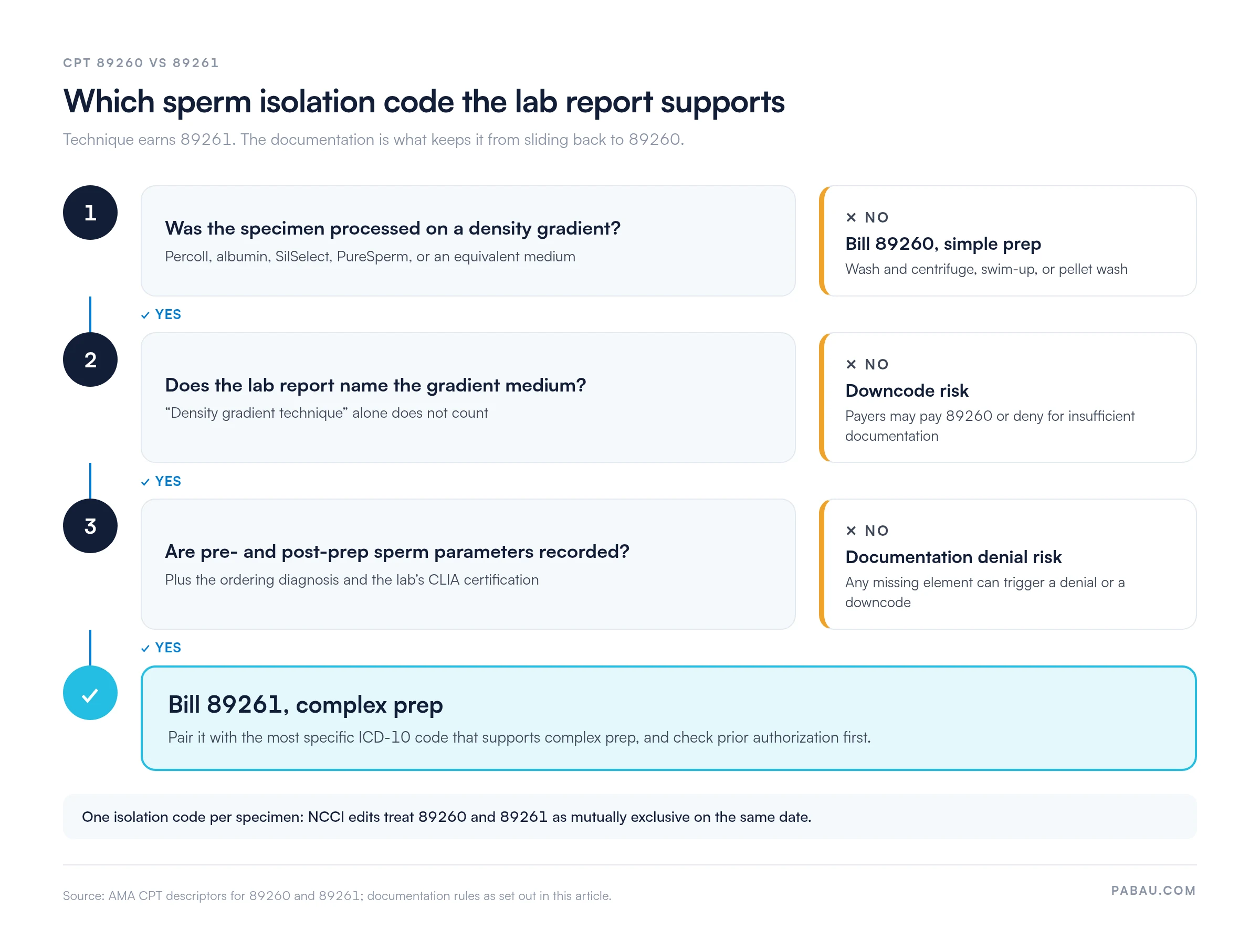
The decision path below shows how technique and documentation together decide which code a claim supports.
CPT code 89261 covers the laboratory preparation step only. It does not include the insemination procedure, egg retrieval, or the semen analysis itself. Bill it when a gradient technique is performed on the raw specimen before one of the following clinical scenarios.
The code is billed per preparation event, not per cycle. If two specimens from the same patient are gradient-processed on the same date, billing twice may be appropriate. Documentation must support both preparations.
Payer reviewers look for five specific elements when auditing claims for CPT 89261. Missing any one of them is enough to trigger a denial or downcoding to 89260.
Practices with strong billing compliance habits build these five fields into their andrology lab report templates. Completeness then comes from the template, so it no longer depends on each staff member’s memory.
Build a structured andrology lab report template with a required field for the gradient medium name. Add a pass/fail checklist for pre- and post-prep parameters. When every report comes from the same template, nobody has to remember the documentation rules, and 89261 downcoding denials drop fast.
The ICD-10 code paired with CPT 89261 must support medical necessity for the complex preparation technique. Payers that scrutinize ART billing look at whether the diagnosis justifies gradient isolation versus a simpler method.
When male factor is not the primary diagnosis, the ART or insemination cycle itself is coded Z31.83 (encounter for assisted reproductive fertility procedure cycle). Always pair the most specific ICD-10 code that reflects the documented clinical situation.
When two diagnoses apply, such as oligospermia plus an ART encounter, list both. Sequence the male-factor code first if sperm quality drove the decision to use complex prep.
The National Correct Coding Initiative (NCCI) treats CPT 89260 and CPT 89261 as mutually exclusive when billed for the same specimen on the same date. Billing both for a single semen sample triggers a bundling edit, and one of the two lines is denied automatically.
NCCI edit tables update quarterly. Verify current edit pairs on the CMS NCCI edits page and in the NCCI Policy Manual before submitting claims. An edit that did not exist last quarter may apply now. Practices using medical claims management software can flag known bundling pairs when the claim is created, before a remittance denial arrives.
Medicare does not cover most infertility and assisted reproductive technology services under the statutory exclusion for services not reasonable and necessary. When CPT code 89261 is billed as part of an ART cycle, Medicare typically denies it as a non-covered infertility service.
Coverage may apply in one narrower scenario. Say 89261 is billed for a diagnostic purpose with no ART intent, such as sperm function testing in a male infertility workup. A Medicare contractor may then apply a Local Coverage Determination (LCD).
Check the LCD for your Medicare Administrative Contractor (MAC) before billing 89261 to Medicare in a non-ART context. A clearinghouse with eligibility verification flags Medicare patients before the claim goes out, so you can check coverage early.
State infertility mandates (currently in effect in 19 states) can require commercial plans to cover ART-related lab services, including sperm preparation. The lab component may be covered even when the plan excludes the clinical ART procedure. Verify your state’s mandate scope and the specific plan’s benefit language before assuming non-coverage.
CPT code 89261 is a Clinical Laboratory Fee Schedule (CLFS) code when billed under the lab fee schedule. When a physician-owned andrology lab bills it, it falls under the Physician Fee Schedule (PFS). The applicable schedule depends on how the lab is certified and how the entity bills.
Verify the current allowed amount using the CMS Physician Fee Schedule lookup tool and the FastRVU 2026 RVU lookup for work/PE/MP RVU values.
Medicare’s ART exclusion means 89261 is rarely covered for beneficiaries in a clinical ART context. The rates that matter most to fertility labs are commercial contracted rates. Review electronic remittance advice (ERA) data from your clearinghouse to benchmark what each payer pays against your charge.
Claims for CPT 89261 are denial-prone because they sit where fertility benefit exclusions, heavy documentation, and NCCI bundling rules meet. These are the six most common denial patterns and the fix for each.
For fertility labs, denial tracking works best by payer and by lab staff member as well as by code. When one technician’s reports draw more documentation denials than the rest, training and template enforcement will do more than appeals work.
The claim adjustment reason code (CARC) on each remittance shows which of these patterns caused the denial. Our breakdown of common medical billing denial codes pairs each CARC with its fix.
An ART cycle generates multiple CPT codes billed across the lab and clinical services. CPT 89261 is one piece of that claim set. Understanding where it fits prevents both under-billing and bundling errors.
Our reference on IVF procedure billing codes covers the embryo transfer and cryopreservation codes billed in the same ART cycle. Coding the cycle as a group, rather than code by code, prevents both underpayment and NCCI bundling denials.
Embryos frozen after an IVF cycle are thawed in a later frozen embryo transfer cycle. The lab bills CPT 89352 for that thaw, once per thaw session rather than once per embryo.
When billing a complete IUI or IVF cycle, create a cycle-level charge capture checklist of every expected code. That means the semen analysis, the sperm prep (89260 or 89261), the clinical procedure, and any embryology services. Reviewing the checklist before claim submission catches missing prep codes and incorrect code selection in the same pass.
In many andrology labs, sperm prep is written up in free-text notes, and a biller reads each note to choose 89260 or 89261. That handoff is where the gradient medium goes missing and the claim gets downcoded.
Practice management software like Pabau moves that choice into the record. A lab report template with a required gradient-medium field and pre- and post-prep parameters means every report arrives complete. Claims then go out through Pabau’s Claim.MD clearinghouse integration, which checks for coding errors, missing fields, and NCCI conflicts before submission.
Denials that still come back are tracked by code and payer, so you can see whether one payer or one report template drives the pattern. The result is fewer 89261 claims paid at the 89260 rate.

Pabau helps fertility and andrology practices manage lab documentation, claims submission, and denial tracking in one place. See how our claims management tools support reproductive medicine billing.

CPT 89261 is a documentation code as much as a procedure code. The gradient technique earns it, but the named medium in the lab report is what gets it paid.
Fix the lab report template first, because every other control depends on it. Then confirm the diagnosis supports complex prep, and check prior authorization before the cycle starts. The trade-off is a few extra fields for the lab team, against claims that stop sliding to the 89260 rate.
Book a demo to see how Pabau keeps fertility lab documentation and CPT 89261 claims in step.

Need the full ART lab code set? IVF procedure billing codes covers the reproductive medicine billing range from oocyte retrieval through embryo transfer.
Looking to reduce claim denials across your fertility practice? Denial management in healthcare explains how to set up a systematic tracking and appeal workflow.
Want to verify eligibility before every ART cycle? Insurance eligibility verification walks through how eligibility checks catch coverage issues before claims go out.
Want 89261 claims paid on the first pass? What is a clean claim in medical billing? explains what a payer needs to process a claim without rework.
Weighing a clearinghouse for fertility billing? Claim.MD clearinghouse review covers what it checks before a claim reaches the payer.
CPT code 89261 covers sperm isolation using complex preparation techniques, such as Percoll gradient, albumin gradient, or density gradient centrifugation. The prep readies sperm for insemination or diagnostic evaluation with semen analysis. It does not include the insemination procedure itself or the semen analysis, which are billed under separate codes.
CPT 89260 covers simple sperm preparation, such as a basic wash and centrifuge. CPT 89261 covers complex preparation using a gradient technique, with Percoll, albumin, SilSelect, or equivalent density gradient media. The technique performed decides which code applies, and the two cannot be billed together for the same specimen on the same date.
No, Medicare generally does not cover CPT 89261 when billed as part of an assisted reproductive technology cycle, because Medicare excludes infertility services. A narrow exception may exist when the code is billed for a purely diagnostic purpose with no ART intent. Check the applicable Local Coverage Determination from your Medicare Administrative Contractor to confirm.
Yes, CPT 89261 applies to gradient-based sperm preparation before IUI, IVF, and ICSI procedures. It also covers diagnostic gradient isolation in a male infertility workup. The clinical use case does not change the code. What decides it is whether a gradient technique was used, whichever downstream procedure the sperm will support.
No. CPT 89260 and CPT 89261 are mutually exclusive for the same specimen on the same date under NCCI bundling edits. Billing both will result in one claim being denied automatically. Only one sperm isolation code can apply to a single semen specimen; the technique performed determines which code is correct.
The lab report must name the specific gradient medium used, since “gradient centrifugation” alone is not enough. It must also include pre- and post-preparation sperm parameters (concentration, motility, progressive motility) and reference the ordering diagnosis. A CLIA-certified andrology or embryology laboratory must generate it. Missing the named gradient medium is the most common documentation deficiency that leads to downcoding to CPT 89260.



