CPT code 93503: Swan-Ganz catheter billing and modifiers
CPT code 93503: Official descriptor and procedure overview In the AMA CPT code s...

Last Updated: Oct 23, 2026
87625 is the CPT code for genotyping HPV types 16 and 18, with type 45 included if performed. The descriptor reads "Infectious agent detection by nucleic acid (DNA or RNA); Human Papillomavirus (HPV), types 16 and 18 only, includes type 45, if performed."
It is usually run after a positive pooled high-risk HPV result. It shows whether the two types behind most cervical cancers are present. It is often confused with 87624, which reports one pooled high-risk result instead.
Let Pabau's smart automation suggest the right codes, reduce claim denials, and keep your practice compliant—effortlessly.
Automate repetitive tasks and focus on what matters most—your patients.
Reduce coding errors and ensure compliance with the latest regulations.
Clean claims, fewer denials, and faster reimbursements.
Powerful insights and reporting to help your practice thrive.
HIPAA compliant SOC 2 certified GDPR-compliant Trusted by 4,000+ clinics worldwide

CPT code 87625 reports HPV genotyping for types 16 and 18 only, and it includes type 45 if the assay tests for it.
Pooled high-risk HPV detection is 87624 and pooled low-risk detection is 87623, so the code follows the types the lab reports.
Labs usually run 87625 after a positive pooled 87624 result, so it pairs with a diagnostic code such as R87.810.
Medicare bills screening HPV tests with G0476 under NCD 210.2.1, once every five years for asymptomatic patients aged 30 to 65.
Pabau’s claims management software checks CPT and ICD-10 pairings before submission to cut denials on HPV lab claims.
CPT code 87625 carries an official descriptor from the American Medical Association (AMA). It reads “Infectious agent detection by nucleic acid (DNA or RNA); Human Papillomavirus (HPV), types 16 and 18 only, includes type 45, if performed.” It sits in the microbiology section of the CPT codebook. The performing laboratory reports it, not the ordering physician’s office.
87625 is a genotyping code. It tells the clinician whether HPV 16 or 18 is present, and most labs run it after a positive pooled high-risk result. Practices running gynecology labs need billing systems that map each assay result to the right HPV code when the superbill is built.
Key points about 87625’s scope:
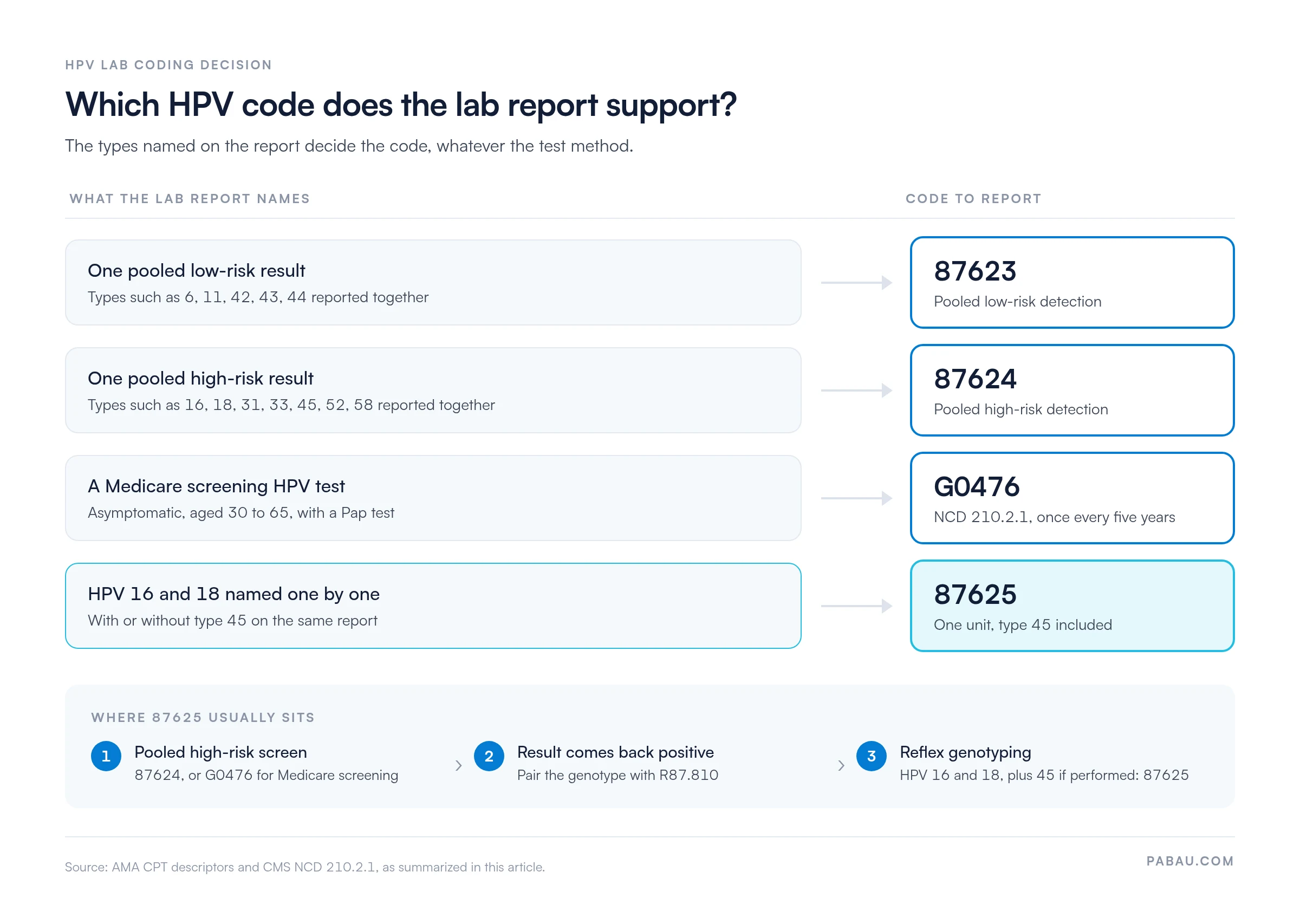
The most common selection error in the HPV code family is billing 87625 for a pooled high-risk result, or 87624 for a 16/18 genotype. Test method plays no part in choosing between them. The HPV types named on the lab report decide the code.
The decision rule follows the types on the lab report. A single pooled high-risk result is 87624, and a pooled low-risk result is 87623. A result that names HPV 16 and 18, with or without 45, is 87625.
Some assays report the pooled result and the 16/18 genotype in one run. In that case, check the payer’s policy and the current NCCI edits before you report 87624 and 87625 together.
The genotype result often decides the next visit. Under ASCCP risk-based guidelines, a patient positive for HPV 16 or 18 is usually referred to colposcopy.
CPT code 87625 reports a laboratory procedure, so the documentation burden falls on two places. Both the ordering clinician’s record and the lab’s report must support the claim.
The lab workflow runs as follows:
The ordering clinician’s record must document the clinical indication, the prior result that prompted genotyping, and the patient’s age. It also names the ordering provider and the specimen source. A complete superbill documentation package ties the lab result back to the diagnosis code before the claim is submitted.
Run an internal audit on your HPV lab claims quarterly. Pull every 87625 claim and check two things: The ICD-10 code used, and whether a positive pooled result or abnormal Pap is on file. A genotype claim with a screening-only code and no prior result is a pattern payers often deny.
The right ICD-10-CM code depends on why the genotype was run. Most 87625 claims follow an abnormal or positive result, so a diagnostic code is the usual pairing.
Always verify diagnosis codes against the current CMS ICD-10-CM code files for the fiscal year, since descriptions and valid codes change annually. Some MAC jurisdictions list covered diagnosis codes in their local coverage policies, so check those as well.
Medicare’s preventive HPV benefit does not use CPT 87625. Screening HPV tests are covered under National Coverage Determination (NCD) 210.2.1 and billed with HCPCS code G0476, alongside a Pap test.
Key Medicare parameters for HPV testing:
For the current Medicare rate, check the CMS Clinical Laboratory Fee Schedule for the calendar year. CMS updates the file every year, so verify the figure before you quote it to billing staff.
A test that falls outside covered parameters needs an Advance Beneficiary Notice (ABN) signed before the service. Without one, the lab cannot bill the patient if Medicare denies the claim.
Labs that bill through Pabau, our practice management and billing platform, can send electronic claims via Claim.MD and confirm eligibility first. Pabau’s claims management software also checks ICD-10 and CPT pairings at claim level, which catches screening-versus-diagnostic errors before the payer sees them.
Cotesting pairs a Pap test with a pooled high-risk HPV test, which is 87624, or G0476 for Medicare screening. 87625 joins the claim when the pooled result is positive and the lab reflexes to genotyping on the same specimen. Coding this sequence correctly prevents both undercoding and bundling denials.
Cotesting is billed with a Pap cytology code, such as 88174 or 88175, on the same date of service.
Most CPT 87625 denials are preventable with upstream claim edits. These are the patterns that appear most often on HPV genotyping claims:
Your denial management workflows should flag any 87625 claim with no diagnostic indication before it leaves the practice. A front-end claim edit saves the 30- to 60-day turnaround of a denial and appeal cycle. Clean claim submission, which validates the code pair, prior result and eligibility before transmission, is the cheapest fix available to gynecology billing teams.
Commercial payers generally follow USPSTF guidance, but each plan layers its own rules on top. Four areas create the most billing friction:
Always run insurance eligibility verification before the appointment and confirm how the plan treats HPV genotyping. Commercial coverage policies, often called clinical policy bulletins, sit on each payer’s provider portal. Check the policy for the specific plan year, since large employers often modify standard plan benefits.
When a commercial patient calls about an unexpected HPV bill, pull the original claim and check the ICD-10 code first. A genotype billed with a diagnostic code usually falls under the diagnostic benefit, even when the patient expected a free screen. Explaining that before the test, or correcting a wrong code on resubmission, settles many of these calls.
Most HPV coding errors start at claim entry, when someone reads a lab report and picks 87624 or 87625 from memory. The mistake surfaces weeks later as a denial, and the appeal delays payment further.
In Pabau, each lab code is checked against its diagnosis code before the claim leaves the practice. Eligibility checks and Claim.MD submission run from the same patient record. A screening code on a follow-up genotype gets caught at entry, before the payer ever sees it.
The result is fewer resubmissions, faster payment and a clear record of why each HPV test was run.

Pabau’s claims management tools help gynecology and women’s health practices check CPT and ICD-10 pairings before submission. They also track denial patterns and submit clean claims through Claim.MD.

CPT code 87625 is narrow by design. It answers one question, whether HPV 16 or 18 is present, and it usually follows a positive pooled screen. Billing teams that treat it as a follow-up code avoid most of the denials covered here.
The trade-off is documentation. A genotype claim pays when the record shows the result that prompted it and the diagnosis code says the same. Put that check at claim entry and keep Medicare screening on G0476. Book a demo to see how Pabau checks HPV code pairings before your claims go out.

Need to understand how clearinghouse submissions work? How a medical claims clearinghouse works explains the path from claim generation to payer adjudication.
Want to track denial patterns across your lab codes? Denial codes in medical billing covers the CARC and RARC codes you will see on your 835 remittances for HPV claims.
Looking for ERA and remittance guidance? Electronic remittance advice (ERA) explained walks through reading 835 files to identify patterns in HPV claim adjustments.
CPT code 87625 reports a lab test that detects HPV types 16 and 18, plus type 45 if the assay includes it. It is a genotyping test, usually run after a positive pooled high-risk HPV result to help decide whether a patient needs colposcopy.
CPT 87624 reports one pooled result for high-risk HPV types. Those include 16, 18, 31, 33, 35, 39, 45, 51, 52, 56, 58, 59 and 68. CPT 87625 reports genotyping for types 16 and 18 only, including 45 if performed. The types named on the lab report decide the code, whatever the test method. Pooled low-risk testing is a third code, 87623.
Medicare may cover 87625 as a diagnostic test when the record supports medical necessity, subject to the MAC’s local coverage policy. A positive pooled result is the usual support. It does not use 87625 for screening. Screening HPV tests are covered under NCD 210.2.1 and billed with G0476, alongside a Pap test. Coverage is once every five years for asymptomatic patients aged 30 to 65.
For genotyping after a positive pooled result, use R87.810 (cervical high risk HPV DNA test positive). After an abnormal Pap, use the cytology finding, such as R87.610 (ASC-US on cytologic smear of cervix), or N87.1 for moderate cervical dysplasia. Z12.4 and Z01.419 (encounter for gynecological examination (general) (routine) without abnormal findings) fit only when the payer treats genotyping as part of the screen.
No fixed screening interval applies to 87625, because it is billed as follow-up to a documented result. Payers judge each claim on medical necessity, so check the plan’s policy for any limit. The five-year Medicare interval belongs to G0476 screening, and the 12-month interval for higher-risk patients applies to Pap tests.
Yes. When a lab reflexes to genotyping on a cotesting specimen, 87625 and 88175 can be billed on the same date of service. NCCI edits do not normally bundle them, but check the current quarterly edit file and the payer’s policy. Make sure the ICD-10 codes on the claim support both the cytology and the genotype.
No. The 87625 descriptor includes type 45 if performed, so an assay that reports 16, 18 and 45 is billed as one unit of 87625.