

HCPCS Code Q4185: Cellesta flowable amnion billing guide
HCPCS Code Q4185: definition and official descriptor HCPCS Code Q4185 is the Lev...

Last Updated: Nov 20, 2026
84270 is the CPT code for sex hormone binding globulin (SHBG), measured by immunoassay on a serum specimen. Clinicians order it with total testosterone to calculate free testosterone and to work up PCOS, hypogonadism, and infertility.
Coders sometimes confuse 84270 with the testosterone codes (84402 free, 84403 total). That mix-up can trigger payer or NCCI edits and delay payment for the whole panel. This reference covers the official descriptor, covered indications, ICD-10 pairings, and the documentation that keeps a claim payable.
Let Pabau's smart automation suggest the right codes, reduce claim denials, and keep your practice compliant—effortlessly.
Automate repetitive tasks and focus on what matters most—your patients.
Reduce coding errors and ensure compliance with the latest regulations.
Clean claims, fewer denials, and faster reimbursements.
Powerful insights and reporting to help your practice thrive.
HIPAA compliant SOC 2 certified GDPR-compliant Trusted by 4,000+ clinics worldwide

CPT Code 84270 covers SHBG measurement by immunoassay on a serum (SST) specimen. It is a lab code, not an evaluation and management code.
Medical necessity hinges on a supported ICD-10 pairing, such as PCOS (E28.2), testicular hypofunction (E29.1), or an infertility workup.
Most 84270 denials stem from a non-covered ICD-10 code, missing clinical documentation, or a payer or NCCI edit on same-day testosterone codes.
Pabau’s claims management software works with Claim.MD to run eligibility checks and claim edits before submission.
CPT Code 84270 is the laboratory code for measuring sex hormone binding globulin (SHBG) in serum. Its official descriptor, maintained by the AMA’s CPT Editorial Panel, reads Sex hormone binding globulin (SHBG). The analyte is a glycoprotein made mainly by the liver that binds testosterone, dihydrotestosterone, and estradiol in circulation.
Labs measure it by immunoassay, either chemiluminescent immunoassay or radioimmunoassay depending on the performing laboratory. The specimen is serum, collected in a serum separator tube (SST/red-top).
The code sits within the Chemistry subsection of the Pathology and Laboratory section of the CPT code set. It has no technical/professional component split, so the global rate applies when an independent laboratory bills it.
SHBG is a carrier protein. It binds sex hormones tightly and reduces their bioavailability. Only the unbound (free) fraction and the loosely albumin-bound fraction are biologically active. That is why total testosterone can sit in the normal reference range while a patient still shows symptoms of androgen deficiency or excess. The SHBG level decides how much of that total reaches tissues.
Ordering SHBG alongside total testosterone lets the clinician calculate free testosterone without a direct free testosterone assay (CPT 84402), which commonly uses equilibrium dialysis. The Vermeulen formula is the most widely cited method, using total testosterone, SHBG, and albumin. Men’s health practices managing testosterone replacement therapy (TRT) patients run this calculation at routine monitoring visits.
Clinical contexts where SHBG testing is ordered include:
Medical necessity for CPT Code 84270 is established when the clinical record documents a condition for which SHBG measurement changes clinical management. Payer policies vary, and Medicare Local Coverage Determinations (LCDs) differ by Medicare Administrative Contractor (MAC) jurisdiction. Coders should verify the current LCD for their region. The indications below are broadly accepted across major commercial and government payers.
Ordering 84270 for screening without a documented clinical indication is a common reason payers deny the claim as not medically necessary. A general wellness panel with no supporting diagnosis is the typical example. If a Medicare patient’s indication may not be covered, an Advance Beneficiary Notice (ABN) must be on file before the draw.
Before ordering CPT 84270 as part of a hormone panel, confirm the ordering provider has documented the specific clinical question the SHBG result will answer. Phrases like ‘androgen panel’ or ‘hormone check’ in the chart note are insufficient. The note must connect the test to a clinical decision, for example ‘ordering SHBG to calculate free testosterone and guide TRT dosing adjustment.’
The ICD-10-CM codes below are broadly accepted as supporting diagnoses for CPT Code 84270. Exact covered-code lists differ between MAC jurisdictions and commercial payers, and they are updated each fiscal year. Use the CrossCoder CPT-to-ICD-10 crosswalk and your payer’s current LCD to confirm the specific codes recognized under your jurisdiction before billing.
Fertility practices ordering SHBG as part of a comprehensive panel should confirm that the supporting ICD-10 code is specific to the clinical scenario. Using N97.9 when a more specific infertility code applies (e.g., N97.1 for tubal-factor infertility) can trigger a payer edit requesting more documentation. On the male side, E29.1 fits primary testicular hypofunction, while hypogonadism of pituitary origin points to E23.0. Linking each lab order to the chart note at the point of care keeps the diagnosis and the test order aligned.
SHBG is rarely ordered on its own. The codes below are the most frequent co-orders. Before submitting the claim, check which combinations are clinically logical and which may trigger an edit.
When the clinical intent is a calculated free testosterone, pair 84270 with a total testosterone result billed as 84403, not 84402. Where the payer or clinical scenario calls for a direct free testosterone measurement, 84402 is correct. Billing 84402 and 84270 on the same date may trigger a payer or NCCI edit. Check the current Medicare NCCI PTP edits before submitting the combination, or look the pair up in the AAPC Codify CPT lookup.
Three codes sit close enough to 84270 that coder confusion is predictable. Each one measures something different.
Medicare coverage for CPT Code 84270 is governed at the MAC level through Local Coverage Determinations. There is no single national coverage determination (NCD) that universally mandates or excludes 84270 across all jurisdictions. In practice, a claim that pays cleanly under Noridian (Jurisdictions E and F) may face more scrutiny under Palmetto GBA or CGS. The difference comes from how each contractor defines covered indications in its current LCD.
These coverage principles apply across most MACs:
CPT Code 84270 is reimbursed under the Clinical Laboratory Fee Schedule (CLFS), not the Physician Fee Schedule. The CLFS rate is a single national payment amount with no facility or non-facility distinction, and no work/practice expense/malpractice RVU split. The rate is updated annually by CMS and applies uniformly across geographic areas (no geographic adjustment for CLFS codes).
Because CLFS rates are revised each January and are subject to Congressional budget adjustments, publishing a specific dollar figure here would be misleading within months. The current payment rate is in the CLFS files on the CMS Clinical Laboratory Fee Schedule page. Open the effective-year file and look up code 84270. Billing staff who need the figure for contract modeling or prior-authorization requests can download the same file there.
84270 denials cluster around four root causes, and solid denial management workflows catch most of them before submission. For the full list of reason codes, Pabau’s reference on common denial codes maps each CARC to its root cause and fix.
Each of these denials has a check that stops it before the claim leaves the practice, and the five checks run in a fixed order.
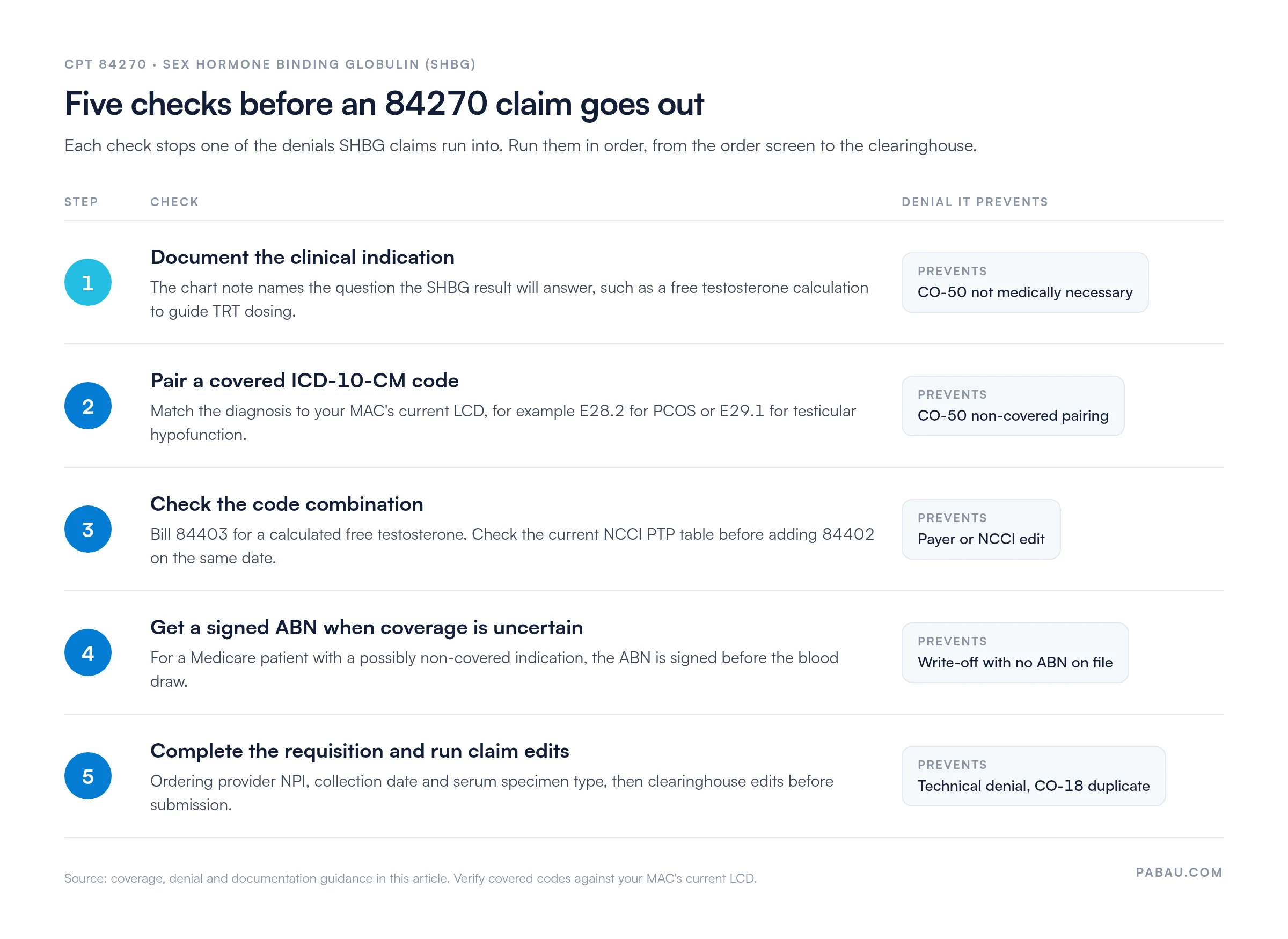
A clearinghouse that runs claim-level edits before the claim reaches the payer catches duplicate and code-combination errors early. Pabau, the practice management platform we build, sends US claims through Claim.MD. It runs real-time eligibility checks and claim edits against thousands of US payers. Our Claim.MD clearinghouse guide explains how those pre-submission checks work.
A clean claim submission for 84270 depends on documentation that links the specific test to a specific clinical question. These are the elements payers look for when auditing SHBG claims.
Practices with high volumes of androgen-panel orders benefit from a standardized lab requisition. It prompts the ordering provider to pick the clinical indication from a list of covered ICD-10 codes before the order finalizes. The indication is then captured when the test is ordered, not reconstructed later at the billing workstation. Pairing that workflow with medical billing compliance protocols for lab orders reduces retrospective audit exposure.
Run a quarterly audit on 84270 claims: pull all denied claims, sort by CARC code, and map each root cause to the lab order workflow. If CO-50 (not medically necessary) dominates, the fix belongs at ICD-10 selection before order entry. If CO-97 (bundling) dominates, the fix belongs in the coder’s code-combination review. Each denial cluster has a different upstream fix.
Many practices place the lab order in one system, write the indication in another, and build the claim in a third. Each handoff is a chance for the ICD-10 code on the claim to drift away from the chart note.
Practices can switch on Labs in Pabau to order Quest tests from the patient record. Labcorp orders placed in Labcorp Link sync their results back automatically. SHBG and testosterone results then sit on the same record as the note that justified them, with a trend chart for TRT monitoring.
When the claim goes out, Pabau sends it through Claim.MD as a CMS-1500/837P claim, with eligibility checks before submission and ERA remittances posted back. The diagnosis, the documentation, and the claim stay in one place, so a coder can confirm the pairing before the payer does.

Pabau connects ordering providers, lab requisitions, and billing workflows in one place. Submit cleaner CPT 84270 claims, with eligibility checks and claim edits run before submission.

Getting CPT Code 84270 paid cleanly comes down to the workflow around a simple code. Start with the order: if the chart note names the question the SHBG result answers, the ICD-10 pairing usually follows. The trade-off to remember is 84403 versus 84402, since only one of them is needed for a free testosterone answer.
Pabau’s claims management software connects lab order documentation to claim submission in one workflow, with Claim.MD running eligibility checks and claim edits before submission. Book a demo to see how that workflow handles high-volume endocrine and androgen panels.

Need a full revenue cycle overview? What is revenue cycle management explains how lab billing fits into the end-to-end practice revenue workflow.
Concerned about billing compliance for lab orders? Medical billing compliance guidance covers audit readiness, documentation standards, and payer-specific requirements.
Want to understand how clearinghouse integration works? Claim.MD clearinghouse overview explains how pre-submission claim validation reduces denials for lab and procedure codes.
Building a denial management process from scratch? Denial codes in medical billing maps the most common CARC codes to their root causes and corrective actions.
CPT Code 84270 covers the laboratory measurement of sex hormone-binding globulin (SHBG) in a serum specimen using an immunoassay method. SHBG is a protein that binds testosterone and estrogen in circulation. Measuring it lets clinicians calculate free (bioavailable) testosterone without a direct dialysis measurement. It also helps evaluate PCOS, hypogonadism, infertility, liver disease, and thyroid dysfunction.
Medicare covers CPT Code 84270 when it is ordered for a medically necessary indication supported by a covered ICD-10-CM diagnosis. The applicable MAC’s Local Coverage Determination defines which diagnoses qualify. Coverage conditions vary by jurisdiction. Ordering SHBG as a screening test without a documented clinical indication does not meet Medicare medical necessity standards and will be denied.
CPT Code 84270 is paid under the Clinical Laboratory Fee Schedule (CLFS), which publishes a single national rate in an annual file. Because the rate changes and is subject to Congressional adjustments, take the current figure from the CLFS files on cms.gov. A figure published in a reference article goes out of date quickly.
Yes. Billing CPT 84270 (SHBG) and CPT 84403 (total testosterone) on the same date of service is clinically logical, because they measure distinct analytes. This combination is the standard approach when calculating free testosterone with the Vermeulen formula. Pairing 84270 with 84402 (free testosterone) on the same date may trigger a payer or NCCI edit, so check the current NCCI PTP table first.
Yes. SHBG is a primary biomarker in PCOS evaluation. Women with PCOS typically show low SHBG, which amplifies the effect of androgens even when total testosterone is not dramatically elevated. ICD-10-CM code E28.2 (polycystic ovarian syndrome) is a broadly accepted supporting diagnosis for CPT 84270 billing.
The four common denial triggers are a missing or non-covered ICD-10 pairing and a screening order with no documented clinical indication. A possible payer or NCCI edit when 84270 is billed with 84402 on the same date is the third. The fourth is a missing ABN for a Medicare patient whose indication is not covered. Checks at order entry and pre-submission claim edits prevent most of them.





