CPT code 48152: Whipple procedure without pancreatojejunostomy
CPT code 48152: Official description and procedure overview CPT code 48152 descr...

Last Updated: Nov 13, 2026
83861 is the CPT code for microfluidic analysis utilizing an integrated collection and analysis device, tear osmolarity. It reports one point-of-care tear osmolarity test, such as TearLab, used to diagnose and monitor dry eye disease.
Each eye is a separate test. When both eyes are tested, the claim carries 83861-RT and 83861-LT as two lines, with QW on Medicare claims. Payment comes from the Clinical Laboratory Fee Schedule, at $22.48 per eye in 2026.
Let Pabau's smart automation suggest the right codes, reduce claim denials, and keep your practice compliant—effortlessly.
Automate repetitive tasks and focus on what matters most—your patients.
Reduce coding errors and ensure compliance with the latest regulations.
Clean claims, fewer denials, and faster reimbursements.
Powerful insights and reporting to help your practice thrive.
HIPAA compliant SOC 2 certified GDPR-compliant Trusted by 4,000+ clinics worldwide

CPT code 83861 reports one microfluidic tear osmolarity test on one eye, using an integrated device such as the TearLab Osmolarity System.
When both eyes are tested, bill 83861-RT and 83861-LT as two lines, with QW on Medicare claims, and never use modifier 50.
Payment comes from the Clinical Laboratory Fee Schedule, not the Physician Fee Schedule, at $22.48 per eye in 2026.
No 83861 claim is payable without a current CLIA Certificate of Waiver, and its number goes in Box 23 of the CMS-1500.
Pabau, the practice management platform we build, sends 83861 claims through Claim.MD and posts each line’s remittance to the patient record.
CPT code 83861, as published by the American Medical Association, carries the descriptor Microfluidic analysis utilizing an integrated collection and analysis device, tear osmolarity.
It sits in the Chemistry subsection of the Pathology and Laboratory section. The code is reported once for each eye tested, and Medicare pays it from the Clinical Laboratory Fee Schedule.
The test measures the salt concentration of tears in milliosmoles per liter (mOsm/L). Elevated osmolarity indicates tear film hyperosmolarity, one of the two core mechanisms of dry eye disease.
The TearLab Osmolarity System collects a 50-nanoliter sample from the inferior lateral tear meniscus with an integrated tip. It gives an automated reading within seconds, at the point of care, one eye at a time.
CPT 83861 covers one point-of-care tear osmolarity test on one eye. That includes the tear collection with the integrated device tip, the microfluidic analysis, and the automated reading. The code is device-specific, so it applies to TearLab and similar integrated analyzers that meet the descriptor.
The TearLab tip is applied to the inferior lateral tear meniscus of each eye. The system analyzes the 50-nanoliter sample in under 30 seconds and displays an osmolarity value on the handheld reader.
A reading of 308 mOsm/L or higher in either eye is consistent with dry eye disease. So is a difference of 8 mOsm/L or more between the two eyes. Both cut-offs come from TearLab’s clinical validation data.
Documentation must establish medical necessity and support the diagnosis code on the claim. A complete record for 83861 includes all of the following:
Documentation that simply records “osmolarity tested” with a value and no clinical interpretation is frequently cited in denials. The note must connect the result to a clinical decision.
Practices must hold a valid CLIA Certificate of Waiver or higher to bill CPT 83861. The FDA categorized the TearLab Osmolarity System as waived under the Clinical Laboratory Improvement Amendments. Without a current, site-specific CLIA certificate, the claim cannot be paid, whatever the payer’s coverage policy says.
Key steps for medical billing compliance around CLIA:
A lapsed or missing CLIA number in Box 23 is among the most common billing errors on 83861 claims and triggers an automatic denial.
Payers require a supported ICD-10-CM diagnosis code on every 83861 claim. The primary supported codes fall under the H04.12x family for dry eye syndrome. Use the most specific laterality code available based on the patient’s documented condition. Refer to the CDC ICD-10-CM lookup tool for the current year’s valid codes.
Symptom-only codes (e.g., eye dryness NOS) are accepted by some payers but rejected by others. Where a dry eye diagnosis has been established, use the confirmed H04.12x code rather than a symptom code to reduce denial risk.
CPT code 83861 is paid under the CMS Clinical Laboratory Fee Schedule, not the Medicare Physician Fee Schedule. The CLFS sets one national payment limit for each lab test, with no geographic adjustment.
For 2026 that limit is $22.48 for each 83861 line. Check the current quarter’s file before quoting patients or projecting revenue.
Because the rate is per eye, a two-eye test pays $44.96 as two lines of $22.48. A claim that reports both eyes on one line collects half of that. Remittances come back line by line when claims run through the Claim.MD clearinghouse, so a short-paid LT or RT line is easy to spot.
Always look up the current-year CLFS rate directly in the CMS published fee schedule before billing season begins. CMS publishes the final CLFS rule each November. Download the rate file and cross-reference your practice management system to catch any rate changes before they cause revenue surprises.
Commercial payer coverage for CPT 83861 is inconsistent and set policy by policy. Run insurance eligibility verification and read the payer’s policy before performing the test. Several major payers publish medical policies that limit the covered indications.
Payer stances change. Always verify against the current published LCD or medical policy document before testing, especially for commercial plans. Document prior authorization numbers in the patient chart and on the claim.
CPT 83861 is a unilateral test, reported once for each eye. When both eyes are tested, submit 83861-RT and 83861-LT as two line items of one unit each. On Medicare claims, add QW to both lines for the CLIA-waived test.
Modifier 50 is the wrong choice here. Payers expect the two-line, per-eye convention for this code, so a single 83861-50 line can trigger an edit or a denial. The chart below shows the claim both ways.
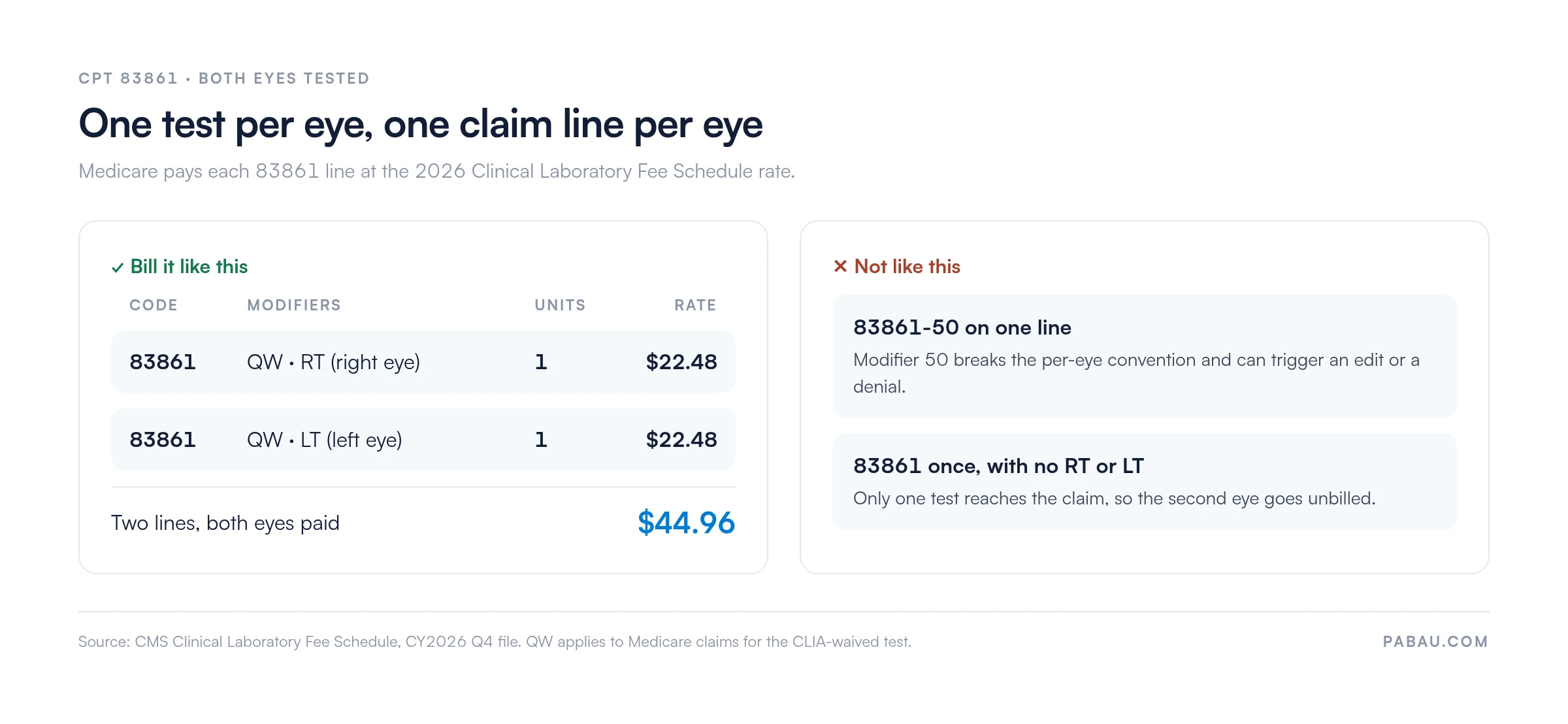
The table sums up how each modifier applies to 83861.
Place of service also matters. Billing 83861 under POS 11 (office) rather than POS 22 (outpatient hospital) is correct for the typical optometry or ophthalmology in-office test. Using POS 22 applies hospital outpatient rates, which may differ from the CLFS rate and can trigger additional edits.
Denials on 83861 follow predictable patterns, and each one arrives with a reason code on the remittance. Our guide to medical billing denial codes explains what each code means. Then work through a denial management workflow tied to that code, not a generic appeal letter.
There is no single answer, because each payer sets its own limit. Medicare sets no national frequency cap, but every test needs documented medical necessity. Commercial plans often cap testing at one or two times a year in their medical policy.
When retesting within the same year, document the clinical reason in the patient record before the encounter. A note referencing a new medication change, treatment initiation, or worsened symptoms gives the appeal a foundation if the payer questions frequency.
Build a frequency tracker into your billing workflow for 83861. Flag each patient at the first test of the calendar year so billing staff know when a second test approaches a payer’s annual limit. A quick pre-authorization check before the second encounter prevents most frequency-related denials.
CPT 83861 is rarely billed in isolation. Dry eye workups often involve additional diagnostic and therapeutic procedures. Knowing which codes can be billed on the same date and which are bundled prevents both underbilling and claim edits.
Consult the AAPC CPT code range lookup and the relevant payer LCD to confirm bundling rules before submitting a multi-code claim.
Punctal plugs are the most common same-day add. When plugs go in at the visit where tear osmolarity is measured, 68761 is reported once for each punctum closed. The thermocautery and laser methods of closure are a separate code, 68760.
83861 claims tend to break between the exam room and the claim form. The per-eye readings sit in the clinical note, and someone rebuilds the RT and LT lines by hand in a separate billing tool.
Pabau keeps the clinical note and the claim on the same patient record. Its claims management software checks eligibility before the visit and submits CMS-1500 claims through Claim.MD. ERA remittances post back to that same record, line by line.
So when Medicare pays the RT line and short-pays the LT line, your billing team sees it the day the remittance lands. They can correct and resubmit while the claim is still fresh.
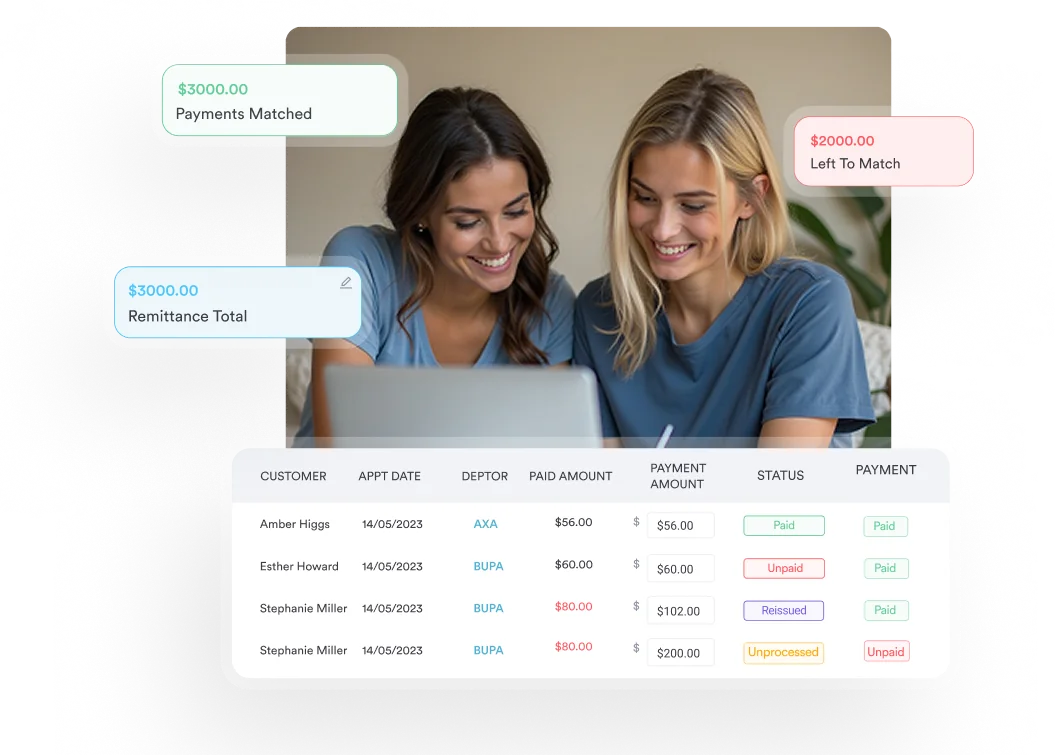

Pabau checks eligibility, submits claims through the Claim.MD clearinghouse and posts each remittance line to the patient record. See how it fits optometry and ophthalmology billing.

The per-eye rule decides most of what 83861 pays. A two-eye test is two lines, 83861-RT and 83861-LT, each paid at the CLFS rate. Collapse them into one line and the practice is paid for one eye at best, or denied outright.
The rest is groundwork done before the patient sits down. Keep the CLIA certificate current, check the payer’s policy and frequency cap, and record both readings with an interpretation. Book a demo to see how Pabau keeps the osmolarity note, the claim lines and the remittance on one patient record.

Photographing the lids or meibomian glands at the same visit? CPT code 92285 covers external ocular photography with interpretation and report.
Billing the eye exam alongside the osmolarity test? CPT code 92014 explains the comprehensive eye exam for established patients.
Looking for the full picture of medical billing fundamentals? What is medical billing? breaks down the end-to-end process from encounter to payment posting.
CPT code 83861 is the billing code for microfluidic tear osmolarity analysis with an integrated collection and analysis device, such as the TearLab Osmolarity System. It is used to diagnose and monitor dry eye disease. The code sits in the Pathology and Laboratory section and is paid from the Clinical Laboratory Fee Schedule.
Yes. Practices must hold a valid CLIA Certificate of Waiver or higher to bill CPT 83861, because the TearLab test is categorized as CLIA-waived. Without a current, site-specific certificate, the claim cannot be paid, whatever the payer’s coverage policy says.
The primary supported codes are H04.121 (right), H04.122 (left), H04.123 (bilateral) and H04.129 (unspecified) dry eye syndrome. Use the most specific laterality code the documentation supports. Some payers accept H04.141-H04.149 for lacrimal gland atrophy, and symptom-only codes raise the denial risk.
No. CPT 83861 is a unilateral, per-eye test, so modifier 50 does not apply. When both eyes are tested, submit 83861-RT and 83861-LT as two line items, adding QW on Medicare claims. A single 83861-50 line breaks that convention and can trigger an edit or a denial.
The most common reasons are a missing or expired CLIA number in Box 23, and both eyes billed on one line or with modifier 50. Others are a symptom-only ICD-10 code, a plan that treats the test as investigational, or a frequency limit reached without documented justification.
The 2026 Medicare Clinical Laboratory Fee Schedule rate for CPT 83861 is $22.48 per eye. A test of both eyes, billed as two lines, pays $44.96. The CLFS is one national rate, and CMS updates it each year, so check the current file before billing.