

HCPCS code E0198: Water pressure pad billing guide
HCPCS code E0198 is a water pad for a standard mattress HCPCS code E0198 is the ...

Last Updated: Oct 13, 2026
68761 is the CPT code for closure of the lacrimal punctum; by plug, each. It reports permanent or long-term punctal plug insertion, one unit for every punctum treated.
The word "each" sets the unit count. Four plugs placed across both eyes are four units, not two, and not one bilateral line. Biodegradable collagen plugs fall under the adjacent code 68760. The plug material decides which code applies, not the insertion technique.
Let Pabau's smart automation suggest the right codes, reduce claim denials, and keep your practice compliant—effortlessly.
Automate repetitive tasks and focus on what matters most—your patients.
Reduce coding errors and ensure compliance with the latest regulations.
Clean claims, fewer denials, and faster reimbursements.
Powerful insights and reporting to help your practice thrive.
HIPAA compliant SOC 2 certified GDPR-compliant Trusted by 4,000+ clinics worldwide

CPT Code 68761 covers permanent silicone punctal plug insertion, reported per individual punctum rather than per eye or per session.
Four plugs placed bilaterally come to four units of 68761, each on its own claim line, so modifier 50 rarely fits.
The three most common denial triggers are a non-covered ICD-10 code, missing prior authorization, and a unit count that contradicts the note.
A pre-claim review of plug material, punctum count and payer modifier preference stops most 68761 rejections before submission.
CPT Code 68761 sits in the lacrimal system repair range of the AMA’s CPT code set, 68700-68770, which covers procedures on the ocular adnexa.
The official descriptor reads: Closure of the lacrimal punctum; by plug, each. That final word sets the unit. One punctum treated is one unit, and the modifier and the payment on each claim line follow from it.
Material type and intended duration separate 68760 from 68761. The insertion technique is the same for both codes. Payers, however, treat them differently for coverage and reimbursement, so the choice decides whether the claim is paid.
The decision rule is short. If the plug dissolves on its own, use 68760. If the patient needs a clinical visit to have it removed, use CPT Code 68761. Billing 68761 for a collagen plug is the most frequent wrong-code denial in this family.
Treating 68761 as a per-eye code is the most common billing error attached to it. Every individual punctum treated in one session is one billable unit. A patient has four puncta in total, upper and lower in each eye.
When two puncta are treated in the same eye, the Centers for Medicare and Medicaid Services (CMS) multiple procedure payment reduction rules apply. The primary procedure is reimbursed at 100% of the fee schedule. Additional procedures performed in the same session on the same eye are reduced, typically to 50% for the second unit. The grid below pairs each plug configuration with its unit count and the modifier that belongs on the line.
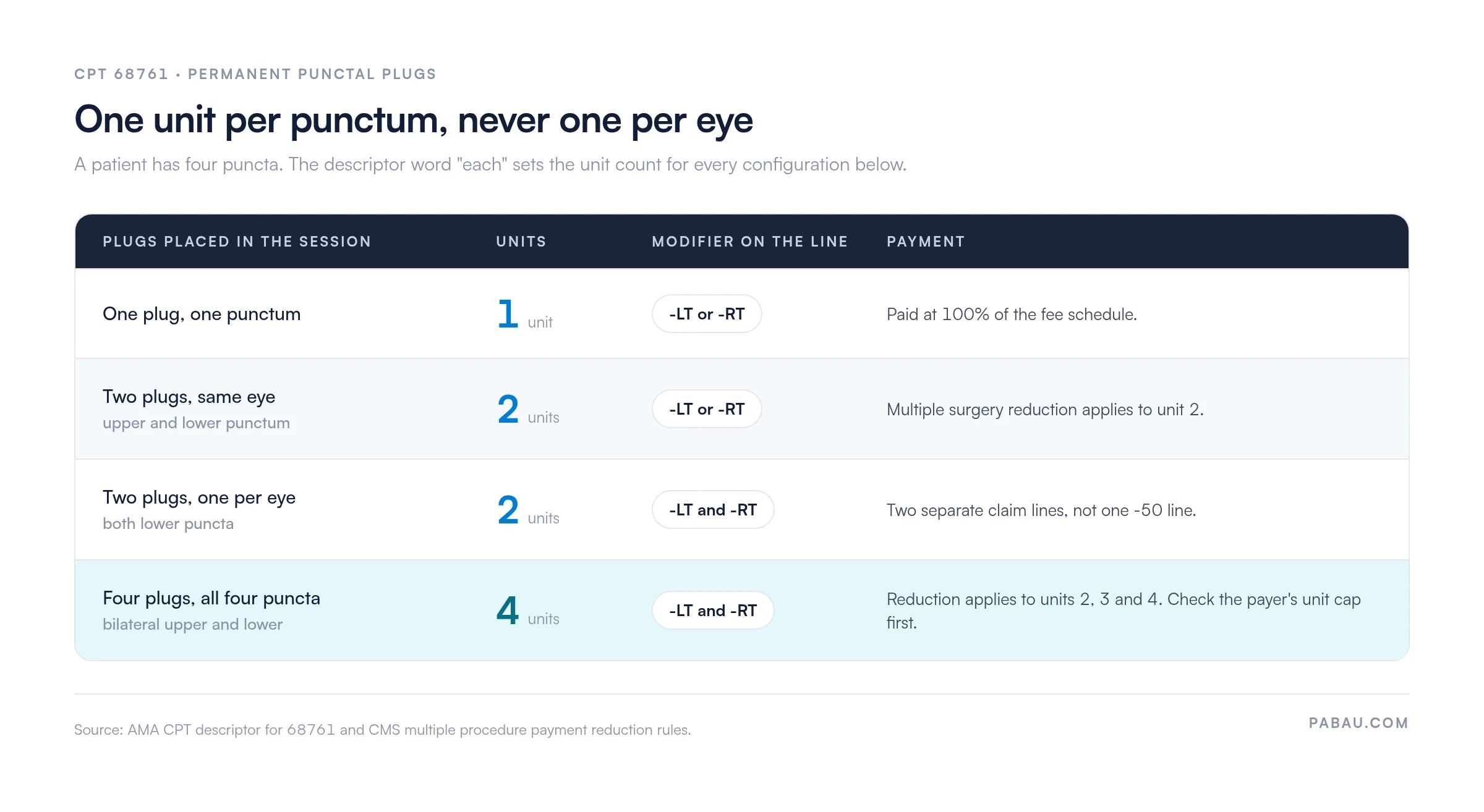
Verify the applicable reduction percentage against the current Medicare Physician Fee Schedule, because the rates change annually.
Modifier selection for 68761 is one of the more nuanced areas in ophthalmology billing. The per-punctum descriptor creates a bilateral situation that the standard rules describe poorly, and payer preferences differ on how to report it.
Coders reach for modifier -50 on any procedure done on both sides, and 68761 is where that habit misfires. The per-punctum descriptor changes the logic. When both lower puncta are treated, submit two units of 68761 on separate claim lines, one with -LT and one with -RT. A single -50 line tells the payer the procedure was performed bilaterally on one anatomical site, which describes neither punctum accurately.
Some Medicare Administrative Contractors (MACs) and commercial payers do accept -50 for the bilateral lower puncta scenario. Check your MAC’s published billing articles and your commercial contracts before adopting a house standard. Inconsistency across payers drives most modifier-related denials on this code. Build a payer-specific modifier check into the step where coverage is verified before the procedure.
Run a payer-specific modifier audit for 68761 across your top five payers before the next claim cycle. Pull the last 90 days of 68761 claims and flag any that used -50 without a documented payer acceptance. Rework those to -LT/-RT where the payer requires it, then record each payer’s preference somewhere the whole billing team can check it.
The diagnosis code on a 68761 claim decides whether the procedure is covered. Medicare Administrative Contractors working under Novitas Local Coverage Article A56780, Billing and Coding: Lacrimal Punctum Plugs, restrict which diagnoses support permanent punctal plug insertion. That article accompanies LCD L35095. Submitting an ICD-10 code outside the covered list is the most preventable denial cause for this procedure. Check the diagnosis against the current ICD-10-CM code index before the claim goes out.
Always use the most specific laterality code available. Local Coverage Article A56780 and the determination behind it require documented failed conservative treatment. Artificial tears are the usual example, and the trial has to come before a permanent plug is judged medically necessary. That documentation belongs in the medical record, not only on the claim.
Medicare reimbursement for CPT Code 68761 is published annually in the Medicare Physician Fee Schedule (MPFS). Use the CMS Physician Fee Schedule lookup tool to retrieve the current-year facility and non-facility rates for your area. Geographic practice cost indices adjust the national rate by locality. The national average facility rate has historically run in the region of $60 to $90 per unit. That figure moves with every annual MPFS update.
Practice management software like Pabau submits CMS-1500 and 837P claims through the Claim.MD clearinghouse to thousands of US payers. Real-time eligibility checks and electronic remittance advice come back into the same record, which shortens the posting cycle after payment.
The same CMS lookup breaks each rate into its work, practice expense and malpractice RVU components alongside the conversion factor. Commercial payers usually reimburse at a multiple of the Medicare rate, though the multiplier varies by contract and region. Request fee schedule verification from commercial payers annually, since those rates are not refreshed for you.
The supply code question comes up on most 68761 claims. HCPCS code A4263 describes a permanent, long term, non-dissolvable lacrimal duct implant, each. Whether A4263 is separately billable alongside 68761 depends on the MAC jurisdiction and the site of service. That eligibility has not been confirmed uniformly across MACs, so verify with your own MAC before adding the code. Billing it without that confirmation creates overpayment risk on audit.
Prior authorization requirements for 68761 vary by payer type, plan and MAC jurisdiction. No blanket rule applies across all payers, which makes pre-claim verification the only reliable check.
The clinical documentation that supports a prior authorization request starts with the diagnosis code and its laterality. Add the duration and severity of symptoms, then a record of prior conservative treatments with dates and response. Diagnostic findings belong in the request as well: Schirmer test results, TFOS DEWS II grading and corneal staining scores. So does the physician’s rationale for permanent occlusion.
A clean claim for 68761 needs the procedure note to document several specific elements. Payers and MACs audit these points, and a missing one supports a post-payment recoupment request even on a claim that was paid first time. The list below is the minimum for clean claim submission on this code.
A separate evaluation and management (E&M) code is billable on the same day as 68761 in one situation only. The E&M has to be a significantly separately identifiable service beyond the decision to place the plug. When billing both, append Modifier -25 to the E&M code, not to 68761. National Correct Coding Initiative (NCCI) edits bundle the pre-procedure assessment into the global period by default. Modifier -25 on the E&M unbundles it where the documentation supports the split.
Common NCCI bundling edits pair 68761 with certain diagnostic ophthalmology procedures. Review the CMS procedure-to-procedure edits for 68761 to see which companion codes are bundled by default and which unbundle with a modifier. The ophthalmology superbill should carry those restrictions, so front-desk staff do not select two bundled codes together.
Denials on 68761 follow predictable patterns. The table below maps the most common denial reasons to their root causes and corrective actions. A structured pre-submission review prevents most of them. That matters more here than on most codes, because a four-unit session multiplies one error by four.
CARC reason codes returned on remittance advice speed up root-cause identification when they are read alongside the reasons above. Most claim management systems surface CARC codes on ERA reports, so the billing team can triage denials by cause instead of opening each rejection individually.
Build a 68761-specific denial log that captures the CARC code, payer name, denial date and unit count for every rejection. After 30 days, sort it by payer and CARC. Three or more denials with the same CARC from one payer point at a broken step in the billing process. Treat that as a process fix rather than a one-off documentation slip.
Coders often need to cross-reference 68761 against adjacent codes or run crosswalks to diagnosis codes. The AAPC Codify CPT lookup carries code definitions, related codes and medical necessity crosswalk tools. The AMA’s coding resources page gives access to the official CPT data files and RVU downloads maintained by the CPT Editorial Panel. Both settle the question when a payer challenges the descriptor language or a related code pairing.
Practices that process high volumes of 68761 claims should also follow the American Academy of Ophthalmology’s EyeNet coding guidance. It covers per-punctum scenarios and local coverage criteria in detail. CMS updates the MPFS every January. Re-checking the rate at the start of each calendar year keeps the first remittance run free of surprises.
A practice billing 68761 today usually counts plugs off the procedure note by hand. It then relies on one biller to remember which payers want -LT/-RT instead of -50. That knowledge sits with one person. When they are away, the unit count and the modifier drift away from what the note actually says.
Pabau holds the procedure note and the claim in the same patient record. The plug count documented in the note is the count that reaches the claim line. Payer-specific modifier preferences are stored against the payer rather than in one biller’s memory. Prior authorization documents attach to the same record, so an appeal does not start with a search through email.
Our claims management software then submits through the Claim.MD clearinghouse with eligibility checks and CPT validation applied before the file leaves. Unit and modifier errors surface at submission rather than 30 days later on a remittance report. That is the difference between a five-minute correction and a reworked claim.

Pabau’s claims management tools help ophthalmology practices track per-unit billing rules, manage prior auth documentation, and submit clean 68761 claims the first time.

The money on 68761 is won before the claim is built. Count the puncta in the note and match the plug material to 68760 or 68761. Confirm the payer’s modifier preference while the patient is still on the schedule. A claim assembled that way rarely comes back.
The trade-off worth remembering is that no single modifier rule holds across every payer, so a house standard will be wrong somewhere. Keep a payer-level record instead, and revisit it each year when contracts and the fee schedule change.
Pabau’s claims tools keep per-unit rules, modifier preferences and prior authorization documents in one place for ophthalmology billing. Book a demo to see how that holds up against your own payer mix.

List Item #1
List Item #2
CPT Code 68761 is the procedure code for closure of the lacrimal punctum by plug, each. It reports permanent or long-term punctal plug insertion, and it is billed per individual punctum treated rather than per eye or per session.
CPT Code 68761 is billed per individual punctum. “Each” in the official descriptor means one unit per punctum treated. Four plugs placed across both eyes equals four units, not two.
Modifier -50 is accepted for bilateral punctal plug procedures by some payers. Medicare and many commercial payers prefer separate claim lines with -LT and -RT modifiers for per-punctum codes. Verify your MAC’s billing articles and your commercial contracts before applying modifier -50.
CPT 68760 covers temporary punctal plug insertion using biodegradable, collagen or dissolvable plugs. CPT 68761 covers permanent or long-term silicone and thermosensitive plugs. The plug material and its intended duration determine which code applies.
Prior authorization requirements vary by payer. Traditional Medicare generally does not require it, but most commercial plans and many Medicare Advantage plans do. State Medicaid programs each set their own rules. Verify with the specific payer before scheduling the procedure.
NCCI edits bundle the pre-procedure assessment into the global period for 68761 by default. A same-day E&M can be unbundled using Modifier -25 on the E&M code when a separately identifiable evaluation is documented. Review the current CMS NCCI tables for specific code-pair edits, as they are updated quarterly.



