



CCSD code G5100: Bypass of duodenum billing guide
CCSD code G5100 bills a bypass that leaves the duodenum in place CCSD code G5100...

Last Updated: Oct 16, 2026

CPT Code 81002 covers a urinalysis by dipstick or tablet reagent, non-automated and without microscopy.
Two questions decide the code: whether an analyzer read the strip, and whether a microscopic sediment exam was documented.
Modifier QW is not required on 81002, because the code has no non-waived counterpart to distinguish it from.
CPT 81002 and 81003 cannot be billed on the same date of service, and no modifier bypasses that NCCI edit.
Practice management software like Pabau submits and tracks 81002 claims through Claim.MD, which reaches thousands of US payers.
CPT Code 81002 is a urinalysis by dipstick or tablet reagent, non-automated and without microscopy. It applies when a nurse or medical assistant dips a reagent strip in urine and reads the color change by eye. No microscopic sediment exam is performed or documented.
This reference covers the official descriptor, how 81002 differs from 81000, 81001 and 81003, and what Medicare pays under the Clinical Laboratory Fee Schedule. It also covers ICD-10 pairings, documentation requirements, bundling rules, and the errors that drive denials.
The American Medical Association (AMA) defines 81002 as a urinalysis by dip stick or tablet reagent. The panel covers bilirubin, glucose, hemoglobin, ketones, leukocytes, nitrite, pH, protein, specific gravity, and urobilinogen. Two qualifiers at the end of the descriptor decide the code. The test must be non-automated, and it must be without microscopy.
The four dipstick urinalysis codes differ on two axes. One is whether an analyzer read the strip. The other is whether a microscopic sediment exam was performed and charted.
The grid below maps the four codes onto those two axes, so a documented method lands in one square.
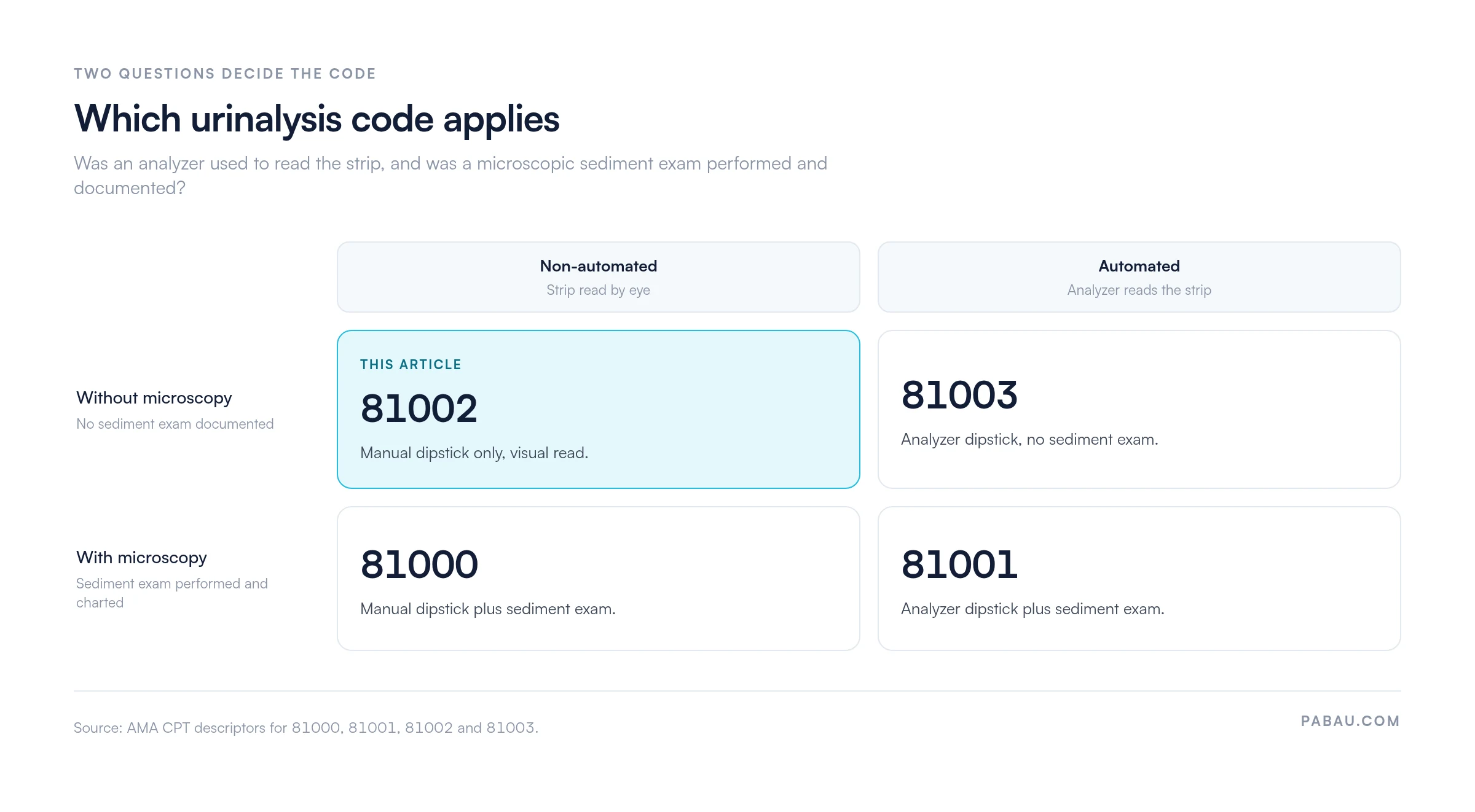
Decision rule: if a nurse or medical assistant dips a strip and reads it visually, CPT Code 81002 is correct. If the strip feeds an automated reader such as a Clinitek or Urisys analyzer, 81003 applies. Add a documented microscopic sediment exam to the manual read and the code becomes 81000. Add one to the automated read and it becomes 81001.
CPT Code 81002 is the right code when a manual dipstick test is performed in the office and no microscopy follows. Common clinical scenarios include:
The code does not fit when the practice uses an automated dipstick reader, which is 81003. It also does not fit when a clinician performs and documents a microscopic sediment exam, which is 81000. Many practices keep both a manual dip protocol and an analyzer, so confirm with clinical staff which method was used.
Every CPT Code 81002 claim needs a supporting diagnosis code that establishes medical necessity. The ICD-10-CM codes below are the most frequently paired. Verify each code against the current ICD-10-CM year before billing, because the code set updates annually.
N39.0 carries more 81002 claims than any other diagnosis code. Reviewing its documentation requirements before you submit prevents the medical-necessity denials that follow a vague pairing.
Medicare pays for CPT Code 81002 under the Clinical Laboratory Fee Schedule (CLFS), not the physician fee schedule. The amount sits at roughly $3 to $5 per test. Confirm the current-year rate in the CMS Clinical Laboratory Fee Schedule files before you estimate collections.
Key reimbursement facts billing staff should know:
Look up the current-year amount in the CMS Clinical Laboratory Fee Schedule files rather than a prior-year billing manual. CMS updates the CLFS every January and issues quarterly corrections. A rate copied from a document six months old may no longer match what your MAC pays.
A clean 81002 claim needs the medical record to confirm five elements. Missing one of them is enough for a payer to deny the claim or retract payment on audit. Build these into the clinical workflow rather than the billing workflow.
Documenting “UA performed” without listing the method creates ambiguity. Auditors use ambiguous method documentation to reclassify 81002 claims as 81003, if an analyzer was present in the office, or to deny them entirely. Train clinical staff to name the specific method in the note.
The National Correct Coding Initiative (NCCI) prohibits billing CPT Code 81002 and CPT 81003 on the same date of service for the same patient. The two codes describe alternative methods for the same test. Billing both asserts that the patient received two separate urinalyses by two different methods, which payers treat as unbundling.
Catching this conflict before submission costs less than reworking the denial afterward. NCCI edits are enforced at the clearinghouse and again in the payer’s adjudication system. A claim carrying both codes is denied, and no modifier override exists for this particular edit.
Commercial payers follow CMS NCCI edits as a baseline, and some add restrictions of their own. EmblemHealth, for example, publishes a policy that bundles 81002 and 81003 into the payment for a same-day E&M service. Check your major payer contracts for any policy stricter than NCCI.
Many payer policies allow CPT Code 81002 to be billed separately from a same-day evaluation and management (E&M) code. That treatment is not universal. A significant number of commercial payers fold in-office dipstick urinalysis into the E&M payment when the visit is the primary reason for the encounter.
Billing 81002 alongside an E&M code means knowing the payer’s rule before you submit:
One modifier is occasionally relevant to CPT Code 81002, and one modifier that coders reach for by habit does not belong on it.
Modifier QW is the one to leave off. CMS lists 81002 among the waived tests that bill without QW, because the code has no non-waived counterpart to distinguish it from. The practice still needs a valid CLIA certificate of waiver on file to bill the test at all.
Audits of in-office urinalysis claims surface the same errors year after year. Preventing them at the point of coding costs less than reworking them afterward, and the denial code reference maps the reason codes payers send back.
High-volume in-office labs create billing overhead that compounds quickly. A practice running 30 urinalysis tests a week generates roughly 1,500 claims a year from this one code. Each rework carries an administrative cost that manual processes absorb badly at a few dollars per claim.
Practice management software like Pabau keeps that work inside one system. Its built-in claims management software turns the charge captured at checkout into the claim, so nobody re-keys an 81002 line into a separate billing tool.
Pabau submits those claims through the Claim.MD clearinghouse, which reaches thousands of US payers. Claim status comes back into Pabau, and the electronic remittance advice returns automatically after adjudication. The billing team can see where each urinalysis claim stands without opening a payer portal.
The AAPC Codify CPT lookup is still worth keeping open alongside the billing system when you need to verify a descriptor or a bundling pair.
Run a quarterly audit of your 81002 denials and sort them by reason code. CO-97 points at bundling, and CO-50 points at a diagnosis that did not support the test. Both are fixed in the charge capture template rather than in the appeals queue.

Pabau submits and tracks CPT 81002 claims through the Claim.MD clearinghouse and pulls the remittance advice back automatically. See how an in-office lab charge reaches the payer without a second system.

CPT Code 81002 is a two-question code. Confirm that no analyzer read the strip, confirm that no sediment exam was documented, and the selection is settled.
The denials attached to it are rarely about the code. They come from a chart note that says “UA performed” and stops there, or from 81003 riding along on the same claim. Both are workflow problems, and both cost less to fix upstream than to appeal at four dollars a claim.
Put the method question in the charge capture template, keep 81002 and 81003 apart, and this code stops generating rework. Book a demo to see how Pabau moves an in-office lab charge from checkout to a submitted claim.

Need a reference for understanding how clearinghouse submissions work? Our medical claims clearinghouse guide explains how 837 files route from practice to payer and how ERA responses map back to individual claims.
Dealing with a high denial rate on lab claims? Denial management in healthcare covers the workflow steps for categorizing, appealing, and preventing the denial patterns that recur most often in physician office billing.
Want to understand the broader billing framework your urinalysis claims live inside? What is revenue cycle management maps the full cycle from patient registration through final payment, and shows where lab codes create bottlenecks.
CPT Code 81002 is a urinalysis performed by dip stick or tablet reagent, non-automated and without microscopy. The panel covers bilirubin, glucose, hemoglobin, ketones, leukocytes, nitrite, pH, protein, specific gravity, and urobilinogen. It applies when a nurse or medical assistant dips a reagent strip in urine and reads it visually.
The most common ICD-10-CM pairings are N39.0 for urinary tract infection, R82.90 for abnormal urine findings, and Z00.00 for a routine adult wellness exam. E11.65 covers type 2 diabetes with hyperglycemia, and R80.9 covers unspecified proteinuria. The diagnosis must support medical necessity for ordering the test.
Yes. CPT 81002 is coded on the method performed, not on the result. If the dipstick shows leukocytes or nitrite but no microscopic sediment exam was conducted, 81002 remains correct. Only when a clinician performs and documents a sediment exam does the manual dipstick become 81000.
The medical record must include a provider order dated the day of service. It also needs the test result with specific analyte findings and the method used. Add the date of specimen collection, the performing staff member, and a diagnosis code that supports medical necessity. Charting a bare result such as UA normal, with no method named, leaves the claim vulnerable on audit.
No. CMS lists 81002 among the waived tests that bill without the QW modifier, because the code has no non-waived counterpart to distinguish it from. Appending QW adds nothing to the claim line. The practice does still need a valid CLIA certificate of waiver on file to bill the test.



