



CCSD code G5100: Bypass of duodenum billing guide
CCSD code G5100 bills a bypass that leaves the duodenum in place CCSD code G5100...

Last Updated: Oct 16, 2026

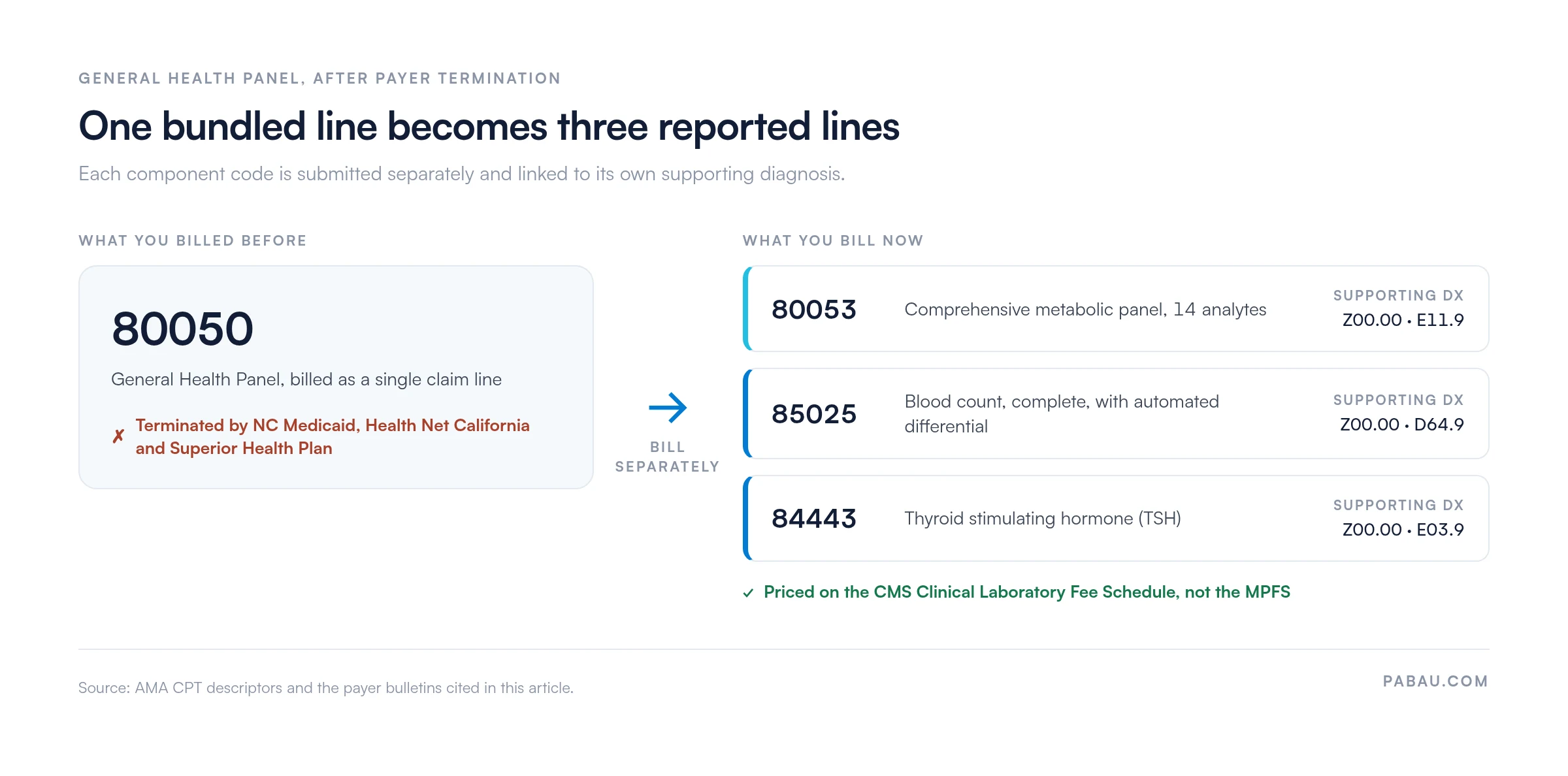
CPT code 80050 describes the general health panel, which bundles a CMP (80053), a CBC with differential (85025), and a TSH (84443).
NC Medicaid terminated coverage retroactive to December 31, 2021, so claims for dates of service from January 1, 2022 are denied.
Health Net California and Superior Health Plan both ended coverage in January 2026, and Medicare Part B does not pay the panel separately.
These are laboratory codes with no RVUs, so price them from the CMS Clinical Laboratory Fee Schedule rather than the Physician Fee Schedule.
Pabau’s claims management software helps practices verify payer coverage and submit the component codes through its Claim.MD clearinghouse integration.
CPT code 80050 is the general health panel. It bundles a comprehensive metabolic panel (80053), a complete blood count with differential (85025), and a thyroid-stimulating hormone test (84443) into one billable code.
Payers started withdrawing coverage in 2022. NC Medicaid, Health Net California, and Superior Health Plan now deny the bundle, and Medicare Part B does not pay it separately. Practices report the three component codes on separate claim lines instead.
This reference covers the official code description, the bundled tests, and how termination dates differ by payer. It also covers the fee schedule these codes are priced from, billing guidelines, ICD-10 pairings, and the component codes to use going forward.
CPT code 80050 is the General Health Panel, classified under Organ or Disease Oriented Panels in the American Medical Association (AMA) CPT code set. The panel bundles three routine laboratory tests into a single billable code, used historically in annual wellness visits and preventive care encounters.
The official AMA lay description positions this panel as a general screening tool, not a diagnostic panel for one organ system. That distinction matters for billing. Payers have long questioned whether the bundle adds clinical value beyond its components ordered separately with documented medical necessity.
The general health panel bundles three established laboratory tests. Each has its own standalone CPT code, so practices can bill them individually now that the bundle is not covered. Knowing what each component measures also supports medical necessity documentation at the individual-test level.
The bundle requires all three components. If a provider orders only the CMP and TSH without the CBC with differential, the 80050 code does not apply. Billing 80050 when not all three components are ordered is a coding error that payers flag on audit.
Yes, for a growing list of payers, though not on a single national date. Terminations run from 2022 to 2026, and some commercial payers still process the claim while others deny it outright. Check the payer’s current policy bulletin for this code before you submit it.
Treat CPT 80050 as non-billable until you have confirmed coverage with that payer for the date of service. Submitting it and waiting for the denial delays reimbursement for the component tests you can bill instead.
Laboratory panels are not priced on the Medicare Physician Fee Schedule. CPT 80050 and its components carry no RVUs, so an MPFS lookup returns no rate for them. Medicare prices these codes from the Clinical Laboratory Fee Schedule (CLFS), which sets a national payment amount per test.
Historical CLFS amounts placed CPT 80050 in a low-reimbursement range relative to its three components combined. The bundle never paid more than the components ordered separately, so the appeal of the panel code was administrative simplicity rather than revenue.
As of 2026, with coverage terminated by multiple payers, any specific dollar rate for CPT 80050 should be treated as historical. Verify current amounts for 80053, 85025, and 84443 in the CMS Clinical Laboratory Fee Schedule files for the current year.
Practices that previously received electronic remittance advice showing 80050 payment will now see denial or zero-payment lines instead. Moving to component billing means updating charge master entries, superbill templates, and any order sets that mapped to 80050 as a bundled order.
Check your practice’s charge master for any active entry listing CPT 80050. Update those entries to list 80053, 85025, and 84443 as three separate line items before submitting any lab claims for general health panels. Submitting the old bundle code after payer termination dates generates denials that require manual appeal work.
When CPT 80050 was an active covered code, a handful of billing errors generated most payer denials. They still matter, because the same issues apply to the component codes.
The AAPC CPT code lookup carries descriptor detail and coding tips that help confirm component code selection for laboratory panels. It does not publish CLFS amounts, so pull the payment figures from CMS.
Medical necessity for the panel, and for its component codes, requires a supporting diagnosis. The ICD-10-CM codes below historically accompanied CPT 80050 claims and remain relevant for component billing. Confirm the pairing against your payer’s Local Coverage Determination before you rely on it.
The CDC/NCHS ICD-10-CM web tool confirms a code’s current description and validity. Pabau’s ICD-10-CM code library covers each of these diagnoses in more depth.
For preventive visit encounters, the Z00.xx codes are the primary drivers. When ordering tests for a specific chronic condition, use that condition’s ICD-10-CM code rather than a Z code. Many payers apply different frequency rules to diagnostic and preventive encounters.
NC Medicaid’s bulletin instructs providers to bill the individual laboratory component tests rather than the bundled panel code. The three codes are 80053, 85025, and 84443, each submitted as its own line item. Price each one from the CLFS and link it to the diagnosis that supports it.
The claim itself changes shape. One line item becomes three, and each carries its own diagnosis linkage.
Practice management software like Pabau submits these component codes through its Claim.MD clearinghouse integration, which connects to thousands of US payers. The integration supports real-time eligibility checks, so billing staff can confirm coverage for each component code before the encounter. That matters most in practices running high volumes of annual wellness visits, where 80050 used to be the default panel order.
When a widely used panel code is withdrawn by several payers at once, the damage arrives on two fronts. Billing workflows fall out of date, and denials age toward write-off before anyone spots the pattern.
A code transition needs more than a new superbill. Charge masters, order sets, note templates, and staff training all have to move together, and any one of them left behind keeps producing denials.
Pabau’s claims software for practices handles the submission side of that change. Through the Claim.MD clearinghouse partnership, it supports CMS-1500 and 837P submission, real-time eligibility verification, and electronic remittance advice processing.
When 80050 denials arrive on an 835 remittance, the CARC reason codes appear in the billing dashboard. Billing teams can see the pattern and correct the workflow before submitting more claims against a code the payer no longer pays.
Practices ordering high volumes of laboratory panels gain the most, because eligibility and claims processing sit in the same system as the order.

Pabau integrates with Claim.MD to help practices submit component lab codes accurately, verify payer-specific coverage, and track denial patterns in real time. See how practices use it to stay current on billing changes like the CPT 80050 discontinuation.

The bundle is gone at more payers every year, and the replacement is not complicated. Bill 80053, 85025, and 84443 as separate lines, each tied to a diagnosis that supports it, and price them from the CLFS.
The harder part is the date. NC Medicaid’s termination reaches back to dates of service in January 2022. Old claims and appeals can therefore turn on which year the service falls in, so check the effective date before you rebill.
Update the charge master once, then let the billing system watch the denials. That is how a practice stops losing revenue to a policy change it did not cause. Book a demo to see how Pabau handles component lab codes and payer coverage checks in one place.

Need a framework for managing claim denials? Denial codes in medical billing explains CARC codes, denial categories, and how to build an appeals workflow.
Want to understand how clearinghouses fit into the claims process? How medical claims clearinghouses work covers payer connectivity, scrubbing logic, and why the clearinghouse step matters.
Exploring billing compliance requirements for your lab orders? Getting credentialed with insurance companies outlines the steps practices need to complete before payers will process their claims.
Billing the metabolic panel on its own now? CPT 80053 covers the comprehensive metabolic panel, its documentation, and the payer edits that apply to it.
Need the blood count side of the panel? CPT 85025 covers the complete blood count with automated differential and how to bill it.
CPT code 80050 is the general health panel. It bundled a comprehensive metabolic panel (80053), a CBC with differential (85025), and a TSH test (84443) into one claim line. Practices used it for annual wellness visits and preventive care encounters. Multiple payers have terminated coverage since 2022.
Medicare Part B does not separately reimburse CPT 80050 as a bundled panel in 2026. Laboratory codes are priced on the CMS Clinical Laboratory Fee Schedule, not the Physician Fee Schedule, so check the current CLFS files. Rates and coverage policies change every year.
Bill the three component codes individually. They are 80053 (comprehensive metabolic panel), 85025 (CBC with automated differential), and 84443 (TSH). Each is submitted as a separate line item with its own supporting ICD-10-CM diagnosis code. Verify that your payer does not apply bundling edits to the three codes together.
Medicaid coverage varies by state. North Carolina Medicaid terminated coverage retroactive to December 31, 2021, so the code is denied for dates of service on or after January 1, 2022. The bulletin directs providers to bill the individual component codes. Other state programs set their own timelines, so check your state’s fee schedule and provider bulletins.
Z00.00 and Z00.01 cover a general adult medical examination without and with abnormal findings. E03.9 (hypothyroidism) supports TSH ordering, E11.9 (type 2 diabetes) supports CMP monitoring, and D64.9 (anemia) supports the CBC. Confirm the accepted codes in the payer’s own coverage policy.
CPT 80050 is the general health panel. It bundles the CMP (80053), the CBC with differential (85025), and TSH (84443). CPT 80053 is one component of that bundle, the comprehensive metabolic panel, which measures 14 analytes. Those include electrolytes, kidney function markers, liver enzymes, and glucose. With 80050 discontinued, 80053 is billed on its own.



