



CCSD code G5100: Bypass of duodenum billing guide
CCSD code G5100 bills a bypass that leaves the duodenum in place CCSD code G5100...

Last Updated: Oct 16, 2026

CPT Code 77061 describes digital breast tomosynthesis (DBT) performed on one breast. Code 77062 covers both breasts.
Medicare does not pay 77061. CMS lists it with status code I in the CY2026 fee schedule file, so it carries no RVUs and no payment amount.
For Medicare patients, diagnostic DBT is billed with add-on code G0279 appended to CPT 77065 or 77066, per CMS Transmittal R3844CP.
77061 remains a valid, billable code for commercial payers, which price it under their own contracted fee schedules.
Modifier 26 (professional component) and modifier TC (technical component) are the most commonly applied modifiers. RT and LT indicate laterality when the payer requires it.
Incorrect laterality, usually billing 77062 when only one breast was imaged, is the most common denial reason for this code.
Practice management software like Pabau submits imaging claims electronically and tracks what the payer sends back, so denial patterns surface by code.
CPT Code 77061 covers digital breast tomosynthesis (DBT) performed on one breast, acquisition and interpretation included. In contrast, its bilateral counterpart is 77062. In particular, laterality is the distinction that decides whether the claim pays on first pass.
Medicare adds a second problem. In fact, it does not pay CPT Code 77061 at all. Specifically, CMS assigns the code status I in the CY2026 fee schedule file, meaning invalid for Medicare purposes and not separately priced. Diagnostic DBT for a Medicare patient is billed with HCPCS add-on code +G0279 instead.
Unless a section names Medicare, the guidance below applies to commercial claims. Consequently, that split runs through the whole DBT family. Even so, the AMA descriptor and the modifiers stay the same for both. Still, the code on the claim does not.
CPT Code 77061 describes digital breast tomosynthesis (DBT), unilateral. Namely, the American Medical Association’s CPT code set defines the service. Specifically, it covers acquisition and interpretation of 3D tomographic images from a single breast in one session.
DBT uses a moving X-ray tube to capture multiple low-dose images of the breast at different angles. Then, software reconstructs these into a series of thin image slices, producing a three-dimensional data set that radiologists review layer by layer. As a result, this approach reduces the tissue-overlap problem inherent in conventional 2D mammography, making it easier to identify masses in dense breast tissue.
The full AMA descriptor reads: Digital breast tomosynthesis; unilateral. The short descriptor is: Tomosynthesis, breast, unilateral.
Three CPT codes describe digital breast tomosynthesis, and the distinction between them drives more billing errors than any other factor in DBT coding. Basically, laterality is binary: one breast or two. Acquisition versus interpretation is also relevant for 77063.
Key distinctions: 77061 and 77062 are standalone codes used when DBT is the primary or diagnostic imaging modality. Code 77063 is an add-on reported with screening mammography (77067) when supplemental DBT acquisition is performed, and it cannot be reported alone. So, verify laterality in the radiology report before choosing between the three.
Payer type narrows the choice further. Commercial plans, for instance, accept 77061 and 77062 as written. However, Medicare does not. Instead, it pays screening DBT through 77063 and diagnostic DBT through HCPCS add-on code G0279. In short, the chart below maps payer, intent, and laterality onto the code that belongs on the claim.
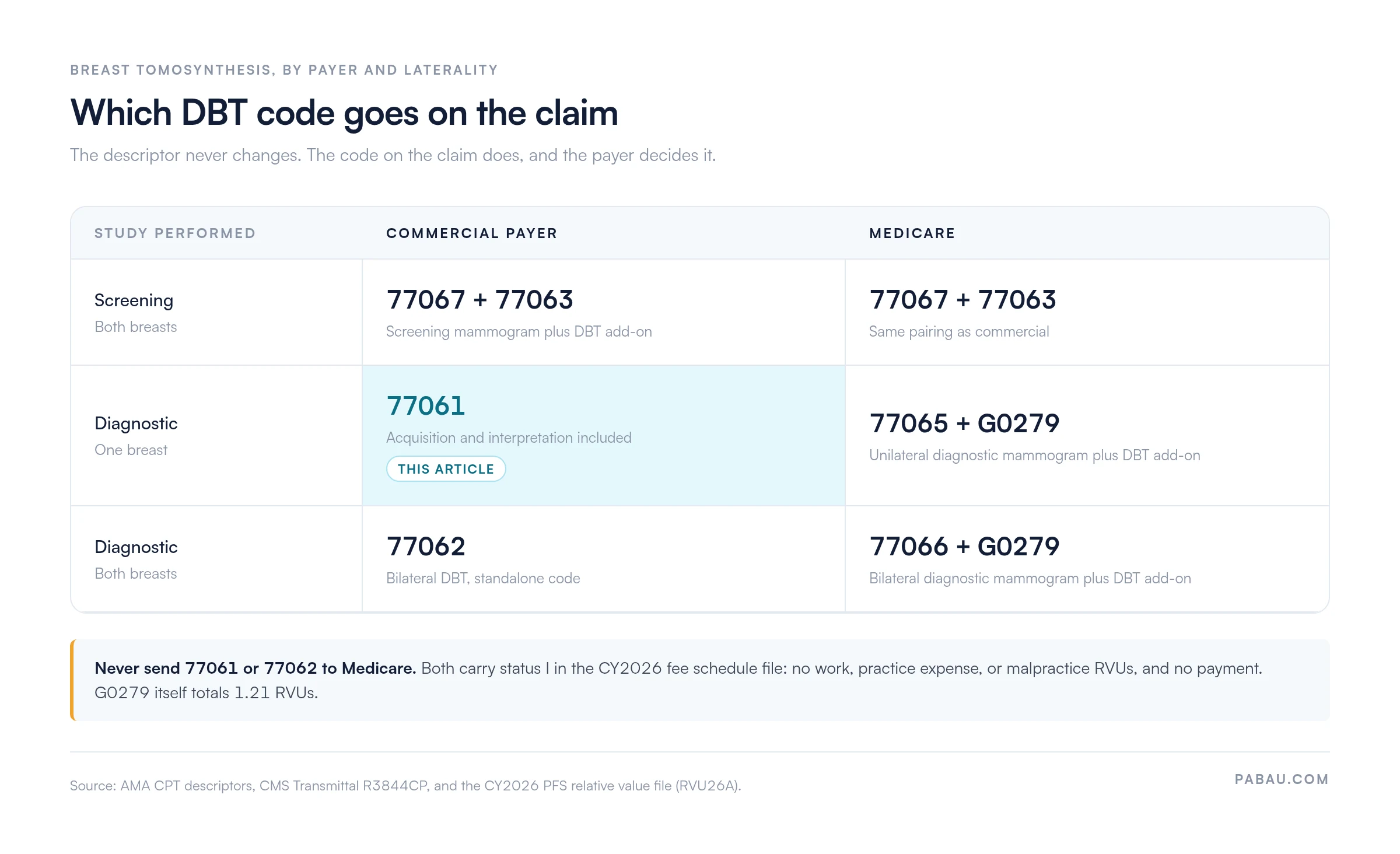
Altogether, six modifiers apply to CPT Code 77061, in four categories: component, laterality, reduced service, and distinct service. In short, modifier selection decides whether the claim pays, and whether it splits correctly between the reading radiologist and the facility.
When a hospital-employed radiologist reads images from a hospital-owned machine, no modifier is typically needed, because the facility bills the global code. When the reading physician and facility are separate billing entities, modifier 26 and TC must be split across two claims. As a result, appending both to a single claim is a common unbundling error that triggers automatic denial.
In general, these modifiers apply to commercial claims for 77061. On a Medicare claim the same component logic applies, but it attaches to 77065 or 77066 and the G0279 add-on rather than to 77061.
Medicare does not pay CPT Code 77061. Explicitly, CMS lists the code with status indicator I in the CY2026 National Physician Fee Schedule Relative Value File, RVU26A. Status I means invalid for Medicare purposes and not separately priced, so the code carries no work, practice expense, or malpractice RVUs. Either way, that holds for the global code and for both component splits.
Status I is not a coverage decision that varies by contractor. Rather, it is a national coding exclusion written into the fee schedule file itself, published in the CMS PFS relative value files. In effect, no MAC prices 77061, no locality adjustment applies, and no Local Coverage Determination turns the code back on. Therefore, a line that reports 77061 to Medicare will not pay.
Medicare pays for diagnostic digital breast tomosynthesis through a different code. Instead, HCPCS add-on code +G0279 covers diagnostic DBT, unilateral or bilateral, and is appended to CPT 77065 or 77066 on the same claim. In fact, CMS established that pathway in Transmittal R3844CP, effective for dates of service on or after January 1, 2018.
CY2026 carries two conversion factors: $33.5675 for qualifying APM participants and $33.4009 for everyone else. Applied to a total of 1.21 RVUs, that puts G0279 at roughly $40 nationally before geographic adjustment. GPCIs then move the figure by locality. Run the CMS Physician Fee Schedule lookup tool for your own MAC jurisdiction rather than relying on a national average.
Outside Medicare, however, 77061 is still a valid and billable CPT code. Commercial payers accept it for unilateral diagnostic DBT and price it under their own contracted fee schedules, so rates vary by contract and region. Even so, a few plans still apply investigational or prior-authorization policies to DBT. Read the plan’s medical policy before the study rather than after the denial.
Before submitting a 77061 claim, confirm your facility’s MQSA certification is current. The FDA Mammography Quality Standards Act requires active certification for any facility billing mammography codes. An expired certificate triggers an automatic denial. The fix is facility re-certification, not a payer appeal.
Claims for CPT Code 77061 require documentation that establishes medical necessity for a unilateral rather than bilateral study. In other words, payers treat the laterality decision as a clinical judgment call. So, the record must support it explicitly. Indeed, missing or vague documentation is the second most common denial cause after incorrect laterality coding.
The superbill and the radiology report together form the claim’s evidentiary foundation. Regardless, both must be retained. Required elements include:
For a Medicare patient, the same report supports 77065 or 77066 plus G0279, so it must document the diagnostic indication and the DBT acquisition separately. There is no LCD to check for 77061 itself, because Medicare never prices the code. Commercial payers are where the policy variation lives, so read the plan’s medical policy for DBT before the study.
A claim for CPT Code 77061 without a supporting diagnosis code will be denied. Above all, the ICD-10-CM code must establish medical necessity for the unilateral procedure. The codes below are commonly paired with 77061, though individual plans restrict coverage to specific diagnosis categories. Accordingly, check the payer’s medical policy before assuming a combination is covered. For a Medicare patient, however, the same diagnoses attach to 77065 or 77066 with G0279, not to 77061.
Pair each diagnosis code with the laterality recorded in the radiology report. In other words, a right-breast study coded to N63.2x is a mismatch between the procedure code and the diagnosis. As a result, payers reject it.
Billing 77061 moves through six steps. Indeed, skipping one is where most radiology denials start.
Most 77061 denials trace back to one of six preventable errors. Overall, knowing where the claim breaks down is the first step in building a clean-claim process.
Pre-bill audits of laterality, modifier, and diagnosis code combinations catch most of these before submission. Check a rejection against the denial codes for billers reference before you appeal it. Then run a monthly root-cause analysis on 77061 claims. By and large, most teams find one or two systemic errors behind the majority of their denials.
CPT Code 77061 sits within a family of breast imaging codes. Chiefly, coders must understand the full set to avoid substitution errors and to correctly report combined imaging encounters.
The CMS coding and billing guidance covers how these mammography and breast imaging codes interact under Medicare. Thus, set up charge capture rules for these code combinations before denials accumulate.
CPT Code 77061 carries a long list of checks. In detail, laterality verification, modifier splits, NCCI edits, and the Medicare-versus-commercial split all have to be right before the claim goes out. As a result, manual processes leave too many of those checkpoints open to human error.
Practice management software like Pabau keeps the charge, the claim, and the payer response in one record. For example, Pabau’s claims software for radiology lets imaging teams raise a DBT charge from the appointment. Then, the claim goes out electronically. Subsequently, the payer response lands against the same record. Namely, submission runs through the Claim.MD clearinghouse, which returns eligibility checks and ERA files into the same billing workflow.
For practices with high DBT volumes, denial tracking by CARC reason code shows which laterality or modifier error is driving the most write-offs. In effect, that turns a stack of individual appeals into one charge capture fix. A payer-mix problem like the 77061 and G0279 split also shows up early, rather than at the end of the quarter.

Run a monthly report filtered to CPT Code 77061 denials only, sorted by denial reason code. Watch the share coming from laterality mismatches, reason code CO-4 or CO-16. Where those lead the list, run a charge capture audit rather than a batch of appeals. Systemic errors need systemic corrections.

Pabau’s claims management tools help radiology and imaging practices raise the charge, submit it electronically, and track every payer response in one place. See how it works for your team.

CPT Code 77061 has a narrow use case. It covers digital breast tomosynthesis on one breast, acquisition and interpretation included, and it is billed to commercial payers rather than Medicare. In fact, four errors account for most of the denials that follow it.
Getting those four right, every time, takes a structured charge capture process rather than a per-claim appeal. Pabau keeps the charge, the claim, and the payer response in one record, so a repeating error shows up early. To see how it fits a radiology or imaging billing workflow, book a demo.

Need to understand how claims get processed end to end? Medical claims clearinghouse guide explains how electronic claims move from submission to payment and where denials originate.
Want to reduce the manual work behind each claim? Electronic remittance advice (ERA) processing covers how automated payment posting eliminates manual reconciliation for high-volume imaging practices.
Concerned about billing compliance exposure? Insurance credentialing guide walks through the payer enrollment steps that must be in place before any imaging claim can be paid.
CPT Code 77061 is used to bill for digital breast tomosynthesis (DBT) performed on one breast, including both image acquisition and radiologist interpretation. It is reported when a 3D mammogram is performed unilaterally in a diagnostic or surveillance context. In essence, it is a commercial-payer code. Instead, Medicare uses G0279 with 77065 or 77066 for the same service.
In short, 77061 is for DBT on one breast (unilateral) and 77062 is for DBT on both breasts (bilateral). Billing 77062 when only one breast was imaged is a laterality error and will result in a denial or a demand for overpayment recovery.
Modifier 26 (professional component) and TC (technical component) are used when the reading physician and the facility are separate billing entities. In addition, modifiers RT and LT specify which breast was imaged and are required by many commercial payers. Modifier 52 applies when the procedure was not completed as planned.
Yes, in most cases. A unilateral DBT (77061) and a conventional unilateral diagnostic mammogram (77065) on the same breast in the same session can generally be billed together. Even so, documentation must support the medical necessity of both studies, and the claim should be verified against NCCI edits for the current year.
Namely, G0279 carries 0.59 work RVU, 0.59 practice expense RVU, and 0.03 malpractice RVU for CY2026, a total of 1.21. Applied to the CY2026 conversion factors of $33.5675 and $33.4009, that comes to roughly $40 nationally before geographic adjustment. Instead, use the CMS Physician Fee Schedule lookup tool for your own locality.



