



CCSD code G5100: Bypass of duodenum billing guide
CCSD code G5100 bills a bypass that leaves the duodenum in place CCSD code G5100...

Last Updated: Oct 16, 2026

CPT Code 74170 describes a CT of the abdomen performed without contrast material first, then with contrast, in a single session.
74170 covers the abdomen only. Coders frequently reach for 74177 or 74178 when the pelvis was never scanned.
74177 is a contrast-only code. The combined abdomen and pelvis code that matches 74170’s two-phase protocol is 74178.
The 2026 Medicare national average for 74170 is about $259, from 7.75 total RVUs at the $33.4009 conversion factor.
Practice management software like Pabau checks the code, modifier, and ICD-10 pairing before a 74170 claim reaches the clearinghouse.
CPT Code 74170 covers a CT of the abdomen performed without contrast material first, then repeated with contrast in the same session. It is the abdomen-only biphasic code. Coders reach for it when a renal mass, hepatic lesion, or adrenal nodule needs a pre-contrast baseline before enhancement can be measured.
This reference covers the AMA descriptor, Medicare rates and RVUs, and the modifiers that apply. It also covers documentation requirements, ICD-10 pairings, and the denial patterns that cost radiology billing teams the most rework. The tables are built for day-to-day claim entry rather than for study.
The American Medical Association (AMA) defines CPT Code 74170 as: Computed tomography, abdomen; without contrast material(s), followed by contrast material(s) and further sections. Three elements of that wording are non-negotiable:
Radiologists call this a biphasic CT. The non-contrast run captures baseline attenuation values. The post-contrast run shows enhancement patterns. Ordering both in sequence is clinically distinct from ordering contrast-only imaging, and that distinction is what the code captures. Payers verify it first during a medical necessity review.
The ordering physician must document a clinical reason that requires both phases. Contrast alone (CPT 74160) is adequate for many studies. CPT Code 74170 is warranted when the pre-contrast baseline changes the clinical picture. Common indications include:
Medical necessity is not self-evident from the diagnosis alone. The radiology order and the referring physician note must explain why both phases are clinically necessary, not simply that a CT abdomen was ordered. That distinction drives the Local Coverage Determinations (LCDs) issued by Medicare Administrative Contractors (MACs).
Medicare reimburses CPT Code 74170 under the Medicare Physician Fee Schedule (MPFS). The national averages below reflect 2026 MPFS relative value data.
Payment varies by Geographic Practice Cost Index (GPCI) locality. Verify current rates with the CMS Physician Fee Schedule lookup tool for your MAC jurisdiction before you submit.
These are national averages, not guaranteed payment amounts. High-cost localities such as San Francisco, New York, and Anchorage reimburse above the national average, and rural MAC jurisdictions fall below it.
Use the FastRVU 2026 RVU lookup tool to pull locality-adjusted figures for your practice ZIP code before you build a fee schedule.
The two tables reconcile on purpose. Multiply the total RVUs by the conversion factor, then check the result against any vendor fee schedule. If the two disagree, one of the numbers is stale. Check the RVU file before you assume the payment figure is right.
Modifier selection for CPT Code 74170 depends on the billing entity, the service context, and whether the study was repeated or altered. Applying the wrong modifier is one of the top five denial triggers for CT abdomen codes.
Modifier 26 and TC are mutually exclusive with a global bill. Never append both to the same claim line. If the practice owns the scanner and employs the radiologist, bill globally with no modifier. If the radiologist is contracted and reading from a remote site, bill 26 and let the facility bill TC.
The medical record must support every element of the CPT Code 74170 descriptor. Payers audit radiology claims heavily, and incomplete records are the most common cause of post-payment recoupment requests. A compliant 74170 record includes:
Link the contrast administration note to the radiology report before the claim is generated. Missing the pre-contrast phase description is a frequent audit finding, and it downcodes 74170 to 74160 on appeal.
Pairing CPT Code 74170 with the correct ICD-10-CM diagnosis codes is required for Medicare and most commercial payers to establish medical necessity. The codes below are commonly accepted as supporting diagnoses. Individual payer LCDs may restrict or expand the list, so check your MAC’s applicable LCD before you submit.
The ICD-10-CM code has to match the clinical documentation. Billing R10.9 when the record names a specific diagnosis such as C22.0 is an upcoding risk, and it can trigger an OIG audit flag.
The CT abdomen family is the most common source of billing confusion in radiology. Two variables decide the code: the anatomy covered, and the contrast protocol. Picking the wrong one is a medical necessity mismatch, and it produces a denial, a downcode, or a recoupment demand at audit.
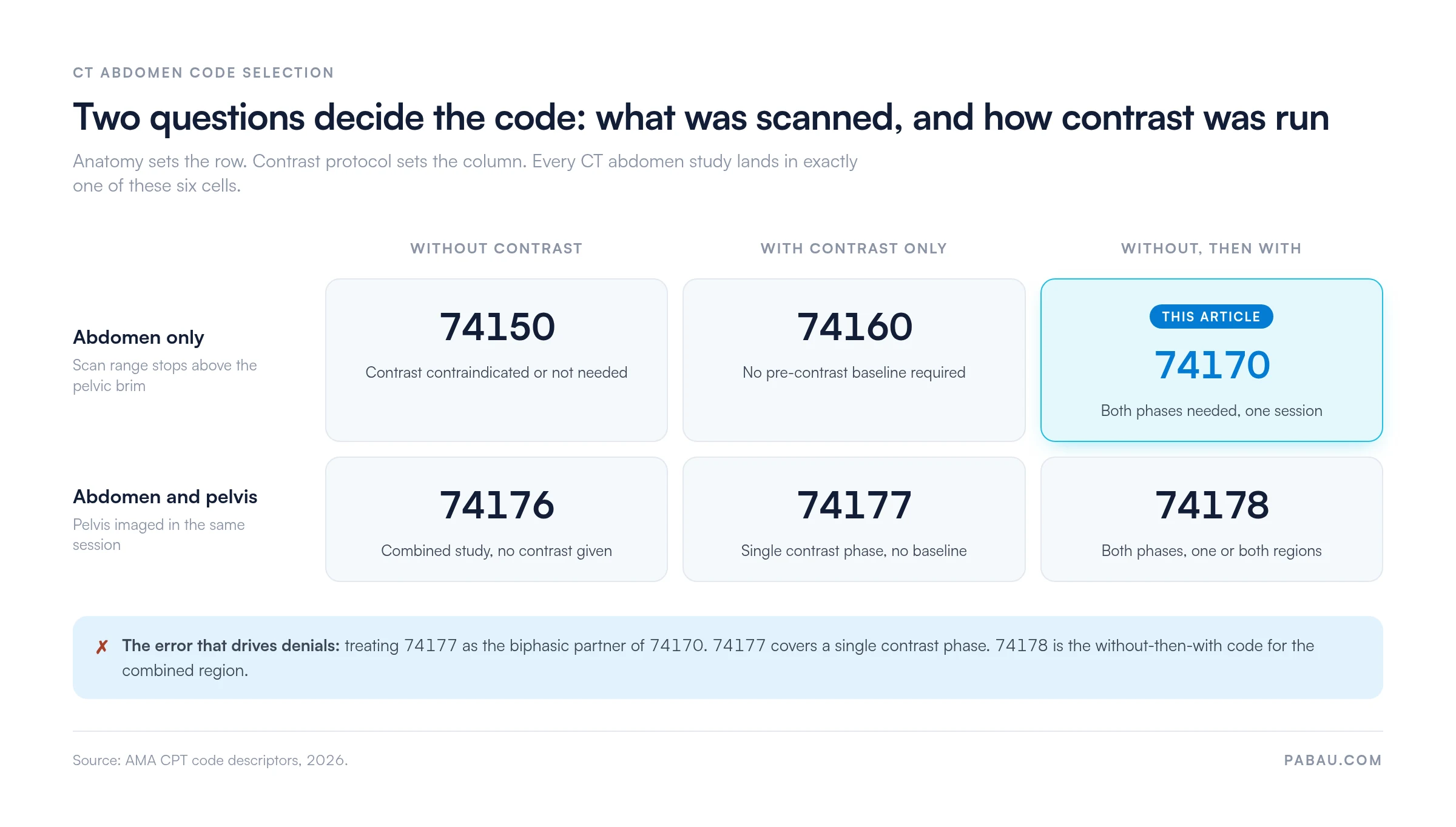
These two codes differ on both anatomy and contrast protocol. CPT Code 74170 covers the abdomen alone and requires two contrast phases. CPT 74177 covers the abdomen and pelvis together, with a single contrast phase and no pre-contrast baseline.
Coders often treat 74177 as the combined-region twin of 74170. That swap misstates the scan range and the protocol at the same time, which is why it draws scrutiny from both sides. If the pelvis was scanned and both phases were run, the claim belongs on 74178. If only the abdomen was scanned, 74170 stands.
CPT Code 74178 is the combined-region analog to 74170. Its descriptor covers a study without contrast in one or both body regions, followed by contrast material and further sections. That is the same without-then-with sequence 74170 describes, extended across the abdomen and the pelvis.
The AAPC code descriptors put 74178, not 74177, in that biphasic slot. Plenty of billing cheat sheets still have it the other way around. For a 74170 coder the rule is short. Once the pelvis is in scope, the claim moves to 74177 or 74178.
When contrast is administered as part of a 74170 study, the agent itself may be separately billable under HCPCS. Q9967 covers low osmolar contrast material, 300-399 mg/ml iodine concentration, per ml. It is the code most often used for the IV contrast given alongside CT procedures. Two caveats apply.
First, Medicare and many commercial payers bundle contrast into the procedure rate for hospital outpatient settings. Billing Q9967 alongside 74170 in those settings triggers an automated bundling edit and a denial. Check your MAC’s billing instructions and your commercial payer contracts before you append Q9967 to a 74170 claim.
Second, the rules vary by setting. Freestanding imaging centers and physician offices may separately bill Q9967 where hospital outpatient departments cannot.
Setting drives more than the contrast line on a 74170 claim. HCPCS code C1830 is reported only by hospital outpatient departments, and packaging folds it into the procedure’s APC rate.
Q9967 sits in a family split by iodine concentration. Q9965 covers 100-199 mg/ml and Q9966 covers 200-299 mg/ml, both billed per ml. Read the concentration off the product label rather than defaulting to Q9967, and record the contrast product name, formulation, and volume in the clinical record.
Denial patterns for 74170 cluster around five root causes. Each one is preventable with the right front-end workflow, and each one is cheaper to catch before submission than to appeal afterwards.
A clean 74170 claim comes down to confirming the code, the modifier, the ICD-10 pairing, and the place of service before transmission. Each of those is a field a biller can check in under a minute. Each one is also a denial that never happens.
Run a monthly denial pattern report filtered by CPT 74170. Group denials by reason code (CARC). Watch for CARC 50 (non-covered service) and 57 (no prior authorization). If either passes 15% of your 74170 denials, a payer-specific rule is slipping past your billing workflow. Correct it at the payer level, not the code level.
Medicare coverage for CPT Code 74170 is governed by MAC-issued Local Coverage Determinations. Which LCD applies depends on the MAC administering your region.
Most CT abdomen LCDs require the ordering clinician to document a covered indication. They also expect evidence that a lower-intensity study, such as ultrasound, was considered or already performed.
Commercial payers frequently work to different rules. Prior authorization requirements for outpatient CT vary by plan and by region. High-deductible plans apply more utilization management scrutiny to advanced imaging codes, including 74170. Check authorization requirements for each payer before the study is scheduled, not after it is performed.
A 74170 coding error usually surfaces weeks later, when the remittance arrives. The claim went out with 74177 on it, and the payer denied it for a descriptor mismatch. A biller now rebuilds a claim that was wrong at the point of entry. The scan was correct. The record was correct. Only the code was not.
Practice management software like Pabau moves that check to the front of the process. Built-in CPT and ICD-10 catalogs let billers select 74170 from the stored descriptor instead of from memory. The anatomy and contrast wording sits in front of them at entry. The system also flags code combinations that payers bundle.
Our Claim.MD integration then submits to thousands of US payers and returns claim status without a second login. Electronic remittance advice posts back automatically against the original claim line. Your team can see which 74170 claims paid at the locality rate and which came back short. They work the exceptions rather than the whole batch.

Pabau connects with Claim.MD to give radiology billing teams real-time claim status, automated remittance posting, and built-in CPT and ICD-10 catalogs. No manual code lookups, no missed modifiers.

CPT Code 74170 is a narrow code, and its three conditions carry the whole decision: abdomen only, both contrast phases, one session. Check the report’s scan range against the billed code before the claim goes out. That single check prevents the denial that costs the most to rework.
The wider lesson sits in the 74177 and 74178 mix-up. Descriptors get revised and memory does not. A coder who reads the stored descriptor at entry stops repeating an error that a cheat sheet written three revisions ago will keep producing.
Book a demo to see how Pabau catches 74170 code and modifier errors before your claims reach the clearinghouse.

Need the combined abdomen and pelvis biphasic code? CPT Code 74178 sets out the descriptor, rates, and documentation for the two-phase study that covers both regions.
Billing the contrast agent as well as the scan? HCPCS Code Q9966 explains how low osmolar contrast is billed per ml, and when payers bundle it into the procedure rate.
Want to reduce claim denials across your whole CPT code set? Denial codes in medical billing covers the CARC and RARC codes that appear most often on radiology claim EOBs.
Need to understand how clearinghouse submissions work for radiology codes? Medical claims clearinghouse guide explains how electronic claims flow from practice to payer, and where 74170 claims most often stall.
Credentialing with payers who cover CT abdomen studies? How to get credentialed with insurance companies walks through the payer enrollment process step by step.
CPT Code 74170 is a computed tomography procedure code. It describes a CT of the abdomen performed without contrast material first, followed by contrast material and further sections, in a single session. It is distinct from CT abdomen with contrast only (74160) and from the combined abdomen-and-pelvis codes (74176, 74177, 74178).
They differ on anatomy and on contrast protocol. CPT 74170 covers the abdomen alone, scanned without contrast and then with contrast. CPT 74177 covers the abdomen and pelvis with a single contrast phase and no pre-contrast baseline. The combined-region code that matches 74170’s two-phase protocol is 74178, not 74177.
Six modifiers apply. Modifier 26 covers the professional component, for radiologist interpretation billed separately. Modifier TC covers the technical component, for facility equipment and staff. Modifier 52 signals reduced services, and 59 a distinct procedural service. Modifiers 76 and 77 cover a repeat study by the same or a different physician. Modifiers 26 and TC are mutually exclusive with a global bill.
The 2026 national Medicare average is about $259 before geographic adjustment. That figure is 7.75 total RVUs multiplied by the $33.4009 conversion factor. Qualifying APM participants are paid on the higher $33.5675 factor. Reimbursement varies by MAC locality, so confirm the locality-adjusted rate with the CMS Physician Fee Schedule lookup tool.
Use 74160 when contrast is administered but no pre-contrast baseline is clinically required. Use 74170 when the indication requires both a non-contrast phase and a post-contrast phase in the same session. Renal mass enhancement calculation, hepatic lesion characterization, and adrenal washout protocols are the usual examples. Billing 74170 when only a contrast phase was performed is upcoding.
Five causes account for most 74170 denials. The record fails to establish why both contrast phases were required. The pelvis was scanned but 74170 was billed anyway. Two CT abdomen codes were unbundled on the same date. A modifier error split the professional and technical components incorrectly. Q9967 contrast was billed separately to a payer that bundles it.
It depends on the payer and the setting. In freestanding imaging centers and physician offices, Q9967 may be separately billable. In hospital outpatient settings, most payers bundle contrast into the procedure rate, which makes a separate Q9967 line a bundling-edit denial. Verify your payer’s policy before you bill contrast separately.



