

HCPCS code E0198: Water pressure pad billing guide
HCPCS code E0198 is a water pad for a standard mattress HCPCS code E0198 is the ...

Last Updated: Oct 13, 2026
C1830 is the HCPCS Level II code for powered bone marrow biopsy needle.
That split causes most of the friction. One team documents the needle, another codes it, and Medicare often folds the device payment into the procedure. If the operative note never says "powered," the charge has nothing behind it on audit.
Let Pabau's smart automation suggest the right codes, reduce claim denials, and keep your practice compliant—effortlessly.
Automate repetitive tasks and focus on what matters most—your patients.
Reduce coding errors and ensure compliance with the latest regulations.
Clean claims, fewer denials, and faster reimbursements.
Powerful insights and reporting to help your practice thrive.
HIPAA compliant SOC 2 certified GDPR-compliant Trusted by 4,000+ clinics worldwide

HCPCS code C1830 reports a powered bone marrow biopsy needle, and only a hospital outpatient department can bill it.
The code describes the device, so the physician still reports the biopsy itself with a separate CPT code.
OPPS usually packages device payment into the APC for the procedure, so check the status indicator in Addendum B.
A C1830 charge survives review only when the operative note names a powered device in words a coder can verify.
Practice management software like Pabau keeps device and treatment detail inside the clinical record, so documentation is ready when a payer asks.
C1830 describes a powered bone marrow biopsy needle, a motorized device that drills through cortical bone to collect a marrow core. It sits in the HCPCS Level II C-code series. The Centers for Medicare and Medicaid Services (CMS) maintains that series for devices and items furnished in Medicare hospital outpatient departments. Patients paying up front and claiming later need a superbill, which itemizes the service, the code and the charge. The CARC denial code list is short enough to learn, and most rework traces to a handful of entries.
C-codes are facility codes. A hospital outpatient department (HOPD) reports C1830 on the UB-04 institutional claim to identify the device it used. The attending physician reports the biopsy on a CMS-1500 claim with a CPT code. Two claims, two code sets, one encounter.
The device decides the code. A powered needle uses a motor to rotate or oscillate the trocar through the cortex. A manual needle relies on the operator pushing and twisting by hand. C1830 applies to the first one only.
That distinction feels obvious in the procedure room. It stops being obvious three weeks later. A coder reads “bone marrow biopsy performed with needle and trocar” and has to decide whether the charge is supportable. It isn’t. Without the word “powered,” or a device name that traces to a powered system, the charge comes off.
Clinicians order the bone marrow test itself for a familiar set of hematologic reasons:
Volume is what turns a small mapping error into a large one. A hematology-heavy department runs this pathway daily, so one bad chargemaster line repeats hundreds of times before anyone spots it. Confirm that the powered device maps to C1830, and that the manual device maps nowhere near it.
Medicare pays for hospital outpatient services through the Outpatient Prospective Payment System, or OPPS. It groups services into Ambulatory Payment Classifications (APCs). Each APC carries a national payment rate, and a wage index then adjusts the labor share for local costs.
Devices behave differently from procedures inside that system. Instead of earning a line-item payment, most device codes get folded into the APC for the procedure they supported. So the honest answer to “what does C1830 pay?” is usually “nothing on its own.” The money arrives inside the biopsy’s APC.
CMS republishes those numbers every year, so a rate you looked up last January is already stale. Check these five fields in the current OPPS Addendum B:
The status indicator is the one field that answers whether Medicare pays C1830 separately. Two values matter for devices.
Status indicator N marks items and services packaged into the APC rate. Payment goes to the primary procedure, and the device line pays zero. Status indicator H marks a pass-through device category, which earns a separate payment on top of the APC rate.
Look the indicator up rather than assuming it. CMS moves codes between those buckets, and a change resets what your department can expect to collect.
Pass-through status is temporary by design. CMS grants it to new device categories that meet a cost threshold. It then runs for at least two years and no more than three. When the window closes, the device drops back into standard APC packaging.
Budget for that cliff. A service line built on pass-through revenue will feel the change the January it expires. Nothing about the coding itself will have changed.
Run a quarterly chargemaster audit to confirm C1830 maps only to powered device encounters. Then re-check the APC assignment and status indicator against the current OPPS Addendum B every January, when the new rule takes effect.
Submitting these codes through a claims management tool keeps the inevitable payer queries organized and answerable.
Denials on device C-codes trace back to three things. The setting is wrong, the note never names the device, or the payer rejects the diagnosis. Device codes are a small piece of the revenue cycle, but they fail in predictable ways. Work through them in that order.
Hospital outpatient departments submit C1830, and nobody else does. Physician group practices and freestanding ambulatory surgery centers outside OPPS jurisdiction don’t report C-codes at all. The attending physician’s CPT code goes on a separate CMS-1500 claim.
Office-based settings collect marrow too. No C-code appears anywhere on that claim.
Medicare Administrative Contractors (MACs) ask for the same five things every time. Missing one of them is the usual reason a C1830 charge doesn’t survive review.
Structured medical documentation keeps those five pieces in one place instead of three. A note that says only “biopsy needle” won’t support C1830 when a MAC requests records, whatever the invoice shows. Chapter 4 of the Medicare Claims Processing Manual is the operational reference for OPPS device reporting.
Better still, fix it at the source. The note then carries the word the coder needs, without anyone chasing it later.
Bill one unit per powered needle used during the encounter. Two biopsy sites accessed with two separate powered needles support two units, as long as the note describes both.
Modifiers rarely apply here. C1830 is a device code, and most of the modifier logic that governs CPT reporting passes it by. Check your MAC’s local coverage determination (LCD) anyway, because jurisdictions differ.
Capturing units at the point of care beats rebuilding them from the chart a week later. That’s where EHR integration earns its keep.
Six questions, asked before the claim leaves the building, catch nearly everything:
C1830 never travels alone. The facility claim carries the device code, the professional claim carries the CPT procedure code, and ICD-10-CM diagnoses support both. Here’s what usually appears alongside it.
Those descriptors changed in 2018. CPT used to read “aspiration only” and “biopsy, needle or trocar,” and plenty of chargemaster notes still quote the retired wording. If your crosswalk says “aspiration only,” it’s out of date.
When one session yields both an aspirate and a core specimen, the physician reports 38222 on the professional claim. A single specimen goes to 38220 for aspiration or 38221 for biopsy instead.
Other device C-codes follow the same facility-only logic. C1827 and C1885 go on the same claim form, filed by the same team, under the same reporting rules.
To confirm a descriptor before you code, the AAPC code lookup shows C1830’s current wording and crosswalk references. The CMS annual HCPCS Level II file governs where the two disagree.
Every C1830 claim needs at least one ICD-10-CM code explaining why the marrow was sampled. These are the ones that show up most often.
Pick the most specific code the documentation supports. Unspecified codes are acceptable while the specific diagnosis is still unconfirmed, and not after. Pair C1830 with the diagnosis that drove the biopsy, never a lone symptom code.
C1830 is a Medicare construct. CMS built the C-code series for OPPS reporting, so coverage outside traditional Medicare isn’t guaranteed. The four payer types tend to behave like this:
When a payer refuses C-codes outright, facilities usually report the device inside the overall facility charge instead. Get that instruction from the payer in writing and file it with the account.
Written guidance is what defends the approach on audit.
None of this is unique to bone marrow. Any claim carrying a billable supply runs the same gauntlet.
Check your MAC’s local coverage determination before billing C1830 for a diagnosis that isn’t on the payer’s approved list. A mismatch between the billed diagnosis and the covered indication is one of the most common denial reasons for device codes.
CMS added C1830 to the HCPCS Level II code set effective October 1, 2011. It has been active ever since. That longevity is exactly why the code needs an annual review rather than a one-time setup.
The descriptor is stable. The payment treatment isn’t. CMS sets APC assignment, status indicator, and pass-through eligibility in the OPPS Final Rule each November. They take effect the following January.
You’ll also see C1830 listed in later CMS transmittals, inside routine device-code reference appendices. A transmittal number doesn’t establish when the code started or what it originally said. Treat those references as housekeeping, not history.
C1830 lives or dies on one line in the procedure note. Plenty of teams still write that note as free text. The word “powered” appears when the operator remembers it, and vanishes when they don’t. Nobody finds out until a payer asks.
Digital forms carry required fields, so the operator selects the device before the note can be signed. Stock tracking logs the specific item against the patient record at the same moment.
Checkout then builds an itemized invoice from what was actually used, so the charge and the clinical note agree from the start. Your coder gets a record that already answers the question they were going to ask.
One honest caveat: Pabau is built for private practices rather than hospital chargemasters. Treat it as the documentation layer feeding your billing, not as a replacement for your facility’s claim system.
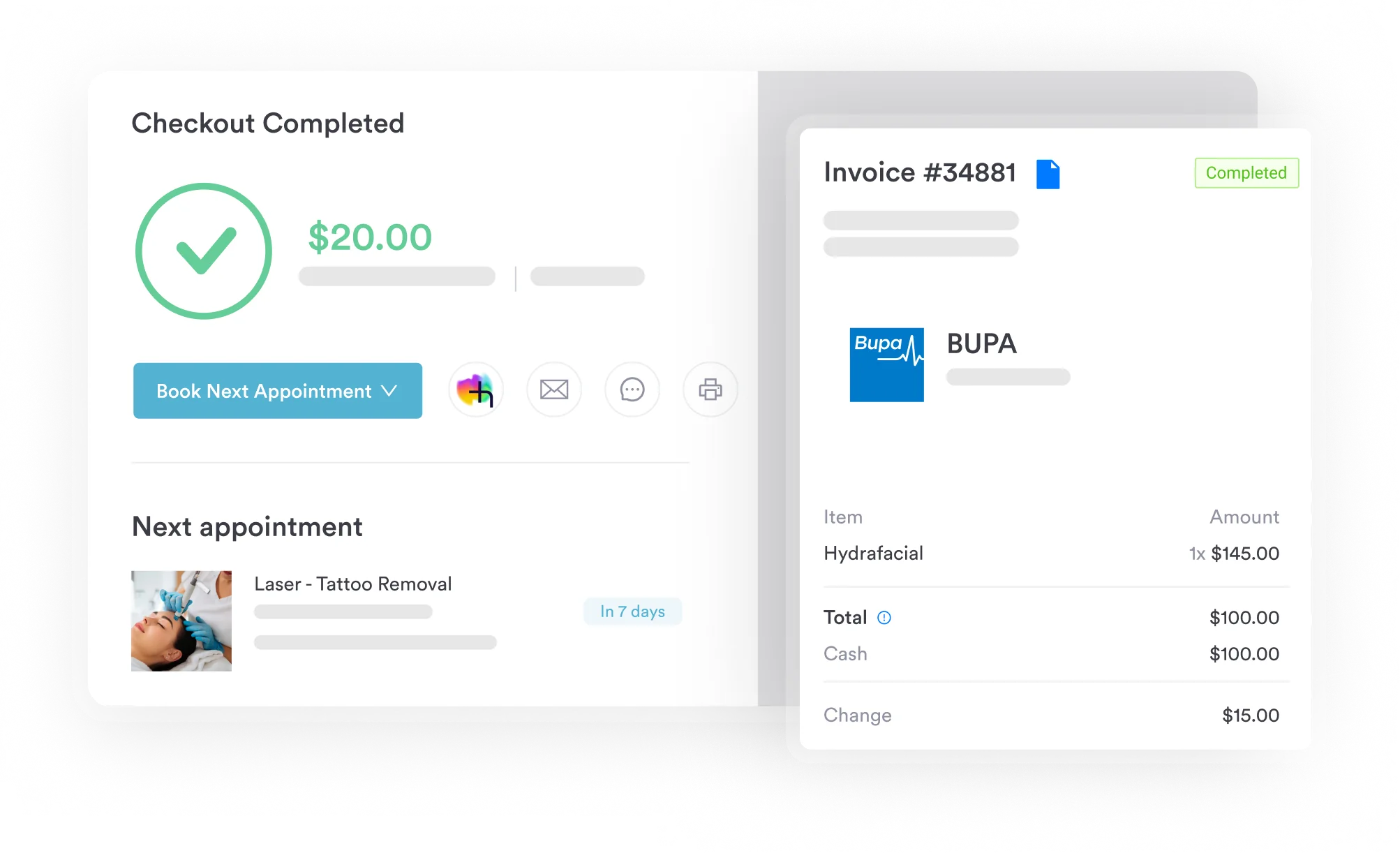

Pabau’s digital forms and stock tracking record the device used at the point of care. Your treatment note and your charge then agree before anyone bills.

The C1830 decision gets made in the procedure room, not in the billing office. If the note names a powered device, everything after that is bookkeeping. If it doesn’t, no amount of chargemaster tuning will rescue the charge.
So build the January habit. Pull Addendum B, check the status indicator, confirm pass-through status, and reconcile the chargemaster mapping. That’s an afternoon of work, and it holds for a year.
The documentation half is worth fixing at the source instead. Book a demo to see how Pabau captures device and treatment detail at the point of care.

Billing another OPPS device code? HCPCS code C1827 covers the neurostimulator generator code and the same facility-only reporting rules.
Coding a catheter on the same claim form? HCPCS code C1885 walks through the transluminal angioplasty laser catheter code.
Coding cervical ankylosing spondylitis? ICD-10 code M45.2 for ankylosing spondylitis explains how this code narrows the diagnosis to the cervical spine.
Reporting other HCPCS codes in outpatient care? HCPCS code G0281 covers electrical stimulation for chronic wounds and its coverage limits.
Coding a lumbar disc claim? ICD-10 code M51.26 for lumbar disc displacement explains why documenting radiculopathy determines whether the claim gets denied.
Yes. Report the device code even when the status indicator shows the payment is packaged. CMS builds future OPPS rates from the charges hospitals report, so dropping packaged lines distorts the data your own rates come from.
Most facilities map device and supply C-codes to a medical or surgical supply revenue code in the 027x range. Sterile supply (0272) is the usual pick. Mapping is a facility and MAC decision, so confirm yours before changing the chargemaster.
No. A powered biopsy needle is a single-use instrument that leaves with the specimen, so nothing stays in the patient. Edits, revenue codes, and documentation rules written for implanted devices don’t apply to it.
One unit per powered needle used. Two separate needles at two sites support two units, provided the note describes both. One needle used at both sites is still a single unit.
No. Packaged device payment already sits inside the APC payment for the biopsy, so the patient owes only the coinsurance for that procedure. A separate device charge to the patient is not supportable.



