HCPCS code C1731: Catheter billing, OPPS reimbursement, and denial guide
HCPCS code C1731: Official descriptor and code series context HCPCS code C1731 i...

Last Updated: Oct 8, 2026
70470 is the CPT code for computed tomography, head or brain; without contrast material, followed by contrast material(s) and further sections.
The code covers one encounter in which both phases are acquired, interpreted and reported together. Its siblings 70450 and 70460 each describe a single phase, so billing that pair to represent a combined study triggers an NCCI bundling edit.
Let Pabau's smart automation suggest the right codes, reduce claim denials, and keep your practice compliant—effortlessly.
Automate repetitive tasks and focus on what matters most—your patients.
Reduce coding errors and ensure compliance with the latest regulations.
Clean claims, fewer denials, and faster reimbursements.
Powerful insights and reporting to help your practice thrive.
HIPAA compliant SOC 2 certified GDPR-compliant Trusted by 4,000+ clinics worldwide

CPT code 70470 covers a head CT performed without contrast first, then with contrast and further sections, in a single encounter.
Modifier 26 bills the radiologist’s interpretation and modifier TC bills the facility’s equipment, staff and supplies.
Billing 70450 and 70460 together to represent a combined study triggers an NCCI bundling edit and a denial.
Medicare payment for 70470 changes with locality and place of service, so check the CMS fee schedule lookup each year.
Practice management software like Pabau submits 837P claims through Claim.MD, tracks their status, and posts remittances without manual keying.
CPT code 70470 is the procedure code for computed tomography of the head or brain. The study is performed without contrast material first, then with contrast material and further sections. That descriptor is set by the American Medical Association’s CPT code set.
The code sits in the Radiology section, under Diagnostic Radiology (Diagnostic Imaging), Head and Neck subsection. Its category range is 70010-76499 and its narrower group range is 70010-70559.
The combined protocol is the critical distinction. The radiologist acquires non-contrast images first, then administers contrast and acquires additional sections. Both phases are captured, interpreted, and reported as a single encounter under 70470. Billing them as two separate codes triggers NCCI bundling edits and a denial.
Radiology practices billing across several imaging modalities need the whole three-code family in front of them. The protocol on the ordering physician’s signed order decides which code applies. A radiologist’s preference at reporting time does not.
The three head CT codes map directly to the contrast protocol ordered. Select the code from what was performed and documented on the day. Where the protocol changed mid-study, the performed protocol governs the code choice.
Never bill 70450 and 70460 together to represent a combined study. CMS NCCI edits bundle the pair, and payers treat it as a single-code service. The correct code for both phases in one encounter is always 70470.
Brain MRI follows the same three-tier pattern, where CPT code 70552 covers the contrast-only study and 70553 the combined without-then-with protocol. Picking the modality first, then the contrast tier, keeps the claim aligned with what the radiologist performed.
Modifiers for CPT code 70470 follow standard radiology billing conventions. The professional and technical components are often billed separately, depending on the practice setting. The table below covers the modifiers most relevant to this code.
Modifier 59 does not guarantee payment, and appending it routinely to override edits invites audit. Document the clinical rationale in the record before you append it. Payer policies on modifier 59 vary, so verify with each payer before billing.
Medicare reimbursement for CPT code 70470 is calculated under the Medicare Physician Fee Schedule (MPFS). The schedule applies Relative Value Units (RVUs) adjusted by the Geographic Practice Cost Index (GPCI) for each locality. Because GPCI multipliers vary by state and CMS locality code, no single national figure applies to every practice.
Verify current rates with the CMS Physician Fee Schedule lookup tool for your locality and year. Practices billing the global code receive a combined rate. Those splitting into professional (modifier 26) and technical (TC) components receive the applicable sub-component rate instead.
Always run eligibility verification before imaging. Confirm the patient’s Medicare Part B coverage, any Medicare Advantage plan rules, and whether prior authorization is required for CPT 70470 under the specific plan. A single pre-service check heads off the eligibility denials that arrive weeks later.
CPT 70470 carries different Medicare rates depending on the place of service. Non-facility rates (Place of Service 11, office) are generally higher for the professional component, because the physician absorbs overhead costs. Facility rates are lower, because the facility bills separately for that overhead.
After CMS processes the claim, the electronic remittance advice confirms the paid amount and any adjustments. Reconcile each remittance against the locality-specific MPFS figure for the date of service.
Medical necessity for CPT code 70470 is governed by CMS Local Coverage Determination (LCD) A57215. That policy covers MRI and CT scans of the head and neck. The ordering physician’s documentation must establish a clinical indication that matches a covered diagnosis code.
The table below lists commonly accepted supporting diagnoses. Each one is drawn from the ICD-10-CM codes the policy recognizes for head imaging. A claim without a covered diagnosis code may be denied as medically unnecessary.
These codes may support medical necessity under LCD A57215. They do not guarantee coverage. The documentation must substantiate why the combined protocol is indicated rather than a simpler non-contrast study. Use specific rather than unspecified ICD-10 codes where the diagnosis is established.
Documentation for CPT code 70470 claims must establish medical necessity for the combined protocol specifically. Support for a head CT in general will not carry the claim. Capturing every required field at the point of order reduces rework downstream.
Radiology billing staff should build this checklist into the order workflow. Catching an incomplete order before the scan costs far less than correcting the claim afterward.
The National Correct Coding Initiative (NCCI) establishes which codes cannot be billed together without a modifier override. For CPT code 70470, the important bundling relationships involve the sibling head CT codes.
NCCI edit tables are updated quarterly, so verify current edit pairs through the CMS NCCI tools before you assume a pair has held. A structured denial management process catches NCCI rejections quickly and routes them to the right appeal path.
Run a monthly audit of 70470 claims denied for NCCI edits. Sort by denial reason code and trace each denial to the code pair that triggered it. Most head CT denials of this kind follow one of two patterns: 70470 billed alongside 70450, or alongside 70460. Fixing the charge capture workflow at source beats appealing claims one at a time.
CPT code 70470 belongs to the head and neck CT family, which spans codes 70450 through 70498. The family follows one pattern across four anatomic regions, shown in the grid below. The AAPC Codify CPT lookup gives searchable access to every code in the range.
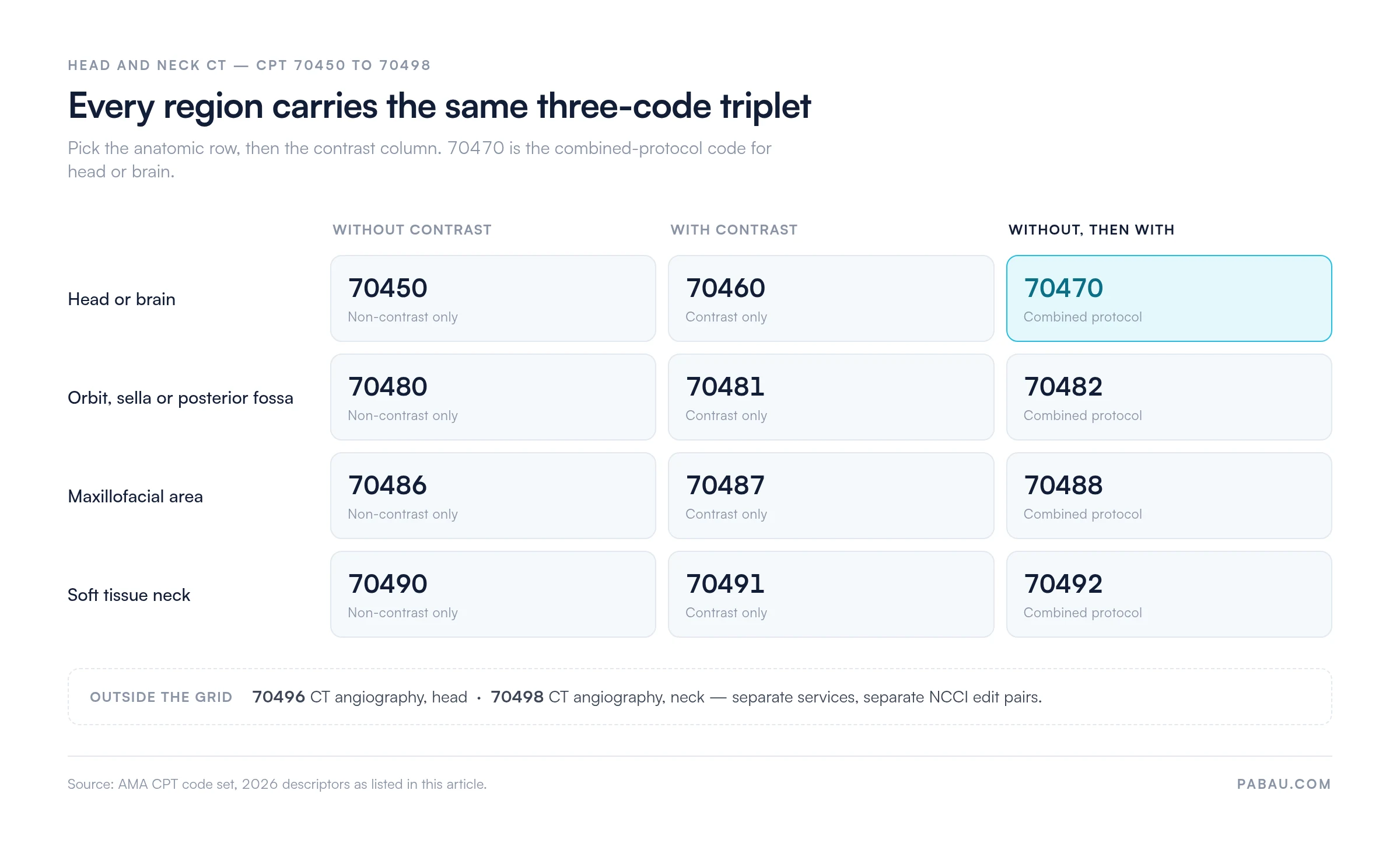
CT angiography codes 70496 and 70498 are distinct services from the standard head CT codes. They require different clinical indications, carry separate reimbursement rates, and have their own NCCI edit pairs. Never substitute a CTA code for a standard CT code on the basis of contrast use alone.
Billing CPT code 70470 correctly means getting several steps right in sequence. A wrong code, a missing modifier, or a weak ICD-10 link each produces a denial. Fixing one afterward takes longer than preventing it. Here is the workflow for radiology billing teams.
Most radiology billing teams work 70470 across three systems. Eligibility sits with the payer portal, the charge sits in the imaging system, and the claim file is built somewhere else again. Each handoff is a chance to lose the modifier or the diagnosis link.
Practice management software like Pabau keeps the sequence in one place. Pabau’s medical claims management tools integrate with Claim.MD to check eligibility before the study is booked. The same record carries the CPT code, its modifiers, and the supporting ICD-10 codes into an 837P claim.
Claims route to more than 4,000 US payers, and 835 remittances post back against the original charge automatically. Radiology billing staff then see which 70470 claims paid, which hit an NCCI edit, and which need an appeal.

Pabau integrates with Claim.MD to submit CPT 70470 claims electronically, verify eligibility before each study, and post remittances automatically. See how radiology billing teams use Pabau to reduce first-pass denials.

CPT code 70470 is the right code when both phases of a head CT are ordered, performed, and interpreted in one encounter. The costly errors on this code are all preventable. A missing modifier, a weak ICD-10 link, and 70450 or 70460 billed alongside 70470 account for most of them.
Build the check into the order, before the scanner is booked. A protocol stated on the signed order, a covered diagnosis, and the right component modifier settle the coding question early.
Answering it there costs far less than appealing later. Book a demo to see how Pabau runs that sequence for radiology billing teams.

Need to understand how clearinghouse submissions work for imaging codes? Medical claims clearinghouse guide covers how 837P claims flow from practice to payer.
Trying to reduce denied radiology claims? Revenue cycle management overview explains the end-to-end billing workflow for imaging practices.
Want to understand Claim.MD pricing before integrating? Claim.MD pricing breakdown covers what clearinghouse fees look like in practice.
CPT code 70470 bills a computed tomography of the head or brain with both contrast phases. The non-contrast images come first, then contrast material and further sections, all in one encounter. It is ordered when the physician needs a baseline and an enhanced study to compare. Tumor characterization, lesion enhancement assessment, and post-treatment surveillance are the usual indications.
CPT 70450 covers a non-contrast CT head only. CPT 70460 covers a contrast-only CT head. CPT 70470 covers both phases in sequence, with non-contrast images first and contrast plus further sections after. The combined protocol has one code, so never bill 70450 and 70460 together to represent it. That pair is an NCCI bundled edit and will be denied.
Modifier 26 covers the professional component, used when the radiologist bills for interpretation only. Modifier TC covers the technical component, billed by the facility for equipment, staff and supplies. Modifier 59 marks a distinct procedural service on the same date, and it needs documentation. Modifiers 76 and 77 cover a repeat procedure by the same or a different physician. Modifier 59 should not be used routinely to bypass NCCI edits.
Medicare reimbursement for CPT 70470 varies by geographic locality and place of service. No single national rate applies to all practices because CMS adjusts payment using Geographic Practice Cost Index (GPCI) multipliers by locality. Use the CMS Physician Fee Schedule lookup tool for your locality, year, and place of service code. It returns the rate that applies to your claim.
No. CPT 70470 and 70460 are an NCCI bundled pair and cannot be billed together for the same patient on the same date of service. The combined protocol code already includes the contrast phase described by 70460. Billing both results in a denial. Modifier 59 may apply only in rare, well-documented circumstances where two distinct studies occurred for separate clinical indications.
LCD A57215 recognizes several diagnoses that may support medical necessity for CPT 70470. They include R51.9 (headache, unspecified), C71.9 (malignant neoplasm of brain), and I61.9 (nontraumatic intracerebral hemorrhage). G35 (multiple sclerosis) and S09.90XA (unspecified head injury, initial encounter) also appear. The ordering physician’s documentation must explain why the combined protocol is necessary for that diagnosis. Covered code lists change with LCD updates, so verify against the current A57215 version.
Yes, CPT code 70470 is active and valid for 2026. The code and its descriptor have been stable within the CPT code set. Confirm the current descriptor in the official AMA CPT code book. The CMS Physician Fee Schedule also shows it for the applicable date of service.