

HCPCS Code L0472: Hyperextension TLSO billing guide
HCPCS code L0472: Official descriptor and device definition HCPCS code L0472 des...

Last Updated: Nov 5, 2026
66170 is the CPT code for fistulization of sclera for glaucoma; trabeculectomy ab externo in absence of previous surgery. The surgeon raises a scleral flap and creates a guarded fistula, so aqueous humor drains into a filtering bleb under the conjunctiva.
The code applies to an eye with no prior surgery or trauma at the operative site. Scarring from earlier surgery or injury moves the claim to 66172. Mitomycin C or 5-FU does not change that choice, so a primary trabeculectomy with an antifibrotic stays 66170. The code carries a 90-day global period.
Let Pabau's smart automation suggest the right codes, reduce claim denials, and keep your practice compliant—effortlessly.
Automate repetitive tasks and focus on what matters most—your patients.
Reduce coding errors and ensure compliance with the latest regulations.
Clean claims, fewer denials, and faster reimbursements.
Powerful insights and reporting to help your practice thrive.
HIPAA compliant SOC 2 certified GDPR-compliant Trusted by 4,000+ clinics worldwide

CPT code 66170 covers trabeculectomy ab externo on an eye with no previous surgery, while 66172 covers an eye scarred by earlier surgery or trauma.
An antifibrotic such as mitomycin C does not change the code, so a primary trabeculectomy with mitomycin C is still billed as 66170.
The 90-day global period bundles routine post-operative visits, bleb checks and suture lysis, and a return to the OR takes modifier 78.
Medicare and most payers expect an RT or LT modifier that matches the laterality in the ICD-10 glaucoma code.
Pabau’s claims management software checks eligibility, tracks each claim’s status and flags denied claims for rework through Claim.MD.
CPT code 66170 is the American Medical Association code for fistulization of sclera for glaucoma; trabeculectomy ab externo in absence of previous surgery.
In plain terms, it is a trabeculectomy on an eye with no earlier surgery or trauma at the operative site. The “ab externo” approach means the surgeon works from outside the eye inward. A scleral flap and an ostium (opening) let aqueous humor drain into a subconjunctival bleb.
The procedure has four key surgical steps coders must see documented in the operative note:
Surgeons often apply mitomycin C or 5-FU to the scleral flap during a primary trabeculectomy. The antifibrotic does not change the code, so the claim stays 66170. Depending on the payer and the site of service, the drug itself may be reported with J7315.
The difference between 66170 and 66172 is the eye’s surgical history. 66172 applies when scarring from previous ocular surgery or trauma is present, and its descriptor includes injection of antifibrotic agents. Billing one when the record supports the other is an audit risk in both directions.
The choice comes down to one question about the eye’s history, set out in the chart below.
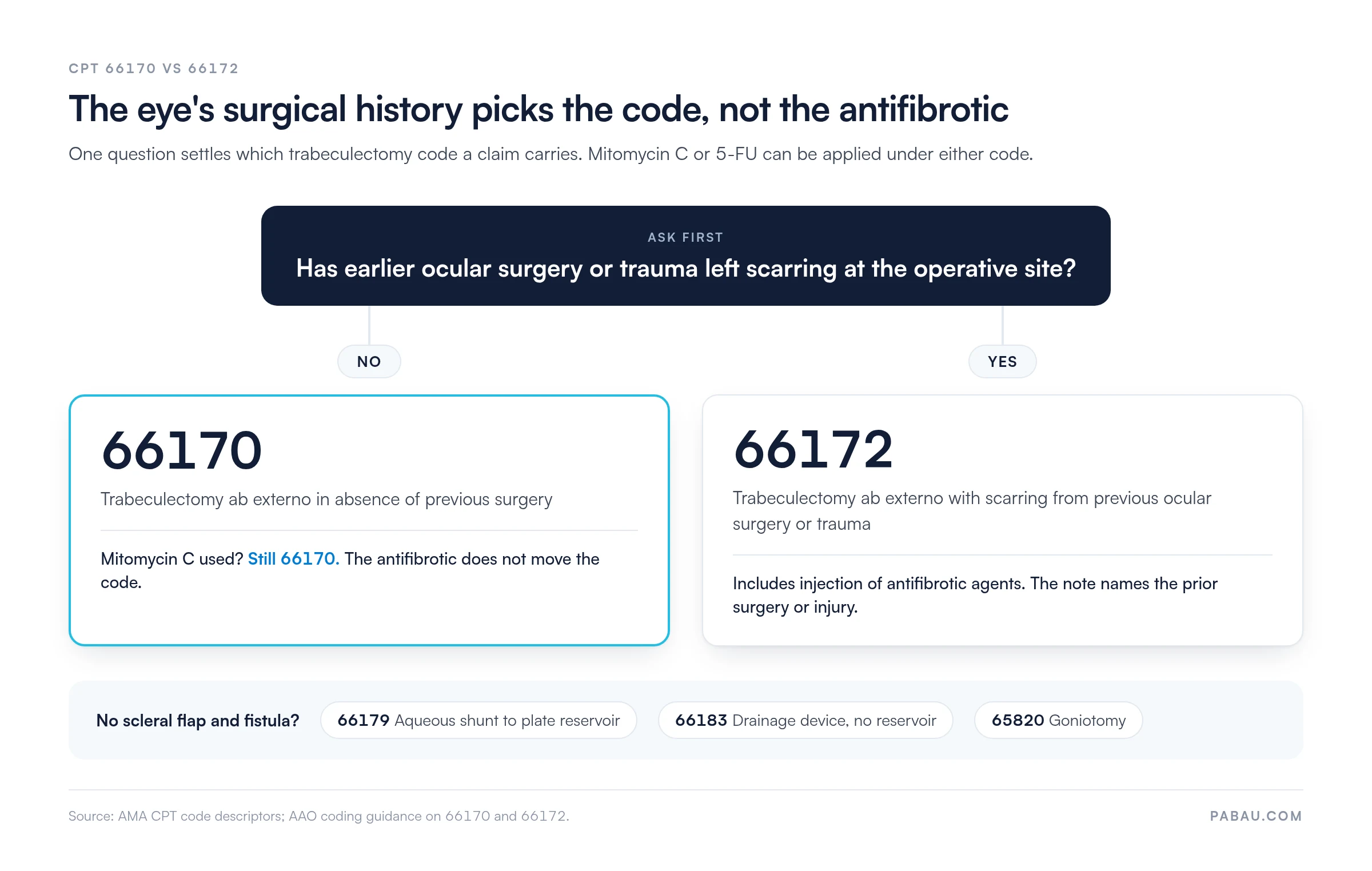
One edge case worth flagging: a surgeon may decide on mitomycin C partway through a primary trabeculectomy. The code still stays 66170, because the eye had no previous surgery. The operative report, read alongside the surgical history, governs code selection.
Micro-invasive glaucoma surgery (MIGS) has its own code family, and payers sometimes question 66170 when a MIGS procedure might have been clinically appropriate. Coders should understand where each code applies.
66170 is appropriate when the surgeon performs a full ab externo trabeculectomy with scleral flap and bleb creation. MIGS codes apply to angle-based or suprachoroidal device procedures. Medical necessity documentation should still explain why trabeculectomy was chosen over a less invasive option.
Check your MAC’s local coverage policies and each commercial payer’s glaucoma surgery policy before submitting 66170 claims. Some set documentation expectations beyond CMS national policy, such as IOP history and failed prior therapy. A claim that meets national standards can still be denied if it misses a local requirement.
A clean claim for CPT code 66170 needs a glaucoma diagnosis from category H40, coded to full laterality. Where the code carries a stage, that is required too. Missing either detail is a common denial trigger for this code.
On codes that carry a stage, the 7th character (mild, moderate, severe or indeterminate) is mandatory. A 7th character of 0 reports “stage unspecified,” which can prompt a medical necessity review. Confirm that the laterality in the record matches both the ICD-10 code and the RT/LT modifier on 66170.
Surgical modifiers on CPT code 66170 are not optional for Medicare claims. Each modifier serves a specific billing function. Using the wrong one, or leaving out a required one, can lead to a denial.
Bilateral trabeculectomy on the same date is rare and highly payer-specific. Before billing it, check which modifier the payer expects and how it prices the second eye.
CPT code 66170 carries a 90-day global surgical period. The Medicare Physician Fee Schedule bundles routine post-operative care into the procedural payment. Billing surgical ophthalmology cleanly depends on knowing exactly what is bundled and what can be billed separately.
Included in the global package (cannot be billed separately):
Separately billable during the global period (with the right modifier):
A bleb or wound revision is generally reported with 66250. Inside the 90-day window, a revision that needs a return to the OR also takes modifier 78.
Medicare reimbursement for CPT code 66170 is set each year by the Medicare Physician Fee Schedule (MPFS). The conversion factor and practice expense RVUs both change each January. Look up the current rate directly rather than relying on a figure printed anywhere, this guide included.
Use the CMS Physician Fee Schedule lookup tool to retrieve current year rates for CPT 66170. Enter the code and select your locality, or “National” for the national average. Then compare the facility rate (ASC or hospital) against the non-facility rate (office-based procedure). The FastRVU 2026 RVU lookup tool shows the current work, practice expense, and malpractice RVUs.
Three billing distinctions affect your reimbursement calculation:
Traditional Medicare does not require prior authorization for CPT code 66170 under current CMS policy. Medicare Advantage plans often do, and requirements vary widely across commercial payers. Verify with each plan before scheduling the procedure.
Standard documentation most payers request when prior authorization is required:
Confirm insurance eligibility verification for the patient’s plan before the authorization request goes in. Medicare Advantage patients deserve extra care, since some change plans at open enrollment. A prior authorization issued under the wrong plan cannot be transferred.
66170 claims combine surgical documentation requirements with strict modifier and diagnosis specificity rules. The most common denial patterns, and how to prevent them, are set out below.
Structured denial management workflows for surgical codes should track the CARC (claim adjustment reason code) on each 66170 denial. Patterns then show up by denial type rather than claim by claim. For the full list of codes payers use to explain denials, see the guide to denial codes in medical billing.
A clean claim for CPT code 66170 requires documentation in two places: the pre-operative record and the operative note.
Pre-operative record must include:
Operative note must include:
The surgical history statement is the element coders most often find missing. Without it, a payer auditing the claim cannot tell from the operative note whether 66170 or 66172 fits.
Consider adding a standard line on prior surgery or trauma to your operative note template. For practices aiming at a clean claim rate above 95%, it is worth standardizing across all surgeons.
Run a quarterly audit of all 66170 and 66172 claims from the prior 90 days. Check each claim against the operative note and the surgical history. Confirm the history matches the code billed, the laterality modifier matches the ICD-10 laterality, and the diagnosis stage matches the clinical record. This three-point check finds most audit risks before a payer does.
CPT code 66170 sits within a broader family of glaucoma surgery codes. Knowing where it fits prevents unbundling errors and helps coders select correctly when documentation describes an adjacent procedure.
Use the AAPC Codify CPT lookup to review the full descriptor for each code in the 66150-66250 range. It includes the parenthetical instructions and cross-references that govern bundling rules.
Rework on a 66170 claim usually starts with a detail that never reached the claim form. Typical culprits are the operative eye, the glaucoma stage, and the surgical history. Each one can slip when billing staff re-key the claim from the operative note in a separate system.
Pabau, the practice management platform we build, raises the insurance claim from the invoice your practice already creates.
Its claims management software sends the claim through Claim.MD, our US clearinghouse partner, to thousands of US insurance payers. Real-time eligibility checks run before surgery, so a lapsed Medicare Advantage plan surfaces before the authorization request goes in.
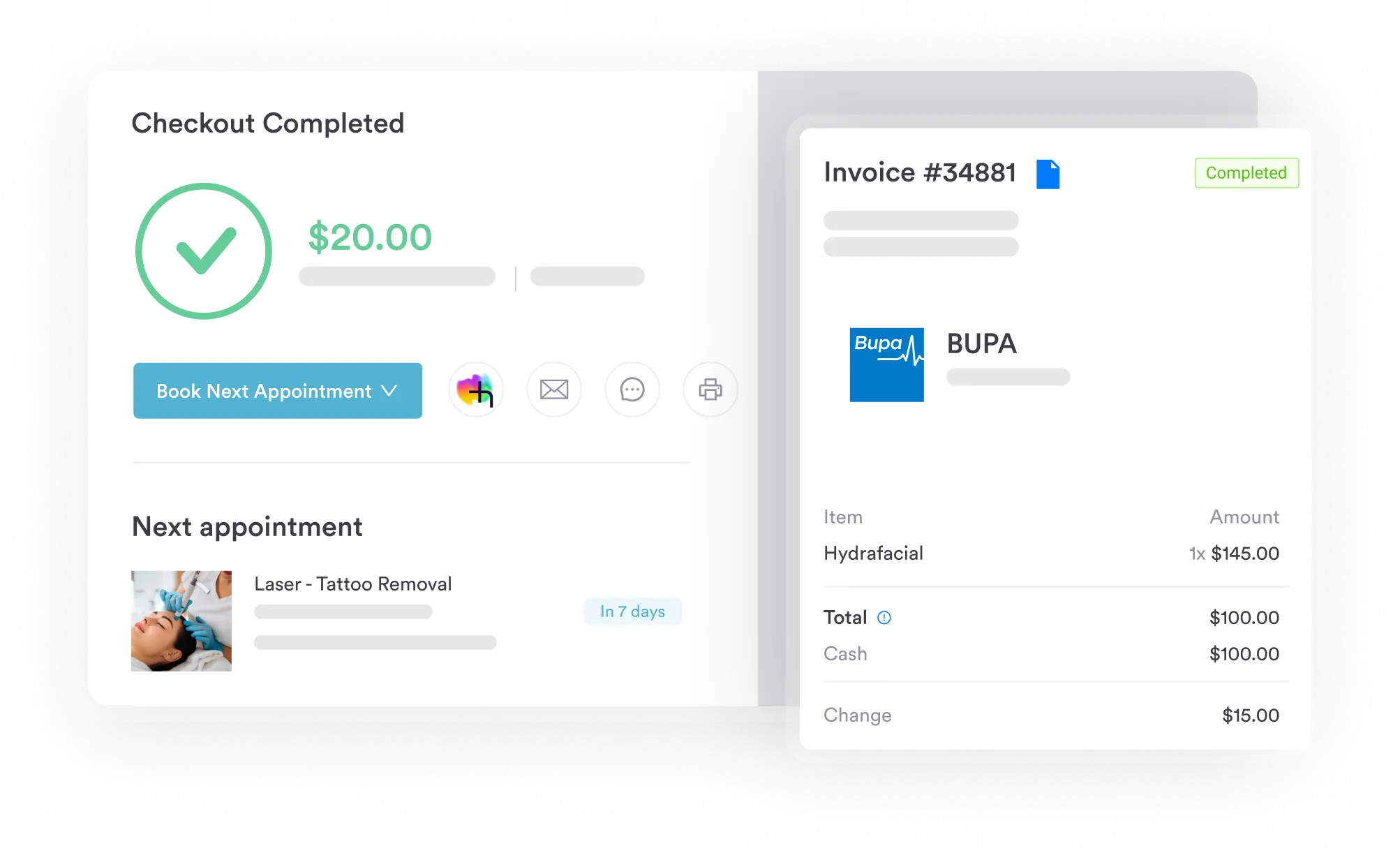
After submission, each claim’s status updates from the payer, and denied claims are flagged for rework. Electronic remittance advice comes back into Pabau and ties each payment to the claim it settles. Our medical claims clearinghouse guide explains how that payer routing works.

Pabau raises insurance claims from your invoices, checks eligibility in real time, and flags denied 66170 claims for rework. Your billing team spends less time chasing payers and more time on clean claims.

Put the eye’s surgical history into the operative note, and 66170 becomes a straightforward claim. That one line settles 66170 against 66172, whatever antifibrotic the surgeon used. Leave it out, and even a correctly coded claim is hard to defend on audit.
The trade-off is a little template work up front for fewer corrected claims later. Standardize the history line, the antifibrotic record, and the laterality across your surgeons, and audits get shorter. Book a demo to see how Pabau tracks each surgical claim from submission to remittance.

Need to understand how clearinghouses process surgical claims? Medical claims clearinghouse guide explains how payer routing and claim validation work for surgical ophthalmology codes.
CPT code 66170 is the billing code for trabeculectomy ab externo in absence of previous surgery. The surgeon creates a guarded fistula through the sclera so aqueous humor drains into a filtering bleb. It applies to a trabeculectomy on an eye with no earlier surgery or trauma at the site, with or without an antifibrotic.
The difference is the eye’s surgical history. 66170 covers an eye with no previous surgery, while 66172 covers scarring from previous ocular surgery or trauma. Antifibrotic use does not decide between them, so a primary trabeculectomy with mitomycin C is still 66170. The record must document the history either way.
Primary open-angle glaucoma codes are the most common: H40.111- for the right eye and H40.112- for the left. Angle-closure codes (H40.20X- to H40.23-) and secondary glaucoma codes (H40.3- and H40.4-) also apply. Codes that carry a stage need the 7th character, and the laterality must match the RT or LT modifier.
CPT 66170 has a 90-day global surgical period. All routine post-operative visits, bleb monitoring, and standard bleb management are bundled into the surgical payment. A return to the OR for a complication takes modifier 78. An unrelated procedure in the same window takes modifier 79.
The most frequent denial reasons are a missing RT or LT modifier and an ICD-10 code without stage or laterality. Others are choosing between 66170 and 66172 on the wrong basis and thin medical necessity documentation. Post-operative services billed inside the 90-day global period without the right modifier also get denied.
Traditional Medicare does not require prior authorization for CPT 66170. Medicare Advantage plans frequently do, as do many commercial payers. Required documentation typically includes serial IOP measurements, visual field results, and documentation of failed medical therapy. Verify prior authorization requirements with each individual payer before scheduling surgery.



