HCPCS code P9058: Red blood cells, leukocytes reduced, CMV-negative, irradiated
HCPCS code P9058: Official descriptor and key attributes HCPCS code P9058 report...

Last Updated: Oct 26, 2026
63035 is the CPT add-on code for laminotomy (hemilaminectomy) at each additional cervical or lumbar interspace. It covers decompression of nerve root(s), including partial facetectomy, foraminotomy and/or excision of a herniated intervertebral disc.
The code is listed separately in addition to the primary procedure. Only two primaries qualify: 63020 for a cervical laminotomy and 63030 for a lumbar one. A laminectomy billed as 63047 takes add-on 63048 instead, and payers reject the mismatch.
Let Pabau's smart automation suggest the right codes, reduce claim denials, and keep your practice compliant—effortlessly.
Automate repetitive tasks and focus on what matters most—your patients.
Reduce coding errors and ensure compliance with the latest regulations.
Clean claims, fewer denials, and faster reimbursements.
Powerful insights and reporting to help your practice thrive.
HIPAA compliant SOC 2 certified GDPR-compliant Trusted by 4,000+ clinics worldwide

CPT Code 63035 is a +add-on code for laminotomy at each additional cervical or lumbar interspace, billed alongside a qualifying primary code, not alone.
Valid primary codes are only 63020 and 63030. Reexploration levels use +63043/+63044, and 63047 (laminectomy) uses +63048, not 63035.
Modifier 51 is never appended to 63035. It is on the CMS modifier 51 exempt list as an add-on code.
Each additional interspace must be individually documented in the operative report. A vague note saying multi-level laminotomy will trigger denial.
CPT Code 63035 is the add-on code for laminotomy at each additional cervical or lumbar interspace. It is reported with one of two primary codes, 63020 or 63030, and never on its own.
The American Medical Association descriptor reads as one long line. Taken in its three parts, it says:
Those three parts do most of the billing work. “Each additional interspace” makes it a per-level code. “Cervical or lumbar” rules out the thoracic spine. The add-on instruction means it only pays alongside a qualifying primary.
CPT Code 63035 may only be reported alongside a qualifying primary laminotomy code. It has no standalone reimbursement value and payers will deny it if submitted without a primary on the same claim.
Only two primary codes qualify for +63035: 63020 for a cervical laminotomy and 63030 for a lumbar one. Reexplorations bill under their own family, with +63043 or +63044 for extra levels. A laminectomy billed as 63047 takes +63048. The map below shows which add-on follows which primary.
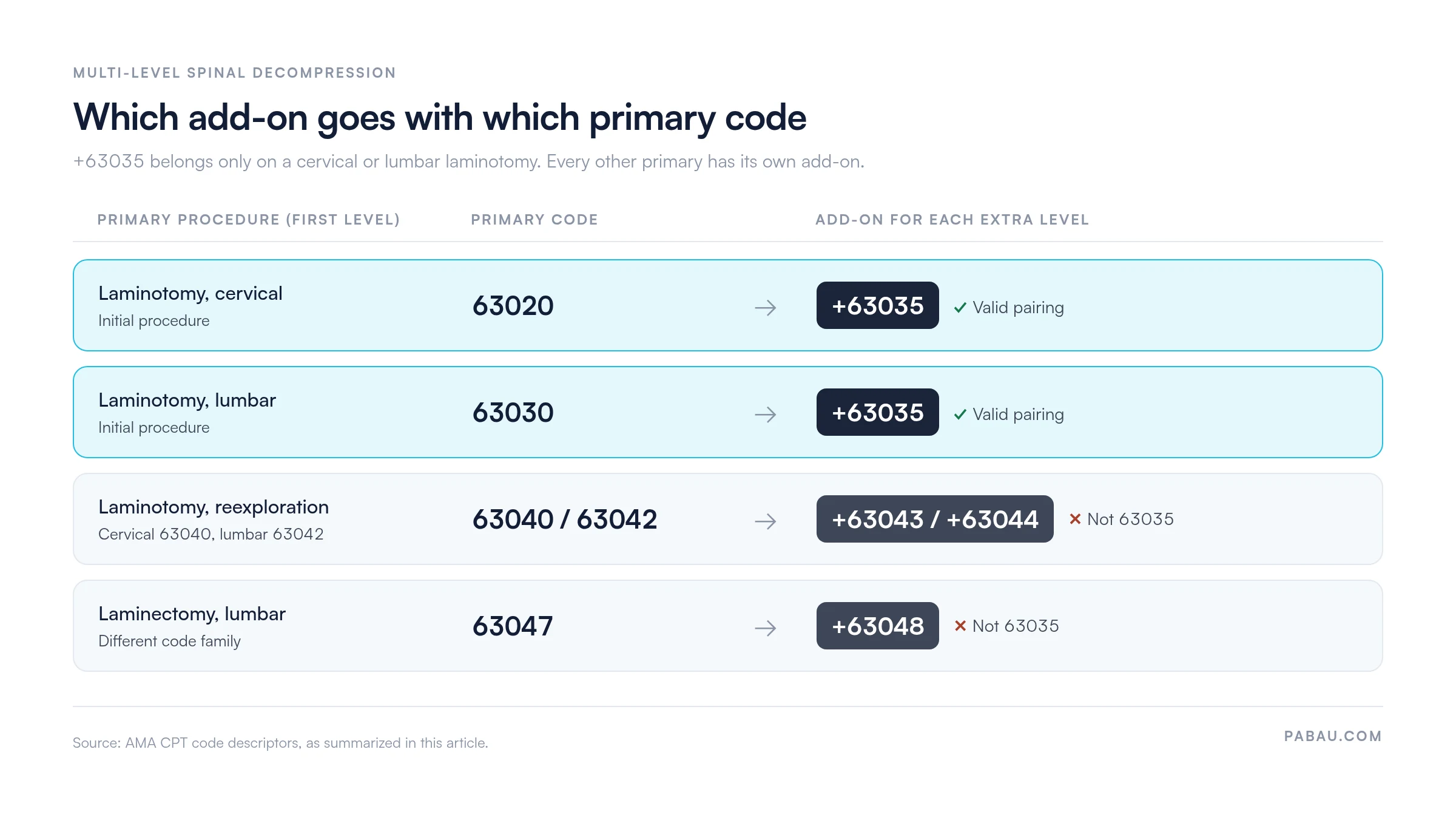
Key add-on rules:
CPT 63030 is the primary lumbar laminotomy code for a single interspace. CPT Code 63035 is the add-on for every additional interspace operated on in the same session. The split is simple on paper, but a multi-level claim only holds up when the operative note names every level billed.
A two-level lumbar laminotomy at L4-L5 and L5-S1 bills as: 63030 (L4-L5, primary) + 63035 (L5-S1, add-on). A three-level procedure adds a second unit of 63035. Each level must appear by name in the operative report.
CPT 63047 is the primary laminectomy code for a single level. Its add-on is CPT 63048, not 63035. Using CPT Code 63035 when the primary was 63047 is wrong code family mixing and generates an NCCI bundling error.
The decision logic is straightforward: match the add-on to its code family.
If your operative report documents a laminectomy at the primary level and a laminotomy at the additional level, contact your MAC for guidance before reporting. Mixed-technique multi-level procedures are not addressed by a single standard pairing rule.
Before submitting any multi-level spinal decompression claim, confirm the primary code family first. Print the operative report, circle the procedure name at each level, and match each to its code family. Laminotomy levels get 63035; laminectomy levels get 63048. Mixing families is one of the easiest audit findings to prevent on spinal surgery claims.
CPT Code 63035 has a short modifier list. Most errors come from applying modifiers that do not apply, not from skipping ones that do.
The operative report is the billing record for CPT Code 63035. Vague multi-level language fails. Each additional interspace must be individually named and described. The diagnosis has to support each level too. Lumbar disc herniation with radiculopathy, for example, is typically coded M51.16.
A compliant operative report for a two-level procedure includes all of the following at each level:
A note that reads “laminotomy performed at two levels, L4-S1” without level-specific pathology and technique descriptions is insufficient to support CPT Code 63035. Payers routinely downcode multi-level claims to a single level when the note reads like this.
CPT Code 63035 reimbursement under Medicare is calculated from the Medicare Physician Fee Schedule (MPFS) using work, practice expense, and malpractice RVU components. Facility and non-facility rates differ because the practice expense component changes based on where the procedure is performed.
For current RVU values and exact dollar amounts, use the CMS Physician Fee Schedule lookup tool. Rates change with each annual MPFS update and vary by geographic location (GPCI). Any specific dollar figure cited elsewhere may reflect a prior year.
CPT Code 63035 denials follow predictable patterns. Most are preventable with a pre-submission review that takes under five minutes per claim.
A structured denial management workflow catches most of these before they age into write-offs. Flag any 63035 denial by denial reason code and track which category recurs. Watch the wrong-family error (63035 with 63047) and thin operative notes first. Better dictation templates for operative reports fix both at the source.
Knowing the relevant CARC denial codes for spinal surgery claims helps your team triage and respond faster. Even so, submitting a clean claim on the first pass beats any appeal.
Run a monthly report on all 63035 claims denied in the prior 30 days. Group them by denial reason. If the same reason appears more than twice, it is a process problem, not a one-off error. Claim-level review catches mistakes after the fact. Process review stops them from recurring.
Without a clearinghouse connection, a spinal billing team checks each 63035 pairing by hand. Then it chases claim status by phone and waits days to learn why an add-on unit was refused.
Pabau, the practice management platform we build, connects to the Claim.MD clearinghouse. It submits CMS-1500 and 837P claims electronically and runs real-time eligibility checks before the procedure date.
ERAs come back with CARC denial codes attached, so your team can work a rejected add-on the same day it arrives. For spinal surgery claims management, that speed matters, because one multi-level procedure can carry several units of 63035.
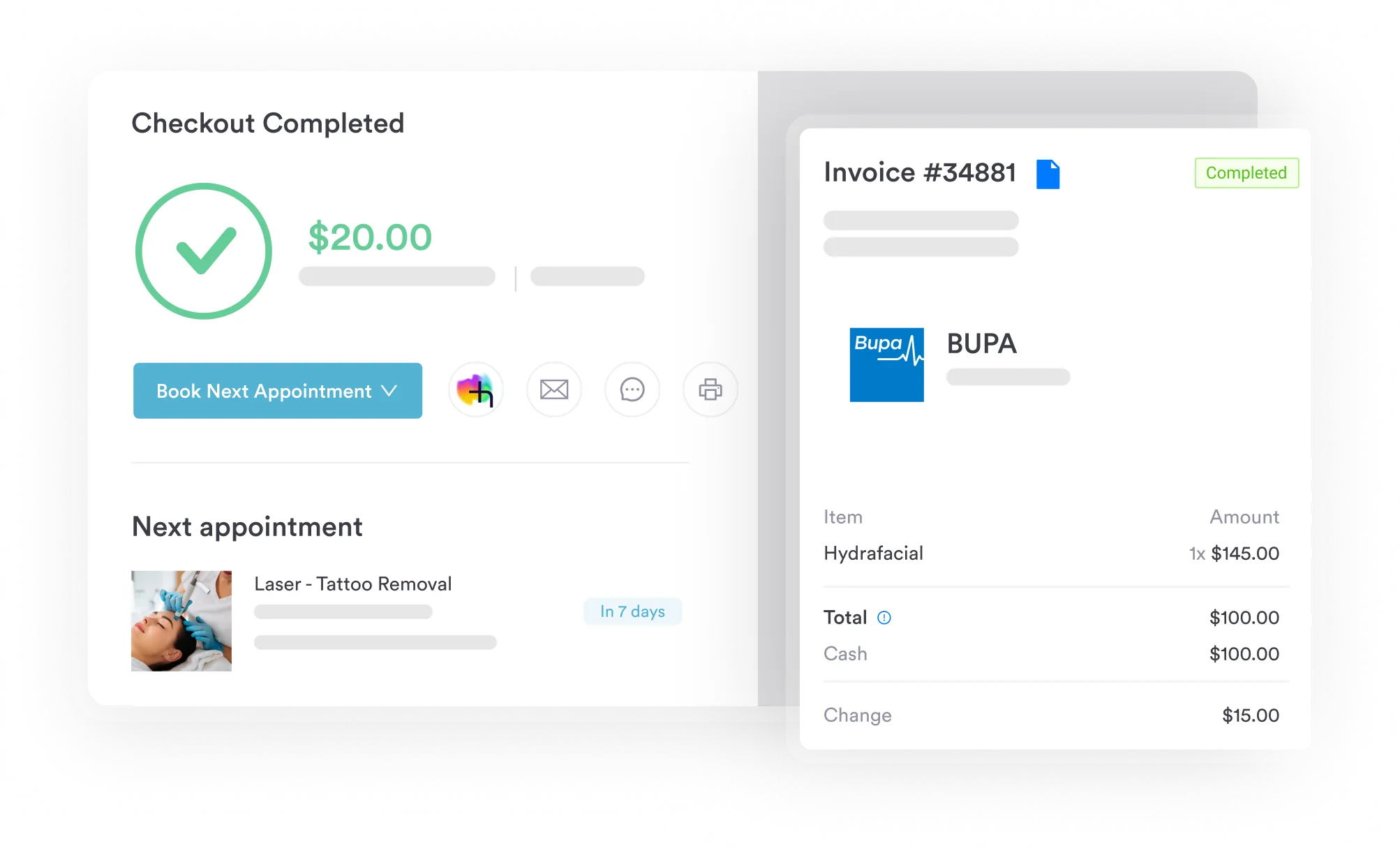

Pabau submits claims through the Claim.MD clearinghouse and returns ERAs with CARC denial codes. Your team can correct a rejected 63035 unit the same day it comes back.

Treat every multi-level spinal claim as two checks before it leaves the practice. Confirm that 63035 sits on a 63020 or 63030 primary. Then confirm the operative note names each extra level and its own pathology.
Those checks take minutes per claim. Skipping them costs weeks of appeal work on every add-on unit a payer refuses, and the same error repeats until the dictation template changes.
Book a demo to see how Pabau gets spinal surgery claims through the clearinghouse and turns denials around the same day.

Need to understand how clearinghouse submissions work? Medical claims clearinghouse overview explains the electronic submission pathway from practice to payer.
Building an appeal for a denied multi-level spinal claim? Medical billing fundamentals covers the documentation and appeal process for surgical claims.
Want to verify eligibility before the procedure date? Insurance eligibility verification walks through real-time eligibility checks and what to do when coverage is unclear.
CPT Code 63035 is used to report a laminotomy performed at each additional spinal interspace beyond the one covered by the primary procedure code. It is an add-on code, meaning it is always billed alongside a qualifying primary such as 63030 (lumbar laminotomy) or 63020 (cervical laminotomy), never alone.
Yes, CPT 63035 is a designated add-on code, indicated by the “+” prefix in the CPT manual. It cannot be billed without a qualifying primary procedure on the same claim, and it is exempt from modifier 51 (multiple procedures).
CPT 63030 is the primary lumbar laminotomy code covering the first interspace operated on. CPT 63035 is the add-on code reported for each additional interspace in the same session. A two-level lumbar laminotomy at L4-L5 and L5-S1 bills as one unit of 63030 plus one unit of 63035.
No, CPT 63035 should not be billed with 63047. When 63047 (laminectomy) is the primary code, the correct add-on for additional levels is CPT 63048, not 63035. Using 63035 with a 63047 primary mixes code families and generates an NCCI bundling conflict.
Modifier 51 is never used with CPT Code 63035. Modifier 59 (or X-modifiers XS/XU) may be appended when an NCCI edit requires a distinct-service indicator. Laterality modifiers LT and RT apply when required by the MAC. Modifiers 78 and 79 apply for related or unrelated procedures within the primary procedure’s 90-day global period.
The Medicare reimbursement rate for CPT 63035 changes annually with the MPFS update and varies by geographic location (GPCI adjustment). Use the CMS Physician Fee Schedule search tool at cms.gov to look up current facility and non-facility rates for your MAC jurisdiction. Any fixed dollar figure not tied to the current fee schedule year may be out of date.
Microdiscectomy is typically reported using CPT 63030 (lumbar laminotomy with disc excision) for the primary level, with 63035 added for each additional level. The microscope add-on code 69990 may also be reported if the surgeon used an operating microscope, subject to payer policy and documentation requirements.