HCPCS code G0143: Thin-layer Pap screening with rescreening
HCPCS code G0143 means two manual reads of one liquid-based slide HCPCS code G01...

Last Updated: Oct 19, 2026
58940 is the CPT code for oophorectomy, partial or total, unilateral or bilateral.
CPT code 58940 covers open removal of part or all of one or both ovaries through a laparotomy (open abdominal) incision. A laparoscopic ovary removal is coded under 58661 instead, so the approach in the operative report decides which code applies.
Let Pabau's smart automation suggest the right codes, reduce claim denials, and keep your practice compliant—effortlessly.
Automate repetitive tasks and focus on what matters most—your patients.
Reduce coding errors and ensure compliance with the latest regulations.
Clean claims, fewer denials, and faster reimbursements.
Powerful insights and reporting to help your practice thrive.
HIPAA compliant SOC 2 certified GDPR-compliant Trusted by 4,000+ clinics worldwide

CPT code 58940 covers open (laparotomy) oophorectomy only. Laparoscopic removal of the ovary or adnexa is coded separately under 58661.
A bilateral 58940 goes to Medicare as one line, one unit, with no modifier 50. CMS gives the code bilateral indicator 2, so the 150% adjustment does not apply.
ICD-10 codes C56.x (ovarian malignancy) and N83.x (non-inflammatory ovarian disorders) are the most commonly accepted medical necessity diagnoses. Unsupported diagnoses are the leading denial trigger.
Pabau’s claims management software streamlines submission and tracks denial patterns across gynecologic surgical codes, including 58940.
CPT code 58940 is defined by the American Medical Association as “Oophorectomy, partial or total, unilateral or bilateral.” The procedure encompasses open surgical removal of one ovary (unilateral) or both ovaries (bilateral), either partially or in their entirety, performed through a laparotomy incision.
The code sits within the CPT Ovary section (58800-58960) and applies exclusively to the open approach.
The open approach is the defining characteristic. A surgeon who converts from laparoscopic to open mid-procedure documents the open approach in the operative report and bills 58940.
A surgeon who completes the removal laparoscopically without conversion bills 58661 instead. Billing 58940 for a laparoscopic case misrepresents the approach and creates a documentation mismatch that payers flag on audit.
Common clinical indications include ovarian malignancy, large or symptomatic ovarian cysts, torsion, endometriosis, and prophylactic surgery in BRCA1/BRCA2 carriers.
According to the American Medical Association’s CPT code set overview, CPT codes are updated annually and coders should verify the current descriptor each coding year.
Understanding the boundaries of the code prevents both undercoding and overbundling errors.
Two questions settle which of these codes an operative report supports: the surgical approach first, then what the surgeon removed.
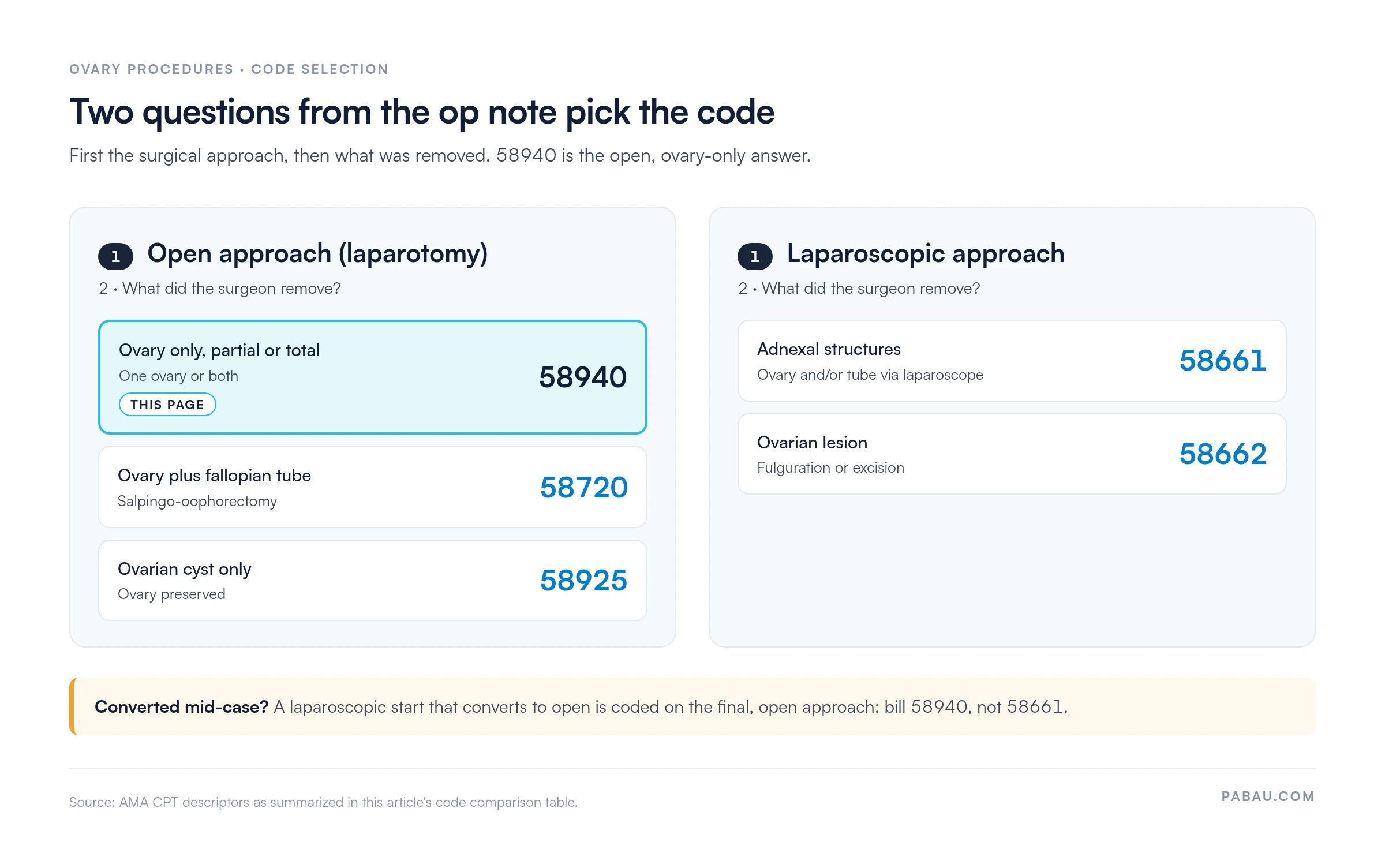
The operative report is the billing foundation for 58940. Payers audit this code specifically because the laparoscopic-versus-open distinction is invisible on the claim form. The operative report must establish open approach beyond any ambiguity.
Structured procedure note templates help surgeons capture each required field at the time of dictation. Required operative report elements for a valid 58940 claim include the following.
If a procedure begins laparoscopically and converts to open, the conversion must be documented explicitly. Bill for the open approach (58940), not the laparoscopic code, when conversion occurs.
Flag laparoscopic-to-open conversions in your billing queue before submission. A procedure that starts under 58661 and converts to an open oophorectomy should be re-coded to 58940 based on the final operative report. Submitting the originally scheduled code without verifying the op note is one of the most common approach-mismatch denials in gynecologic surgical billing.
Modifier selection for 58940 directly affects reimbursement amount and claim acceptance rate. Most errors come from treating a bilateral case like any other bilateral surgery, when this code already covers both sides.
For a bilateral 58940, Medicare expects one line, one unit, and no modifier 50. The 2026 Medicare Physician Fee Schedule gives the code bilateral surgery indicator 2. Its RVUs already assume a bilateral procedure, so the 150% adjustment does not apply.
Laparoscopic 58661 works differently. It carries indicator 1, so modifier 50 does apply there and Medicare pays 150% of the single-procedure amount. On 58940, modifier 50, RT and LT lines, or 2 units earn nothing extra. Medicare pays the lower of the charge or 100% of the single-code amount, and the claim may be edited or denied.
Pairing 58940 with a diagnosis code that payers do not recognize as medically necessary for oophorectomy is the single most common reason for denial. These are the primary ICD-10-CM categories that support the procedure.
Verify each diagnosis against the specific payer’s local coverage determination (LCD) before billing. Coverage for prophylactic oophorectomy under Z40.02 often requires genetic counseling documentation and may trigger prior authorization. Payers differ on which N83.x codes they accept without prior documentation of conservative management failure.
Where the diagnosis carries laterality, keep it consistent with the modifier on the claim line. A benign right-ovary tumor coded D27.0 pairs with the RT modifier, never LT.
CPT 58940 carries a 90-day global surgical period under the Medicare Physician Fee Schedule. Pre-operative visits from the day before surgery and post-operative care within 90 days are bundled into the single payment. Separate billing for routine follow-up within this window will be denied.
Reimbursement amounts vary by geographic locality and change with annual Medicare Physician Fee Schedule updates. Use the CMS Physician Fee Schedule lookup tool to retrieve current facility and non-facility rates for your specific geographic practice location (GPCI).
For a quick Work/PE/MP RVU breakdown, the FastRVU 2026 RVU lookup tool pulls current CMS data by code and location.
A bilateral 58940 pays 100% of the Medicare fee schedule amount, the same as a unilateral one. The code carries bilateral indicator 2, so the standard 150% bilateral rule does not apply.
Expecting 150% on this code causes two problems. The claim goes out with an inflated charge that invites edits, and the correct 100% payment gets flagged as an underpayment to chase. Commercial payers may set their own bilateral rules, so check the contract before you set expectations.
The prior authorization process for 58940 varies by payer and plan year. Traditional Medicare does not require prior authorization (PA) for inpatient surgical procedures, but Medicare Advantage plans may impose their own PA requirements. Most commercial plans and Medicaid programs require prior authorization for elective oophorectomy.
The authorization request typically needs to include:
Payers processing BRCA-related prophylactic oophorectomy requests under Z40.02 frequently insist on the genetic counseling note itself as a supporting document.
For urgent or emergent cases, such as ovarian torsion or a ruptured cyst with hemorrhage, prior authorization is typically waived. The practice must still notify the payer within the plan’s emergent notification window, commonly 24-48 hours after admission.
Document the emergent clinical indication clearly in the medical record. Billing staff should confirm retroactive authorization protocols with each payer for emergent oophorectomy cases.
Most 58940 denials fall into four categories. Identifying which category a denial belongs to at the remittance stage speeds resolution significantly.
Systematic denial management in healthcare starts with categorizing every denied 58940 claim by remark code at the remittance stage.
Practices that track remittance denial codes by CPT code can see whether their denials cluster around approach documentation or medical necessity.
Approach errors are fixed at the dictation level, and medical necessity errors with better ICD-10 pairing protocols. The two problems have completely different root causes and require different interventions.
The National Correct Coding Initiative (NCCI) bundles certain procedure codes with 58940 when performed during the same operative session by the same surgeon. Billing both without proper documentation and an appropriate modifier results in the secondary code denying with CO-97.
Verify current NCCI tables via the CMS NCCI policy tool before submitting concurrent procedure claims, as bundled code pairs and modifier indicators change quarterly. Key NCCI bundling considerations for 58940 include the following.
Submitting a clean claim for 58940 with concurrent procedures means confirming NCCI modifier indicators before the claim leaves the practice. Modifier 59 is a valid override only when the concurrent procedure was distinct, with its own indication and its own documentation.
Payers audit modifier 59 usage on surgical claims, and patterns of routine application without supporting documentation can trigger recovery audits.
Run your concurrent procedure pairs through the current CMS NCCI table before submitting multi-code gynecologic surgical claims. CMS publishes NCCI updates quarterly, so a pair that was separately billable last quarter may be bundled this quarter. Build a simple NCCI lookup step into your pre-submission workflow for any 58940 claim that includes more than one procedure code.
When both ovaries are removed during the same open surgical session, the procedure is bilateral. The descriptor already reads “unilateral or bilateral,” so one code covers either case. How you report it still depends on the payer.
In a staged bilateral oophorectomy, one ovary is removed at the first surgery and the second at a later one. Each encounter is billed as a separate unilateral oophorectomy with the appropriate LT or RT modifier. The bilateral indicator plays no part here, because each claim reports one side only.
Each denial pattern in this guide starts before submission. A converted case stays on 58661, a bilateral claim carries a modifier 50 that Medicare will not pay, or nobody checks an NCCI pair. Catching those by hand means re-reading the op note and the payer’s rules on every claim.
Practices that bill through Pabau, our practice management and billing platform, route 58940 claims electronically via Claim.MD, our integrated clearinghouse partner. Claim.MD supports CMS-1500 and 837P submission to thousands of US payers and returns electronic remittance advice for payment reconciliation.
The claims management software within Pabau tracks claim status and flags remittance denial codes against submitted codes before they age past timely filing deadlines. Your team sees whether denials cluster around approach documentation or diagnosis pairing, and fixes the habit once.

Pabau’s integrated claims management tracks 58940 submissions, flags denial patterns, and routes electronic claims through Claim.MD to thousands of US payers. See how gynecologic practices use Pabau to cut claim turnaround time.

CPT code 58940 rarely fails on its descriptor. It fails when the claim stops matching the operative report, so the op note is where the billing work starts.
Build two checks into your pre-submission routine. Confirm the final approach on every case that started laparoscopically. Then check how each payer wants a bilateral case reported, since Medicare takes one line with no modifier 50. Both take minutes, while a corrected claim restarts the payment clock.
Book a demo to see how Pabau keeps gynecologic surgical claims matched to the op note from coding through payment.

Need to understand how clearinghouse submission works for surgical codes? How a medical claims clearinghouse works covers the end-to-end claim submission pathway from practice to payer.
Want to reduce your denial rate across all procedure codes? What is revenue cycle management explains how systematic RCM processes reduce write-offs and speed payment collection.
Billing for IVF or other fertility procedures alongside gynecologic surgery? IVF CPT codes covers the full procedure code set for fertility treatments billed in the same specialty.
CPT code 58940 covers open oophorectomy, meaning partial or total removal of one or both ovaries performed through a laparotomy (open abdominal) incision. It does not cover laparoscopic ovary removal, ovarian cystectomy with ovary preservation, or fallopian tube procedures performed without ovarian removal.
CPT 58940 is the open oophorectomy code. CPT 58661 covers laparoscopic removal of adnexal structures (ovary and/or tube via laparoscope). The surgical approach is the primary distinction. Billing 58940 for a laparoscopic case, or 58661 for a laparotomy case, is an approach mismatch. It is a leading cause of claim denial and audit exposure.
A case is bilateral when both ovaries are removed during the same open surgical session. For Medicare, report 58940 once, on one line with one unit and no modifier 50. CMS assigns the code bilateral indicator 2, so the 150% adjustment does not apply and payment is 100% of the fee schedule amount. Commercial payers may set their own rules, so check the contract.
The strongest ICD-10-CM supports are C56.x (malignant neoplasm of ovary), D27.x (benign ovarian neoplasm), and N83.x (ovarian cysts and disorders). N83.51x/N83.52x (torsion of the ovary or fallopian tube) and Z40.02 (prophylactic removal for BRCA risk) also qualify. Verify against the specific payer’s local coverage determination before billing, as accepted diagnoses vary by plan.
The four most common denial reasons are approach mismatch, an unsupported medical necessity diagnosis, a missing or incorrect laterality modifier, and NCCI bundling edits. Approach mismatch means a laparoscopic procedure was billed under the open code. Approach mismatch and missing laterality are the most preventable with a pre-submission operative note review step.
No. CPT 58940 (open approach) and CPT 58661 (laparoscopic approach) represent alternative methods for removing ovarian structures. A single surgical session uses one approach. Billing both codes for the same operative session misrepresents the procedure and will deny under NCCI edits. If a laparoscopic case converted to open, bill only 58940 for the final completed approach.