

HCPCS Code Q4175: Billing, coverage, and documentation guide
HCPCS code Q4175: Code description and product identity HCPCS Code Q4175 is the ...

Last Updated: Nov 20, 2026
Billable Code
58541 is the CPT code for laparoscopic supracervical hysterectomy (LSH), with or without morcellation; uterus 250 g or less. The surgeon removes the uterine body laparoscopically, leaves the cervix in place, and removes no tubes or ovaries.
Coding errors often start in documentation: The operative note omits uterine weight, or supracervical is confused with total hysterectomy. CPT 58541 heads a four-code family, 58541 through 58544, split by uterine weight and adnexal removal.
Let Pabau's smart automation suggest the right codes, reduce claim denials, and keep your practice compliant—effortlessly.
Automate repetitive tasks and focus on what matters most—your patients.
Reduce coding errors and ensure compliance with the latest regulations.
Clean claims, fewer denials, and faster reimbursements.
Powerful insights and reporting to help your practice thrive.
HIPAA compliant SOC 2 certified GDPR-compliant Trusted by 4,000+ clinics worldwide

CPT code 58541 covers laparoscopic supracervical hysterectomy for a uterus of 250 g or less. The cervix stays in place, and no tubes or ovaries are removed.
Specimen weight must be documented in the operative or pathology report, because a claim without it is open to downcoding or denial.
The supracervical family has four codes, 58541 to 58544, split by uterine weight (250 g or less, or over 250 g) and by adnexal removal.
Tube or ovary removal at the same session is reported with 58542, never as 58541 plus 58661.
In the US, Pabau, a practice management platform, sends CMS-1500 and 837P claims through Claim.MD, with eligibility checks and ERA remittances included.
CPT code 58541 describes a laparoscopic supracervical hysterectomy (LSH) for a uterus weighing 250 grams or less. The CPT code set is maintained by the American Medical Association. It lists the descriptor as Laparoscopic supracervical hysterectomy (LSH), with or without morcellation; uterus 250 g or less. The surgeon removes the uterine body and leaves the cervix in place.
The code does not include removal of the ovaries or fallopian tubes. “Supracervical” (also called subtotal) is the key clinical differentiator. A total hysterectomy removes the whole uterus, cervix included. A supracervical hysterectomy leaves the cervical stump behind. That anatomical difference drives a different code, different documentation, and sometimes different payer policies.
CPT 58541 covers laparoscopic removal of the uterine body with the cervix left in situ, for a specimen at or below 250 g. Knowing where the code stops prevents both undercoding and unbundling.
Included in 58541:
Not included, and how to code it instead:
The four supracervical laparoscopic hysterectomy codes (58541 through 58544) differ on exactly two variables: Uterine specimen weight and whether the adnexal structures are removed. Choosing among them is a documentation exercise rather than a clinical judgment call. The operative and pathology reports must supply both data points.
The practical workflow: Confirm the approach was laparoscopic and the cervix was retained, then read the pathology specimen weight. At or below 250 g with no adnexal removal is 58541. At or below 250 g with adnexal removal is 58542. Above 250 g, the same adnexa logic leads to 58543 or 58544.
Beyond the 58541 family, coders must tell supracervical from total laparoscopic approaches apart. The deciding fact is whether the cervix was removed, and the operative note has to say so explicitly.
58570 is the direct counterpart to 58541: same weight band, no adnexa, but the cervix comes out. A coder who trusts the word “laparoscopic” without confirming cervix status will assign 58541 when 58570 is correct, or the reverse. When tubes or ovaries are also removed, the total code becomes 58571. A combined laparoscopic and vaginal approach points to 58550 instead.
Payer audits for gynecologic surgery focus on this distinction because the payment rates differ. The grid below shows how cervix status, specimen weight and adnexal removal combine to pick one of six codes.
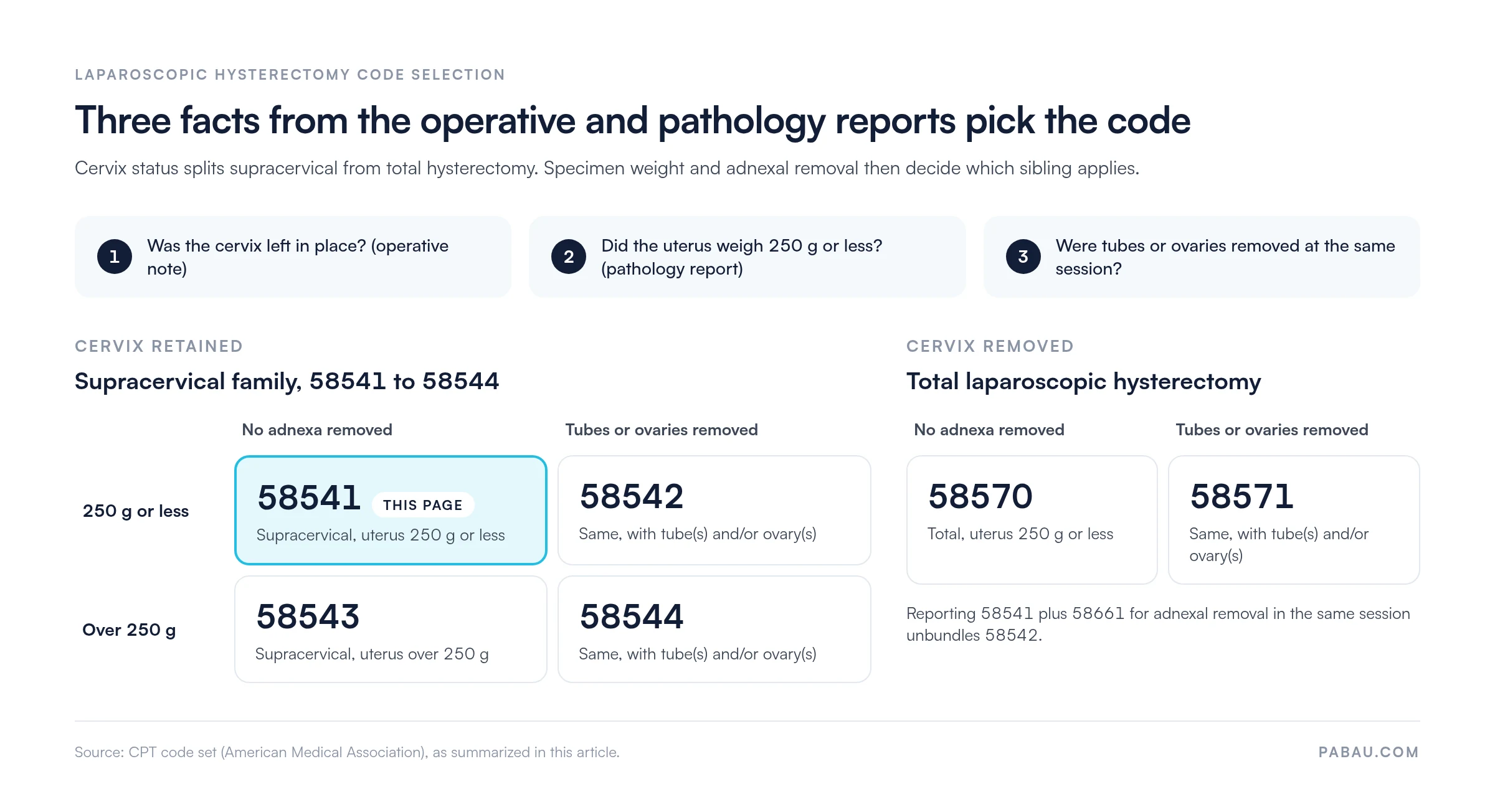
The 250 g cutoff has to come from a documented measurement in the operative or pathology report. Coders cannot infer or approximate specimen weight from the surgeon’s description of uterine size, the number of fibroids, or surgical difficulty.
The CMS Physician Fee Schedule assigns different payment amounts to 58541 and 58543. That is why payers audit weight documentation when claims for the larger-uterus codes arrive without supporting pathology.
What to look for in the operative record:
When weight is absent from both the operative note and the pathology report, query the surgeon before the claim goes out. A 58541 claim without documented weight invites a medical records request and possible downcoding or denial.
Run a documentation checklist at charge entry: Approach (laparoscopic confirmed), specimen weight in grams, cervix retained (yes/no), adnexa removed (yes/no), and any conversion to open. If any field is blank, hold the claim and query the surgeon. A claim held at charge entry needs one correction, while a denied claim needs a corrected claim or an appeal.
Complete documentation for CPT 58541 spans the operative report, the pathology report, and the pre-operative record that establishes medical necessity. Payer audits for gynecologic surgery typically request all three.
The ICD-10 diagnosis code on a 58541 claim signals medical necessity to the payer. Local Coverage Determinations from Medicare Administrative Contractors can restrict which diagnoses support coverage, so check the applicable LCD before submitting. Coders can confirm each diagnosis in our ICD-10-CM library for coders before pairing it with 58541.
Pairing 58541 with a diagnosis the MAC’s LCD does not list leads to a medical necessity denial on a Medicare claim. Documentation alone cannot reverse that denial, so check the applicable LCD before submission.
Medicare payment for CPT code 58541 is calculated from the Medicare Physician Fee Schedule (MPFS) using relative value units (RVUs). Rates are updated each January 1 and vary by geographic locality. Verify the current year’s figures in the CMS Physician Fee Schedule search tool rather than relying on printed references.
The 90-day global period bundles post-operative visits within 90 days of the procedure into the surgical fee. A separate E&M service during that window needs modifier 24 (unrelated E&M) or modifier 79 (unrelated procedure). E&M services billed without a modifier during the global period are a consistent audit finding in gynecologic surgery.
For current reimbursement figures checked against CMS data, use the FastRVU lookup tool.
Prior authorization requirements for CPT 58541 vary by payer and change with plan year updates. Many commercial payers and Medicare Advantage plans require prior auth for elective hysterectomy, so check the specific plan’s current authorization list before assuming coverage.
When you submit a prior authorization request for CPT 58541, include this documentation to cut down on back-and-forth requests:
Medicare fee-for-service does not require prior authorization for most gynecologic surgeries. Medicare Advantage plans operate under separate rules and frequently do require auth. Verify at the plan level before scheduling elective procedures.
Modifiers attached to CPT 58541 give the payer extra clinical or billing context. Using the wrong modifier, or leaving out one that is required, is a common denial trigger for laparoscopic hysterectomy claims.
Modifier 22 carries a higher audit risk than the others. Payers expect documentation detailed enough to justify the extra reimbursement. A one-line note stating “dense adhesions present” rarely suffices without time documentation and a description of the additional work.
Denials for CPT 58541 cluster around a predictable set of documentation failures. You can prevent most of them at charge entry rather than through appeals.
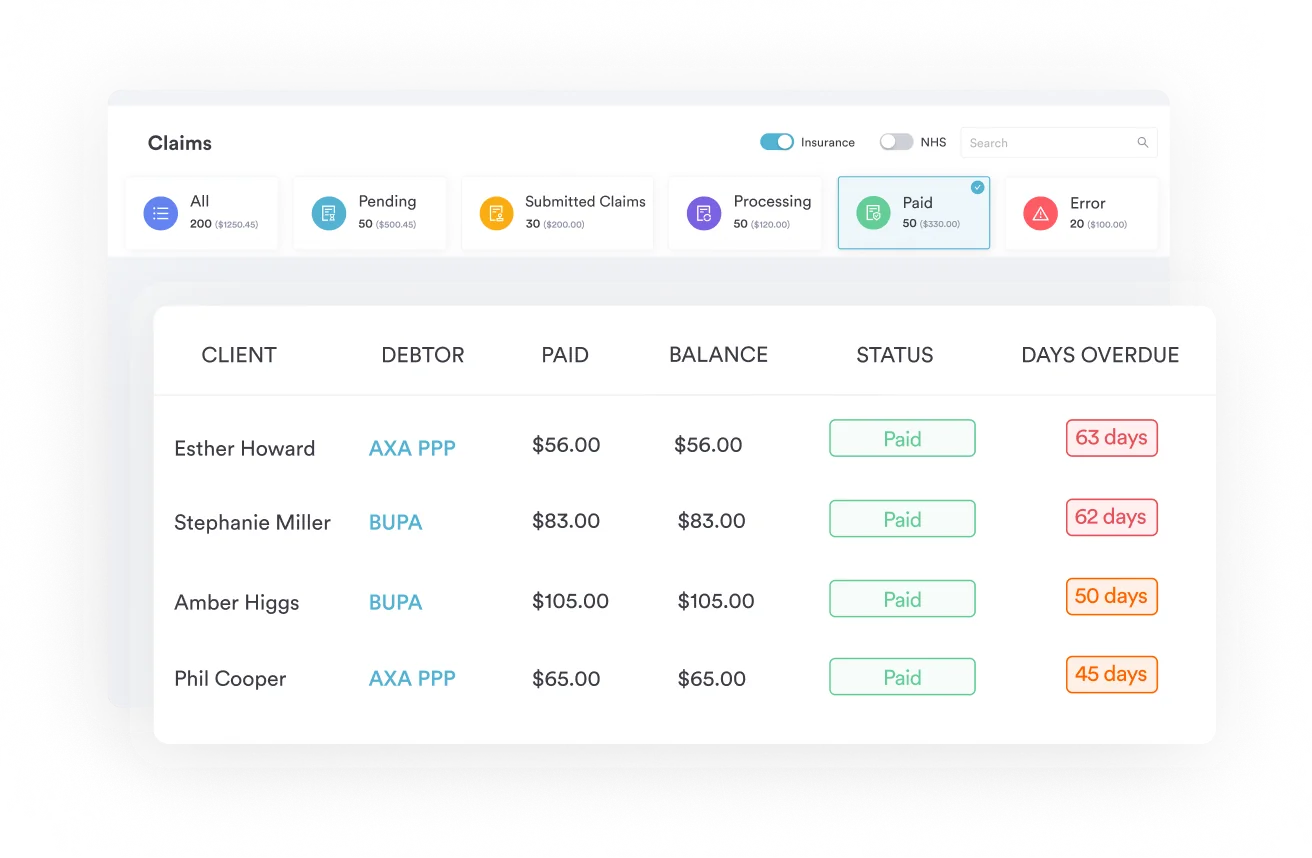
For US practices, Pabau sends insurance claims through the Claim.MD clearinghouse. Its claims software for gynecologists builds CMS-1500 and 837P claims, runs eligibility checks, and posts ERA remittances. Secondary claims go out from the same record, so a coordination-of-benefits balance is not rekeyed by hand.
NCCI (National Correct Coding Initiative) edits define what is bundled into CPT 58541 and what may be reported separately. NCCI edits are updated quarterly, so check the current edit tables before assuming a code pair is or is not subject to an edit. The AAPC Codify CPT lookup includes NCCI edit indicators you can check at the code level.
Bundled into 58541 by NCCI edits:
A service with an active NCCI edit against 58541 can be reported alongside it only with modifier 59. The service has to be distinct and independently documented.
Removing the tubes or ovaries at the same session is not a separate service. For a uterus of 250 g or less, the whole procedure is reported with 58542. Billing 58541 plus 58661 for that session unbundles it. If an NCCI edit has already denied a claim, our guide to denial management in healthcare covers the appeal workflow.
Before appending modifier 59 to bypass an NCCI edit, confirm the op note documents a separate indication for each service. An NCCI edit exists because the two services are usually performed together. Modifier 59 tells the payer they were not, and that claim is audit-eligible. Document the clinical reason each service was separately necessary.
In a typical surgical billing workflow, a 58541 claim is assembled by hand. A biller reads the operative note, waits for the pathology weight, then keys the code and diagnosis into a separate billing tool. Each handoff is a chance to lose the weight or the cervix status.
Pabau keeps the clinical record and the claim in one system. The operative note and consent forms sit on the patient record, so your biller codes from the same file the surgeon signed.
In the US, Pabau submits CMS-1500 and 837P claims through Claim.MD. Eligibility checks run before the procedure, ERA remittances post when the payer responds, and secondary claims go out from the same record. Your billing team spends its time confirming weight and cervix status instead of rekeying claims.

In the US, Pabau sends CMS-1500 and 837P claims through Claim.MD, with eligibility checks and ERA remittances. Each 58541 claim is built from the patient record the surgeon documents in.

Treat 58541 as a documentation code first. When the pathology weight and the cervix status are on file before charge entry, the choice between 58541 and its siblings stops being a guess.
The trade-off is a short hold on each claim until pathology reports. That wait costs less than a corrected claim or an appeal. Build the hold into your charge-entry routine, and query the surgeon whenever either fact is missing.
Book a demo to see how Pabau carries the operative record into US insurance claims for gynecologic surgery.

Need a clearinghouse integration for surgical claims? Pabau’s Claim.MD clearinghouse guide explains how the integration handles electronic claims, ERA posting, and denial tracking for US practices.
Looking for clean claim best practices? The clean claim guide covers what payers check before adjudicating a surgical claim and how to reduce front-end errors.
Dealing with recurring denials on surgical codes? Denial management in healthcare outlines the workflow for tracking, appealing, and preventing claim denials across procedure code types.
Coding a total laparoscopic hysterectomy on a larger uterus? CPT code 58572 covers the total approach when the uterus weighs more than 250 g.
CPT code 58541 is the billing code for a laparoscopic supracervical hysterectomy (LSH) on a uterus weighing 250 grams or less. The uterine body is removed laparoscopically and the cervix is left in place. Removal of the tubes or ovaries is not included in this code.
CPT 58543 describes the same laparoscopic supracervical hysterectomy without adnexal removal, but for a uterus weighing more than 250 grams. The uterine specimen weight, documented in the pathology report, is the only difference between the two codes.
Use 58541 when the cervix is retained (supracervical approach) and the uterus weighs 250g or less. Use 58550 when the procedure is a laparoscopic-assisted vaginal hysterectomy (LAVH) in which the cervix is removed. Whether the cervix was retained or removed is the main decision point.
No. CPT 58541 does not include removal of the ovaries or fallopian tubes. When tubes or ovaries are removed at the same session for a uterus at or below 250g, report 58542 instead. Billing 58541 plus 58661 for that session is unbundling.
Prior authorization requirements vary by payer and plan year. Many commercial and Medicare Advantage plans require prior auth for elective hysterectomy. Medicare fee-for-service generally does not, but always verify at the individual plan level before scheduling.
Medicare reimbursement for CPT 58541 is calculated from the MPFS. Work, practice expense, and malpractice RVUs are multiplied by the annual conversion factor and adjusted for geographic locality. Rates change each January 1, so verify the current year’s figures in the CMS Physician Fee Schedule search tool at cms.gov.





