CPT code 44625: Enterostomy closure with resection
CPT code 44625 needs three things in one operation CPT code 44625 reports an ope...

Last Updated: Oct 8, 2026
CPT code 42821 is the procedure code for tonsillectomy and adenoidectomy performed on a patient aged 12 or over. It is published by the American Medical Association (AMA) as part of the CPT® code set.
Both structures have to come out in the same operative session for 42821 to apply. The patient’s age on the date of surgery separates it from CPT 42820, which covers the same procedure in a patient under 12.
This reference covers the 2026 Medicare reimbursement, RVU values, modifiers, ICD-10-CM crosswalk, documentation requirements, and NCCI bundling rules for CPT code 42821.

CPT code 42821 reports tonsillectomy and adenoidectomy for patients aged 12 or over. Patients under 12 are billed with CPT 42820.
The 2026 Medicare national allowed amount is approximately $272. Verify your locality rate with the CMS Physician Fee Schedule lookup tool.
Modifiers -22, -52, -62 and -80 are the ones applied most often to this code. Payer acceptance of -50 varies, so confirm it before submitting.
Practice management software like Pabau links ICD-10 codes, applies modifiers, and routes claims through a clearinghouse for clean submission.
CPT code 42821 is a surgical procedure code describing tonsillectomy and adenoidectomy in a patient who is 12 years of age or older. It sits in the Excision and Destruction Procedures subsection of the Surgery chapter, under the Throat (Pharynx, Adenoids, Tonsils) heading.
The official AMA descriptor reads: “Tonsillectomy and adenoidectomy; age 12 or over.” Both procedures must be performed in the same operative session for 42821 to apply. If only the tonsils are removed, use CPT 42826 for a patient aged 12 or over.
Adenoids removed on their own are coded by whether the adenoidectomy is primary or secondary. CPT 42831 covers a primary adenoidectomy at age 12 or over. CPT 42836 covers a secondary adenoidectomy in that same age band, and CPT 42835 covers a secondary adenoidectomy under 12.
Tonsillectomy removes the palatine tonsils. Adenoidectomy removes the adenoid tissue, also called the pharyngeal tonsil, in the same procedure.
In adults and older adolescents both structures are usually larger and more vascular than in young children. That affects operative time and complexity, which is what puts modifier -22 in play on some adult cases.
Common indications for T&A in patients 12 and older include recurrent tonsillitis and a history of peritonsillar abscess. Sleep-disordered breathing with tonsillar or adenoid hypertrophy also qualifies, as does obstructive sleep apnea confirmed by polysomnography.
The American Academy of Otolaryngology sets three episode thresholds for recurrent tonsillitis, and any one of them supports the indication:
Payer local coverage determinations (LCDs) set their own episode-frequency thresholds. Check the relevant LCD before submitting.
CPT 42820 and CPT 42821 describe the identical surgical procedure. The only differentiator is the patient’s age at the time of surgery. Selecting the wrong one is among the most common reasons T&A claims come back for correction.
Age is determined on the date of the surgical encounter, not the date of the original consultation or the billing date. A patient who turns 12 three days before surgery is billed under CPT code 42821.
Record the date of birth and the operative date explicitly in the chart note. That is what protects the claim against age-related edits in a post-payment audit.
Modifiers adjust how a claim is processed without changing the code itself. For T&A procedures, modifier selection depends on the clinical scenario and the payer’s own requirements. The table below covers the modifiers applied most often to CPT code 42821. Verify acceptance with the specific payer before submitting.
Confirm modifier acceptability with the specific payer before filing. Modifier -50 is frequently rejected on T&A codes because CMS treats tonsillectomy as bilateral by definition. Send a modifier -22 claim with a typed narrative attached. A generic operative note on its own rarely earns increased-service payment.
Medicare reimburses CPT code 42821 under the Physician Fee Schedule (PFS). Rates vary by site of service and geographic locality. The figures below are approximate 2026 national unadjusted amounts, so treat them as a starting point rather than a quote. Use the CMS Physician Fee Schedule lookup tool to retrieve your locality-specific rate.
These are approximate national figures from the 2026 CMS Physician Fee Schedule, and they should be verified through the CMS PFS lookup before use. Geographic Practice Cost Indices (GPCIs) move the allowed amount by roughly 15% to 25% either way depending on locality. Check your own locality before building a fee schedule or quoting a patient estimate.
On most procedure codes the non-facility rate is the higher of the two. The physician absorbs overhead, supplies, and nursing staff in an office setting, so the practice expense RVU is larger. In a hospital or ASC the facility bills for those costs instead, and the physician’s practice expense RVU drops.
CPT 42821 barely shows that split. The surgery is virtually always performed in a hospital outpatient department or an ASC, and the two published rates land close to each other. The place-of-service code still has to match where the surgery happened, or the claim invites a payment reduction or an edit on audit.
RVUs set Medicare payment by weighting the work, practice expense, and malpractice cost of a procedure. The values below are approximate 2026 figures for CPT 42821. Confirm them against the CMS PFS lookup or the CMS data file for your billing year. Do that before the numbers go into a contract or a compensation model.
CMS sets the conversion factor annually. For 2026 it is approximately $33.40, and about $33.57 for qualifying participants in an advanced alternative payment model. Multiply total RVUs by the GPCI-adjusted factor to estimate the allowed amount for your locality. The chart below runs that arithmetic for CPT 42821.
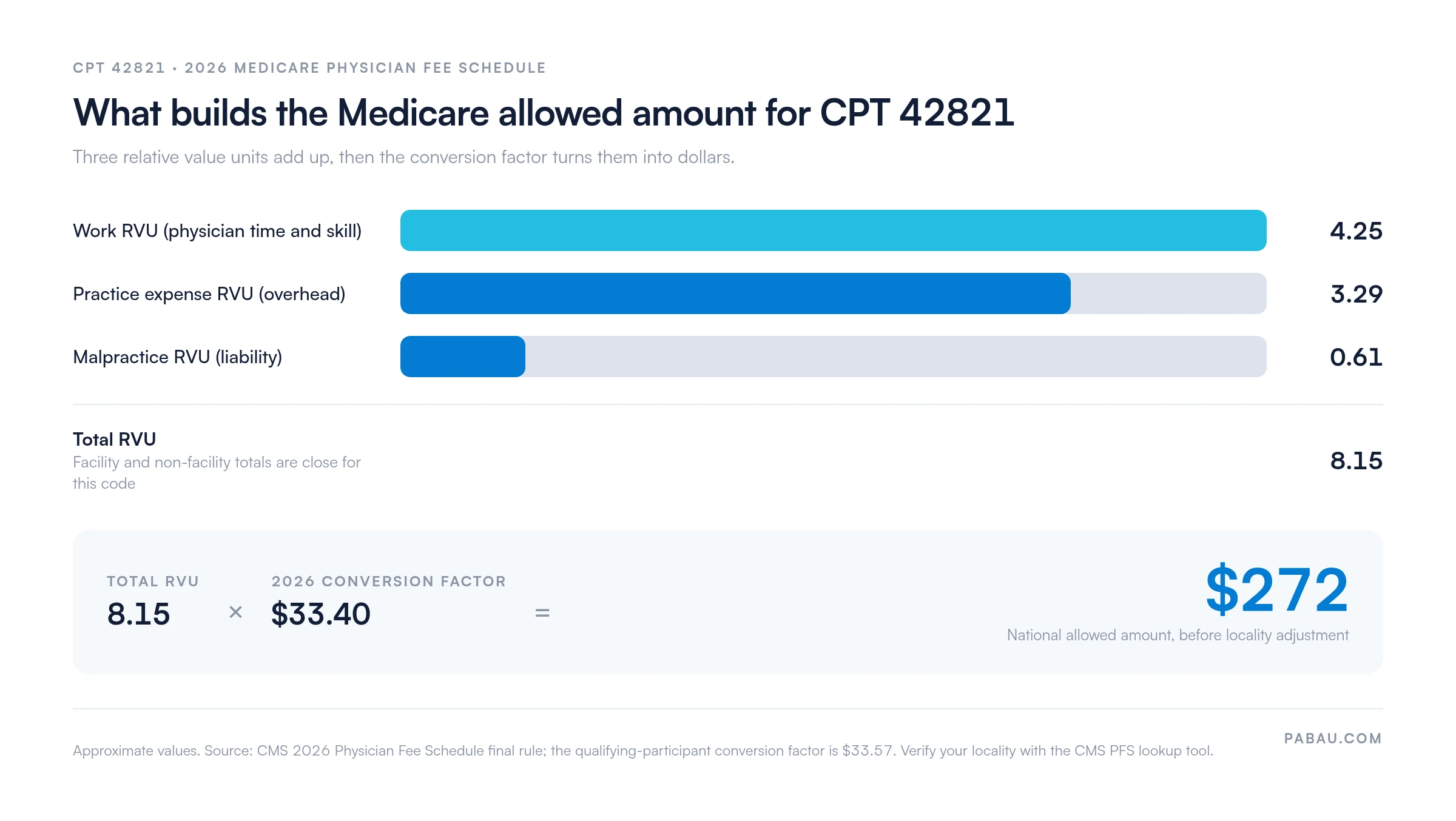
wRVUs also feed physician compensation benchmarking in ENT group practices. An out-of-date work value therefore costs more than a single underpaid claim.
Every claim for CPT code 42821 needs at least one ICD-10-CM diagnosis code establishing medical necessity. Payers cross-reference that diagnosis against their LCD to decide whether the procedure was clinically appropriate. The table below lists the codes linked most often on adult and adolescent T&A claims.
Use the most specific code the documentation supports. J35.03 beats J35.9 when the record shows both chronic tonsillitis and adenoiditis. Payer LCDs often list the accepted diagnoses outright. A code outside that list can trigger an automatic denial even when the surgery was clinically appropriate.
If the record points to a diagnosis outside this table, the wider ICD-10-CM codes reference carries the rest of the set.
Documentation is what turns a correct code into a paid claim, and it is the first defense in a post-payment audit. For CPT code 42821 the operative report and the pre-operative record have to establish medical necessity together.
Prior authorization rules vary widely between commercial payers, and many require authorization for T&A in adults specifically. Confirm the requirement before the case is scheduled, not after the claim comes back.
CMS’s National Correct Coding Initiative (NCCI) publishes quarterly edits defining which code pairs cannot be billed together without a modifier.
The edits touching CPT 42821 are refreshed every quarter, so read the current table rather than a static list. Sound denial management starts with knowing which edits apply before the claim goes out.
Unbundling means billing component codes separately when a comprehensive code already exists. It is a CCI violation and can trigger overpayment recovery. Where a pairing is unclear, check the current NCCI Physician Edits table on the CMS website before filing.
CPT code 42821 sits in a family of tonsil and adenoid codes covering different procedure combinations and age bands. Picking the wrong member of that family is one of the most common billing errors in otolaryngology.
Billing CPT code 42821 cleanly depends on each step of the workflow being completed in order. A wrong place of service, a missing ICD-10 link, or the wrong modifier produces either a denial or an underpayment.
ENT practices running a high volume of T&A cases save time with a stored claim template. Pre-load it with 42821, the common modifiers, and the standard ICD-10 crosswalk. That cuts entry time per case and lowers the error rate on busy surgical days.
Most ENT billing teams rebuild the same claim by hand on every T&A case. Someone reads the operative note and checks the date of birth against the surgery date. Then they pick 42821 or 42820, link a diagnosis, and hope the modifier holds.
Pabau, practice management software for medical and aesthetic practices, holds that sequence in one record. The operative note, the patient’s date of birth, the linked ICD-10 code, and the modifier all sit on the same claim.
Validation runs before transmission rather than after a rejection arrives. Claims route through Claim.MD to thousands of US payers, and ERA remittances post back against the original charge automatically.
For a practice carrying surgical volume, that adds up to cleaner claims management. Fewer age-mismatch denials, fewer NCCI edits caught by the payer instead of by your team, and a shorter path from operative note to posted payment.

Pabau’s claims management software links ICD-10 codes, applies modifiers, and submits clean claims through Claim.MD to thousands of US payers. That cuts denials on high-volume surgical codes like CPT 42821.

Most preventable denials on CPT code 42821 come down to three checks. Confirm the patient was 12 or older on the surgery date. Pair the claim with a diagnosis that satisfies the payer’s LCD, then review bundling before the claim is transmitted.
None of that is hard on a single case. Repetition across a full surgical list turns a small inconsistency into a denial rate. That is why the three checks belong in the claim workflow rather than in someone’s memory.
Building those checks into the claim itself costs nothing per case and removes the rework later. Book a demo to see how Pabau validates ENT surgical claims before they reach the payer.

Want to understand how clearinghouse submissions work? Medical claims clearinghouse guide covers how claims move from practice management software to payer and back.
Seeing claim denials you can’t explain? Denial codes in medical billing breaks down the most common CARC reason codes and how to appeal them.
Need a primer on insurance eligibility checks? Insurance eligibility verification explains how real-time eligibility lookups prevent avoidable claim failures before surgery day.
CPT code 42821 is used to report tonsillectomy and adenoidectomy performed on a patient aged 12 years or older. It covers the combined surgical removal of both the palatine tonsils and the adenoid tissue in a single operative session.
CPT 42820 applies when the patient is under age 12 at the time of surgery. CPT 42821 applies when the patient is 12 or older. The procedures described are identical. Only the patient’s age on the date of the surgical encounter separates them, not the consultation or billing date.
The codes linked most often are J35.01 (chronic tonsillitis), J35.03 (chronic tonsillitis and adenoiditis), and J35.3 (hypertrophy of tonsils with adenoids). G47.33 (obstructive sleep apnea, adult) is used as a secondary diagnosis. Select the most specific code the clinical documentation supports, and verify it appears on the payer’s LCD before submitting.
The modifiers applied most often are -22 for increased procedural services, -52 for reduced services, -62 for two surgeons, and -80 for an assistant surgeon. Use -22 only where operative complexity was substantially greater than typical, with documentation attached. Modifier -50 is rarely applicable and frequently rejected on this code, so confirm acceptance before appending it.
CPT 42831 reports a primary adenoidectomy alone in a patient aged 12 or over. CPT 42836 reports a secondary adenoidectomy in that same age band. If both the tonsils and the adenoids come out in the same session, use CPT 42821 instead. Billing an adenoidectomy code alongside 42821 triggers an NCCI bundling edit.
The family splits by which structures are removed and by the patient’s age. Combined tonsillectomy and adenoidectomy is 42820 under 12 and 42821 at age 12 or over. Tonsillectomy alone is 42825 under 12 and 42826 at age 12 or over. Adenoidectomy alone at age 12 or over is 42831 when primary and 42836 when secondary. Lingual tonsil excision is 42870 at any age.