HCPCS Code V5095: Semi-implantable middle ear hearing prosthesis
HCPCS Code V5095: Definition and clinical descriptor HCPCS Code V5095 is the Lev...

Last Updated: Nov 25, 2026
42420 is the CPT code for excision of a parotid tumor or parotid gland; total, with dissection and preservation of the facial nerve. The surgeon removes the whole gland, superficial and deep lobes, and keeps the facial nerve intact.
The code sits in the 42410-42426 parotid excision family. Extent of gland removed separates it from 42415, which takes only the lateral lobe with the same nerve dissection. Nerve handling separates it from 42425, which sacrifices the facial nerve.
Let Pabau's smart automation suggest the right codes, reduce claim denials, and keep your practice compliant—effortlessly.
Automate repetitive tasks and focus on what matters most—your patients.
Reduce coding errors and ensure compliance with the latest regulations.
Clean claims, fewer denials, and faster reimbursements.
Powerful insights and reporting to help your practice thrive.
HIPAA compliant SOC 2 certified GDPR-compliant Trusted by 4,000+ clinics worldwide

CPT code 42420 reports a total parotidectomy: the whole parotid gland or tumor comes out while the facial nerve is dissected and preserved.
The 42415 vs 42420 choice turns on how much gland was removed, because both codes include dissection and preservation of the facial nerve.
Sacrificing the facial nerve moves the case to 42425, and adding a unilateral radical neck dissection moves it to 42426.
For CY 2026, 42420 carries 19.04 work RVUs and 30.71 facility RVUs, about $1,030.86 nationally before locality adjustment.
The operative note must show that the deep lobe was removed, or 42415 becomes the defensible code on audit.
CPT code 42420 reports excision of a parotid tumor or parotid gland; total, with dissection and preservation of the facial nerve. AAPC’s summary of CPT 42420 describes the same procedure: the provider removes the parotid gland with the tumor and dissects and preserves the facial nerve. The code sits in the Surgery section, Digestive System subsection, under excision procedures on the salivary gland and ducts (42400-42450).
Two elements define the code. The whole gland comes out, the superficial (lateral) lobe and the deep lobe alike. The facial nerve, cranial nerve VII, is dissected free through the gland and left intact. Both elements have to appear in the operative note for 42420 to hold up on audit.
Older references sometimes describe 42420 as a superficial parotidectomy. That reading is wrong, and it is the source of most miscoding in this family. A superficial (lateral lobe) parotidectomy with the nerve dissected and preserved is 42415.
The surgical package for 42420 covers the whole operation, from incision to closure. These services are part of the code and are never billed on their own line:
These services fall outside 42420. Some move the case to a different code, and others are billed by a different provider:
Coders recognize a total parotidectomy by the sequence the operative note describes. The surgeon finds the facial nerve trunk first, then follows each branch forward through the gland.
The superficial lobe is lifted off the nerve branches. The surgeon then works beneath the preserved branches to remove the deep lobe. That second step is what turns a superficial parotidectomy into a total one.
Total parotidectomy is chosen when disease reaches the deep lobe or the whole gland. Typical indications include:
Look for phrases such as deep lobe dissected from beneath the nerve, total parotidectomy, or gland removed in its entirety. Pair them with a statement that every nerve branch was intact at closure.
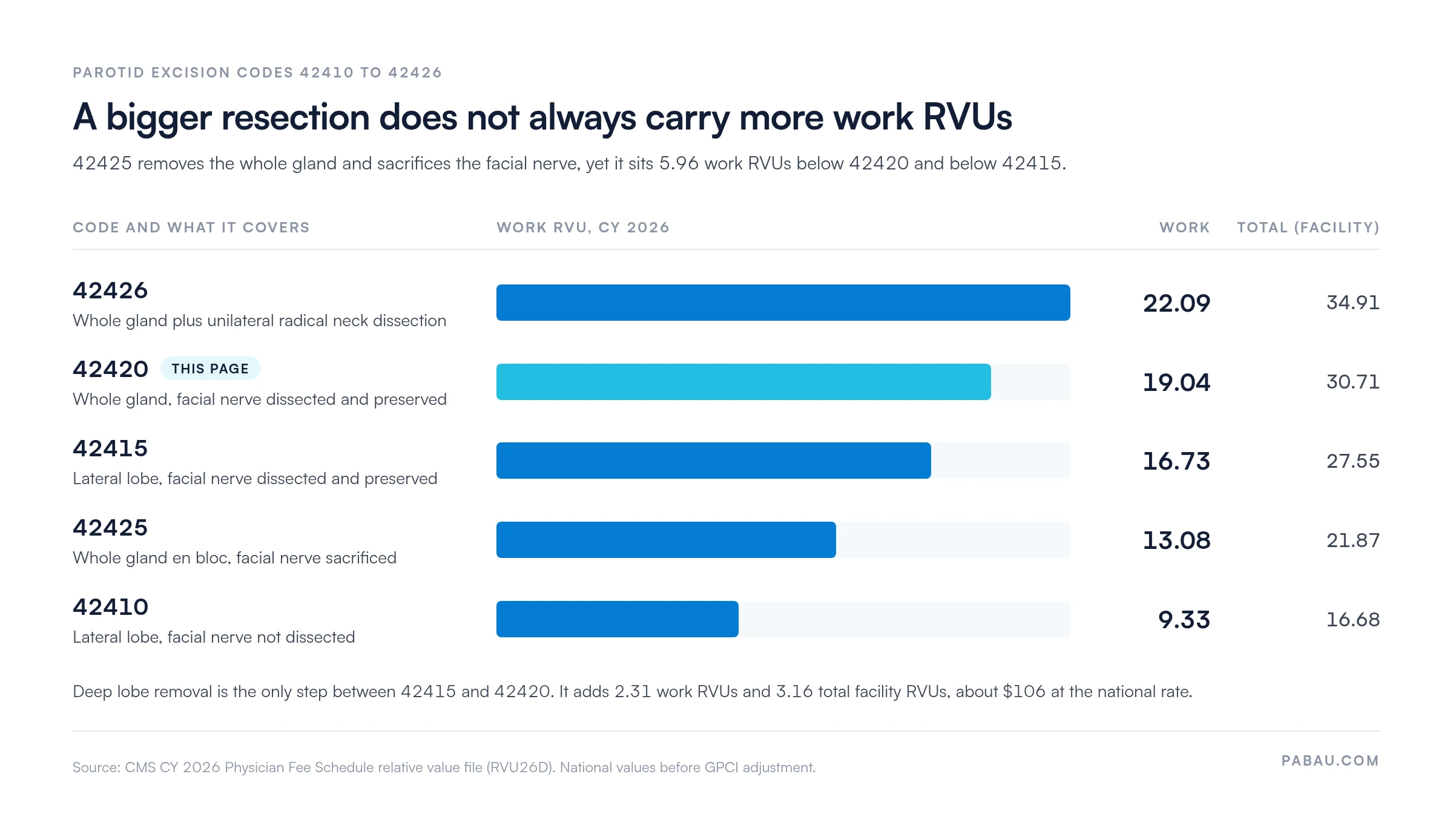
Five codes report parotid excision. Two questions sort them: how much of the gland came out, and what happened to the facial nerve. The RVU values come from the CY 2026 Physician Fee Schedule relative value file.
The critical distinction: 42415 and 42420 both include dissection and preservation of the facial nerve, so the extent of gland removed decides between them. If the deep lobe stayed in place, the case is 42415, however careful the nerve work was.
The RVU ladder also breaks a common assumption. A bigger operation does not always pay more. 42425 removes the gland and sacrifices the nerve, yet it carries 5.96 fewer work RVUs than 42420. The fee schedule values 42425 lower, though the file gives no reason. Ranked by work RVU, the five codes line up like this.
One neighbor is often pulled into this family by mistake. CPT 42408 reports excision of a sublingual salivary cyst (ranula). It is not a parotid code.
Before you code any parotidectomy, find the sentence in the operative note that says what happened to the deep lobe. If the deep lobe stayed, the case is 42415 or 42410, not 42420. If the note is silent, query the surgeon before the claim goes out.
Medical billing compliance for surgical claims means every element of the descriptor is visible in the record. For 42420, the operative note should show:
Auditors look for the deep lobe first. A note that describes careful nerve dissection but never mentions the deep lobe reads as a superficial parotidectomy. That claim is likely to be downcoded to 42415.
Payers check medical necessity by matching the procedure to the diagnosis. The codes below are common pairings, not a coverage guarantee. Confirm current code status in the CDC/NCHS ICD-10-CM tabular list before you submit.
Coding note: a malignant diagnosis does not by itself change the procedure code. If the nerve was preserved, C07 pairs with 42420. If the tumor invaded the nerve and the surgeon sacrificed it, the procedure becomes 42425.
CMS sets Medicare payment for CPT 42420 through the annual Medicare Physician Fee Schedule (MPFS). The values below come from the CY 2026 PFS relative value file (RVU26D, October 2026 release). Payment varies by locality, so treat the national figures as a starting point.
The two conversion factors follow the CY 2026 split between qualifying participants in advanced alternative payment models (QP) and other clinicians. Multiply the total RVUs by the factor that applies to the billing clinician, then apply the locality GPCI.
42415 carries 3.16 fewer total RVUs, about $106 less nationally. That is the amount at stake when a total parotidectomy is documented as a superficial one.
CMS assigns a 90-day global period to CPT 42420. The surgical fee covers related care from the day before surgery through 90 days after it. Understanding medical billing fundamentals such as the global package prevents the most common postoperative error: billing related follow-up visits separately.
Included in the global package:
Billable separately with the right modifier:
Modifiers explain circumstances that the base code cannot. These are the ones that come up most often on 42420 claims.
Prior authorization rules for 42420 depend on the payer and the plan. Check the rule for the current benefit year before you schedule.
Payers usually ask for CT or MRI of the parotid, fine needle aspiration results, and clinical notes explaining why the deep lobe needs removal.
Most 42420 problems trace back to the 42415 boundary. Good denial management starts with knowing these patterns before the claim leaves your system.
When a 42420 claim does come back short, the remittance names the reason in a group code plus a reason code. Look each one up in the denial codes reference before you decide between a corrected claim and an appeal.
Set a payment variance alert in your billing system. Any 42420 claim that pays close to the 42415 rate, about $106 lower nationally, should open a review task. Most of those payments trace back to a note that never mentions the deep lobe.
Most 42420 denials start before the claim is built. The note never mentions the deep lobe, the authorization still says 42415, or nobody checks laterality. Pabau, a practice management and billing platform, keeps the surgical record, the claim, and the payer response in one place. Your team can then run those checks before submission.
Pabau’s claims management software sends the 837P claim through Claim.MD, our US clearinghouse integration. Eligibility checks run before the surgery date, and returned ERAs post payments without manual keying.
Your coders still choose between 42415, 42420, and 42425 from the operative note. Pabau sends the claim they build to the payer and shows how each one was paid. A 42420 claim that pays at the 42415 rate stands out in the remittance instead of slipping past the appeal window.
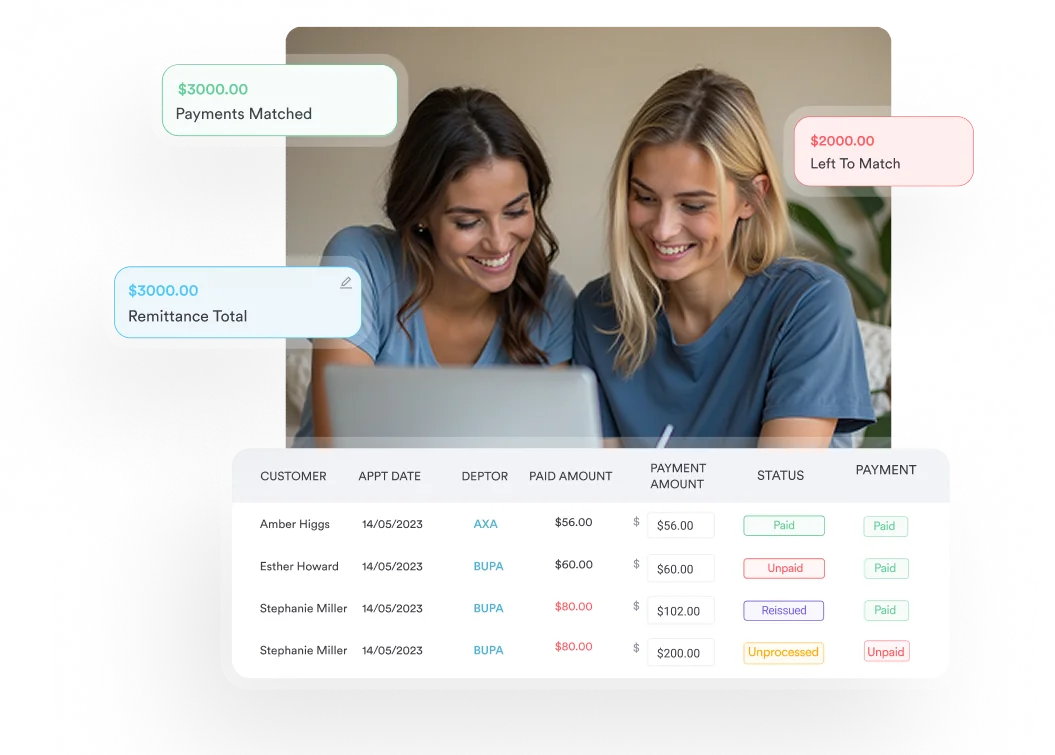

Pabau sends ENT surgical claims through Claim.MD, checks eligibility before the surgery date, and posts returned ERAs automatically. See how Pabau’s claims management keeps 42420 claims moving from submission to posted payment.

Code 42420 only when the operative note puts the deep lobe in the specimen and the facial nerve intact at closure. Careful nerve work with the deep lobe left behind is 42415, and a sacrificed nerve is 42425.
The fix sits upstream of the claim. Correct the 42420 descriptor in your charge master, and query the surgeon whenever a note skips the deep lobe. Each downcode you prevent keeps about $106 per case at the national rate.
Book a demo to see how Pabau carries a surgical claim from eligibility check to posted payment.

Need a clearinghouse for ENT surgical claims? Claim.MD clearinghouse explains how 837P claims, eligibility checks, and ERAs run through one connection.
Confused about the reason codes on a 42420 remittance? Denial codes in medical billing explains the common CARC and RARC codes and how to act on them.
Want to see how the 837P carries your CPT and ICD-10 data? The 837 file explained breaks down each loop and segment relevant to surgical claims.
Coding a malignant parotid tumor? ICD-10 code C07 covers the diagnosis that most often pairs with a total parotidectomy.
CPT code 42420 reports excision of a parotid tumor or parotid gland; total, with dissection and preservation of the facial nerve. It includes the incision, identification of the nerve trunk, dissection of its branches, removal of both lobes, and closure. Nerve monitoring by a separate professional (95940 or G0453), anesthesia, and surgical pathology are billed by those providers.
Both codes report a total parotidectomy. The difference is the facial nerve. CPT 42420 applies when the nerve is dissected and preserved. CPT 42425 applies when the gland is removed en bloc and the facial nerve is sacrificed, usually because a tumor has invaded it.
Both codes include dissection and preservation of the facial nerve. The difference is how much gland is removed. CPT 42415 removes only the lateral (superficial) lobe. CPT 42420 removes the whole gland, including the deep lobe beneath the nerve. If the operative note does not document deep lobe removal, 42415 is the defensible code.
Original Medicare does not require prior authorization for 42420, although medical necessity must be documented. Most commercial payers and many Medicare Advantage plans do require it. Confirm the approval names 42420, and update it if a planned superficial parotidectomy became a total one.
In the CY 2026 Medicare Physician Fee Schedule, CPT 42420 carries 19.04 work RVUs and 30.71 total facility RVUs. At the conversion factors of $33.5675 and $33.4009, that is about $1,030.86 or $1,025.74 nationally, before locality adjustment. CMS does not price the code in a non-facility setting.