

CCSD code G5100: Bypass of duodenum billing guide
CCSD code G5100 bills a bypass that leaves the duodenum in place CCSD code G5100...

Last Updated: Oct 16, 2026
38505 is the CPT code for a needle biopsy of a superficial lymph node, including cervical, inguinal, and axillary nodes. It reports the percutaneous needle approach only, and it carries a 000-day global period, so no post-operative window follows the procedure.
Most denials on this code trace back to approach and depth. A note that describes an open or deep biopsy belongs to 38500, 38510, or 38525 instead. Missing laterality modifiers and imaging guidance billed without its own interpretation report are the other frequent causes.
Let Pabau's smart automation suggest the right codes, reduce claim denials, and keep your practice compliant—effortlessly.
Automate repetitive tasks and focus on what matters most—your patients.
Reduce coding errors and ensure compliance with the latest regulations.
Clean claims, fewer denials, and faster reimbursements.
Powerful insights and reporting to help your practice thrive.
HIPAA compliant SOC 2 certified GDPR-compliant Trusted by 4,000+ clinics worldwide

CPT Code 38505 covers a needle biopsy of a superficial lymph node, and it is separate from the open biopsy codes in the same family.
The 2026 Medicare national average is roughly $170 non-facility and $75 facility, so check your own MAC locality rate before billing.
The global period is 000 days, which means no post-operative window bundles follow-up visits into the procedure payment.
Laterality modifiers and imaging-guidance documentation cause most of the avoidable denials on this code.
Practice management software like Pabau submits finished claims through Claim.MD, with real-time eligibility checks and ERA posting.
CPT Code 38505 is the correct code when a clinician samples a lymph node with a needle at a superficial site. The official AMA descriptor reads: Biopsy or excision of lymph node(s); needle, superficial (eg, cervical, inguinal, axillary).
The code covers the needle approach at superficial sites only. Deep nodes, open dissections, and sentinel-node mapping each carry their own codes. Mixing them up is the most common coding error in this family.
Oncology, general surgery, and infectious disease teams reach for this code most often. The clinical situations behind it are usually one of these four:
When the node sits too deep to reach percutaneously, or the surgeon opens the site, the code changes with it. An open biopsy of the same superficial node belongs to 38500, not this code.
Medicare reimbursement depends on where the service is performed. The CMS Physician Fee Schedule Look-Up Tool is the definitive source for current-year rates. The figures below are 2026 national averages and shift by Medicare Administrative Contractor (MAC) locality.
Both figures are the code’s total RVUs multiplied by the CY2026 conversion factor of $33.4009. That arithmetic is worth running yourself, because it is the quickest way to catch a stale rate in a billing system. MAC localities can push the office rate above $190 in high-cost regions and closer to $150 elsewhere.
Use the FastRVU 2026 RVU lookup to confirm the work, practice expense, and malpractice RVUs behind your own locality rate.
Modifier selection affects both payment and compliance exposure. Using the wrong modifier, or leaving out a required one, is the most common reason this code generates a denial or a medical review request.
Before reaching for -59, check whether a more specific X-modifier fits: XE (separate encounter), XS (separate structure), XP (separate practitioner), or XU (unusual non-overlapping service). The AAPC Codify CPT lookup carries modifier applicability guidance for 38505 that billing staff can check before submission.
The global period for CPT Code 38505 is 000 days. Medicare treats it as a minor procedure, so the payment covers only the related work on the day of the procedure itself. There is no 10-day or 90-day post-operative window attached to this code.
What that changes in practice:
Several widely used coding references still list 010 days for 38505. That single digit decides whether a same-day E/M needs -25. Check the global surgery indicator in the current Medicare relative value file. Build the claim from that, not from a post-operative window this code never had.
Ultrasound guidance (CPT 76942) may be separately reportable when image guidance is used during the biopsy, but it is not automatic. Some payers bundle guidance into the primary procedure payment, particularly for superficial nodes where they treat it as integral to the work.
To support a separate 76942 claim, the record must include real-time sonographic images, a permanent copy of those images, and a written interpretation report. Noting “ultrasound was used” in the operative note is not enough, and it will generate a denial. Check the payer’s local coverage determination (LCD) before unbundling guidance from the biopsy.
Before billing 76942 alongside CPT Code 38505, pull the relevant MAC’s LCD. Confirm whether ultrasound guidance is separately reimbursable for superficial node biopsies in your jurisdiction. What Medicare allows nationally does not always match what an individual MAC permits locally.
Medical necessity is established through the diagnosis codes submitted on the claim. The ICD-10-CM codes below are the pairings that come up most often, based on the clinical indications this procedure supports.
The diagnosis code has to support the clinical rationale in the operative note, because payers cross-reference it against their coverage criteria. Where localized lymphadenopathy is the indication, the coding detail behind R59.0 is worth checking before the claim is built. Coding it for a patient with a known primary malignancy, where the intent is staging, misrepresents the picture and invites an audit.
A lymphoma confirmed through this biopsy can later lead to a donor stem cell transplant. That infusion is billed under 38240 per donor, not with the lymph node biopsy codes.
A complete operative note is non-negotiable for CPT Code 38505. One missing standard element is enough for a payer to downcode or deny the claim. The list below reflects Medicare’s surgical documentation standard and the elements audits cite most often for lymph node biopsy codes.
Reviewing the note against this checklist before submission beats reworking a denial three weeks later. Every missing element delays payment.
Every avoidable denial on this code traces back to one of five decisions made between the operative note and the submitted claim. The sequence below is worth pinning up next to the coding desk.
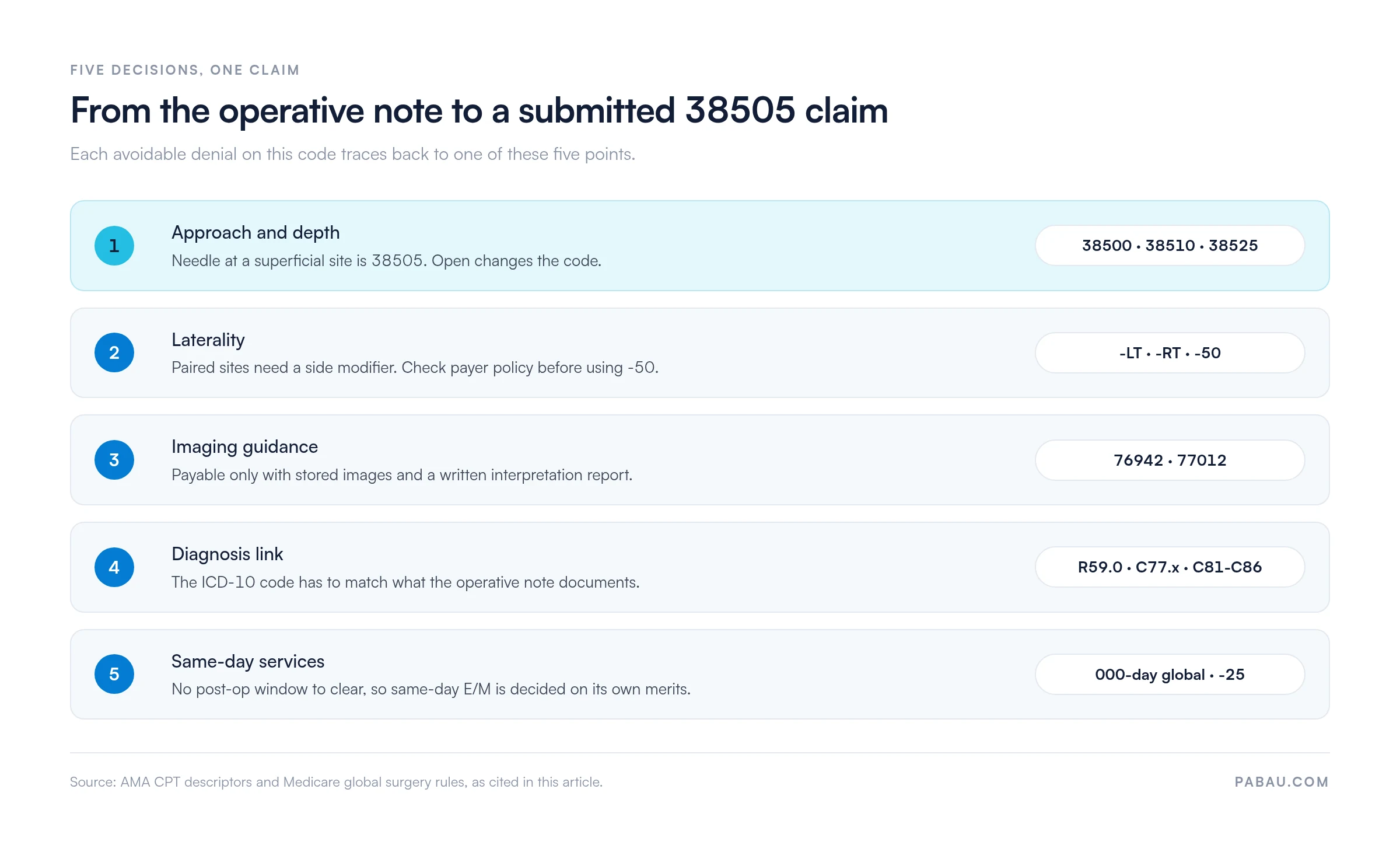
Where rejections keep repeating, sorting them by denial codes shows which of the five decisions is going wrong. That turns a backlog into a training item rather than a monthly rework cycle.
Billing a lymph node biopsy has several moving parts. Modifier selection, imaging-guidance decisions, diagnosis linkage, and documentation checks all have to line up before the claim goes out. Handling that across a separate billing tool is where most of the errors above start.
Practice management software like Pabau keeps the claim in the same record as the appointment and the treatment note. Nobody re-keys a code from one system into another. Pabau’s tools for cleaner claims management run a validation check in the background every time a claim is sent. Completed claims then go out electronically through Claim.MD, the US clearinghouse Pabau integrates with.
From there, each claim’s status moves through five stages, from pending to paid or error. Real-time eligibility checks and electronic remittance advice (ERA) posting run over the same connection. A stalled 38505 claim shows up without opening a separate clearinghouse portal.
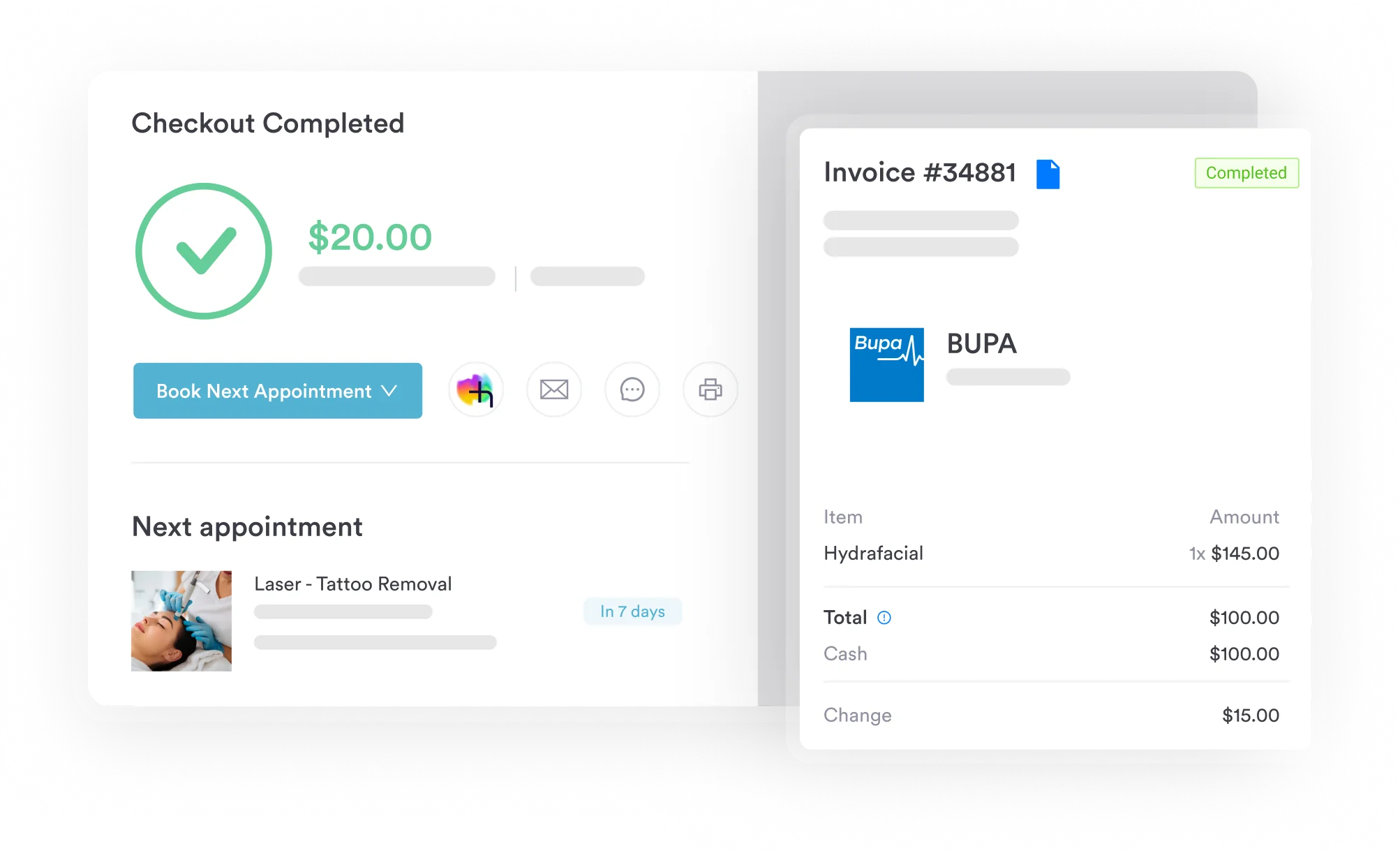
That matters most at the point of resubmission. A denial lands against the record that holds the operative note. The coder can compare what was documented with what was billed, without hunting through a second system.

Pabau runs a validation check on every claim before it goes out, then submits it through Claim.MD with real-time eligibility checks and ERA posting. Your billing team follows each claim from pending to paid in one place.

CPT Code 38505 is a straightforward code with exacting billing dependencies. The approach and depth decide the code, the site decides the modifier, and the documentation decides whether a guidance code survives review. None of that is hard once the sequence is settled.
The detail worth re-checking today is the global period. A 000-day indicator means there is no post-operative window to protect, so the modifiers built for one do not belong on this claim. Anything your billing system inherited from a 010-day assumption is worth auditing this month.
If claim rework is eating your billing team’s week, book a demo to see how Pabau keeps coding, documentation, and submission inside one patient record.

Need to understand how claims move through the system? What is medical billing walks through the end-to-end process from charge capture through payment posting.
Getting repeated denials on surgical claims? Denial management in healthcare covers how to categorize, appeal, and prevent recurring rejections by code family.
Want to verify payer rules before submitting? Insurance eligibility verification explains how real-time eligibility checks surface payer-specific modifier and bundling rules before the claim is built.
CPT Code 38505 is the procedure code for a needle biopsy of a superficial lymph node, including cervical, inguinal, and axillary nodes. It reports the percutaneous needle approach specifically. Open lymph node biopsies use different codes: 38500 for open superficial, 38510 for open deep cervical, and 38525 for open deep axillary.
CPT 38505 covers a needle biopsy of a superficial node, while CPT 38525 covers an open excision of a deep axillary lymph node. The approach and the depth are the defining differences. Using the needle code when the operative note describes an open procedure is an error auditors identify quickly.
The global period for CPT Code 38505 is 000 days. Medicare treats it as a minor procedure, so the payment covers only related work on the procedure date and there is no post-operative window. Follow-up visits after that date are separately billable. A significant, separately identifiable E/M service on the same date is reported with modifier -25.
The most common pairings are R59.0 (localized enlarged lymph nodes) and R59.1 (generalized enlarged lymph nodes). The C77.x series covers secondary and unspecified malignant neoplasm of lymph nodes by region. Lymphoma staging uses codes from the C81-C86 range. The diagnosis code has to match the clinical rationale documented in the operative note.



