CCSD Code S5322: Injection of therapeutic substance into keloid scar
CCSD Code S5322: definition and clinical description CCSD Code S5322 is the proc...

Last Updated: Nov 13, 2026
37609 is the CPT code for ligation or biopsy of the temporal artery. One unilateral code covers both procedures, and most claims come from biopsies that confirm or rule out giant cell arteritis.
The code carries a 10-day global period. The pathologist bills the specimen examination separately with CPT 88305, and a bilateral biopsy takes modifier 50 on Medicare claims.
Let Pabau's smart automation suggest the right codes, reduce claim denials, and keep your practice compliant—effortlessly.
Automate repetitive tasks and focus on what matters most—your patients.
Reduce coding errors and ensure compliance with the latest regulations.
Clean claims, fewer denials, and faster reimbursements.
Powerful insights and reporting to help your practice thrive.
HIPAA compliant SOC 2 certified GDPR-compliant Trusted by 4,000+ clinics worldwide

CPT code 37609 covers both ligation and biopsy of the temporal artery under a single unilateral code.
ICD-10-CM M31.6 (Other giant cell arteritis) is the primary diagnosis paired with 37609, with M31.5 and R68.89 as secondary options.
Surgical pathology (CPT 88305) is not bundled with 37609. The pathologist bills it separately when a biopsy specimen goes to pathology.
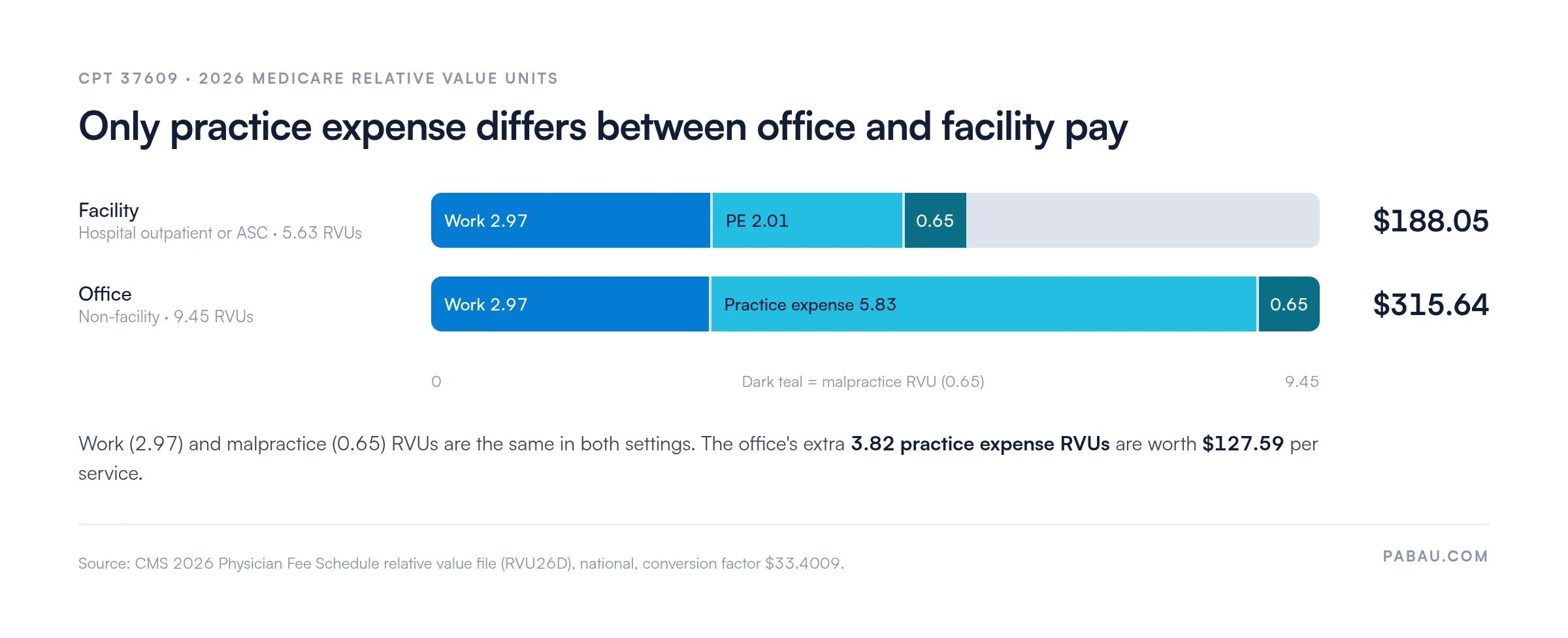
Medicare pays $315.64 for 37609 in the office and $188.05 in a facility in 2026, and the difference comes entirely from practice expense RVUs.
Pabau, the practice management and billing platform we build, submits 37609 claims electronically through the Claim.MD clearinghouse.
CPT code 37609 reports ligation or biopsy of the temporal artery, two procedures that share one code. CMS lists it in its 2026 Physician Fee Schedule relative value file as “Ligation/bx temporal artery,” with a 10-day global period. Both procedures sit under one code because they involve the same vessel and a similar level of surgical work.
The two variants are not separately reportable. Whether the surgeon performs an open excisional biopsy of a temporal artery segment or ligates the vessel to control hemorrhage, 37609 is the correct code. The procedure is unilateral by default, so each side of the head is a separate service.
Understanding the operative steps helps coders verify that the operative note contains the documentation elements needed for a clean claim. The biopsy variant drives the overwhelming majority of 37609 volume, so this section focuses on that procedure while noting where the ligation technique differs.
The operative note must state which procedure was performed (ligation or biopsy), the laterality, the anesthesia used and where the specimen went. For a biopsy, it also gives the length of the excised segment. Missing any of these elements is a common audit trigger.
Payers require specific documentation to establish medical necessity and confirm the service matches the billed code. They look closely at 37609 claims, because temporal artery biopsy pays relatively well for a brief outpatient procedure.
The following elements must appear in the medical record for a defensible 37609 claim.
A clean claim submission for 37609 pairs these documentation elements with the correct ICD-10 code and place of service. All of it is in place before the claim leaves the practice. Once a denial is in progress, missing documentation can only be added through a formal appeal.
Run a five-point check before submitting any 37609 claim. Confirm the operative note states the procedure variant (ligation or biopsy), the laterality and the specimen disposition. It should also give the segment length for a biopsy and the ESR or CRP value behind the clinical indication.
The ICD-10-CM diagnosis code paired with 37609 must reflect the clinical indication documented in the medical record. Giant cell arteritis (GCA) is the most common indication, and M31.6 is the standard pairing for confirmed or suspected GCA. Assigning M31.6 without supporting documentation of GCA diagnostic criteria risks claim denial and audit exposure.
The American College of Rheumatology (ACR) classification criteria for GCA inform what payers accept as clinical justification for M31.6. The 1990 ACR criteria classify a patient as having GCA when at least three of these five findings are present.
In the original study, three or more of the five findings gave 93.5% sensitivity and 91.2% specificity. Use R68.89 when the biopsy is diagnostic in intent but the GCA diagnosis has not yet been confirmed in the record.
Medicare reimbursement for CPT code 37609 is determined by the Medicare Physician Fee Schedule (MPFS) published annually by the Centers for Medicare and Medicaid Services. Payment rates vary by place of service and by geographic adjustment factor (GAF). The figures below are 2026 national unadjusted rates at the $33.4009 conversion factor. Verify locality-specific amounts in the CMS Physician Fee Schedule Look-Up Tool before quoting rates to providers.
Rates change each January with the annual MPFS update. Use the FastRVU lookup tool to estimate locality-adjusted payment for your area. The office rate is higher because its practice expense (PE) RVUs cover the overhead of running the procedure room. In a hospital or ASC, the facility bills that overhead on its own claim.
Work and malpractice RVUs are identical in both settings, so the whole $127.59 difference sits in practice expense, as the chart below shows.
Bilateral temporal artery biopsy occurs when GCA is suspected but the first biopsy returns a negative result. Because GCA can affect arteries in a skip-lesion pattern, clinicians sometimes biopsy both temporal arteries to increase diagnostic yield. Each side is a separate reportable service.
Confirm payer-specific bilateral billing rules before submission. The Medicare Claims Processing Manual covers modifier 50 in Chapter 12. Medicare Advantage plans may follow different instructions than traditional Medicare.
Traditional Medicare does not typically require prior authorization for CPT 37609 when medical necessity is documented. Medicare Advantage plans and commercial insurers commonly do require prior auth. Requirements vary by plan, so treat the following as a general framework.
Routine insurance eligibility verification before scheduling the procedure should include a check for prior authorization requirements. Payers that require prior auth for 37609 generally demand the following clinical criteria in the authorization request.
When authorization is denied on initial request, appeal with ACR classification criteria evidence and a letter of medical necessity from the treating rheumatologist or ophthalmologist. Citing the published GCA criteria gives the reviewer a standard to check the chart against, which a generic necessity letter does not.
Several codes are misapplied when billing temporal artery procedures. The table below shows the four most common confusion points, with the clinical scenario where each code applies.
The 88305 error is the most financially significant. When the surgeon sends a biopsy specimen to pathology, the pathologist’s gross and microscopic examination is billed as CPT 88305. NCCI edits do not bundle 88305 with 37609, because different providers perform the two services. The surgeon never bills 88305. The pathology group or hospital laboratory bills it on its own claim.
Denials for CPT 37609 cluster around four recurring problems. Each has a corrective action that can be implemented before the claim is submitted. Reactive denial management takes far longer than a documentation review before submission.
CPT code 37609 carries a 10-day global period under the Medicare global surgical package. This means routine postoperative care services provided within 10 days of the procedure date are bundled into the 37609 payment and cannot be billed separately.
Global period rules are a frequent source of audit findings on outpatient surgical procedures. The 10-day global for 37609 is short next to a major surgery’s 90 days. It still causes denials when billing teams overlook it. Check the global period each year in the CMS MPFS, because CMS occasionally reclassifies procedures.
Each denial above traces back to a field the operative note left out or a modifier the claim never got. Catching them by hand means re-reading every note against each payer’s rules before the claim goes out.
Pabau’s claims management software flags missing documentation fields before submission. It also tracks each rejection against its medical billing denial codes, so your team can spot patterns and fix the workflow upstream.
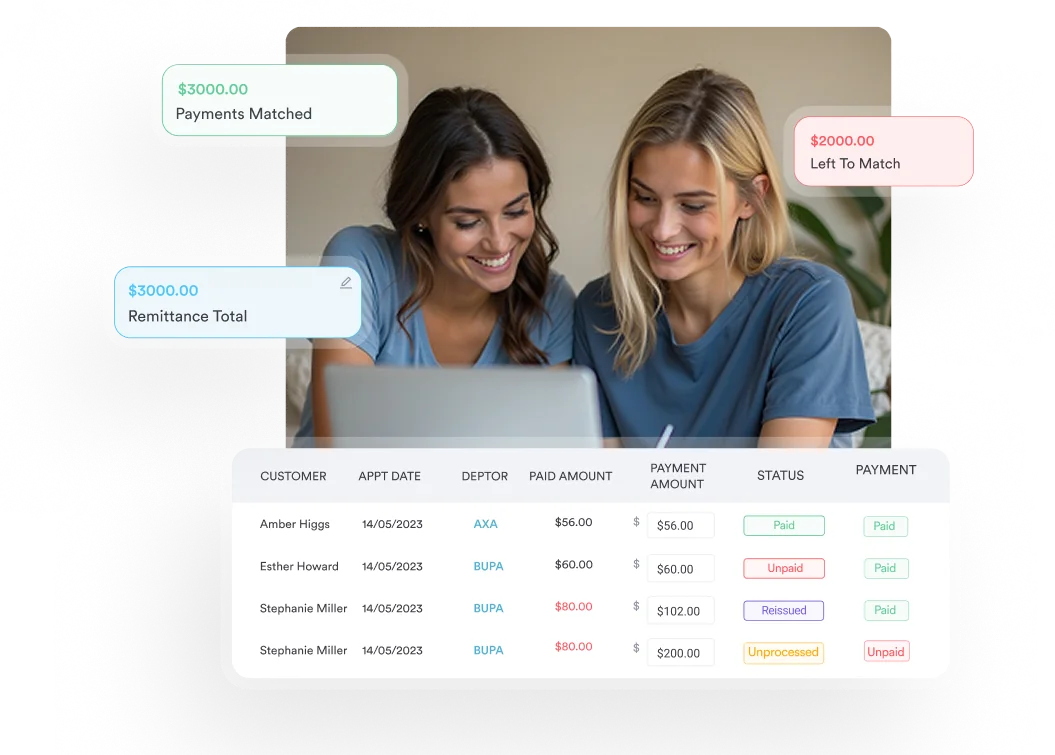
Claims go out through Claim.MD, the clearinghouse Pabau integrates with, in CMS-1500 and 837P electronic formats. Claim.MD reaches thousands of US payers, including Medicare and Medicare Advantage plans. Our Claim.MD clearinghouse guide explains how that routing works.
A clean 37609 claim is mostly decided before the patient reaches the procedure room. Check prior authorization during eligibility verification, and make sure the chart already holds the ESR or CRP value and the symptoms behind the GCA suspicion.
After the procedure, the operative note has to name the variant, the side and where the specimen went. Match the bilateral approach to each payer’s rules, and hold follow-up visits against the 10-day global. Those habits cost minutes per claim, while an appeal costs weeks.
Book a demo to see how Pabau flags missing documentation on each 37609 claim before it reaches the payer.
CPT code 37609 is the procedure code for ligation or biopsy of the temporal artery. One code covers both a surgical tie-off (ligation) and an open excisional biopsy of the superficial temporal artery. It is used most commonly to diagnose giant cell arteritis (GCA) through histopathological examination of the excised arterial segment.
Yes. The AMA CPT descriptor for 37609 explicitly includes both ligation and biopsy of the temporal artery as reportable under the same code. The two variants are not separately reportable; both are reported with 37609 regardless of which technique the surgeon performed.
Yes, 37609 can be billed bilaterally when both temporal arteries are operated on. Medicare accepts modifier 50 appended to a single claim line (37609-50); some commercial payers require two separate lines with laterality modifiers 37609-LT and 37609-RT. Check your specific payer’s billing manual before submitting.
ICD-10-CM M31.6 (Other giant cell arteritis) is the primary diagnosis paired with 37609 for confirmed or strongly suspected GCA. M31.5 applies when GCA co-presents with polymyalgia rheumatica. Use R68.89 when the biopsy is diagnostic in intent but the GCA diagnosis has not yet been confirmed.
No. CPT 88305 is separately billable when a biopsy specimen is sent to pathology for gross and microscopic examination. NCCI edits do not bundle 88305 with 37609. The pathology group or hospital laboratory bills 88305 on a separate claim; the operating surgeon does not bill it.
CPT code 37609 carries a 10-day global period under the Medicare global surgical package. Routine postoperative visits and wound care within those 10 days are bundled into the procedure payment. Visits for unrelated conditions within the global window require modifier 24 and clear documentation of the unrelated reason.
The most common reason is thin documentation of GCA medical necessity, such as missing ESR or CRP values or symptom notes. Others are missing prior authorization from Medicare Advantage or commercial payers, and bilateral claims sent without modifier 50 or LT/RT modifiers. E&M visits billed inside the 10-day global period without modifier 24 also get denied. Reviewing the claim against a documentation checklist before submission prevents most of these.