CCSD code H4430: Examination of rectum under anaesthetic
CCSD code H4430 pays for the examination alone CCSD code H4430 is the UK private...

Last Updated: Oct 20, 2026
J2783 is the HCPCS Level II code for injection, rasburicase, 0.5 mg.
Let Pabau's smart automation suggest the right codes, reduce claim denials, and keep your practice compliant—effortlessly.
Automate repetitive tasks and focus on what matters most—your patients.
Reduce coding errors and ensure compliance with the latest regulations.
Clean claims, fewer denials, and faster reimbursements.
Powerful insights and reporting to help your practice thrive.
HIPAA compliant SOC 2 certified GDPR-compliant Trusted by 4,000+ clinics worldwide

HCPCS code J2783 covers injection, rasburicase, 0.5 mg, the recombinant urate oxidase sold as Elitek.
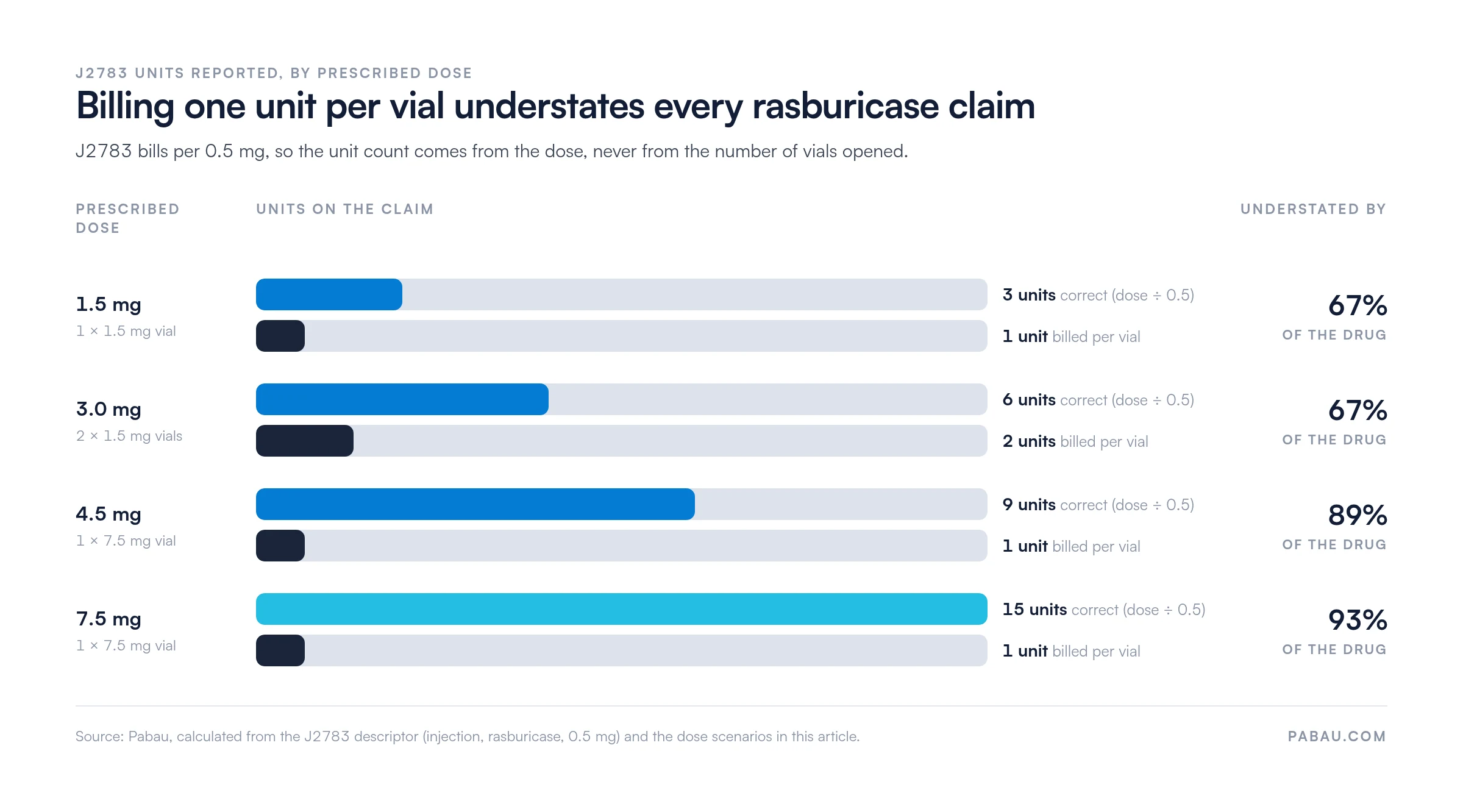
J2783 bills per 0.5 mg, so a 7.5 mg dose is 15 units on the claim.
Medicare Part B pays J2783 at ASP plus 6%, and the amount changes every quarter.
Rasburicase comes in single-dose vials, so each claim needs modifier JW for discarded drug or JZ when none is discarded.
Practice management software like Pabau keeps the treatment note and the charge on one patient record, so coders bill from complete documentation.
HCPCS code J2783 is the Level II code for injection, rasburicase, 0.5 mg. It sits within the J-code category (drugs administered other than by oral method), maintained by CMS under the HCPCS Level II coding system. It also covers each 0.5 mg increment of rasburicase, regardless of vial size or route concentration.
Understanding what rasburicase does helps billing teams document medical necessity correctly. Rasburicase is a recombinant urate oxidase enzyme, FDA-approved for managing plasma uric acid levels in pediatric and adult patients receiving chemotherapy for hematologic malignancies. In fact, it addresses tumor lysis syndrome (TLS), a serious metabolic complication where rapid cancer cell death floods the bloodstream with uric acid.
Elitek is administered intravenously, typically in an oncology infusion center or hospital outpatient department. Rasburicase is a physician-administered drug under Medicare Part B, so it falls under the buy-and-bill model. The practice or infusion center purchases the drug, administers it, and bills the payer for reimbursement.
HCPCS code J2783 is billed per 0.5 mg of rasburicase. The prescribed dose is divided by 0.5 to calculate the number of units to report on the claim. For example, a prescriber ordering 7.5 mg requires 15 units of J2783. In short, getting this calculation wrong is the single most common source of J2783 billing errors.
The size of the error scales with the dose. On a 7.5 mg administration, a per-vial count reports 1 unit instead of 15.
Bill only for the dose actually administered. Rasburicase ships in single-dose vials, so Medicare expects a discarded-drug modifier on the claim. Report the administered units on the primary line, then report any wasted units on a second line with modifier JW.
When nothing is discarded, append modifier JZ to the J2783 line instead. CMS has required JZ as an attestation on single-dose container claims since July 2023. Commercial payers vary, so confirm which of the two each one expects before you submit.
Medicare Part B reimburses HCPCS code J2783 using the Average Sales Price (ASP) methodology. The standard outpatient rate is ASP plus 6%, paid to the billing entity (the oncology practice or infusion center) under the buy-and-bill model. CMS updates ASP payment limits quarterly, so any dollar figure published outside the official CMS files may already be out of date. Pull the current amount from the CMS ASP drug pricing files. The Physician Fee Schedule lookup will not help here, because it covers RVU-based service rates rather than Part B drug pricing.
Put the rate check on the billing calendar. CMS posts a new ASP file every January, April, July, and October. Refresh the J2783 rate in your fee schedule in the first week of each quarter. As a result, a stale rate underpays or overpays every claim filed against it.
CMS requires that outpatient claims for physician-administered drugs include the National Drug Code (NDC) in addition to the J-code. Specifically, for J2783, the NDC on the claim must match the rasburicase product administered. That means the labeler, product, and package configuration all have to line up.
Elitek comes in two vial configurations, 1.5 mg and 7.5 mg, and each carries its own NDC codes. The NDC reported must match the vial actually dispensed, not the J-code descriptor. Package codes change when the manufacturer updates packaging, so check the carton or the FDA NDC directory at the time of dispensing.
On the CMS-1500 claim form, the NDC goes in the shaded area of box 24. Report it in the 11-digit 5-4-2 format, with the unit qualifier “UN” and the number of units dispensed. As a result, missing or incorrect NDC information is a primary denial trigger for J2783 claims.
Payers require a supported ICD-10-CM diagnosis code to establish medical necessity for J2783. Coverage varies by Local Coverage Determination (LCD) or National Coverage Determination (NCD). Specifically, the diagnoses below are those most commonly accepted under Medicare and commercial plans. Verify covered diagnoses against your payer’s specific LCD before billing.
Always report the most specific malignancy or metabolic code available, not a generic one. Payers cross-check the diagnosis against the clinical notes filed with the claim. As a result, a mismatch between the chart and the code reported is a fast path to denial. Run a pre-bill diagnosis audit on every high-cost drug claim, and confirm each entry against the current ICD-10-CM code set.
Run a quarterly diagnosis code crosswalk for J2783. Pull every claim filed in the prior 90 days, then match each ICD-10 code to its clinical note. Any claim where the diagnosis code is less specific than the chart documentation is a denial waiting to happen. Flag these for coder review before payers find them on audit.
Medicare does not require prior authorization for most Part B drugs, including rasburicase, under the standard fee-for-service program. Commercial payers, Medicare Advantage plans, and Medicaid managed care organizations, however, almost universally require prior authorization before administering Elitek.
So, verifying the patient’s benefits before the infusion is scheduled is the first gate against a retroactive denial. For commercial payers, typical prior authorization documentation includes:
Prior authorization requirements vary by payer and change without advance notice. Verify current requirements directly with each payer before each course of treatment. Still, do not assume that an approved prior auth from a previous cycle covers the current one.
A J2783 claim turns on four fields: place of service code, NDC, units, and modifier selection. Check all four before the claim leaves the practice, rather than after the remittance advice comes back. On a drug this expensive, a corrected claim costs weeks of cash flow.
Submit on CMS-1500 for physician office and freestanding infusion center settings. Instead, hospital outpatient departments use the UB-04. For electronic submissions, the 837P transaction set handles professional claims. Also, confirm your clearinghouse maps NDC data correctly in loop 2410. Cross-check the descriptor and modifiers against the AAPC HCPCS code reference before you submit.
Rasburicase denials follow predictable patterns, and most are avoidable with pre-submission controls. In fact, the error types below account for the majority of J2783 rejections.
Consistent denial management catches most of these before claims leave the practice. When a denial does arrive, read the Claim Adjustment Reason Code on the remittance advice. The CARC tells the biller whether the problem was the unit count, the NDC, or the diagnosis linkage.
Set a billing rule in your claims software to flag any J2783 claim where units are fewer than 3. A dose below 1.5 mg of rasburicase is extremely rare in clinical practice. If that flag fires, it almost always means someone billed 1 unit per vial instead of per 0.5 mg. Catching this pre-submission saves the rework of a corrected claim.
Oncology infusion billing involves layering multiple codes on a single claim. J2783 covers the rasburicase drug only. The infusion administration itself is billed separately using the appropriate CPT code. As a result, understanding the full code set prevents undercoding and reduces the likelihood of bundling denials.
An accurate superbill is what holds these codes together. It has to carry the drug code, the administration code, and the visit code, each with its own units and charge. Reconcile it against the infusion record before the coder builds the claim, so the drug units and the administration time agree.
Most J2783 unit errors start away from the billing screen. The infusion is written up in one place and the vial and dose recorded in another. The coder then rebuilds the claim from whichever record is easiest to read.
Pabau is practice management software that keeps the treatment note, the stock used, and the invoice on the same patient record. When a biller opens the encounter, the dose administered and the charge line sit side by side. As a result, that makes the per-0.5 mg unit count something to check against the record, not something to reconstruct.
Pabau also handles medical claims management from that same record, submitting and tracking insurance claims in one place. As a result, your team can see which claims are still outstanding without opening a separate portal.

Pabau links the treatment note, the stock used, and the invoice on the same patient record. Your billing team works from one source instead of three, and every charge traces back to what was documented.

Accurate J2783 billing comes down to four habits. Calculate units from the dose rather than the vial, and match the NDC to what was dispensed. Finally, support the claim with a specific diagnosis, and confirm prior authorization before every commercial administration.
Build those four checks in once and they carry over to every other high-cost drug the practice bills. The work sits at submission, where a fix costs minutes, instead of at appeal, where it costs weeks. Book a demo to see how Pabau keeps infusion notes, charges, and claims on one patient record.

Want to reduce drug claim denials across your practice? Denial management in healthcare covers the workflows and tracking systems that prevent recurring rejection patterns.
Need a foundation for compliant drug billing documentation? Medical billing fundamentals explains the full claim lifecycle from patient intake to reimbursement.
Looking to strengthen your overall revenue cycle? Revenue cycle management breaks down the end-to-end process for practice-based billing teams.
HCPCS code J2783 is the Level II billing code for injection, rasburicase, 0.5 mg. It covers Elitek (rasburicase), a recombinant urate oxidase enzyme used to manage hyperuricemia and tumor lysis syndrome in patients receiving chemotherapy for hematologic malignancies. The code is maintained by CMS under the HCPCS Level II J-code category for drugs administered other than by oral method.
J2783 is reported per 0.5 mg of rasburicase administered. To calculate units, divide the total dose in milligrams by 0.5. A 7.5 mg dose requires 15 units; a 3 mg dose requires 6 units. Billing one unit per vial instead of per 0.5 mg is the most common unit error on rasburicase claims.
J2783 maps to Elitek (rasburicase) NDC codes for both the 1.5 mg/vial and 7.5 mg/vial configurations from Sanofi-Aventis. The exact NDC must match the specific vial dispensed. Always verify current NDC numbers against the product label or FDA NDC directory at time of dispensing, as codes can change with lot updates.
Yes. Under Medicare Part B, Elitek billed as HCPCS code J2783 is reimbursed through the buy-and-bill model. The oncology practice or infusion center buys the drug, administers it, and bills the payer using J2783. Commercial payer contracts may use different pricing methodologies.