

HCPCS Code Q4175: Billing, coverage, and documentation guide
HCPCS Code Q4175: Code Description and Product Identity HCPCS Code Q4175 is the ...

Last Updated: Nov 20, 2026
26145 is the CPT code for synovectomy, tendon sheath, radical (tenosynovectomy), flexor tendon, palm and/or finger, each tendon. The surgeon excises inflamed or proliferative synovium from the sheath, and each tendon is reported on its own line.
Most denials on this code come from one of three documentation failures. The operative note may describe a simple incision rather than radical excision. The coder may bill 26055 on the same digit, although the CCI edit bundles it into 26145. Or the ICD-10 diagnosis may not support medical necessity.
Let Pabau's smart automation suggest the right codes, reduce claim denials, and keep your practice compliant—effortlessly.
Automate repetitive tasks and focus on what matters most—your patients.
Reduce coding errors and ensure compliance with the latest regulations.
Clean claims, fewer denials, and faster reimbursements.
Powerful insights and reporting to help your practice thrive.
HIPAA compliant SOC 2 certified GDPR-compliant Trusted by 4,000+ clinics worldwide

CPT code 26145 reports radical synovectomy (tenosynovectomy) of a flexor tendon sheath in the palm and/or finger, billed once per tendon.
CPT 26055 is a CCI component of 26145 and cannot be billed separately on the same digit at the same encounter.
Operative notes must explicitly document radical or extensive synovial excision, not just incision or release, to support medical necessity.
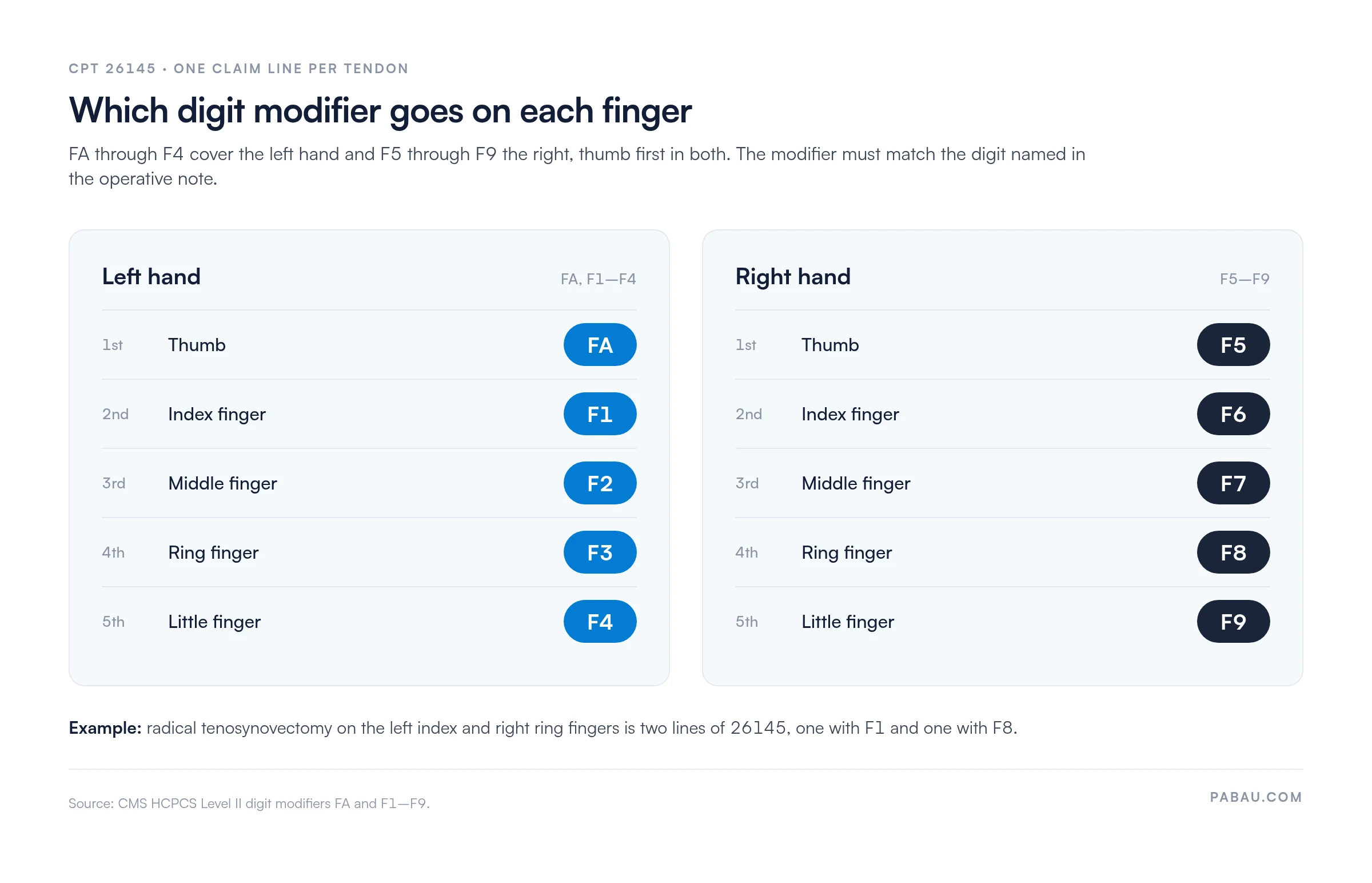
Each tendon goes on its own claim line with the digit modifier for that finger, FA through F9.
Pabau, a practice management platform, sends CPT 26145 claims electronically through Claim.MD and flags denied claims for rework.
CPT code 26145 describes: Synovectomy, tendon sheath, radical (tenosynovectomy), flexor tendon, palm and/or finger, each tendon.
The CPT code set is maintained by the AMA’s CPT Editorial Panel. It places 26145 in the Musculoskeletal System, Hand and Fingers subsection, under excision procedures. The key word in the descriptor is “radical,” which separates this code from a simple tendon sheath incision (CPT 26055). A note without radical-excision language is the documentation problem payers cite most often on audit.
The table below summarizes the core administrative data billers need before submitting a claim.
CPT code 26145 covers an open surgical excision of inflamed or proliferative synovial tissue lining a flexor tendon sheath in the palm or finger. Radical means the surgeon removes synovium extensively rather than simply incising the sheath to relieve constriction. Indications include chronic inflammatory tenosynovitis, rheumatoid arthritis (RA) with tendon involvement, and cases where conservative management (corticosteroid injections, splinting) has failed over a documented period.
Three clinical scenarios support this code:
The descriptor applies per tendon. If the surgeon performs radical tenosynovectomy on two separate fingers in the same session, two units of CPT code 26145 may be reported. Each unit carries the F-modifier that identifies its digit.
CPT 26055 covers tendon sheath incision only, while CPT code 26145 covers radical synovial excision. The distinction determines correct code selection and CCI bundling compliance.
CCI bundling rule: Under National Correct Coding Initiative (NCCI) edits, 26055 is a component of CPT code 26145 for the same digit and session. Billing both together without a valid modifier indicator override results in automatic denial of 26055. Verify the current column 1/column 2 edit pair status and modifier indicator in the CMS Physician Fee Schedule NCCI tables, as edits update annually.
A mismatched diagnosis code is the leading cause of medical necessity denials on CPT code 26145. The diagnosis must reflect chronic or inflammatory tenosynovitis requiring radical excision, not simply a triggering episode that would justify 26055 alone.
Confirm all codes are valid in the current ICD-10-CM edition using the official CDC ICD-10-CM files. On every M65.3x code, digit and laterality are in the 5th and 6th characters, so code to the documented finger and hand. Submitting M65.30 (unspecified) when the operative note identifies the exact finger signals incomplete documentation.
The work RVU for CPT code 26145 is approximately 6.33 wRVUs per available fee schedule data. Verify this figure against the current CMS Medicare Physician Fee Schedule (MPFS) data file before billing, as RVU values update annually. The FastRVU 2026 lookup tool provides facility and non-facility payment calculations based on the current CMS data file.
Payment amounts vary by Medicare locality due to the Geographic Practice Cost Index (GPCI). A practice in San Francisco will receive a different payment for CPT code 26145 than one in rural Mississippi. Always use the locality-specific calculation from the CMS MPFS search tool rather than applying a national average. Facility rates (hospital outpatient, ASC) differ from non-facility office rates because practice expense RVUs are lower when overhead is absorbed by the facility.
Run your 26145 reimbursement calculation using the CMS Physician Fee Schedule search tool at cms.gov, selecting your specific Medicare locality. Third-party calculators often lag CMS updates by weeks. The official CMS file is the authoritative source for fee schedule amounts.
CMS Medically Unlikely Edits (MUEs) cap the number of units a provider can bill per claim line for CPT code 26145. The current MUE value must be verified against the CMS MUE table, as values change periodically without advance notice. Billing units above the MUE trigger automatic rejection without additional documentation.
The billing unit is per tendon, not per digit or per hand. This distinction matters for multi-digit or multi-tendon procedures:
The digit modifiers follow a fixed order across both hands, thumb first. Radical tenosynovectomy on the left index and right ring fingers, for example, goes on two lines of 26145 with F1 and F8.
Modifier selection on CPT code 26145 affects payment, audit risk, and claim acceptance. The table below covers the modifiers coders encounter most frequently on hand surgery claims.
The operative note is the primary audit document for CPT code 26145. Payers look for language that confirms the procedure met the descriptor’s “radical” standard. A note that reads “trigger finger release with incision of A1 pulley” supports 26055, not 26145, regardless of what code is billed. Ensuring a clean claim starts with confirming the operative note language before submission.
These elements must be present in the operative documentation:
Medicare does not universally require prior authorization for CPT code 26145, but many Medicare Advantage plans and commercial payers do. The American Medical Association’s CPT coding resources recommend confirming authorization status per payer and plan year before scheduling the procedure.
Key payer considerations for hand surgery practices:
Routine insurance eligibility verification before the procedure date confirms authorization status while there is still time to obtain it. That keeps a missing PA from turning into a post-service denial.
Multi-procedure hand surgery sessions require careful CCI edit review before submitting CPT code 26145 on the same claim as adjacent codes. The bundling rules are not intuitive, and several common pairings trip up experienced coders.
CPT code 26145 has a narrow clinical scope. Each denial reason below traces to a documentation or coding error that can be fixed before claim submission.
Tracking denial management workflows at the code level lets billing teams spot patterns, such as one payer rejecting 26145 without PA. The team can then fix the cause once instead of appealing case by case. Understanding the specific CARC denial codes returned on 26145 rejections helps the team triage appeals with the right supporting documentation.
Before submitting a 26145 claim, run five checks. Confirm the operative note uses ‘radical excision’ language and that no 26055 sits on the same digit and date. Check that the F-modifier matches the digit in the operative report, confirm MUE units, and verify PA status with the payer. Together they cover five of the six denial reasons in the table above.
The 260xx-261xx range contains several codes that hand surgery billers encounter alongside CPT code 26145. Knowing the adjacent codes prevents both under-coding and unbundling errors.
Without a connected system, a biller checks each 26145 claim by hand across separate tools: the operative note, the payer portal, and the clearinghouse. A missed step only shows up weeks later as a denial.
Pabau’s claims management software sends claims electronically through the Claim.MD clearinghouse. It routes claims to thousands of US payers with real-time eligibility checks, so coverage problems surface before the procedure date.
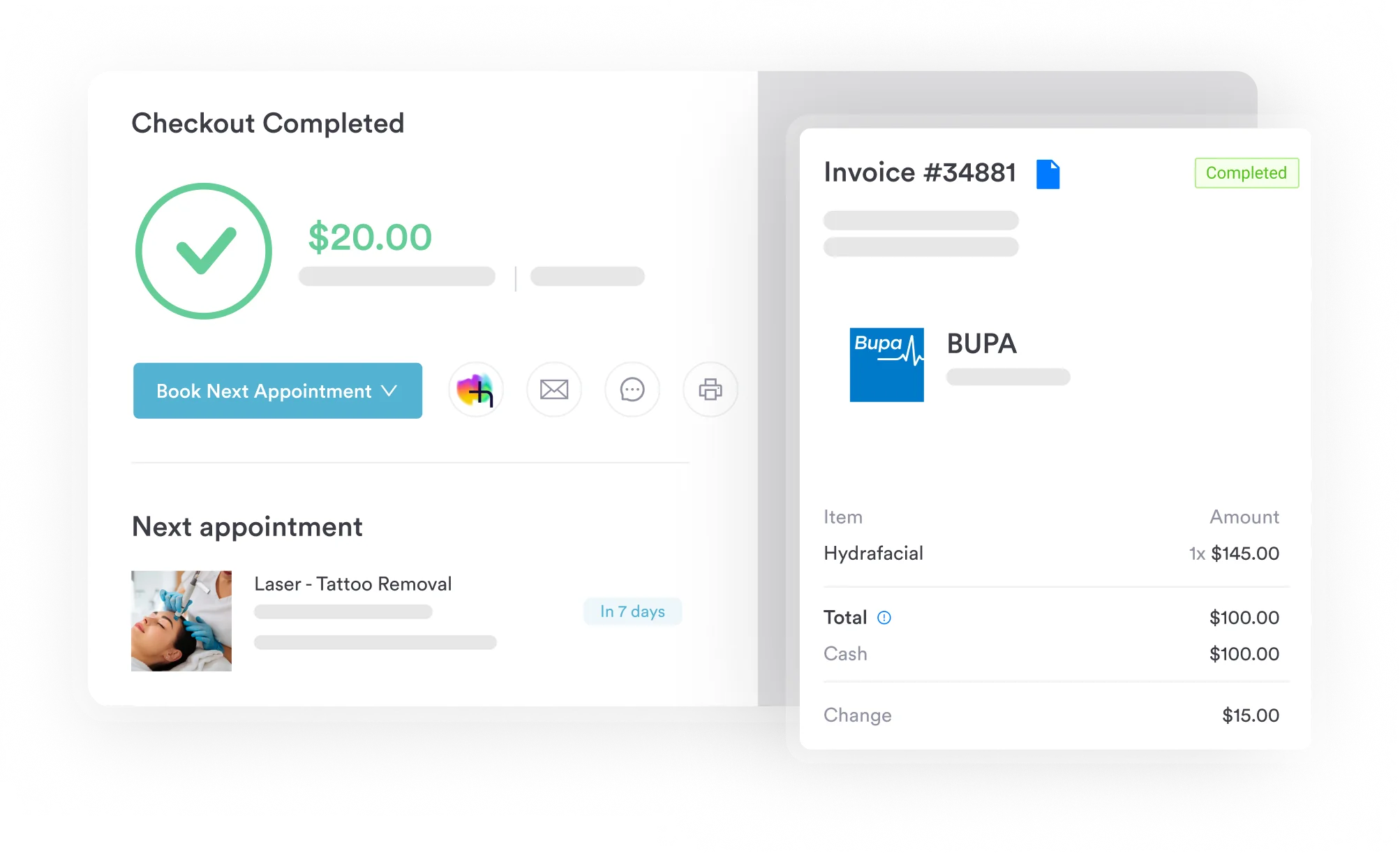
Denied claims are flagged for rework, so the billing team can correct and resubmit a returned 26145 claim from the same patient record. Multi-digit cases stay traceable line by line, each with its own F-modifier.

Pabau sends CPT 26145 claims electronically through Claim.MD, checks eligibility in real time, and flags denied claims for rework.

CPT code 26145 pays for radical work, so the claim has to prove radical work. Two words in the operative note, “radical excision” versus “incision,” often decide approval. The other deciding factor is whether the coder drops 26055 from the same digit before submission.
Build both checks into the pre-submission routine, and give every tendon its own line and F-modifier. Pabau’s claims workflows run on the Claim.MD clearinghouse, with electronic submission, real-time eligibility checks, and denied claims flagged for rework. Book a demo to see how Pabau handles multi-digit 26145 claims from submission to payment.

Need to track multi-payer denial patterns across hand surgery codes? Denial management in healthcare covers how to build a denial tracking workflow that isolates root causes by CPT code.
Submitting claims electronically for the first time? How Claim.MD clearinghouse works explains payer enrollment, 837P file format, and ERA remittance processing for US practices.
Want to understand what a clean claim looks like before submission? Revenue cycle management basics walks through the full claim lifecycle from eligibility to payment posting.
CPT code 26145 is the billing code for radical synovectomy of a flexor tendon sheath in the palm and/or finger, also called tenosynovectomy. The surgeon removes inflamed or proliferative synovial tissue through open excision. It is reported per tendon, under the AMA’s Musculoskeletal System, Hand and Fingers section.
CPT code 26145 is not billable alongside CPT 26055 (trigger finger release) for the same digit at the same encounter. CPT 26055 is a CCI component code bundled into 26145. If the operative note describes both on the same finger, report only 26145. Billing 26055 as well is unbundling and triggers an automatic edit denial.
CPT 26055 covers a simple tendon sheath incision to release a constricting pulley, mainly for trigger finger. CPT 26145 covers radical excision of the synovial lining of a flexor tendon sheath. The surgical scope is broader, the work RVU is significantly higher for 26145, and the documentation must explicitly reflect extensive synovial removal, not incision alone.
CMS sets the MUE value for CPT code 26145, so check the current CMS MUE table, as values change without advance notice. The code is billed per tendon, so a multi-digit session may exceed a single-unit MUE. Use separate claim lines with F-modifiers for each digit rather than stacking units on one line.
Medicare reimbursement for CPT code 26145 varies by geographic locality due to the GPCI adjustment and updates annually with the CMS Physician Fee Schedule. The work RVU is approximately 6.33 wRVUs per available data. Practices calculate the dollar amount from the current year’s CMS conversion factor and their Medicare locality, not from a third-party figure.
The operative note must describe radical or extensive synovial excision, not incision alone, and identify the digit and laterality. It must also record the inflamed or proliferative synovium found during surgery and reference failed conservative treatment. Claims lacking “radical excision” language in the operative report are the most common audit finding on 26145 medical necessity reviews.





