



HCPCS code E0198: Water pressure pad billing guide
HCPCS code E0198 is a water pad for a standard mattress HCPCS code E0198 is the ...

Last Updated: Oct 13, 2026
CPT Code 22514 reports percutaneous vertebral augmentation of one lumbar vertebral body, the procedure most people call lumbar kyphoplasty. A mechanical device creates a cavity inside the fractured body, and bone cement then fills that cavity. Cavity creation is what separates 22514 from the vertebroplasty codes. Fracture reduction, bone biopsy and all imaging guidance are paid inside the code, so none of them is billed separately.
This reference walks through the official descriptor and the rest of the code family. It also covers ICD-10 pairings, Medicare RVUs, modifiers, documentation requirements and the denials that follow when one of them is wrong.

CPT Code 22514 describes percutaneous vertebral augmentation of one lumbar vertebral body. A mechanical device creates a cavity first, and the cement then fills it.
Cavity creation is the dividing line in this code family. Cement injected without it is vertebroplasty (22510, 22511, +22512). Cement injected into a created cavity is augmentation (22513, 22514, +22515).
CPT 22513 covers the thoracic spine, and +22515 is the add-on for each additional thoracic or lumbar body treated in the same session.
Fracture reduction, bone biopsy and all imaging guidance are bundled into 22514, so none of them is separately reportable.
Medicare requires imaging evidence of an acute symptomatic vertebral compression fracture and documented failure of conservative therapy before covering CPT 22514.
Office billing pays far more than hospital billing for 22514, because the practice expense RVU carries the device and cement cost.
Pabau’s claims management software submits CPT 22514 claims through a US clearinghouse, checks eligibility before the visit, and tracks each claim’s status.
CPT Code 22514 describes percutaneous vertebral augmentation of a single lumbar vertebral body — the procedure most people call lumbar kyphoplasty. It’s a surgical, musculoskeletal-system code in the American Medical Association’s CPT code set, and each descriptor segment affects the claim.
The surgeon passes a cannula into the fractured vertebral body, creates a cavity with the device, then fills it with bone cement (usually PMMA) to stabilize the compression fracture. Imaging guidance, fracture reduction and bone biopsy are bundled into 22514 — billing any of them separately triggers a National Correct Coding Initiative (NCCI) edit.
The 22510-22515 range holds two different procedures, not one. Codes 22510, 22511 and +22512 report vertebroplasty, where cement is injected with no cavity created first. Codes 22513, 22514 and +22515 report vertebral augmentation, where a mechanical device creates the cavity. Choosing across that line, or forgetting the add-on, is one of the fastest routes to a recoupment.
The two add-on codes are not interchangeable. Report +22515 only alongside 22513 or 22514, and +22512 only alongside 22510 or 22511. If a lumbar augmentation treats two bodies, bill 22514 plus 22515. Three bodies: 22514 plus two units of 22515. Neither add-on carries its own separate surgical global period. When the fracture sits in the thoracic spine instead, the primary code is CPT code 22513, and the same add-on rules apply.
Choosing a supported ICD-10 diagnosis code is a coverage requirement, not a formality. Medicare and most commercial payers will not pay CPT Code 22514 without a paired diagnosis code that establishes medical necessity. The primary covered indication is an acute, symptomatic vertebral compression fracture.
Coverage for specific ICD-10 codes varies by Medicare Administrative Contractor (MAC) jurisdiction. A code that is covered under one Local Coverage Determination (LCD) may not be covered under another. Always verify your MAC’s covered diagnosis list before billing, and document the fracture acuity and symptom onset date clearly in the operative note.
Medicare reimbursement for CPT 22514 is set annually through the Medicare Physician Fee Schedule (MPFS). Rates are adjusted geographically by the Geographic Practice Cost Index (GPCI), so the national figures below shift with practice location. Use the CMS Physician Fee Schedule lookup tool to find your locality-adjusted rate. The place of service changes the payment more than any other variable on this code.
These figures come from the CMS RVU file for 2026 (RVU26C), and CMS revises them each year. Multiply the total by the annual conversion factor to get the unadjusted national payment. The gap between the two settings is the part worth reading twice.
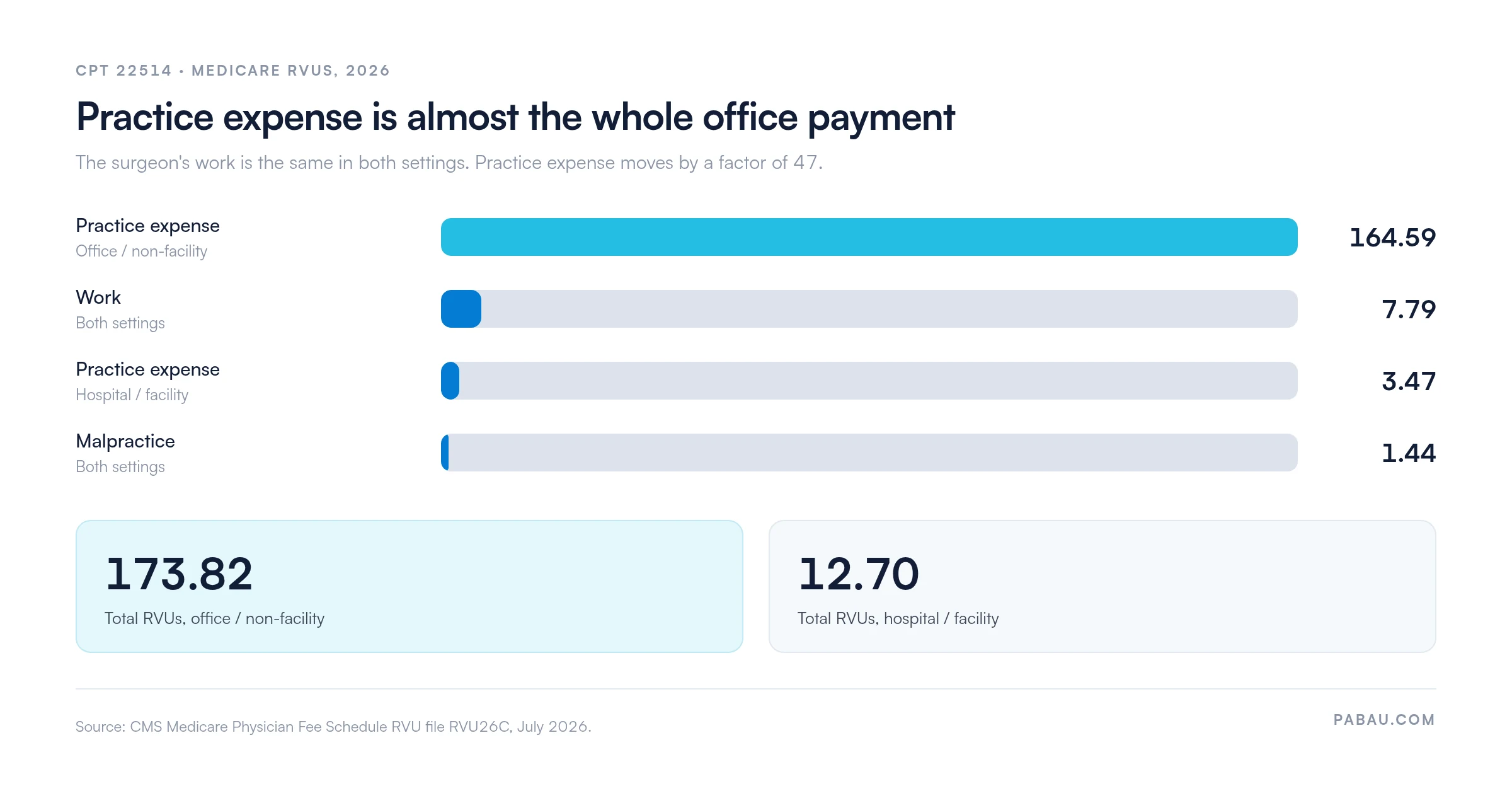
The office total is close to 14 times the hospital total, and practice expense accounts for all of that difference. Billed in an office or ambulatory setting, the practice buys the cavity-creation device and the cement itself. Those supply costs sit inside the non-facility practice expense RVU. In a hospital, the facility is paid for the device on its own claim, which leaves the physician 3.47 practice expense RVUs. Work and malpractice RVUs do not move at all.
Modifiers signal to payers that a procedure was altered in a clinically significant way, or that specific billing circumstances apply. For CPT Code 22514, the most commonly applied modifiers relate to laterality and unbundling of distinct procedures.
Two modifiers people reach for do not belong on this code. CPT 22514 carries a CMS professional/technical indicator of 0, which means the code has no professional and technical split. Modifiers 26 and TC are therefore invalid on it, whoever owns the equipment.
Modifier 50 usage for CPT 22514 requires payer-specific verification. The descriptor already reads “unilateral or bilateral cannulation,” so most MACs treat a bilateral procedure as captured in the base code. They will not pay an additional bilateral premium on top of it. Always confirm your payer’s billing guidelines before appending modifier 50.
The Centers for Medicare and Medicaid Services (CMS) publishes billing and coverage guidance for percutaneous vertebral augmentation that governs when CPT Code 22514 is covered. Coverage criteria vary by MAC jurisdiction under Local Coverage Determinations (LCDs). The general covered indications most MACs recognize include:
Non-covered situations generally include fractures without imaging confirmation and pain that is not clearly localized to the fractured level. They also include the absence of any conservative therapy trial without a documented contraindication. Augmentation performed purely for prophylactic stabilization, with no acute symptomatic fracture, is not covered either.
Medicare does not universally require prior authorization for CPT 22514, but commercial insurers frequently do. Check authorization rules when you verify the patient’s eligibility, before the procedure is scheduled. When authorization is required, payers typically expect:
Prior authorization requirements vary by payer and plan year. Avoid stating a specific payer “always” or “never” requires authorization without checking current payer policies directly.
Weak documentation is the root cause of most CPT 22514 claim denials. The records below belong in the chart before the claim goes out, not after a payer asks for them. A complete documentation package for CPT 22514 includes:
Build the claim from one linked record that carries the CPT code, the applicable modifier and the supporting ICD-10 codes. Keeping them in a single record is what stops the claim elements from drifting out of sync. Attach imaging report dates and authorization numbers at the time of billing, not as a post-denial fix.
Vertebroplasty and balloon kyphoplasty treat the same fractures, and CPT separates them on one fact: whether a cavity was created before the cement went in. That makes 22514 the kyphoplasty code, not the vertebroplasty code. Cement injected straight into a lumbosacral body, with no cavity creation, is vertebroplasty and belongs on 22511 instead.
The error runs both ways, and both directions carry compliance exposure. The operative report settles it. If a balloon, curette or implant created a cavity before cement injection, the lumbar code is 22514. If the cement went in without one, the lumbar code is 22511. Check the AAPC CPT code lookup whenever a descriptor changes.
The covered indications and documentation requirements above point to six recurring denial patterns. Each row below pairs the denial with its root cause and the step that prevents it. A pre-submission check against these six catches most of them before the claim leaves the practice.
Read this table alongside the common denial codes billers see on remittances. Together they let revenue cycle staff read the Claim Adjustment Reason Code (CARC) and route each denial to the right appeal pathway. An 837 claim file carrying the wrong ICD-10 pairing is one of the easiest problems to fix upstream. Catch it before the claim ever reaches the payer.
Static code references tell you what CPT Code 22514 means. Getting the claim paid is a workflow problem, and three steps carry most of the denial risk on a spine code:
Practice management software like Pabau handles those three steps in one system. Pabau’s claims management software sends the CMS-1500 claim out through our Claim.MD clearinghouse integration, which reaches thousands of US payers. Eligibility runs as a 270/271 check before the appointment, so the front desk sees the patient’s coverage while the visit can still be moved.
After submission, the same record tracks the claim’s status and posts the electronic remittance advice against it. Your billing team reads each adjustment and denial reason in the patient’s file instead of chasing paper EOBs. Choosing the code and the diagnosis is still the coder’s call, and the documentation above is what supports it.
A claim that goes out clean the first time shortens days in accounts receivable and cuts the hours spent on appeals. On a code reimbursed in the hundreds or thousands of dollars, one prevented denial pays for a lot of billing time.

Pabau submits CPT 22514 claims through its Claim.MD clearinghouse integration and checks patient eligibility before the visit. Your billing team then tracks each claim’s status and remittance in one place.

Run a quarterly audit of your CPT 22514 denial remittances. Group denials by CARC code (CO-50, CO-96, CO-197 are the most common for vertebral augmentation). If more than 15% of 22514 claims carry the same denial reason, the fix is a workflow change, not a one-off appeal.
CPT Code 22514 turns on one fact in the operative report: whether a mechanical device created a cavity before the cement went in. Treating it as the vertebroplasty code is the most common identity error on this claim. Build the habit of checking that line first, then the ICD-10 pairing, then the modifier. Almost every 22514 denial is decided before the claim is submitted, which is where it is cheapest to prevent.
Pabau’s claims management software submits the claim through a US clearinghouse, checks eligibility before the visit, and tracks the remittance that comes back. Book a demo to walk one spine procedure claim from code entry through to payment posting.

Need to understand what happens when a claim is denied? Denial management in healthcare covers the workflows and appeal strategies revenue cycle teams use to recover denied claims.
Want to understand the claim submission format payers require? What is an 837 file? explains the electronic claim format used for professional and institutional claims.
Looking for the full revenue cycle picture? Revenue cycle management explained walks through every financial touchpoint from patient scheduling to payment posting.
CPT Code 22514 is the procedure code for percutaneous vertebral augmentation of one lumbar vertebral body, better known as lumbar kyphoplasty. A mechanical device creates a cavity in the vertebral body, and bone cement then fills it. Fracture reduction, bone biopsy and all imaging guidance are included when performed in the same session.
CPT 22514 is the kyphoplasty code. Vertebroplasty is cement injection with no cavity creation, and it is reported with 22510, 22511 or add-on 22512. Because 22514 requires a mechanical device to create a cavity first, a lumbar vertebroplasty must go on 22511 instead.
Modifier 50 covers a bilateral procedure, and LT or RT carry laterality when the payer asks for it. Modifier 59 applies when 22514 is billed alongside a second code that carries NCCI edits. Modifiers 26 and TC never apply, because CPT 22514 has no professional and technical split. Modifier 50 still needs payer verification, since many MACs treat bilateral cannulation as included in the base descriptor.
Medicare does not universally require prior authorization for CPT 22514, but many commercial payers do. Prior auth requirements vary by payer and plan year. Always verify at the time of insurance eligibility verification, and obtain authorization before the procedure to avoid post-service denials.



