

CCSD code G5100: Bypass of duodenum billing guide
CCSD code G5100 bills a bypass that leaves the duodenum in place CCSD code G5100...

Last Updated: Oct 16, 2026
21933 is the CPT code for excision, tumor, soft tissue of back or flank, subfascial (eg, intramuscular); 5 cm or greater. It applies when the tumor sits below the deep fascia and measures at least 5 cm, counting the narrowest margins needed for complete excision.
Depth decides most of these claims. If the operative note never places the tumor beneath the fascia, payers treat the excision as subcutaneous and pay it as CPT 21931 instead.
Let Pabau's smart automation suggest the right codes, reduce claim denials, and keep your practice compliant—effortlessly.
Automate repetitive tasks and focus on what matters most—your patients.
Reduce coding errors and ensure compliance with the latest regulations.
Clean claims, fewer denials, and faster reimbursements.
Powerful insights and reporting to help your practice thrive.
HIPAA compliant SOC 2 certified GDPR-compliant Trusted by 4,000+ clinics worldwide

CPT code 21933 covers excision of a back or flank soft tissue tumor that lies below the fascia and measures 5 cm or more.
Size is the tumor’s greatest diameter plus the narrowest margins, so a 4.6 cm tumor removed with a 0.5 cm margin qualifies.
The operative note must state subfascial or intramuscular depth, or the claim is likely to be paid as subcutaneous 21931.
Use modifier 22 only with a written complexity narrative, and add LT or RT only where a payer asks for laterality.
Medicare rates reset every January 1, so pull current RVUs from the CMS fee schedule before quoting reimbursement.
CPT code 21933 reports the excision of a back or flank soft tissue tumor that lies below the fascia and measures 5 cm or more. The American Medical Association (AMA) maintains it in the musculoskeletal section of the CPT code set.
The official descriptor reads: Excision, tumor, soft tissue of back or flank, subfascial (eg, intramuscular); 5 cm or greater. The subfascial (eg, intramuscular) qualifier is the defining clinical criterion. A subcutaneous tumor that sits above the fascia never qualifies, whatever its size.
Size here means more than the tumor alone. CPT measures the tumor’s greatest diameter plus the narrowest margins the surgeon needs for complete excision. So a 4.6 cm intramuscular mass removed with a 0.5 cm margin still meets the 5 cm threshold.
Below that total, the claim belongs to CPT 21932 (subfascial (eg, intramuscular), less than 5 cm).
Coders can only support 21933 if the operative report walks through the depth of the dissection. Here is the sequence a reviewer expects to find.
Two details matter most: the fascial opening and the tumor’s position below it. A note that reads only “excision of back mass” leaves the payer to guess the depth. That guess rarely lands on 21933.
The back and flank excision family runs from 21930 to 21933, with radical resections at 21935 and 21936. Depth picks the pair of codes, and size then picks the code within that pair. The grid below shows how all six line up.
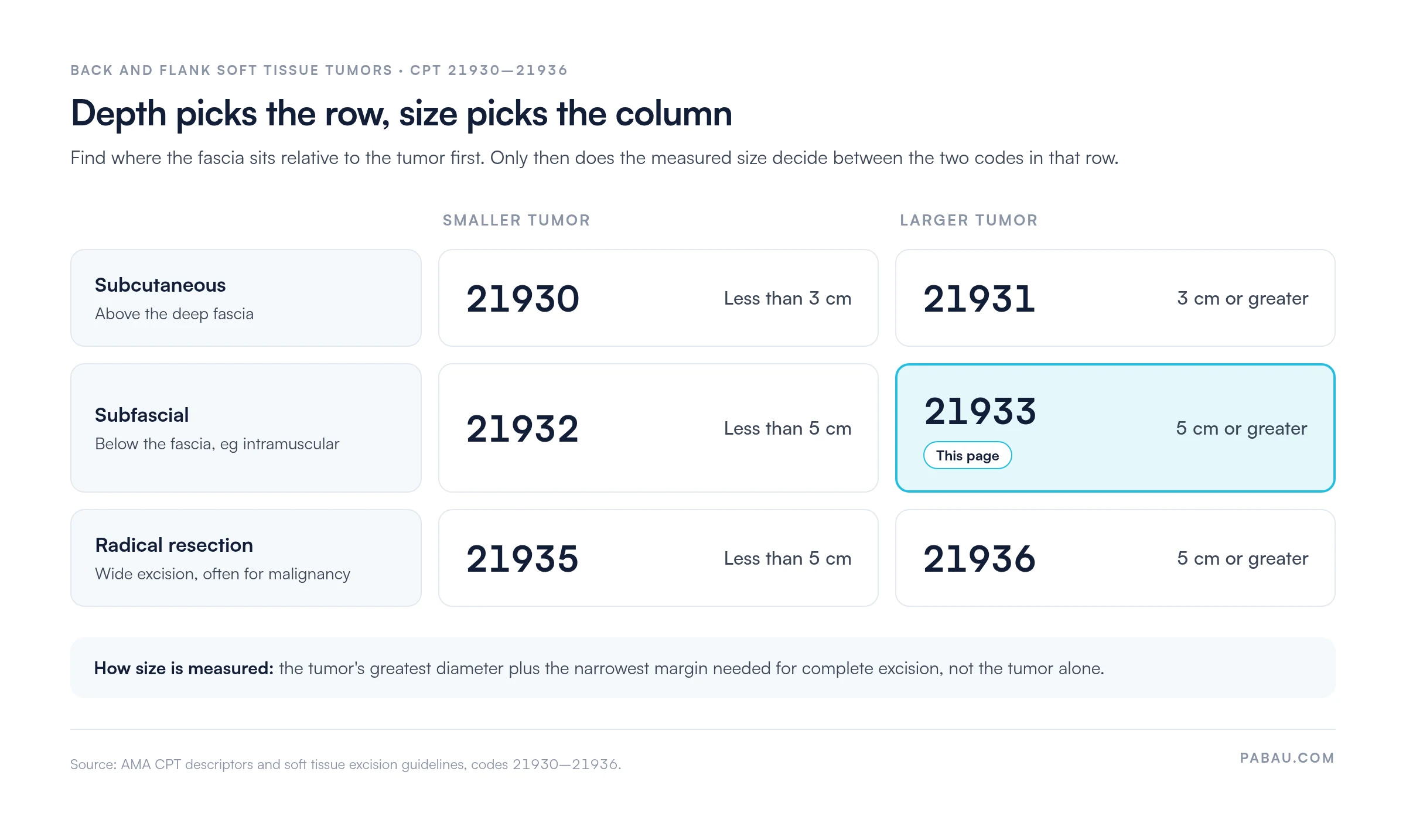
The table adds the billing test for each simple excision code.
Depth outranks size. A 6 cm subcutaneous lipoma on the back still codes to 21931, because it never reaches the fascia. And when the surgeon removes a subfascial mass but the note never mentions the fascia, auditors tend to recode it as subcutaneous.
Pre-operative MRI or CT that describes the tumor as “intramuscular” or “subfascial” helps. Still, imaging supports the operative note and can’t replace it. Both need to say the same thing.
Every 21933 claim needs a linked ICD-10-CM code that supports medical necessity. The pairing must also make clinical sense. A benign diagnosis next to an operative note describing a malignant excision draws payer scrutiny, while a confirmed trunk sarcoma takes C49.6.
Lipomas have their own ICD-10-CM category, D17, so look up the site-specific lipoma code instead of reaching for D21.6. Codes also change every October 1. Check that each code is valid for the date of service, not the billing date.
D21.6, C49.6, and D48.1 are the usual primary diagnoses once pathology is back. M79.89 and R22.2 fit only while definitive pathology is pending or unavailable.
The right modifier depends on what happened in the room, the payer’s policy, and any other procedures in the same session. A wrong or missing modifier is a frequent denial trigger.
Payers review modifier 22 closely on 21933 claims. The record has to show why the case was harder than usual. Operating time well above the norm helps, and so does a narrative naming the adhesions or anatomy the surgeon worked around.
Medicare calculates payment for CPT code 21933 from Relative Value Units (RVUs) in the CMS Medicare Physician Fee Schedule. CMS publishes it every year, effective January 1. The three components are work, practice expense, and malpractice RVUs. A Geographic Practice Cost Index (GPCI) then adjusts each one for the provider’s location.
Any dollar figure printed here would go stale within a year. Before quoting reimbursement, pull current values from the FastRVU 2026 RVU lookup tool or the CMS search tool. Enter code 21933 and the provider’s MAC jurisdiction. Facility rates (hospital outpatient or inpatient) differ from non-facility rates.
Pull the current-year CMS Physician Fee Schedule before quoting reimbursement for CPT 21933. Filter by MAC jurisdiction and by facility or non-facility setting to get the right geographic adjustment. A rate copied from last year’s schedule can be off by several percentage points after the conversion factor update.
Commercial rates for 21933 depend on each payer contract. Most are set as a percentage of Medicare, and the multiplier varies by payer and specialty.
Commercial insurers commonly require prior authorization for elective tumor excision coded to 21933, though rules vary by plan. Traditional Medicare does not require it for this code in most jurisdictions. Medicare Advantage plans frequently do.
Operating without a required authorization produces a denial that is hard to appeal after the fact. Confirm it when the case goes on the schedule, as part of a set prior authorization process for every elective excision.
The record must show where the tumor was, how deep it sat, how big it was, and why it needed surgery rather than observation. A miss on any of the four leads straight to the denials in the next section.
For surgical codes like 21933, link imaging, pre-op notes, the operative report, and pathology before anyone builds the claim. A clean claim for this code has all four answers present and consistent with each other.
Denials on 21933 follow a short list of root causes. Catch them before submission and most avoidable rejections never happen.
The Claim Adjustment Reason Code (CARC) on the remittance tells you which fix applies. Authorization problems usually come back as CARC 197 (precertification/authorization/notification absent) and CARC 15 (authorization number missing or invalid). Our reference on medical billing denial codes explains the rest.
Sort each denial by root cause before you appeal, rather than sending blanket resubmissions. That habit sits at the heart of denial management in healthcare.
Practices bill 21933 as a professional claim on the CMS-1500 form, or its electronic twin, the 837P. A typical claim passes through six hands-on stages.
A medical claims clearinghouse catches formatting and pairing errors at stage five. It can’t see whether the operative note supports subfascial depth, so that check stays with your coders.
Many surgical billing teams still build the 21933 claim by hand. Someone copies the code from the op note, keys diagnoses from the chart, and checks eligibility on a payer portal.
Pabau, the practice management and billing platform we build, pre-fills the CMS-1500 from the patient record instead. Its claims management software integrates directly with Claim.MD to handle electronic submission, real-time eligibility checks, and ERA receipt. The claim then reaches the payer ready for the clearinghouse’s own edits.
Required fields, such as the authorization number, must be complete before the claim can be sent. Claim statuses and remittances then flow back to the same record, so your team sees a denial as soon as the payer posts it.


Pabau pre-fills CPT claims from the patient record and submits them through Claim.MD to thousands of US payers. Eligibility checks, claim statuses, and remittances come back to the same record.

Treat 21933 as a documentation code first and a surgical code second. When the surgeon names the fascia and records size with its margins, the claim holds up on audit. When either detail is missing, the payer picks the code for you.
The cheapest fix sits upstream. Add a depth line and a margin-inclusive size to your excision note template, and confirm authorization when the case is booked. It costs the surgeon one sentence and can save your team an appeal.
Book a demo to see how Pabau sends complete CPT claims and brings each remittance back to the patient record.

Coding a smaller or shallower back mass? CPT code 21930 covers subcutaneous back and flank tumors under 3 cm and how margins change the size.
Was the tumor resected radically instead? CPT code 21936 explains radical resection of back or flank tumors of 5 cm or more.
Building an appeal for a downcoded 21933 claim? Denial management in healthcare covers how to sort denials by root cause and what payers want in an appeal.
Looking for a full reference on claim adjustment reason codes? Denial codes in medical billing maps the CARC values returned on surgical excision claims.
Want to see how clearinghouse edits catch errors? Medical claims clearinghouse workflow explains how electronic routing and edit checks work before a claim reaches the payer.
CPT 21933 carries a 90-day global period. Routine follow-up visits in that window are included in the surgical payment. Report an unrelated visit with modifier 24, and a return to the operating room for a complication with modifier 78.
Simple and intermediate repair are included in 21933. Complex repair of the trunk can be reported separately with codes 13100 to 13102 when the note supports it.
Yes, when the lipoma lies below the fascia and measures 5 cm or more with its margins. Pair it with the matching lipoma code from ICD-10-CM category D17, not D21.6.
Code what was done. A radical resection of a back or flank tumor, usually for sarcoma, reports 21935 under 5 cm or 21936 at 5 cm or more. The note should describe the wider resection explicitly.
An earlier open biopsy of back or flank soft tissue is reported separately. Use 21920 for a superficial site or 21925 for a deep one. The excision then goes on its own claim.



