HCPCS code E0198: Water pressure pad billing guide
HCPCS code E0198 is a water pad for a standard mattress HCPCS code E0198 is the ...

Last Updated: Oct 13, 2026
21930 is the CPT code for excision, tumor, soft tissue of back or flank, subcutaneous; less than 3 cm. It covers benign masses such as lipomas and cysts taken from the layer below the skin and above the fascia.
Two details decide whether the code holds. The operative note must record a measured size in centimeters, and it must confirm the dissection stayed in subcutaneous tissue. A skin lesion excised from the same area belongs to the integumentary series instead.
Let Pabau's smart automation suggest the right codes, reduce claim denials, and keep your practice compliant—effortlessly.
Automate repetitive tasks and focus on what matters most—your patients.
Reduce coding errors and ensure compliance with the latest regulations.
Clean claims, fewer denials, and faster reimbursements.
Powerful insights and reporting to help your practice thrive.
HIPAA compliant SOC 2 certified GDPR-compliant Trusted by 4,000+ clinics worldwide

CPT code 21930 covers a subcutaneous soft tissue tumor of the back or flank under 3 cm.
Tissue depth sets the code family, so a skin lesion belongs in the integumentary series instead.
A measured size in centimeters must appear in the operative note or the pathology report.
The codeable size is the tumor’s greatest diameter plus the narrowest margin taken to remove it.
Practice management software like Pabau validates claim submission fields before the claim reaches the payer.
CPT code 21930 is the procedure code for excising a subcutaneous soft tissue tumor from the back or flank. It applies when the mass measures less than 3 cm. The code sits in the Musculoskeletal System section of the AMA CPT code set, under Back and Flank.
The official descriptor reads:
21930: Excision, tumor, soft tissue of back or flank, subcutaneous; less than 3 cm
Three elements have to line up before the code holds:
Neighboring code numbers are easy to misread. 21920 and 21925 are biopsy codes, so they describe a different procedure type rather than an excision. The excision family itself runs 21930 to 21933, plus 21935 and 21936 for radical resection. There is no 21934.
The procedure behind 21930 is a straightforward open excision. A surgeon marks the skin over the mass, opens the dermis, and dissects down to the tumor capsule through subcutaneous fat. Removal is en bloc, taking the mass whole. Closure then runs in layers, and the specimen usually goes to pathology.
Four clinical pictures account for most of these cases:
Depth is what separates the code families. A tumor confined above the fascia is 21930 or 21931. Once dissection goes into muscle, the intramuscular codes take over, 21932 or 21933. So the operative report has to say which layer the surgeon entered.
Two axes separate these codes: dissection depth and measured size. Depth picks the family, then size picks the code inside it. Work through them in that order, the way the chart below lays them out.
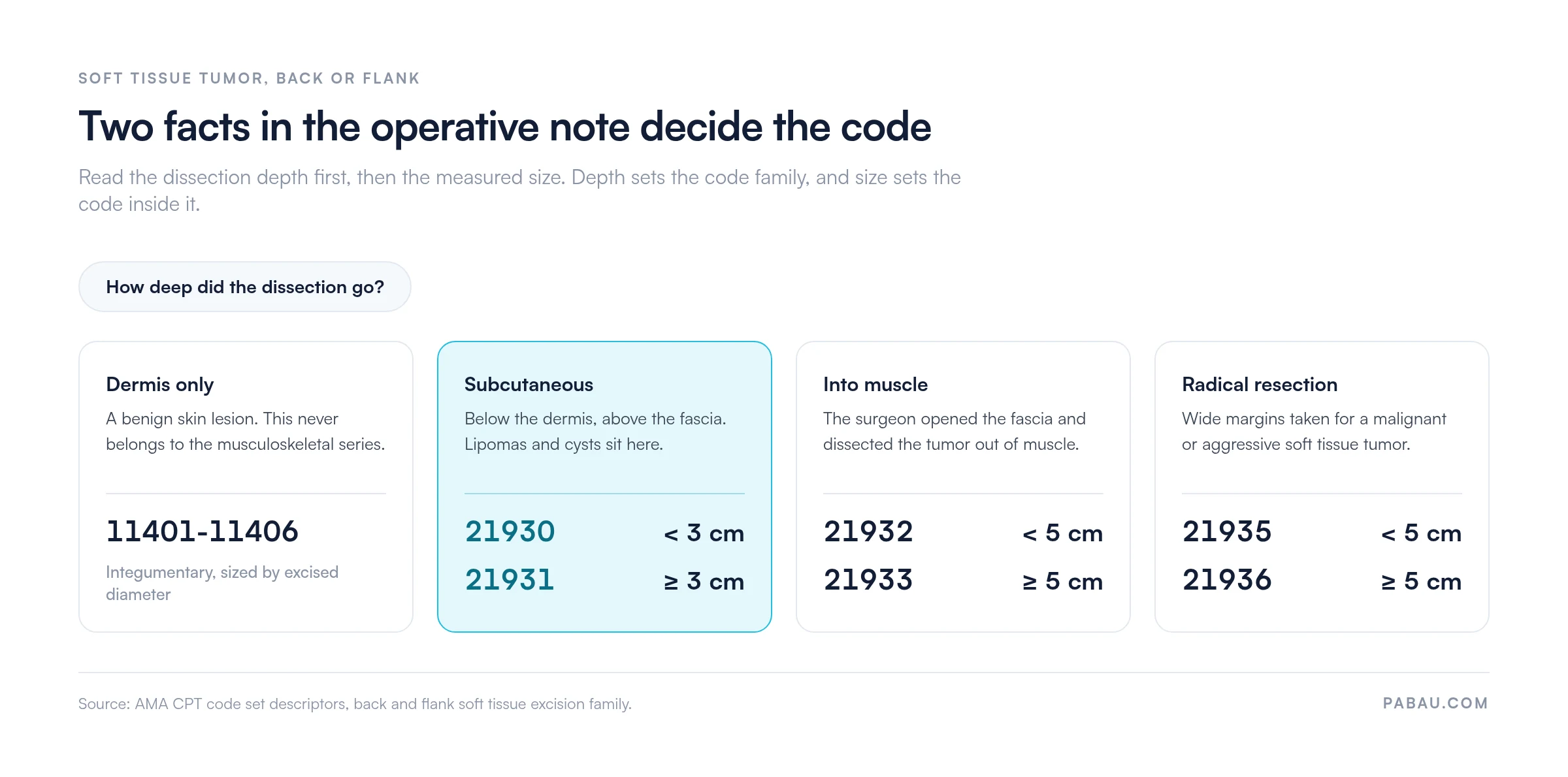
The table below covers the subcutaneous and subfascial codes only. Radical resection of a back or flank soft tissue tumor is reported with 21935 or 21936, and neither one appears here.
CPT counts more than the mass itself. The codeable size is the greatest diameter of the tumor plus the narrowest margin needed to remove it. Both are measured at the time of excision.
That arithmetic moves cases across the threshold. A 2.8 cm lipoma removed with a 0.3 cm margin measures 3.1 cm, which is 21931 rather than 21930. So when the note records only the raw mass and no margin, the practice undercodes by default.
Estimates never support either code. A dimension in centimeters has to appear in the operative note or the final pathology report. CPT asks for the operative measurement.
The most frequent category error is billing a back excision from the integumentary series when the musculoskeletal series is correct. Two factors settle it. One is the tissue layer the surgeon entered, and the other is how CPT classifies the anatomy.
Take a 2.2 cm lipoma removed from the upper back. The note records dissection through subcutaneous fat to the tumor capsule, which supports 21930. Billed as 11402, the same case reads as a skin lesion excision and becomes a common NCCI edit trigger.
Anatomy alone will not decide this for you. When the operative note is vague about the layer, ask the surgeon before the claim goes out rather than after the denial arrives.
Every element below has to appear in the operative note or the pathology report. Miss one and the claim is exposed the moment an auditor opens the chart.
A missing measurement remains the single most common deficiency on these claims. Practices that make the centimeter reading a required field in the operative note template stop the problem at its source.
Build tumor size into your operative note template as a required field, not a free-text reminder. A mandatory centimeter field ahead of the closure section catches the missing measurement before the note is signed, rather than after the claim is denied.
Modifier selection here follows standard musculoskeletal excision rules. Each one has a single trigger condition. Append the wrong modifier, or leave a required one off, and the claim comes straight back.
Bundling itself is governed by the National Correct Coding Initiative, known as NCCI. Those edits apply to every Medicare claim, and most commercial payers adopt them too. Modifier -59 or an X modifier is often needed when 21930 is billed with wound closure in the same session.
Pairing starts with the pathology report, not the referral letter. A supported diagnosis still does not guarantee payment, but a mismatched one gets the claim denied fast.
Check the full wording in the ICD-10-CM code library before you attach one, because the trunk codes read alike and get swapped easily.
Medicare adds a coverage question on top of the pairing. Lipoma excision can be treated as cosmetic, and therefore non-covered, unless the record establishes functional impairment, pain affecting daily activities, or documented growth.
Coverage turns on the Local Coverage Determination for your MAC jurisdiction, so check the applicable LCD on the CMS website before you submit.
For 2026, the Medicare Physician Fee Schedule assigns CPT code 21930 a work RVU of 4.82. Total RVUs come to 16.19 in the non-facility setting and 10.52 in the facility setting. Payment then varies by locality and by payer contract.
The CMS Physician Fee Schedule lookup tool returns the current national rate and the locality-adjusted amounts. For the component breakdown, the FastRVU lookup splits the code into work, practice expense, and malpractice values.
Four parameters drive the amount that lands:
Usually yes on commercial managed care, and usually no on Original Medicare. Medicare still reviews medical necessity after the fact, and Medicare Advantage plans set their own rules. Confirm eligibility and authorization before the procedure is scheduled.
Commercial plans that do require authorization tend to ask for the same evidence:
Most denials on this code are preventable, and every pattern has a matching fix. A structured denial management process catches them before they turn into write-offs.
Seven checks, in the order a biller would work through them. Each one takes seconds and each one prevents a denial that costs a week.

Audit your 21930 claims quarterly using the electronic remittance data your clearinghouse already returns. Filter by denial reason code. One reason repeating across several claims points at the workflow rather than at the coder who touched the last one.
Remittance advice is where the pattern shows up first. The CARC reason code on the 835 maps straight to a corrective action. Read it on every denied 21930 claim and the underlying cause surfaces fast.
Most surgical practices run this in two disconnected places. The operative note sits in the clinical record, and the claim is assembled later in a billing system that cannot see it.
Working from memory, the biller checks the payer’s field requirements, submits, and learns three weeks later that an authorization code was wrong.
Practice management software like Pabau keeps the patient record, the appointment, and the claim in one system.
That check happens in Pabau’s claims tool for billers, which flags a missing membership number or authorization code before the claim is submitted. Claims then go out electronically, and remittances post back against the same patient record.
So the biller stops re-keying data between systems, and stops chasing rejections that a field check would have caught. The coding judgment stays where it belongs, with the person reading depth and size off the operative note.

Pabau validates claim submission fields, sends claims electronically, and posts remittances back against the patient record. See how surgical practices run scheduling, records, and billing in one system.

CPT code 21930 rewards a careful read of the operative note and punishes a quick one. Depth and a measured size decide it, and both facts are written down before a coder ever opens the chart.
So the useful work sits upstream of billing. Make the centimeter reading a required field in the note template, and agree with your surgeons on the wording that confirms subcutaneous dissection. Do that once and the denials that eat a biller’s week mostly stop arriving.
If your team spends longer fixing claims than sending them, the workflow is worth a look. Book a demo to see how Pabau checks claim fields and tracks every surgical submission through to payment.

Need the code for a mass of 3 cm or more? CPT code 21931 covers the same procedure above the size threshold, with the same documentation rules.
Want a framework for working denials systematically? Denial management in healthcare walks through the workflow from CARC code to appeal submission.
Curious how a claim reaches the payer? Medical claims clearinghouse guide explains each hop from practice to payer and where errors get caught.
Building out the wider billing operation? Revenue cycle management overview covers the process from patient registration through to payment posting.
CPT code 21930 is limited to the back and flank. A shoulder, chest wall, or abdominal wall mass has its own soft tissue excision family. Each one is organized the same way, by depth and then size. Read the site wording in the operative note before you pick the family, because “posterior trunk” and “flank” are not interchangeable with “chest wall”.
Medicare assigns CPT code 21930 a 90-day global period, so routine post-operative care is already paid inside the surgical fee. An office visit for an unrelated problem can still be billed, using modifier -24 on the evaluation and management code. An unrelated procedure in that same window takes modifier -79 instead.
Each excision is reported on its own line and sized on its own. The measurements are never added together to reach a higher code. Two masses on the same side usually need modifier -59 or an X modifier. Work on both sides takes modifier -50, or two lines, depending on the payer.
CPT does not require it, but most payers expect a pathology report behind the diagnosis. The report also confirms whether the mass was benign, which is what makes the paired ICD-10 code defensible. Send the specimen unless the record gives a clear clinical reason not to.