HCPCS code T2043: Hospice continuous home care billing guide
HCPCS code T2043 pays for hospice crisis care by the hour HCPCS code T2043 is th...

Last Updated: Oct 7, 2026

CPT code 15135 covers a dermal autograft on special body sites such as the face, scalp, hands, and feet.
It covers the first 100 sq cm of recipient area, or 1% of body area for infants and children.
Use add-on code 15136 for each additional 100 sq cm of graft beyond that threshold.
Common denial triggers include the wrong body-site code, unbundled donor site closure, and missing graft dimensions.
Pabau’s practice management software helps plastic surgery practices document 15135 procedures correctly and track denial patterns for review.
CPT code 15135 covers a dermal autograft applied to a special body site, such as the face, scalp, or hands. The descriptor also lists the eyelids, mouth, neck, ears, orbits, genitalia, feet, and multiple digits. It covers the first 100 sq cm of recipient area. Use it instead of a trunk or limb code from the 15130-15157 family.
This reference covers everything teams at plastic surgery EMR practices need: the full code descriptor, the 15136 add-on relationship, and the ICD-10 crosswalk. It also covers applicable modifiers, Medicare reimbursement context, and the paperwork points payers check first.
The American Medical Association (AMA) owns and maintains the CPT code set. Its parenthetical guidance on the 15130 family is where the body-site and surface-area rules are authoritative. Billers should always reference the current CPT manual alongside this guide.
CPT code 15135 describes a dermal autograft applied to the face, scalp, eyelids, mouth, neck, ears, orbits, genitalia, hands, feet, or multiple digits. It covers the first 100 sq cm of recipient area, or 1% of body area for infants and children. The surgeon harvests a layer of the patient’s own skin from a donor site elsewhere on the body. That tissue is then grafted onto the prepared wound bed at the recipient site.
These body sites are grouped together because they carry greater functional and cosmetic significance than trunk or limb grafts. Payers and payer-adjacent editing systems, including NCCI, apply their own fee schedule values for this group. Surgical access, wound preparation, and post-operative complexity all differ from what CPT 15130 (trunk, arms, legs) covers.
A dermal autograft removes a thin layer of the patient’s own skin from a donor site, commonly the thigh or upper arm. The surgeon then secures it over a prepared wound bed at the recipient site. The graft adheres by plasmatic imbibition in the first 24-48 hours before vascular ingrowth locks in permanent take.
Because the tissue is autologous, rejection risk is eliminated. That makes this the preferred technique for full-thickness burns, traumatic avulsions, and post-excisional defects where primary closure isn’t possible.
CPT code 15135 applies when the recipient site is one of the special body sites listed in the descriptor. A burn patient requiring grafts to both the face and the trunk, for example, would be billed under both 15135 (face) and 15130 (trunk). Modifier -59 or XS is then appended to the secondary code to distinguish the anatomical locations.
Complex craniofacial trauma may also need bony fixation under 21175 before the dermal autograft closes the remaining soft-tissue defect. Managing that kind of multi-site scenario cleanly in plastic surgery practice management needs a billing system that tracks each graft site on its own.
The 100 sq cm threshold applies to the recipient site, not the donor harvest area. Surgeons sometimes note graft size at the donor site instead of the recipient site. If the operative report fails to state recipient site size clearly, payers may downcode or deny for missing surface area details. Measure and record the recipient wound bed in sq cm before graft placement.
CPT 15136 is a designated add-on code reported with 15135 when the total recipient area on the special body sites exceeds 100 sq cm. It is listed as “+15136” in the CPT manual, indicating it cannot be reported as a standalone code. Each unit of 15136 covers an additional 100 sq cm (or 1% body area for infants/children). There is no cap on the number of units, but each extra unit needs a documented surface area measurement to survive audit. Claim scrubbing catches the mismatches that would otherwise come back as a denial two weeks later. Accounts receivable aging shows which codes are slow to pay long before anyone calls it a denial problem.
The 15130-15157 code family covers dermal autografts and tissue-cultured autografts by body site and graft type. Selecting the wrong code from this family is the most common body-site error in skin graft billing. Skin substitute grafts fall under their own family:
For more CPT coding reference guides across surgical specialties, the Pabau procedure code library is a useful companion resource.
Never use CPT 15136 as a companion to CPT 15130 or 15131. The add-on codes are paired: 15131 adds to 15130 (trunk/limb sites), and 15136 adds to 15135 (special sites). Cross-pairing triggers an NCCI bundling edit and automatic denial.
Claim submission for CPT code 15135 needs an ICD-10-CM diagnosis code that shows medical necessity. The diagnosis must reflect the underlying wound condition rather than the surgical procedure itself. Use the AAPC CPT-to-ICD-10 crosswalk to check which diagnosis codes your specific payer accepts together with 15135.
Listing the diagnosis codes above does not guarantee reimbursement. Payers may have local coverage determinations (LCDs) that narrow the acceptable diagnosis set, so review your payer’s LCD before submitting. Post-excisional defects.
Dermatology practices handling those excisions and the reconstructive closure that follows benefit from dermatology software that keeps both procedures in one patient record.
Modifier selection for CPT code 15135 depends on several factors: whether the procedure is bilateral, repeated, or performed by a different provider. It also depends on whether it’s paired with other surgical procedures on the same date of service. Applying the wrong modifier (or omitting one entirely) is among the top three reasons skin graft claims are returned for more information.
A staged graft can repeat at the same site, so 15135 supports more than one billable session. Frequency rules run the opposite way for HCPCS code S0315, which is billed once per disease management program episode, with repeat lines drawing audit review.
Reimbursement for CPT code 15135 is calculated using relative value units (RVUs) published annually in the Medicare Physician Fee Schedule (MPFS). The total payment equals the sum of work RVU, practice expense RVU, and malpractice RVU. Each is multiplied by the geographic adjustment factor for your locality, then by the annual conversion factor CMS sets.
Use the CMS fee schedule tool to retrieve the current year’s locality-specific payment for 15135. National non-facility rates are the standard reference point. Facility rates are lower when the procedure happens in a hospital or ASC, because practice expense is shared. The FastRVU lookup tool provides a quick way to pull work, practice expense, and malpractice RVU components without navigating the full CMS file.
Reimbursement rates change each January 1 when CMS publishes the final MPFS rule. Always cite the current fee schedule year when presenting rates to providers. Presenting a 2024 rate as current in 2026 is a billing compliance issue, not just a hassle.
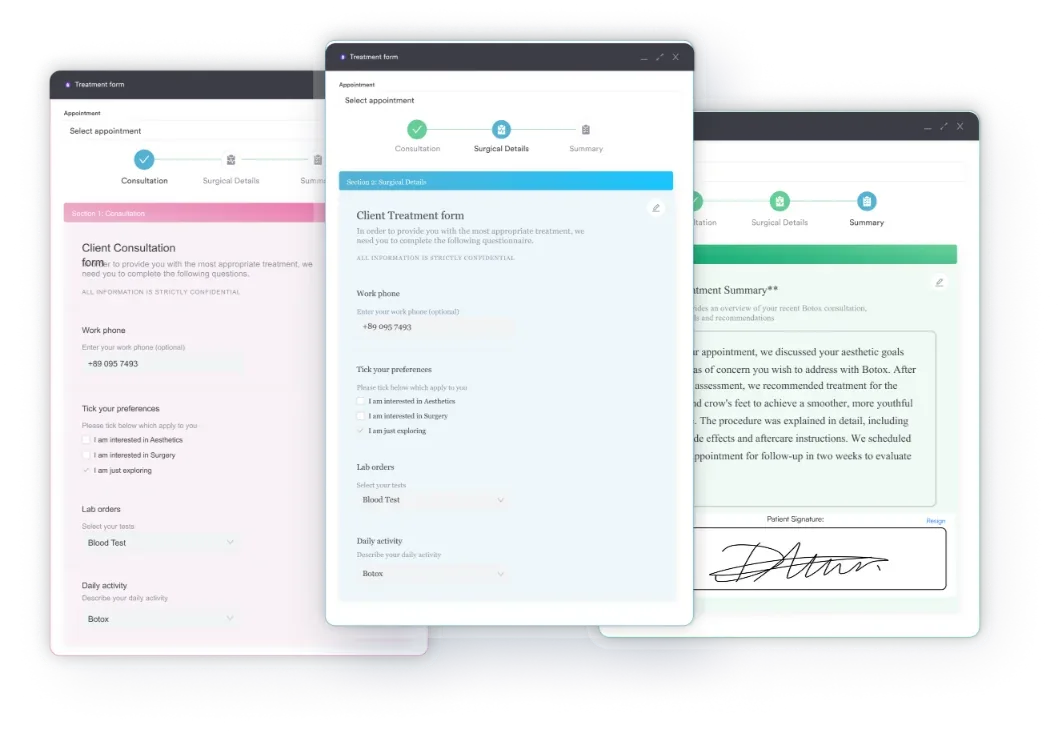
Incomplete documentation is the second most common reason skin graft claims for CPT code 15135 are denied or downcoded after submission. Payers reviewing these claims expect specific details in the operative report, not a narrative that leaves out measurable facts. Structured medical forms reduce the gap between what was performed and what the record proves.
For practices running a cosmetic surgery clinic with reconstructive billing, a set template for skin graft operative reports helps. It reduces the risk of missing required details. Configuring digital intake forms with graft-specific fields prompts surgeons to capture surface area and site details at the point of care.
Most claim failures for CPT code 15135 fall into five categories. Finding which pattern applies to your denials is faster than reviewing each claim one by one. Pabau’s reporting tools let practices filter denials by code and reason, turning pattern spotting into a single report instead of a claim-by-claim audit.
For practices researching plastic surgery software, embedding pre-authorization tracking into the scheduling and billing workflow helps. It stops the most common denials before a claim is ever sent.
Run a quarterly denial report filtered to CPT 15135 and sort by CARCs (Claim Adjustment Reason Codes). CARC 4 means the procedure code is inconsistent with the modifier used, or that a required modifier is missing. CARC 50 means a non-covered service, and the two are the most common. CARC 4 usually points to a missing or mismatched modifier, such as -59 on a multi-site graft claim. CARC 50 often means missing medical necessity documentation or a failed prior authorization.
Many reconstructive practices still track graft records across many operative note templates, spreadsheets, and sticky notes on the biller’s desk. That patchwork is exactly where recipient site size and modifier details go missing before a claim reaches a payer.
Practice management software like Pabau brings clinical documentation, billing, and reporting into one system instead. It prompts surgeons to complete graft-specific fields at the point of care, then keeps that record linked to the claim it supports.
The outcome is a documentation trail that holds up if a payer requests records. A denial report also shows where body-site or modifier errors repeat, so teams can fix the pattern instead of reworking one claim at a time.

Pabau’s digital forms prompt surgeons to capture recipient site dimensions, donor site details, and modifier-relevant information before a claim goes out. Its reporting tools then surface denial patterns so practices can fix root causes instead of resubmitting one claim at a time.

Most CPT 15135 denials come down to picking the wrong body-site code, skipping surface area documentation, or pairing 15136 with the wrong primary code. None of those causes is hard to fix once a practice checks for it before sending the claim.
Build recipient site size and body-site detail into the operative report template first. Then let a single denial report show whether the pattern keeps showing up. That beats auditing claims one at a time. Book a demo to see how Pabau keeps documentation and denial tracking in one place for reconstructive practices.

Billing a full-thickness graft instead? CPT code 15241 covers the full-thickness graft add-on and its own site-specific pairing rules.
Need the tissue-cultured autograft rules for special sites? CPT code 15155 explains billing for tissue-cultured skin autografts at the face and scalp.
Confirming a graft has taken before the next stage of care? CPT code 15860 covers the vascular flow test used to check flap or graft viability.
Coding the donor site closure on its own? CPT code 12055 is the intermediate wound repair guide billers reach for next.
Working on a facial nerve reconstruction case? CPT code 15842 covers free muscle flap grafting for facial nerve paralysis.
CPT code 15135 is a dermal autograft applied to special body sites: the face, scalp, eyelids, mouth, and neck. The code also applies to the ears, orbits, genitalia, hands, feet, and multiple digits. Coverage extends to the first 100 sq cm of recipient area, or 1% of body area for infants and children. The graft itself uses skin harvested from the patient’s own donor site, transplanted as a dermal autograft.
Medicare rates for CPT 15135 vary by locality and change annually with the Medicare Physician Fee Schedule. Use the CMS Physician Fee Schedule lookup tool at cms.gov to retrieve the current non-facility and facility rates for your geographic area. Never rely on a prior year’s rate without checking it against the current MPFS.
Common modifiers include -59, for a distinct procedural service when billing 15135 alongside 15130 for separate sites. Also common is -RT/-LT, the laterality modifier for paired structures like hands or ears. Also common are -76, a repeat procedure by the same physician in a staged graft. And -78, a return to OR for a related procedure in the post-operative period. Modifier -51 applies to the secondary code, not to 15135 when it is the primary procedure.
Medicare generally covers CPT 15135 when medical necessity is shown through the right ICD-10-CM diagnosis code. Documented clinical indications include burns, traumatic wounds, post-excisional defects, and congenital anomalies. Medicaid coverage varies by state. Prior authorization rules differ by payer; check with each payer before scheduling elective reconstructive grafting.