CCSD Code M2510: Ureterocele excision billing guide
CCSD Code M2510: Definition and clinical scope CCSD Code M2510 is the Clinical C...

Last Updated: Nov 3, 2026
14001 is the CPT code for adjacent tissue transfer or rearrangement, trunk; defect 10.1 sq cm to 30.0 sq cm.
The code sits above CPT 14000, which covers trunk defects up to 10.0 sq cm. Trunk defects over 30.0 sq cm move to CPT 14301, which covers any site. The defect area counts the primary defect and the secondary defect from the flap design, recorded in sq cm. Excision of the lesion the flap closes is included in 14001 and is not billed separately.
Let Pabau's smart automation suggest the right codes, reduce claim denials, and keep your practice compliant—effortlessly.
Automate repetitive tasks and focus on what matters most—your patients.
Reduce coding errors and ensure compliance with the latest regulations.
Clean claims, fewer denials, and faster reimbursements.
Powerful insights and reporting to help your practice thrive.
HIPAA compliant SOC 2 certified GDPR-compliant Trusted by 4,000+ clinics worldwide

CPT code 14001 covers adjacent tissue transfer on trunk defects of 10.1-30.0 sq cm, so confirm the trunk site before selecting it.
The defect area counts the primary defect and the secondary defect from the flap design, recorded in sq cm in the operative note.
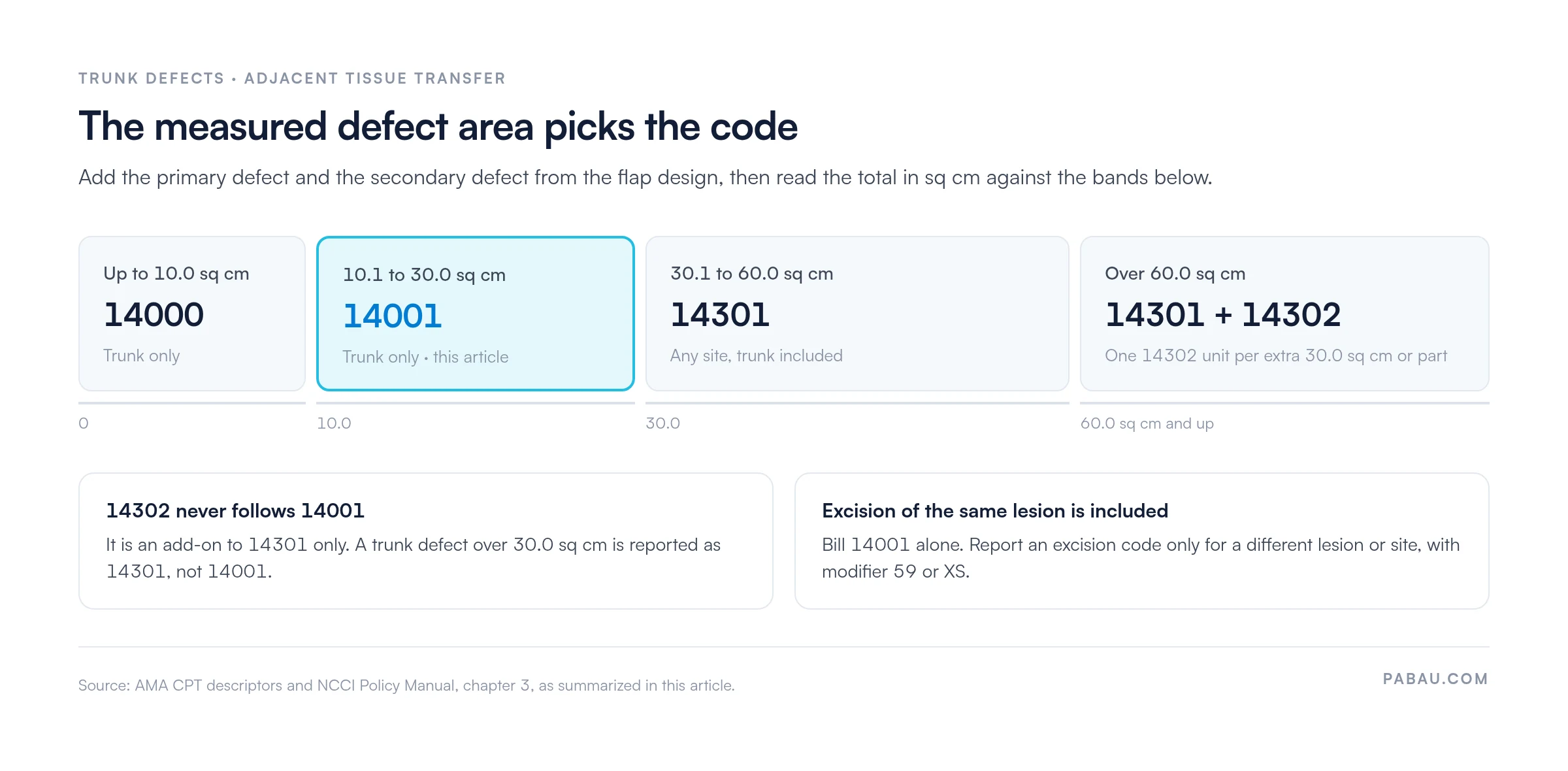
Trunk defects over 30.0 sq cm move to CPT 14301, which covers any site. Add-on CPT 14302 pairs only with 14301, never with 14001.
Excision of the lesion the flap closes is included in 14001 and is not billed separately.
Pabau’s claims management software validates claims and flags errors before submission, so coding problems are fixed before the claim goes out.
The American Medical Association (AMA) defines CPT code 14001 as Adjacent tissue transfer or rearrangement, trunk; defect 10.1 sq cm to 30.0 sq cm. The key elements are the anatomical site (trunk), the procedure type (adjacent tissue transfer or rearrangement), and the defect size range (10.1-30.0 sq cm).
“Adjacent tissue transfer” is the AMA’s umbrella term for flap techniques that use tissue immediately surrounding a defect. The tissue is not harvested from a distant donor site. Instead, the surgeon moves neighboring skin and subcutaneous tissue to close the wound. The AMA groups four techniques under this term.
All four techniques fall under CPT code 14001 when performed on the trunk and the primary defect measures between 10.1 and 30.0 sq cm. The AMA’s CPT code set groups these techniques together because the complexity driver at this anatomical site is defect size, not flap geometry.
CPT 14000 and CPT code 14001 are the two base codes for adjacent tissue transfer on the trunk. The only coding variable between them is defect size. Choosing between them from an unmeasured or estimated wound area is a frequent billing error in this family.
CPT measures the primary defect left by the excision and the secondary defect created by the flap design together. For each one, multiply the length by the widest perpendicular width, then add the two areas. Record every figure in sq cm in the operative report.
Once the total passes 10.0 sq cm, CPT 14000 is no longer correct, however close to the boundary it falls. Above 30.0 sq cm, report CPT 14301 instead of 14001. The bands below show where each total lands, along with the two pairing rules that trip up trunk claims.
The anatomical site is the primary driver of which CPT code family applies. Up to 30.0 sq cm, trunk defects and scalp defects of identical size bill under different code families. Billing CPT 14020 for a back defect, for example, creates a site mismatch that typically ends in denial.
The trunk family (14000/14001) covers the thorax, abdomen, back, and flank. Above 30.0 sq cm, the site no longer changes the code, because 14301 covers any area. A shoulder defect borders both the trunk and the arm, so the operative note should name its location precisely. Payer auditors use that site description to validate the code family.
Measure the primary defect right after excision and the secondary defect as the flap is designed. Once the flap is inset, neither area can be measured again. A note that only gives the wound size at closure does not support CPT code 14001, and it will not survive a payer records request.
CPT code 14001 stops at 30.0 sq cm. Once a trunk defect measures 30.1 sq cm or more, the claim moves to CPT 14301. That code covers adjacent tissue transfer on any area for defects of 30.1 to 60.0 sq cm.
CPT 14302 is the add-on code for each additional 30.0 sq cm, or part thereof, beyond 60.0 sq cm. It is reported only with 14301. It never pairs with 14000, 14001, 14020, 14021 or any other size-banded base code.
To count the 14302 units, subtract 60.0 sq cm (the upper limit of 14301) from the total defect area. Divide the remainder by 30.0 and round up to the next whole unit. A 95 sq cm trunk defect leaves 35 sq cm after the subtraction, which rounds up to two units. That claim reads 14301 + 14302 x 2.
Record each measurement in the operative note so a payer reviewer can check the unit count independently. The AAPC’s CPT code lookup confirms the parent and add-on relationship for this family.
Modifier selection for CPT code 14001 depends on the clinical scenario. A modifier without documented justification draws denials, and so does a missing one where the service called for it.
Modifier 22 requires a cover letter explaining the increased complexity. Submit it with the claim on first pass rather than waiting for a denial and then appealing. Many payers will not reprocess the complexity payment later without the supporting narrative.
A claim for CPT code 14001 is only as defensible as the operative note supporting it. Each element below corresponds directly to a denial category when missing.
Pair the operative note documentation with the correct ICD-10-CM code. Common pairings for CPT code 14001 include C43-range melanoma codes and C44 non-melanoma skin malignancy codes. L-range skin disorder codes fit when reconstruction follows a benign lesion removal with wide margins. Verify each pairing against current CMS ICD-10-CM coding guidelines before claim submission.
Medicare reimburses CPT code 14001 through the Medicare Physician Fee Schedule (MPFS), published annually by the Centers for Medicare and Medicaid Services (CMS). Payment amounts vary by geographic locality and by setting. Non-facility rates apply in a physician office. Facility rates apply in a hospital or ambulatory surgery center.
Because MPFS rates change every January and differ by locality, citing a specific dollar figure here would be misleading. Use the CMS Physician Fee Schedule lookup tool with code 14001, your MAC locality and the current calendar year. It returns the national and locality-adjusted payment amounts.
The RVU structure for CPT 14001 follows the standard MPFS breakdown:
Claims for CPT code 14001 are denied for a predictable set of reasons. Each one has a straightforward prevention step when caught before submission.
Practices with structured denial management catch modifier and bundling errors in pre-submission review rather than after a first-pass denial. Track denials by code and payer so a recurring problem surfaces early. When a 14001 claim does come back, the medical billing denial codes on the ERA tell you which of these reasons the payer applied.
The most consequential billing decision for CPT code 14001 is what else appears on the same claim. Code combinations fall into three groups: pairings that are never allowed, services already included in 14001, and separate services that need a modifier.
A clean workflow for reconstruction claims checks NCCI edit pairs before submission. It also confirms that the operative note language supports any modifier 59 or XS. For practices with high-volume reconstruction billing, clean claims on the first pass cut the cost of rework and skip the denial-appeal cycle.
When a second lesion is excised elsewhere on the trunk, document it as its own procedure, with its site, size and pathology. That separate entry is what supports modifier 59 or XS on the excision code.
Trunk reconstruction claims tend to fail on details a coder could catch before submission. Typical examples are a defect measured at closure, an add-on code attached to the wrong base code, or a same-lesion excision billed alongside the flap.
Pabau, the practice management platform we build, keeps the operative note, the procedure codes and the claim in one patient record. Its claims management software validates claims and flags errors before submission, so your billing team fixes them before the claim leaves the practice.
For practices that submit claims electronically, Pabau integrates with the Claim.MD clearinghouse to route 837P claims to over 4,000 US payers. It also retrieves ERAs and flags payer-specific reimbursement discrepancies before they age into write-offs.

Pabau’s claims management tools help plastic surgery and general surgery practices code accurately, submit cleanly, and follow up on denials before they age. See how it works.

CPT code 14001 rewards precision. The measured defect, not the flap design, decides whether the claim reads 14000, 14001 or 14301. That measurement belongs in the note before closure.
Recording the number takes seconds in the operating room and saves weeks of appeal work later. Code from the documented total and keep the excision of the same lesion inside 14001. Payers then have little left to question. Book a demo to see how Pabau helps surgical billing teams catch coding errors before claims go out.

Closing a 10.1-30.0 sq cm defect on an arm or leg? CPT code 14021 covers the same size band for the scalp, arms and legs.
Want to understand how clearinghouse submissions work? Medical claims clearinghouse guide walks through how 837P files move from practice to payer.
Seeing recurring denials across reconstruction codes? Denial codes in medical billing explains CARC codes and how to read ERA responses to identify patterns.
CPT code 14001 is the AMA procedure code for adjacent tissue transfer or rearrangement on the trunk for defects measuring 10.1 to 30.0 sq cm. It applies to rotation, advancement, transposition, Z-plasty and W-plasty flaps on the thorax, abdomen, back and flank.
CPT 14000 covers adjacent tissue transfer on the trunk for defects up to 10.0 sq cm. CPT 14001 covers the same site for defects of 10.1 to 30.0 sq cm. The anatomical site is identical, so only the measured defect size decides which of the two codes applies.
No. CPT 14302 is an add-on to CPT 14301 only and is never reported with 14001. When a trunk defect exceeds 30.0 sq cm, report 14301 instead of 14001. Add one unit of 14302 for each additional 30.0 sq cm, or part thereof, beyond 60.0 sq cm.
Common pairings include C43-range melanoma codes, C44 non-melanoma skin malignancy codes, and L-range skin disorder codes when reconstruction follows benign lesion excision requiring wide margins. The diagnosis must support the medical necessity of flap reconstruction rather than primary closure.
CPT code 14001 covers trunk defects of 10.1 to 30.0 sq cm. CPT 14301 covers adjacent tissue transfer on any area for defects of 30.1 to 60.0 sq cm. A trunk defect over 30.0 sq cm is therefore billed as 14301, not 14001.
The most common reasons are a same-site repair or same-lesion excision billed separately, and missing defect measurements in the operative note. Picking the wrong anatomical site family and skipping prior authorization cause denials too. Each is preventable with a pre-submission documentation review.