CPT code 01996 – Daily hospital management of epidural or subarachnoid drug administration
Code Definition
01996 is the CPT code for daily hospital management of epidural or subarachnoid continuous drug administration. It reports the anesthesia provider's management of a catheter already in place, one unit per day, on the days after insertion.
The code sits in the Anesthesia section of CPT (00100-01999). Common denial risks include billing on the placement date, a missing dated provider note, and exceeding a payer's covered post-op days. Medicare NCCI does not pay 01996 on the placement date.
Related Information
Section
00100-01999 Anesthesia
Subsection
01990-01999 Anesthesia for Other Procedures
Code range
01996 Daily hospital management of epidural or subarachnoid continuous drug administration
Daily hospital management of epidural or subarachnoid drug administration
Codes
Suggested by Pabau AI
01996Daily hospital management of epidural or subarachnoid drug administration
CPT Code Suggestion
AI
Suggested code
01996Daily hospital management of epidural or subarachnoid drug administrationHigh match
Confidence score
98%
Why this code?
Matches patient diagnosis
Supported by clinical notes
Commonly used for this condition
Why practices choose Pabau
Save hours every week
Automate repetitive tasks and focus on what matters most—your patients.
Improve accuracy
Reduce coding errors and ensure compliance with the latest regulations.
Get paid faster
Clean claims, fewer denials, and faster reimbursements.
Grow with confidence
Powerful insights and reporting to help your practice thrive.
HIPAA compliant•SOC 2 certified•GDPR-compliant•Trusted by 4,000+ clinics worldwide
Key takeaways
CPT code 01996 covers daily management of an epidural or subarachnoid catheter that is already in place, not the catheter insertion or the intraoperative anesthesia.
It is reported as one unit per calendar day, however many management visits that day involves, and no time units apply.
Under Medicare NCCI rules, 01996 is not separately reportable on the day of catheter insertion or the date of surgery, only on later days.
Pabau, a practice management platform with built-in claims, sends claims through Claim.MD with eligibility checks and ERA remittance. It also warns when a case is missing its prior authorization.
CPT code 01996: Definition and official descriptor
CPT code 01996 is the code for daily hospital management of epidural or subarachnoid continuous drug administration, reported once per day after insertion.
CMS’s 2026 NCCI policy manual makes it separately payable on dates after surgery, but not on the date of surgery. The code sits in the Anesthesia section of the CPT code set maintained by the American Medical Association, in the 01990-01999 range for other procedures.
It is a distinct service from intraoperative anesthesia. Once the catheter is placed and the surgical case closes, the anesthesia provider’s daily management of that catheter is a separately billable professional service.
Field
Detail
Code number
01996
Official descriptor
Daily hospital management of epidural or subarachnoid continuous drug administration
Code section
Anesthesia (00100-01999), Anesthesia for Other Procedures (01990-01999)
Code type
Per-diem flat code (no time units)
Eligible providers
Anesthesiologist or non-medically-directed CRNA (payer-dependent); check the MAC for modifier requirements
Billing frequency
Once per calendar day, starting the day after catheter insertion
What CPT code 01996 covers and what it excludes
CPT code 01996 captures the anesthesiologist’s or CRNA’s inpatient management of a catheter that is already in place. It does not cover the placement itself or any intraoperative anesthesia service delivered during surgery.
Included services:
Visiting the patient at the hospital bedside to assess pain level and catheter site
Reviewing and adjusting the drug concentration, infusion rate, or bolus dose delivered through the epidural or subarachnoid catheter
Documenting the patient’s clinical response in the anesthesia or pain management progress note
Ordering or adjusting ancillary medications (antiemetics, adjuvants) related to the catheter-managed analgesia
Planning continuation or removal of the catheter on the following day
Excluded services (do not bill with 01996):
Placement of the epidural or subarachnoid catheter, reported with CPT 62324-62327 when billed separately (under NCCI, not when the same catheter provides the surgical anesthesia)
Intraoperative anesthesia services rendered during the original surgical case
Post-anesthesia care unit (PACU) monitoring immediately following surgery
Services provided by a non-anesthesia provider (e.g., a hospitalist managing the same catheter)
Moderate sedation services (reported with CPT 99152 or 99153 when applicable)
How the procedure works: Clinical context for accurate coding
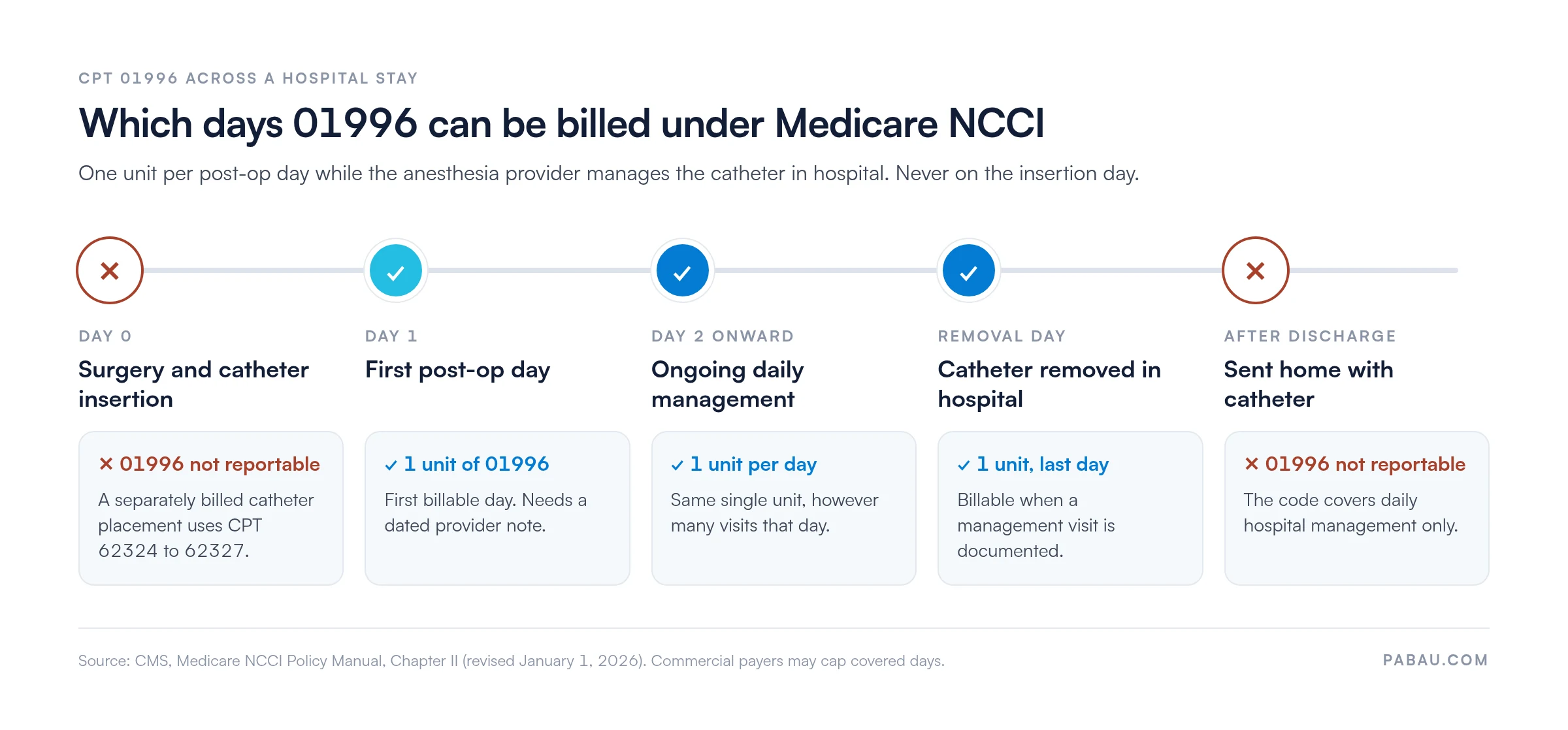
The clinical workflow behind CPT code 01996 tells coders which days are billable and what each day’s note must show. The timeline below follows a typical post-surgical hospital stay, from insertion day to removal or discharge.
Only the days between insertion and removal or discharge carry a unit of 01996, one per day. Source: CMS Medicare NCCI Policy Manual, Chapter II (2026).
Day 0 (surgery day): The anesthesiologist places the epidural or intrathecal catheter. If the catheter also provides the surgical anesthesia, its insertion is included in the anesthesia code. A catheter placed separately for postoperative pain is reported with CPT 62324-62327. Either way, 01996 is not reportable on this date.
Day 1 (first post-op day): The anesthesiologist visits the patient and assesses pain on a validated scale, typically a numeric rating scale. They review the infusion running through the catheter and record findings in a dated progress note. This is the first day CPT code 01996 is billable.
Subsequent days: Daily visits continue while the catheter remains in place and the anesthesia provider manages it. Each calendar day produces one unit of 01996, and reporting continues until the catheter is removed. If the patient is discharged with the catheter in place, 01996 is not reportable for those days.
Catheter removal day: Management on the day of removal is still billable as 01996 if a substantive assessment visit occurs and is documented. Removal of the catheter itself is typically bundled into this service rather than reported separately.
Pro Tip
Document the pain score, drug name and concentration, infusion rate, and your plan in every daily note. Payers that treat 01996 as a daily evaluation service expect the elements of a standard hospital progress note, and a missing one invites a denial.
Documentation requirements for CPT code 01996
Each 01996 claim rests on a substantive, provider-performed evaluation on that specific calendar date. Generic nursing notes or infusion pump logs do not substitute for a physician or CRNA progress note.
Every daily note should contain the following elements to support clean claim submission:
Date of service: The note must be dated and timed, since undated notes invite denial
Provider identity: The anesthesiologist or CRNA must be identified by name and credentials
Patient pain assessment: A numerical or descriptive pain score with a comparison to the prior visit
Drug regimen: Name of the drug, concentration, current infusion rate, and any bolus doses administered
Catheter site assessment: Notation that the catheter insertion site was visually inspected (erythema, leakage, displacement)
Clinical response: Patient’s response to the current regimen, including any adverse effects
Plan: Whether to continue, adjust, or remove the catheter on the next day
Supporting ICD-10 diagnosis: A diagnosis code linking the catheter management to a clinical indication (see the paired ICD-10 section below)
Before billing 01996 in a new jurisdiction, check whether your Medicare Administrative Contractor (MAC) publishes coverage guidance for anesthesia services. Requirements can vary regionally. Structured note templates, such as the medical forms in Pabau, prompt for each element at the point of care.
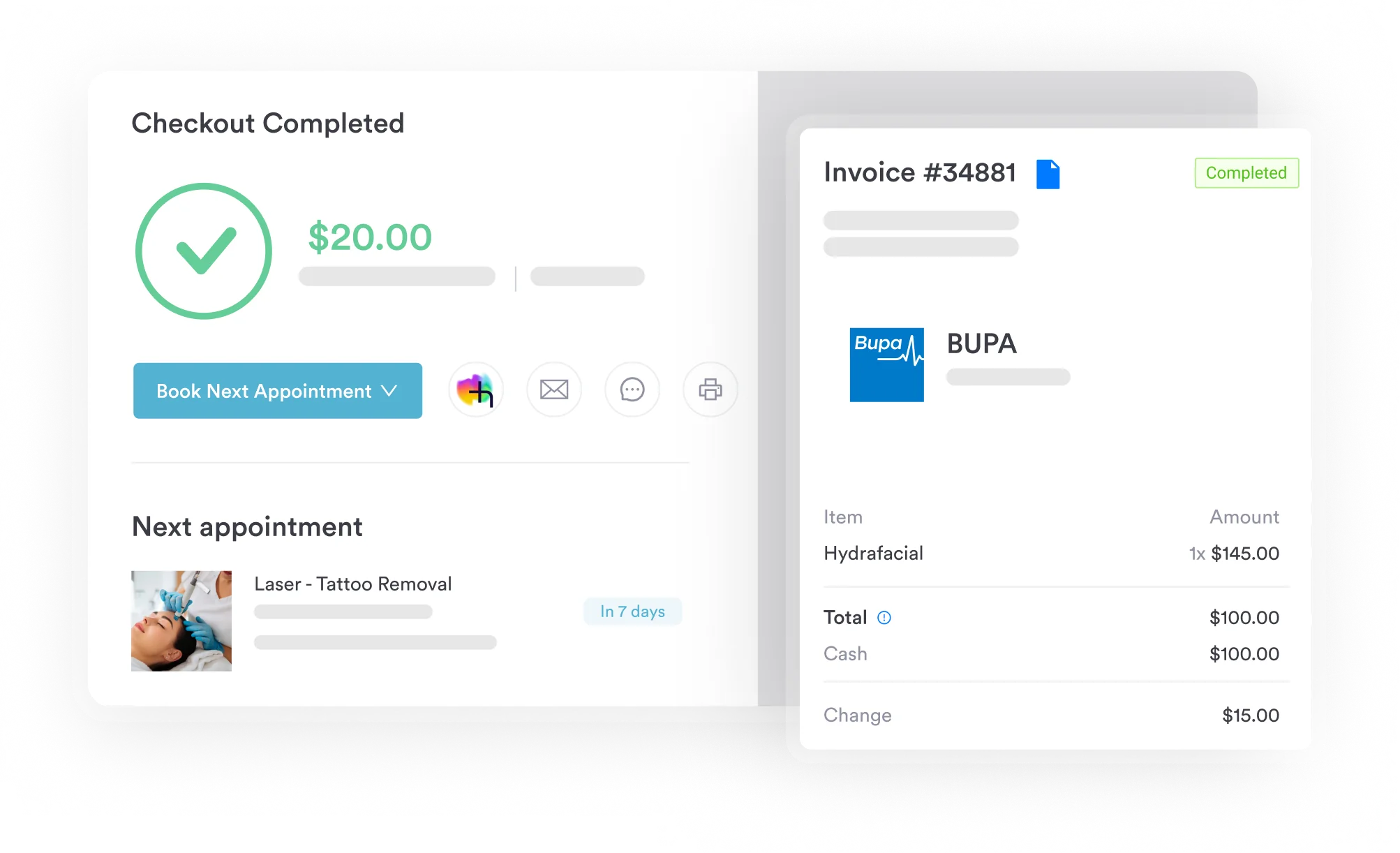
Pabau’s checkout raises the insurer invoice from the completed visit, so each billed 01996 day stays tied to that day’s patient record.
Billing guidelines for CPT code 01996: Units, frequency, and per-day rules
CPT code 01996 is a per-diem flat code. Intraoperative anesthesia codes calculate reimbursement from base units plus time units. By contrast, 01996 pays a fixed amount for each calendar day, however long the visit or however many visits occur. Submit one unit per day, one claim line per date of service.
Billing rule
Detail
Units per day
1 unit per calendar day (per-diem flat code)
Time units
None; time units do not apply to this code
Same-day as catheter placement
Medicare NCCI rule: not separately reportable on the day of insertion or the date of surgery, only on later days. Verify commercial payer policy.
First billable day
The day after catheter placement (post-operative day 1)
Maximum consecutive days
Varies by payer and MAC. Medicare has no national day cap, and contractors pay what standards of medical practice support. Some plans limit coverage, for example TRICARE to 3 days after surgery. Many commercial plans require prior authorization after day 2 or 3.
Provider requirement
Anesthesiologist or non-medically-directed CRNA (payer-dependent); hospitalists and other non-anesthesia providers generally cannot bill this code
A clearinghouse checks each 01996 claim against format and payer edits before it reaches the payer. Pabau sends claims through Claim.MD’s clearinghouse, which connects to thousands of US payers.
Medicare reimbursement for CPT code 01996
Medicare recognizes and reimburses CPT code 01996 under the Medicare Physician Fee Schedule (MPFS). The code carries assigned Relative Value Units (RVUs) across all three components: Work, Practice Expense, and Malpractice. National payment equals the total RVU multiplied by the annual conversion factor and the Geographic Adjustment Factor (GAF) for the practice location.
Reimbursement rates change each calendar year as CMS updates the conversion factor and geographic payment modifiers. For current national payment amounts, use the CMS Physician Fee Schedule lookup tool and enter code 01996 for the relevant payment year. The FastRVU lookup tool also lists Work, PE, and MP RVU values with location-adjusted allowables.
Key Medicare-specific considerations for CPT code 01996 claims:
Medicare Part B covers 01996 when billed by an anesthesiologist or non-medically-directed CRNA (payer-dependent). Only one payment is made per day, and the MAC sets any modifier requirements
Medicare does not apply the anesthesia time-unit formula to this code; it uses the standard MPFS RVU-based calculation
Some Medicare Advantage plans follow original Medicare coverage rules; others have plan-specific day limits that require prior verification
Documentation must support medical necessity for each billed day to pass review on audit
CPT code 01996 vs related codes: Avoiding common confusion
CPT code 01996 is often confused with moderate sedation codes and with anesthesia codes that sound similar. Picking the wrong code invites denials, and some code pairs are subject to National Correct Coding Initiative (NCCI) edits. See the AAPC Codify CPT lookup for the full descriptor of each code referenced below.
Code
What it describes
Key distinction from 01996
Can bill same day as 01996?
01996
Daily hospital management of epidural/subarachnoid continuous drug administration
Reference code; per-diem; anesthesia provider only
N/A
01991
Anesthesia for diagnostic or therapeutic nerve blocks and injections (when performed by a different provider), other than prone position
01991 (not prone) and 01992 (prone) cover anesthesia for a nerve block or injection performed by a different provider. Catheter placement itself is reported with 62324-62327.
Different service; under NCCI, 01996 is never reported on the catheter insertion day
99152
Moderate sedation services provided by the same physician/practitioner performing the procedure; initial 15 minutes
99152 describes procedural moderate sedation, not post-placement catheter management
Check payer and NCCI edit tables before billing both
99183
Physician attendance and supervision of hyperbaric oxygen therapy
Different modality entirely. 99183 is a physician supervision code reported per session, but it describes HBO therapy, not epidural management.
Generally yes, if both services genuinely occur
Commonly paired ICD-10 diagnosis codes for CPT code 01996
Every CPT code 01996 claim needs a supporting ICD-10-CM diagnosis code that establishes medical necessity for continued catheter management. Without a credible diagnosis linkage, claims fail medical necessity review. The table below lists codes often used on post-operative epidural management claims. Diagnosis requirements may vary by MAC jurisdiction and payer.
ICD-10-CM code
Description
When to use with 01996
G89.18
Other acute postprocedural pain
Post-operative pain not classified under a more specific code; a common diagnosis with 01996
G89.28
Other chronic postprocedural pain
Use when the clinical record establishes that post-operative pain has become chronic (typically beyond expected healing timeframe)
Z45.49
Encounter for adjustment and management of other implanted nervous system device
Use when the catheter management is framed as device management rather than pain treatment (less common for temporary post-surgical catheters)
G89.29
Other chronic pain
Secondary code option when chronic pain related to the surgery or underlying condition drives the need for continued management
Z96.89
Presence of other specified functional implants
Secondary code when catheter presence is relevant to the encounter context; rarely used as primary
Coding tip:G89.18 is the usual starting point for 01996 claims. If a more specific postprocedural pain code fits, such as G89.12 for acute post-thoracotomy pain, use it instead. ICD-10-CM sequencing rules favor specificity.
Top claim denial reasons for CPT code 01996 and how to prevent them
Denials for CPT code 01996 cluster around a handful of predictable causes. Each one has a prevention step that works before the claim leaves the practice. For the wider process, see Pabau’s guide to denial management in healthcare and the reference on medical billing denial codes.
Denial reason
Prevention step
Billed same date as catheter placement
Build a charge-entry rule that blocks 01996 when the placement or surgery falls on the same date of service
Missing anesthesiologist’s dated progress note
Require a signed, dated provider note before each daily charge is entered; no note means no charge
Exceeds payer’s authorized number of post-op days
Verify benefits and day limits at admission, record them on the case, and request authorization before the limit is reached
Wrong provider type submitted as billing provider
Confirm that the billing NPI belongs to an anesthesiologist or non-medically-directed CRNA; a hospitalist billing this code will be denied
Duplicate date-of-service billing
01996 pays one unit per day, so a second unit for the same date and patient is denied; check for duplicates before submission
Insufficient medical necessity documentation
Use a structured daily note template that captures pain score, drug regimen, catheter site exam, and next-day plan
Pro Tip
Run a quarterly audit of 01996 claims and pull every date where the code appears alongside the catheter placement code on the same NPI. Any match signals a systematic error in either the placement date or the management date. Fix the root cause in the charge entry workflow, not just the individual claim.
Payer-specific considerations and prior authorization for CPT code 01996
Coverage rules for CPT code 01996 differ by payer type, so the same documented visit can be paid by one plan and denied by another. These rules reflect the broader complexity of medical billing compliance that anesthesia practices navigate:
Medicare: No national day cap applies. Contractors pay for the days that standards of medical practice support, and NCCI rules bar billing on the insertion day. Medical necessity review on audit is the main risk.
Medicaid: State Medicaid programs vary significantly. Some cover 01996 for limited post-operative indications; others do not cover the code at all. Verify with the state’s Medicaid provider manual before billing. Never assume Medicare coverage rules apply to Medicaid claims.
Commercial insurers: Many commercial plans limit 01996 to 2 or 3 days without prior authorization. Claims beyond the threshold may be denied until authorization is obtained. Some plans require authorization before the admission, not after the first denial.
Medicare Advantage: Treat each Medicare Advantage plan as a commercial plan with its own authorization requirements. The plan’s Evidence of Coverage document and provider portal are the authoritative references, not original Medicare policy.
Practical step: Build a benefits-verification step for every patient who will receive a post-operative epidural or intrathecal catheter. Confirm coverage of 01996 and the number of covered days at admission, not on the day a denial arrives.
How Pabau supports CPT code 01996 billing and documentation
The hardest part of billing CPT code 01996 is the daily routine around it. A provider managing catheters on several floors can miss a day, submit a date twice, or bill without that day’s note.
With Pabau’s claims management software, practices can record each day’s note, the authorization and the claim on the same patient record. That keeps the evidence for every billed day in one place when a payer asks for records.
Clearinghouse submission: Claims go through Claim.MD, with eligibility checks before the claim goes out
Electronic remittance: ERA files come back from the payer, so the team sees which days paid and which were denied
Prior-authorization tracking: Authorizations sit on the case, and Pabau warns when a case is missing one
Covered-day records: Practices can record each patient’s covered days on the case, so the billing team knows when a plan’s limit is near
Cut avoidable denials on anesthesia claims
Pabau sends claims through Claim.MD with eligibility checks and ERA remittance, and warns when a case is missing its prior authorization.
CPT code 01996 looks simple on paper: one unit per hospital day after the catheter goes in. Common denial risks include billing on the placement date, a missing dated provider note, and exceeding a payer’s covered post-op days. Medicare NCCI does not pay the code on the placement date at all.
The fix sits upstream of the claim. Confirm covered days and authorization at admission, and require a signed note before each day’s charge. Stop reporting once the catheter comes out or the patient goes home.
Pabau keeps the note, the authorization and the claim on one patient record, then sends the claim through Claim.MD. Book a demo to see how that workflow fits your anesthesia and pain management billing.
Continue your research
Need a framework for managing claim denials systematically?Denial management in healthcare covers root-cause analysis, workflow corrections, and appeal strategies for high-denial codes.
Unclear on how clearinghouses process anesthesia claims?Claim.MD clearinghouse guide explains payer connectivity, 837P transmission, and ERA reconciliation for US practices.
Looking for a primer on the full billing cycle?What is revenue cycle management breaks down each stage from charge capture through payment posting.
Frequently asked questions
What is CPT code 01996?
CPT code 01996 is the billing code for daily hospital management of epidural or subarachnoid continuous drug administration. Anesthesiologists and CRNAs use it to report each calendar day they manage an in-place catheter delivering pain medication to a hospitalized post-operative patient. It belongs to the CPT Anesthesia section and is a per-diem code with no time units.
How many times can CPT code 01996 be billed per day?
Once per calendar day. CPT code 01996 is a per-diem flat code, so only one unit is submitted per date of service. The count of visits or catheter adjustments that day does not change it. A second unit for the same patient and date is denied as a duplicate.
Does Medicare reimburse CPT code 01996?
Yes. Medicare pays CPT code 01996 under the Physician Fee Schedule when an anesthesiologist or non-medically-directed CRNA reports it and documentation supports medical necessity. Only one payment is made per day. Payment is the code’s RVUs multiplied by the annual conversion factor and the geographic adjustment factor. Current rates are in the CMS Physician Fee Schedule lookup tool.
What is the difference between CPT code 01996 and CPT 99152?
CPT code 01996 covers daily management of an epidural or subarachnoid catheter that is already in place. CPT 99152 covers procedural moderate sedation given by the physician performing a separate procedure. The codes describe different services, so check payer and NCCI edit tables before billing both.
What are the most common claim denial reasons for CPT code 01996?
Common denial risks include billing 01996 on the catheter placement date, missing or undated provider notes, and exceeding a payer’s covered post-operative days. Claims submitted under a non-anesthesia provider’s NPI are also denied. Pre-submission charge checks, structured daily notes and benefits verification at admission prevent each of these.
Can CPT code 01996 be billed on the same day as catheter placement?
No, not under Medicare. CMS NCCI rules make 01996 not separately reportable on the day of catheter insertion or the date of surgery, only on later days. Verify commercial payer policy, since plans set their own rules.