



CCSD code G5100: Bypass of duodenum billing guide
CCSD code G5100 bills a bypass that leaves the duodenum in place CCSD code G5100...

Last Updated: Oct 16, 2026

CPT Code 01922 describes anesthesia for non-invasive imaging or radiation therapy, including MRI, CT, PET scans, X-rays, and stereotactic radiation sessions.
Base unit value is 7; total reimbursement equals (base units + time units) multiplied by the Medicare anesthesia conversion factor, which varies by geographic location.
Modifier selection is the most common billing error: use AA for physician-only care, QZ for unsupervised CRNA, QX/QY/QK for medically directed scenarios.
Practice management software like Pabau helps cut down on these errors with digital forms that capture documentation at the point of care, plus claims management tools that automate submission, validation, and tracking.
CPT Code 01922 describes anesthesia services provided during a non-invasive imaging procedure or a radiation therapy session, such as MRI, CT, PET, or stereotactic radiosurgery. The code applies to the anesthesia encounter itself, not the imaging or radiation procedure performed alongside it.
The American Medical Association (AMA) maintains the CPT code set, and CPT Code 01922 sits within the Anesthesia for Radiological Procedures subsection.
The official long description reads: Anesthesia for non-invasive imaging or radiation therapy. The short description used on most claim forms is: Anes non-invasive imaging/radiation therapy.
The code covers any session where a provider delivers anesthesia services to support a patient undergoing a non-invasive imaging procedure or a radiation therapy treatment. Neither the imaging modality nor the radiation approach needs to be specified on the claim; the code applies to the anesthesia encounter itself.
CPT Code 01922 applies when a provider administers anesthesia services during non-invasive imaging or radiation therapy sessions. “Non-invasive” is the operative word: the code does not cover anesthesia for image-guided interventional procedures such as needle biopsies, drain placements, or intravascular catheter work.
The most common clinical applications covered by this code include the following procedure types.
What this code does not cover: Anesthesia for invasive imaging procedures (e.g., arthrography with injection, myelography, or intravascular contrast studies) uses different anesthesia codes. Verify the procedure type with the proceduralist before assigning 01922.
Anesthesia reimbursement follows a base unit plus time unit formula that differs from the RVU-based model used for surgical and evaluation and management codes. For CPT Code 01922, the base unit value is 7, confirmed by the American Society of Anesthesiologists (ASA) Relative Value Guide and consistent across CMS fee schedule data.
The calculation works as follows:
For a 45-minute MRI anesthesia session: base units (7) plus time units (3, representing three 15-minute intervals) equals 10 total units before conversion factor. Apply the relevant Medicare conversion factor for your locality to reach the payment amount.
Use the FastRVU 2026 lookup tool to pull current geographic conversion factor data, then cross-check it against Medicare’s own fee schedule for your locality.
Modifier selection drives more anesthesia claim denials than any other single coding decision. The modifier communicates the care delivery model to the payer: who provided the anesthesia, and in what supervisory arrangement.
Missing or incorrect modifiers on CPT Code 01922 are the fastest path to a preventable denial. The AAPC Codify CPT lookup provides a reference list of valid anesthesia modifiers.
Medicare pays at 50% of the AA rate when modifier QK or QY applies. Confirm current payer-specific rules with each commercial carrier, as contractual rates differ from Medicare’s published schedule.
Qualifying circumstances (QC) are add-on codes that reflect increased complexity of anesthesia services. They may be reported alongside CPT Code 01922 when the specified clinical condition is present and documented. Payer acceptance of qualifying circumstance codes varies; verify policy before billing.
Code 99100 is the most commonly applicable QC code for CPT 01922, particularly in pediatric MRI and radiation therapy cases. Document the patient’s age explicitly in the anesthesia record; payers will request this to support the additional units.
Medicare reimbursement for CPT Code 01922 follows the anesthesia payment formula rather than the standard RBRVS system. The Centers for Medicare and Medicaid Services (CMS) sets a national anesthesia conversion factor, adjusted by the Geographic Practice Cost Index (GPCI) for each locality.
That means a 45-minute MRI anesthesia case billed in Manhattan is reimbursed differently than the same case in rural Mississippi.
The formula is: Total units x (Anesthesia CF x GPCI) = Medicare allowable amount. For the most current conversion factor and locality-specific multipliers, always consult the CMS Physician Fee Schedule rather than relying on prior-year figures. Conversion factors change annually and mid-year corrections do occur.
Key reimbursement facts for CPT Code 01922:
Accurate diagnosis code pairing supports medical necessity on CPT Code 01922 claims. The ICD-10-CM codes most frequently submitted alongside this code reflect the underlying conditions driving the imaging or radiation therapy encounter, from behavioral indications like F84.0 to incidental findings coded as Z03.89.
Many of these diagnoses arrive as referrals: a GP practice flags a behavioral concern.
Always code to the highest degree of specificity available in the medical record. Payers may request supporting clinical documentation for Z-codes or unspecified codes when billed with anesthesia services.

Pabau’s claims management software helps you submit, validate, and track anesthesia claims, while digital forms capture the documentation your billing team needs before claims go out the door.

Insufficient documentation is the second most common reason CPT Code 01922 claims are denied or downgraded on audit. Anesthesia records must stand on their own; a vague proceduralist’s operative note does not substitute for a complete anesthesia record. Using digital anesthesia forms within your practice management platform reduces the risk of incomplete records reaching the billing queue.

Every CPT 01922 claim should be supported by documentation that covers these core elements.
Practices using HIPAA-compliant practice software can automate time-stamped documentation entries, reducing the manual burden of building a complete anesthesia record.
Non-invasive imaging anesthesia billing produces a consistent set of errors across practices. Most are avoidable with the right documentation workflow and modifier review process.
Billing teams covering multiple specialties may also want to check Pabau’s newest coding guides.
Audit your last 30 CPT 01922 claims before year-end. Check modifier consistency, verify time unit calculations against documented start and stop times, and confirm qualifying circumstance codes have supporting clinical documentation. A 30-claim self-audit typically surfaces the same two or three systemic errors repeatedly, making them quick to fix practice-wide.
When CPT Code 01922 does not match the procedure performed, the following related anesthesia codes are the most common alternatives. Selecting the correct code from this group requires knowing whether the imaging procedure was invasive, whether a catheter was placed, and the anatomical region involved.
Recent additions to the library include coaching CPT codes and a billing guide for G0180.
When the radiologist or radiation oncologist performs an invasive step (e.g., placing a catheter for image-guided injection), the anesthesia code shifts from 01922 to the appropriate interventional code. Coordinate with the proceduralist’s billing team to confirm whether any invasive element was performed.
Anesthesia billing errors are rarely random. They cluster around the same three steps: modifier selection at the time of service, time documentation during the procedure, and qualifying circumstance validation at claim submission. Each step requires the billing team to manually retrieve information that was created in the clinical workflow but never connected to the billing record.
Practice management software changes this by connecting clinical documentation to the billing process instead of leaving the two disconnected. Practice management software like Pabau captures anesthesia records, including start and stop times, agents used, and pre- and post-procedure notes, through digital forms completed at the point of care.
That information already sits in Pabau’s claims management software by the time a claim is prepared, rather than being reconstructed from a paper record hours or days later.

The practical result is fewer incomplete claims reaching the clearinghouse.
Pabau’s claims management software also automates claim submission, validation, and tracking.
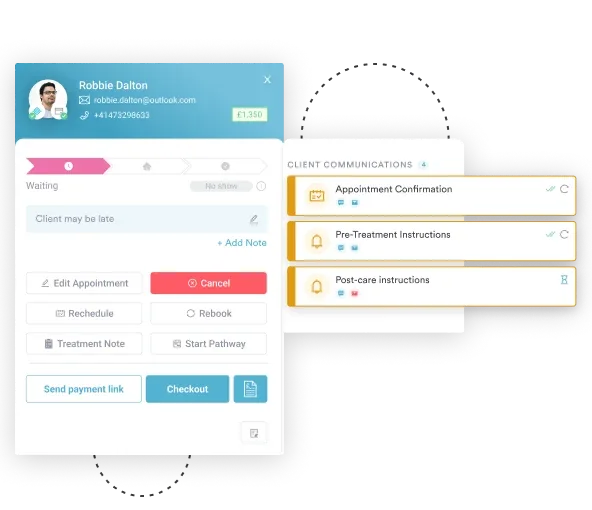
Documentation-to-claim continuity also matters for audit defense. When a payer requests supporting records for a CPT 01922 claim, a complete time-stamped anesthesia record generated within the practice management system is easier to produce and more defensible than reconstructed paper records, whether the diagnosis pairs with C71.9 or a general-symptom code like R68.89.
CPT Code 01922 is a straightforward code with a narrow failure window: the base units are fixed, the procedures it covers are well-defined, and the formula for calculating payment is consistent. The errors that generate denials come from modifier mismatches, incomplete time documentation, and qualifying circumstance codes without clinical backing.
Practice management software like Pabau connects anesthesia documentation to claims management, with digital forms that capture records at the point of care and claims tools that automate submission, validation, and tracking. To see how Pabau can support your anesthesia billing workflow, book a demo with the team.

Billing an anticoagulant injection and hitting a denial? Tinzaparin sodium billing guide explains why this deleted code no longer belongs on a claim.
Billing an iron infusion and second-guessing the unit count? Iron sucrose billing guide explains why a 200 mg infusion bills as 200 units, not by the vial.
Billing a leuprolide depot injection this month? Leuprolide acetate billing guide covers the unit math and when a dose belongs under a different code.
CPT Code 01922 is an anesthesia billing code that describes anesthesia services provided during non-invasive imaging or radiation therapy procedures. It covers sessions such as MRI, CT scan, PET scan, X-ray, and external beam or stereotactic radiation therapy where the patient requires sedation or general anesthesia to complete the procedure. The code belongs to the Anesthesia for Radiological Procedures subsection of the CPT code set maintained by the AMA.
The base unit value for CPT 01922 is 7, as established by the American Society of Anesthesiologists Relative Value Guide. Total reimbursement is calculated by adding these 7 base units to the time units accrued during the procedure (1 unit per 15 minutes), then multiplying the total by the applicable anesthesia conversion factor for your Medicare locality or commercial payer contract.
The most commonly used modifiers are AA (anesthesiologist personally performing the service), QZ (CRNA without physician supervision), QX (CRNA with medical direction), QY (physician directing one CRNA), QK (physician directing two to four concurrent CRNA cases), QS (monitored anesthesia care), and AD (physician supervising more than four concurrent cases). Modifier selection must reflect the care delivery model used, as incorrect modifiers are a leading cause of anesthesia claim denials and compliance risk.
Yes, Medicare covers CPT Code 01922 under Part B when the anesthesia service is medically necessary. Reimbursement is calculated using the anesthesia unit formula and the Medicare anesthesia conversion factor, adjusted by the Geographic Practice Cost Index for your locality. Verify current rates using the CMS Physician Fee Schedule lookup tool, as conversion factors are updated annually and vary by Medicare administrative contractor region.
CPT 01922 applies exclusively to non-invasive imaging and radiation therapy where no catheter, needle, or invasive access is involved. Codes 01924 and 01925 cover anesthesia for therapeutic interventional radiological procedures where arterial catheter access is part of the case. When the imaging encounter includes any invasive element performed by the proceduralist, the anesthesia code shifts to the appropriate interventional code. Always confirm with the proceduralist’s billing team whether an invasive step occurred.
Reimbursement equals total anesthesia units multiplied by the applicable conversion factor. Total units = base units (7) plus time units (1 per 15 minutes) plus any qualifying circumstance units (99100 adds 1 unit, 99140 adds 2, 99116 and 99135 each add 5). The conversion factor is set by the payer: Medicare uses a national base adjusted by GPCI for your locality; commercial carriers negotiate their own rates. Use the PGM Billing CPT lookup or CMS fee schedule tool for current payment estimates.



