



CCSD code G5100: Bypass of duodenum billing guide
CCSD code G5100 bills a bypass that leaves the duodenum in place CCSD code G5100...

Last Updated: Oct 16, 2026

CPT code 01710 covers anesthesia for nerve, muscle, tendon, fascia, and bursa procedures of the upper arm and elbow that don’t have a more specific code. It carries 3 base units.
Reimbursement equals base units plus time units, multiplied by the anesthesia conversion factor. Medicare adds no extra units for physical status; the ASA Relative Value Guide and some commercial payers do.
01710 is not a catch-all for the whole 01710-01782 range. Elbow arthroscopy, humerus osteotomy, and tendon repair each have their own, more specific code.
Practice management software like Pabau validates that required insurer-submission fields are complete before a claim can send, and gives a claim-status dashboard, but it doesn’t select CPT codes or check modifier math.
CPT code 01710 is the anesthesia code for soft-tissue work, nerves, muscles, tendons, fascia, and bursae, on the upper arm and elbow when no more specific code applies. It carries 3 base units, not 5, and that single number touches nearly every dollar figure that follows it on a claim.
Reach for 01710 when a more specific sibling code actually fits better, or mismatch the physical status modifier, and the claim comes back. Anesthesia billing rewards precision: the right scope, the right modifier, the right math. Here’s what CPT code 01710 actually covers, and where practices most often get it wrong.
The official AMA descriptor reads: Anesthesia for procedures on nerves, muscles, tendons, fascia, and bursae of upper arm and elbow; not otherwise specified. That’s a soft-tissue scope, not a catch-all for the entire 01710-01782 range.
01710 applies when the surgical work is genuinely soft tissue, and no more specific code in the range describes it. Common scenarios include:
01710 isn’t the default whenever a procedure happens to sit in the upper arm or elbow. Elbow arthroscopy has its own code, 01732. Humerus osteotomy has its own code, 01742. Open or surgical arthroscopic elbow work that isn’t otherwise specified is 01740. 01710 is reserved for the soft-tissue procedures those codes don’t cover.
CPT code 01710 carries 3 base units, set by the ASA Relative Value Guide and confirmed on the VA’s nationwide anesthesia base-unit table. That number reflects the complexity and risk of the anesthesia service itself, independent of how long the case runs.
Anesthesia reimbursement isn’t a flat fee. It’s built from three components:
Here’s how that plays out for a 45-minute soft-tissue procedure on a P3 patient, billed under a commercial payer that follows the ASA Relative Value Guide: 3 base units + 3 time units + 1 modifying unit for P3 status = 7 total units.
At an illustrative $22 conversion factor, that’s 7 x $22 = $154. Medicare handles physical status differently, more on that below.
Two categories of modifier apply to every CPT code 01710 claim: physical status modifiers that describe the patient, and medical direction modifiers that describe the provider arrangement.
P1 through P6 classify the patient’s health at the time of anesthesia. Medicare pays $0 in additional units for any physical status modifier. The ASA Relative Value Guide, and some commercial payers, add modifying units for P3 through P5 instead. Confirm which method a payer uses before totaling a claim.
The provider arrangement, whether an anesthesiologist performs the case personally or medically directs a CRNA, determines which modifier goes on the claim. Getting this wrong is one of the most common compliance issues in anesthesia billing.
Medical direction rules follow CMS’s seven required activities under 42 CFR 415.110, and state scope-of-practice law can add further conditions in opt-out states. Confirm both before finalizing the modifier on a CPT code 01710 claim.
Practice management software like Pabau doesn’t choose this modifier for you. Its digital forms handle patient intake and consent capture ahead of the procedure, not the intraoperative anesthesia record, so start and stop times and the modifier decision still sit with your anesthesia documentation process.
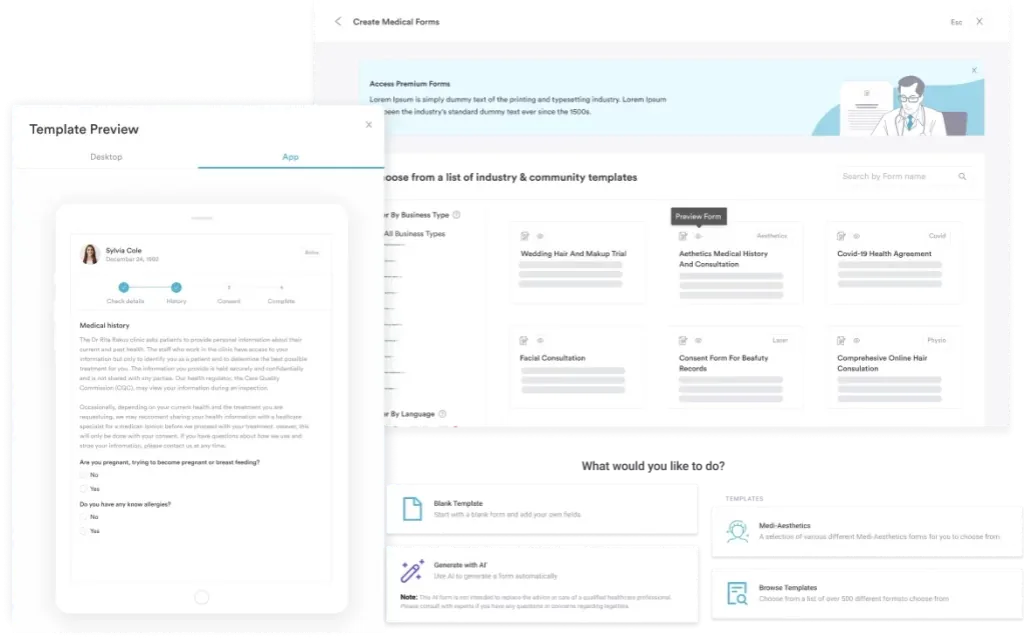

Practice management software like Pabau helps surgical practices keep claim documentation and submission status in one place, so incomplete insurer fields surface before a CPT code 01710 claim gets denied.

The best medical practice management tools capture start and stop times at the point of care, which anesthesia billing depends on.
Medicare reimbursement for CPT code 01710 comes from base units plus time units, multiplied by the anesthesia conversion factor. Physical status adds no units under Medicare policy, so the totals below reflect base and time only.
QK/QX medical direction pairs split that same total 50/50. A P3 patient’s 60-minute case, 7 units at approximately $20.50, pays roughly $71.75 to the directing physician and $71.75 to the CRNA, for the same claim.
Always verify the current-year conversion factor against the CMS Physician Fee Schedule or a tool like FastRVU’s RVU lookup before billing.
Commercial payers use the same base-plus-time structure, but set their own conversion factor and, in some cases, their own physical status add-ons.
Rates are contractual and not publicly posted, so treat any published commercial benchmark as directional only. Confirm the actual figure in each payer contract before billing CPT code 01710.
Qualifying circumstances are add-on codes billed alongside CPT code 01710 when a specific clinical condition applies. They add units on top of the base, not instead of it, and each one carries its own value.
Practices commonly omit 99100 for elderly patients. That share of upper arm and elbow soft-tissue cases is meaningful, and the extra unit is easy to overlook.
99116 and 99135 apply less often to 01710 specifically, since total body hypothermia and controlled hypotension show up more in higher-acuity anesthesia, but document them whenever the technique is genuinely used.
Build a pre-submission checklist for every CPT code 01710 claim: (1) confirm the procedure is genuinely soft tissue, not arthroscopy (01732/01740), osteotomy (01742), or tenotomy/tenoplasty/tenodesis (01712/01714/01716); (2) verify 3 base units are used, not 5; (3) match the physical status modifier to the pre-anesthesia note, and remember Medicare adds no units for it; (4) confirm the medical direction modifier against the OR schedule; (5) cross-check time units against the anesthesia record. Five checks, no surprises.
CPT code 01710 needs a supporting ICD-10-CM diagnosis to establish medical necessity. Because 01710 covers soft-tissue procedures specifically, the diagnosis should point to nerve, muscle, tendon, fascia, or bursa pathology, not a fracture or joint-replacement diagnosis that belongs to a different anesthesia code.
These pairings are guidance only. Medical necessity depends on individual payer policy, and laterality plus encounter-type specificity still has to match the documentation. Use the CDC/NCHS ICD-10-CM web tool to confirm each code’s active status before billing.
01710 is the NOS code for soft-tissue work only. Sibling codes in the same 01710-01782 range cover more specific procedures, and mixing them up is one of the most common audit findings for this code family.
01730 covers closed procedures on the humerus and elbow with no more specific code, at 3 base units, not the “radical procedures” label sometimes attached to it. Radical procedures on the humerus have their own code, 01756, at 6 base units. Don’t conflate the two.
When the procedure is a diagnostic elbow arthroscopy, 01732 is the more specific code and should be used instead of 01710. For tenotomy specifically, 01712 (5 base units) applies. Selecting 01710 NOS when a specific code exists is an audit risk. Closed procedures on the humerus and elbow without a more specific match instead point to 01730. Claim accuracy is cheaper to build at entry than to repair in an appeal. Practices that review a sample of notes each month catch documentation level drift before a payer does.
Accurate billing for CPT code 01710 depends on complete anesthesia records. CMS requires specific documentation elements to support payment; missing any of them can trigger a denial or an audit request.
The following errors account for most CPT code 01710 denials. Each is preventable with the right workflow checks in place.
Most CPT code 01710 denials trace back to an incomplete claim, not a coding mistake. The code was right; a required field just wasn’t filled in before the claim went out.
Practice management software like Pabau doesn’t choose your CPT code or check your modifier math. What it does is connect documentation to submission, so a missing field surfaces before the claim goes out.
None of that replaces a correct base-unit count or the right modifier pairing. It just means the paperwork around the claim doesn’t become its own source of denials.
CPT code 01710 has one job: soft-tissue anesthesia on the upper arm and elbow when nothing more specific fits. Three base units, an NOS scope limited to nerves, muscles, tendons, fascia, and bursae, that part is straightforward.
The complexity shows up in what surrounds it: choosing 01710 over a more specific sibling code, applying the physical status modifier without over-adding Medicare units, and pairing the right ICD-10 diagnosis.
Practice management software like Pabau keeps claim documentation and submission status in one place, so an incomplete insurer field surfaces before a CPT code 01710 claim gets denied, not after. If tightening billing accuracy for anesthesia claims is on your list, book a demo and see how it fits your practice’s workflow.

Billing anesthesia for upper arm tendon surgery? 01712 covers tenotomy specifically, at its own base-unit value.
Coding a humerus osteotomy instead? 01742 is the code the surgeon’s op note actually points to, not 01710.
Need the artery-procedure code for this same region? 01770 covers upper arm and elbow artery work under the same base-plus-time formula.
Looking for the vein-repair equivalent? 01782 rounds out the 01710-01782 family for upper arm and elbow vein procedures.
No. Anesthesia codes are reported once per anesthetic episode, no matter how many soft-tissue sites the surgeon treats. Time units capture the full case duration instead.
Yes. CPT code 01710 is active in the 2026 code set, with no revisions or deletions reported. Confirm current status against the AMA’s CPT code set at the start of each year.
No. Anesthesia services require in-person, hands-on care, so telehealth place-of-service codes don’t apply to 01710 or any other anesthesia code.
Anesthesiologists, CRNAs, and anesthesiologist assistants can each administer it. The modifier on the claim identifies the provider relationship and how payment splits.
Most claims use POS 21, 22, or 24: inpatient hospital, outpatient hospital, or ambulatory surgical center, matching where the procedure happens.
Rarely, but yes. If the anesthesia work was substantially more complex than the code typically describes, modifier 22 can apply with supporting documentation. Payers still evaluate it case by case.



