



CCSD code G5100: Bypass of duodenum billing guide
CCSD code G5100 bills a bypass that leaves the duodenum in place CCSD code G5100...

Last Updated: Oct 16, 2026

CPT Code 00174 describes anesthesia for intraoral procedures, including biopsy; excision of retropharyngeal tumor, classified under the CPT head anesthesia section (00100-00222).
The code carries 6 base units; total reimbursement is calculated using: (base units + time units + modifying units) x conversion factor.
Common billing errors include omitting the QS modifier for MAC cases and misapplying CRNA supervision modifiers (QX, QY, QZ, QK) without confirming the medical direction ratio.
Pabau’s claims management software supports accurate CPT code submission with procedure code libraries and digital documentation workflows that reduce claim errors.
CPT Code 00174 is the anesthesia code for intraoral procedures, including biopsy or excision of a retropharyngeal tumor, billed within the CPT Head Anesthesia section (00100-00222). It carries 6 base units and is frequently confused with the adjacent not-otherwise-specified code, CPT 00170.
This reference guide covers the official descriptor for CPT Code 00174, its 6 base units, the anesthesia billing formula with a worked example, applicable modifiers, qualifying circumstances, ICD-10 crosswalk codes, and documentation requirements for clean claim submission.
CPT Code 00174 is the correct procedure code for anesthesia services provided during intraoral surgical procedures, including biopsy; excision of retropharyngeal tumor. It sits within the CPT Anesthesia section, under the subsection covering procedures on the head (codes 00100-00222), as maintained by the American Medical Association (AMA), the authoritative body for CPT code definitions.
The code covers anesthesia services for intraoral surgical procedures where a retropharyngeal tumor excision is performed, as named specifically in the descriptor. Oral and maxillofacial procedures requiring intraoral access to excise a retropharyngeal tumor should use CPT Code 00174 rather than a more general intraoral biopsy code. See also other CPT coding references on the Pabau procedure codes resource library. Payment posting from a remittance file is faster than manual entry and keeps the adjustment reasons attached. Two practices can bill the same encounter at a different visit level, and the note settles which was right.
CPT 00174 carries 6 base units. Base units represent the inherent complexity and risk of the anesthesia service itself, independent of how long the procedure takes. The American Society of Anesthesiologists (ASA) assigns base unit values; higher-risk or more technically demanding procedures carry more base units.
For context, common head anesthesia codes carry between 4 and 15 base units. At 6 units, CPT 00174 sits toward the lower end of that range. Time units are added on top, which is covered in the billing formula section below.
Anesthesia billing uses a unit-based formula, not the standard RVU system used for most other CPT codes. The CMS Physician Fee Schedule publishes the Medicare anesthesia conversion factor annually; commercial payers set their own conversion factors, which vary by contract.
The formula is: (Base Units + Time Units + Modifying Units) x Conversion Factor = Reimbursement. The Medicare conversion factor changes annually and varies by geographic locality. Use the FastRVU 2026 RVU lookup to confirm current-year Medicare anesthesia conversion factor values by locality. Commercial payer rates are contract-specific and often higher than Medicare.
Time reporting: most payers follow the CMS standard of 1 time unit per 15 minutes. Some commercial payers use 10-minute increments. Verify your payer’s time unit convention before submitting claims for CPT Code 00174 to avoid systematic underpayment or audit flags.
The best medical practice management tools capture start and stop times at the point of care, which anesthesia billing depends on.
Modifier selection is where most CPT 00174 claims run into trouble. Anesthesia modifiers signal who delivered the service and under what supervision arrangement. Selecting the wrong modifier triggers denials and can flag an account for audit. Use AAPC Codify to verify modifier applicability against current payer policies.
For anesthesia and procedure code modifiers, the supervision ratio matters. Medicare distinguishes between medical direction (QX/QY/QK, where the anesthesiologist directs 1-4 CRNAs and meets specific service requirements) and medical supervision (AD, for 5+ concurrent cases).
Misapplying these modifiers constitutes an incorrect claim. The same supervision-ratio logic applies to other anesthesia codes.
Qualifying circumstances are add-on codes reported alongside the primary anesthesia code when specific clinical conditions are present. They add modifying units to the billing formula. Each has strict clinical criteria; billing these codes without documentation support creates upcoding risk.
Code 99100 is the most frequently applicable for intraoral procedures, since pediatric and geriatric patients are common in this procedure category. The same add-on codes apply across the anesthesia code set.
The emergency code 99140 requires documentation that the patient’s life was at immediate risk, not merely that a procedure was performed urgently. Payer acceptance of qualifying circumstances varies; verify with each payer before reporting.
Anesthesia codes are typically paired with the diagnosis code that describes the condition requiring the surgical procedure. For CPT Code 00174, the relevant ICD-10 diagnosis codes reflect the underlying pathology prompting the intraoral procedure or the retropharyngeal tumor excision.
Use the AAPC CPT-to-ICD-10 crosswalk to confirm medical necessity pairings for your payer’s LCD or NCD requirements. A benign nasopharyngeal mass, for example.
Always confirm ICD-10 pairings against your payer’s Local Coverage Determination (LCD) or National Coverage Determination (NCD) before claim submission. Diagnosis code documentation in the anesthesia record must support medical necessity — for example.
CPT 00174 is frequently confused with the adjacent code CPT 00170. Both cover intraoral procedures, but CPT 00170 is the not-otherwise-specified (NOS) code for intraoral biopsy procedures, while CPT 00174 is reserved specifically for anesthesia during excision of a retropharyngeal tumor. Billing the wrong code is a frequent denial trigger in the head anesthesia range.
The two codes differ by one base unit (5 for 00170 versus 6 for 00174), so reimbursement is slightly higher for 00174. The distinction matters most for medical necessity alignment: the ICD-10 diagnosis code paired with the claim should match the specific procedure described by the CPT code selected.
The operative note should clearly document a retropharyngeal tumor excision before 00174 is used instead of the NOS code 00170. For surgical procedure coding guidance across specialties.
Clean claims for CPT Code 00174 require a complete anesthesia record. Missing or incomplete documentation is the most common reason for post-payment audit recoupment in the anesthesia code range. Maintaining HIPAA-compliant documentation practices is also a baseline requirement for all anesthesia claims.
For practices using digital workflows. The same standardization matters whether anesthesia is coordinated at a surgical facility or through a private practice referring patients out for the procedure.
Practices that embed documentation prompts into their workflows report fewer missing-data denials on anesthesia claims.
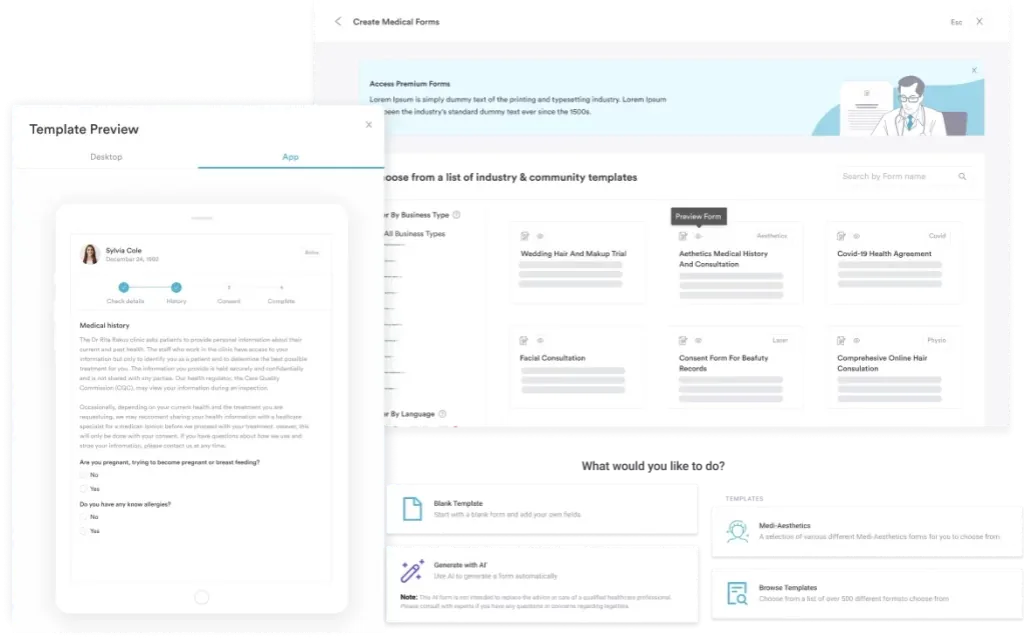
Audit your anesthesia records quarterly for missing start and stop times. A single missing time field converts a clean 00174 claim into a documentation deficiency, often resulting in a request for additional information or outright denial. Build a pre-submission checklist into your billing workflow to catch these issues before the claim leaves your practice.
Anesthesia billing practices that struggle with CPT Code 00174 denials often have a documentation problem, not a coding knowledge problem. Pabau’s claims management software includes a built-in CPT procedure code library, enabling billing teams to attach the correct code, modifiers, and supporting documentation at the point of care rather than reconstructing records after the fact.
For practices where anesthesiologists or CRNAs need to capture pre-anesthesia evaluation notes efficiently.
Surgical practices managing anesthesia coordination alongside procedural workflows benefit from surgical practice management tools that connect clinical and billing functions in a single system.

Pabau’s claims management software supports accurate CPT code submission with procedure code libraries, digital documentation, and built-in billing workflows designed for surgical and anesthesia practices.

CPT 00174 belongs to the head anesthesia code range, which covers procedures from the scalp through the oral cavity and facial structures.
Selecting the most specific applicable code within this range is required. Use the procedure documentation to determine the correct code rather than defaulting to the most familiar one.
Radical intraoral surgery (00176) and radical surgery of facial bones or skull (00192) carry higher base units than CPT 00174, while non-radical facial bone procedures (00190) carry fewer. Billing CPT Code 00174 for a procedure that meets the descriptor for a higher-complexity code in this range is undercoding and reduces reimbursement.
Verify the surgical procedure note against the specific descriptor before selecting the anesthesia code.
Cross-check the anesthesia code selection against the surgical CPT code on the claim. If the surgeon billed a code for radical surgery of facial bones or skull, radical intraoral surgery, or other facial bone work, and the anesthesiologist billed 00174 instead of 00176, 00190, or 00192, the mismatch is an audit flag. Coordinate code selection between the surgical and anesthesia billing teams before submission.
CPT Code 00174 is a precise tool for anesthesia billing on intraoral procedures, including excision of a retropharyngeal tumor. The most common failure points are modifier misselection (especially CRNA supervision modifiers), inadequate time documentation, and incorrect code selection when an adjacent code more accurately describes the procedure.
Practices that build CPT code libraries, modifier rules, and documentation checklists into their workflow at the point of care experience fewer denials than those that reconstruct records after the fact. Pabau’s claims management tools are designed for exactly that workflow. To see how it works in practice, book a demo with the Pabau team.

Anesthesia billing for intracranial procedures? CPT 00212 covers anesthesia for intracranial procedures and subdural taps, another code in the CPT head anesthesia range.
Billing for foot and ankle procedures? CPT 28760 covers Jones-type arthrodesis, with base units, modifiers, and reimbursement guidance.
Need a reference for injection billing? CPT 96372 covers therapeutic injection billing, modifiers, and reimbursement.
CPT Code 00174 covers anesthesia services provided during intraoral procedures, including biopsy; excision of retropharyngeal tumor. It applies to anesthesiologists and CRNAs delivering anesthesia for retropharyngeal tumor excision and other intraoral surgical procedures, and falls within the CPT head anesthesia section (codes 00100-00222).
CPT 00174 has 6 base units, as assigned by the American Society of Anesthesiologists. These represent the inherent complexity of the anesthesia service; time units and any applicable modifying units from qualifying circumstances are added to calculate total billable units.
Yes, a CRNA can bill CPT Code 00174, with the appropriate modifier reflecting the supervision arrangement. Use modifier QZ for an independent CRNA, QX for a CRNA under medical direction, or QY when an anesthesiologist is directing exactly one CRNA. State law governs whether a CRNA may practice without physician direction; modifier selection must match the actual arrangement.
Medicare requires the QS modifier for all MAC claims, including CPT 00174. Modifier G8 is restricted by CMS to codes 00100, 00160, 00300, 00400, 00532, and 00920, so it does not apply to CPT 00174. Modifier G9 applies when the patient has a documented severe cardiopulmonary condition. Verify whether your commercial payers have additional MAC modifier requirements beyond Medicare’s QS mandate.
Add-on code 99100 (extreme age: under 1 year or over 70 years) is the most commonly applicable qualifying circumstance for intraoral procedures billed with CPT 00174. Code 99140 applies when the procedure is performed under emergency conditions. Each qualifying circumstance requires specific documentation support; billing these codes without adequate documentation creates upcoding exposure.
CPT 00170 is the not-otherwise-specified code for intraoral biopsy procedures and carries 5 base units, while CPT 00174 is specific to excision of a retropharyngeal tumor and carries 6 base units. Selection depends on the operative note: general intraoral biopsy with no more specific applicable code maps to 00170; excision of a retropharyngeal tumor maps to 00174.



