CPT code 59120: Surgical treatment of ectopic pregnancy
CPT code 59120: Definition and official AMA descriptor CPT code 59120 is defined...

Last Updated: Nov 26, 2026
T7292 is the CCSD code for trigger point injection/enthesis, more than 1 injection. It covers two or more injections at one session into muscle trigger points or entheses, the points where a tendon or ligament attaches to bone.
The code sits in sub-chapter 3.8.0 Other Procedures of the CCSD schedule used by UK private medical insurers, under reference Fc.116. A single injection at the session is billed as T7290 instead.
Let Pabau's smart automation suggest the right codes, reduce claim denials, and keep your practice compliant—effortlessly.
Automate repetitive tasks and focus on what matters most—your patients.
Reduce coding errors and ensure compliance with the latest regulations.
Clean claims, fewer denials, and faster reimbursements.
Powerful insights and reporting to help your practice thrive.
HIPAA compliant SOC 2 certified GDPR-compliant Trusted by 4,000+ clinics worldwide

CCSD code T7292 covers trigger point or enthesis injections when two or more sites are injected in one session.
T7290 is the single-injection code, so billing T7290 for a multi-site session under-codes the claim.
Most UK private medical insurers may require pre-authorization before injection therapy, so confirm the rule with each insurer first.
Practice software such as Pabau keeps the injection sites, the authorization code and the insurer claim on one patient record.
CCSD code T7292 is a procedure code in the CCSD schedule maintained by the Clinical Coding and Schedule Development Group. It covers trigger point or enthesis injections when more than one injection is given at a single session. The group publishes the CCSD Schedules as the standard procedure codes for UK private healthcare.
Major UK private medical insurers, including Bupa, AXA Health, Aviva and Vitality, use the schedule as their billing reference for this procedure. Its official descriptor reads: “Trigger point injection/Enthesis – more than 1 injection.”
The code sits next to T7290, which covers a single injection, in sub-chapter 3.8.0 Other Procedures. It covers two clinical targets: Trigger points in myofascial tissue, and entheses, where tendons or ligaments attach to bone. Both qualify for T7292 when more than one site is treated, whether the injectate is a local anesthetic, a corticosteroid or both.
Bupa’s CCSD code schedule lists the injection codes recognized within the Bupa network, if you bill Bupa patients.
A trigger point is a hyperirritable band of skeletal muscle that refers pain to a distant location when compressed. An enthesis is the point where a tendon or ligament attaches to bone. Enthesopathy describes inflammation or degeneration at that site. Both are common targets in musculoskeletal (MSK) physiotherapy and pain management. Typical conditions include myofascial pain syndrome, rotator cuff enthesopathy, lateral epicondylalgia and plantar fasciitis. Where lateral epicondylalgia doesn’t settle with injections, a percutaneous tenotomy is billed as CCSD code T7010.
Injection therapy for these presentations typically involves one or more of the following, though the choice varies by practitioner and indication:
When more than one site is treated in the same session, the clinician documents each injection point separately. The note records the substance and volume given at each site, plus the clinical rationale. Tying that per-site record directly to the claim is easier to standardize in purpose-built software than on paper.
The distinction between T7290 and T7292 is simple in principle but often misapplied in practice. T7290 covers a single trigger point or enthesis injection in a session. T7292 covers the same procedure when two or more injections are given at the same visit. The threshold is the number of injection sites treated, not the number of needle passes at a single site.
Say a practitioner treats a left upper trapezius trigger point and a right lower trapezius trigger point in the same appointment. That session is billed as T7292. If they treat only one of those sites that day and book a return visit for the second, T7290 applies to each session separately.
The two codes are mutually exclusive within a single session, so select the one that matches the number of injection sites documented. The diagram below puts that decision and the four records a T7292 claim needs in one place.
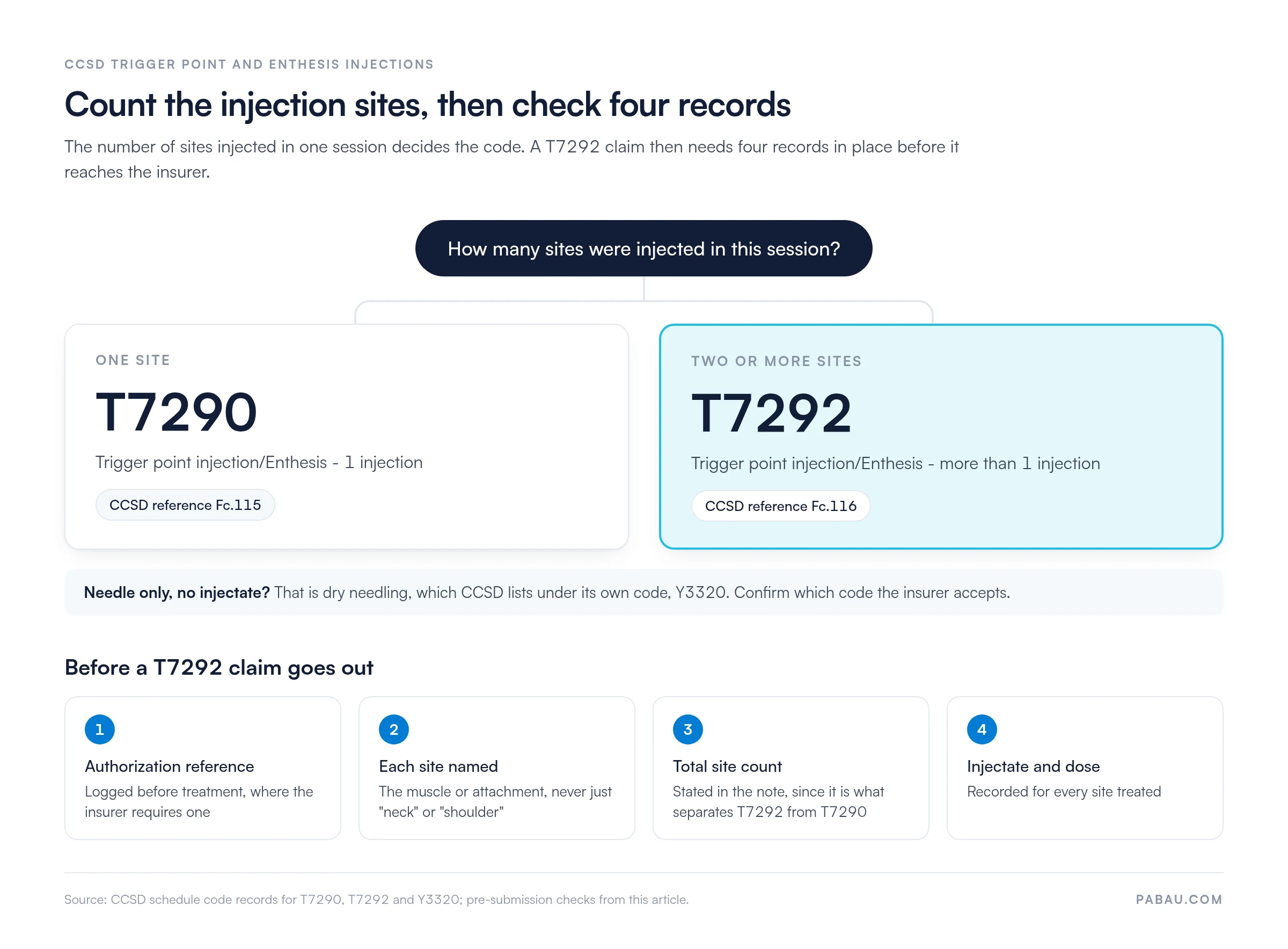
T7290 and T7292 sit within a broader family of CCSD codes, so confirm you have selected the most specific one. The table below lists codes that are sometimes confused with T7292.
Always verify the current CCSD schedule at ccsd.org.uk before submitting a claim. Code descriptors are updated periodically, and the schedule in force at the time of service governs the claim. The CCSD bulletins announce each update as it is published.
Missing or vague documentation is a common reason insurers query or reject a T7292 claim. Record each injection site individually in the clinical note at the time of treatment. Details added after the event carry less weight with insurers.
A complete T7292 procedure note captures all of the following for each site:
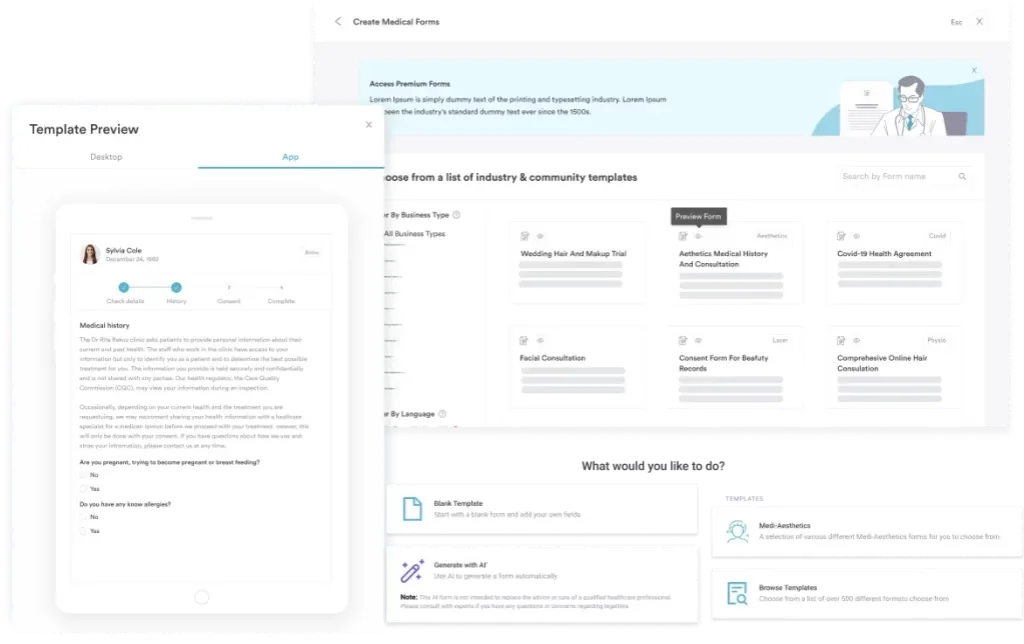
Digital clinical forms that prompt for each required field keep this per-site detail consistent. Paper templates and free-text notes often leave out the injection count, which is exactly what an insurer checks on a T7292 claim. Keeping forms and notes in one patient record also makes supporting documents quick to send if an insurer queries the claim.
Audit your last 20 T7292 procedure notes and check that each one states the total number of injection sites. A note that says only ‘trigger point injections performed’, with no site count, puts that claim at risk. Standardize your note template before you submit the next batch.
Most UK private medical insurers may require pre-authorization before injection therapy is given. Where an insurer requires it, a claim without a valid authorization reference is likely to be rejected, however complete the clinical notes are. The rule is insurer-specific, so confirm it before each episode of care. Check again when the patient has changed insurer or policy since their last treatment.
The table below summarizes how four UK private medical insurers approach pre-authorization. Insurer policies change, so treat it as a starting point and confirm in the current provider portal.
When requesting pre-authorization, give the insurer the CCSD code T7292 and the clinical indication, including the diagnosis where known. Add the number of injection sites planned and the referring clinician’s details if applicable. Record the authorization reference in the patient’s file before treatment begins.
Claim denials for T7292 cluster around a small set of avoidable errors. Each reason below includes the corrective action that reduces its recurrence.
T7292 can share a claim with another CCSD code only when the insurer’s bundling policy allows it and the other service was separately delivered. There is no universal rule, so practices billing several insurer networks need to check each one.
These general principles apply across most UK private medical insurers, though you should always confirm against the current insurer schedule:
When in doubt, call the insurer’s provider line before submitting a combined claim. A denied bundled claim is harder to overturn than one that was cleared in advance.
A consistent workflow for T7292 cuts denials and administrative rework. Running the same seven steps for every practitioner stops individual habits from creeping into the claims.
Before you submit your next batch of T7292 claims, cross-check four elements on every one. You need the authorization reference where the insurer requires one, a note naming each injection site, the total site count, and the injectate per site. Resolve any claim missing one of the four before it goes out, not after a denial.
This workflow only holds if one system stores the authorization reference, the per-site note and the claim together. Comparing UK medical billing software on those three points narrows the shortlist quickly.
In many practices a T7292 claim is pieced together after the session. The clinician writes the note, the front desk chases the authorization reference, and someone else keys the code into the insurer’s portal. Each handoff is a chance for the site count to go missing.
Pabau’s claims management software keeps those pieces on one case. The authorization code, dates and sessions are tracked against the patient, with a warning when one is missing. Claims go to UK insurers through Healthcode and Bupa from the same record that holds the procedure note.
The result is a T7292 claim that matches the note it came from. Fewer claims come back asking for a reference or a site count, and your team spends less time rebuilding sessions for an insurer.
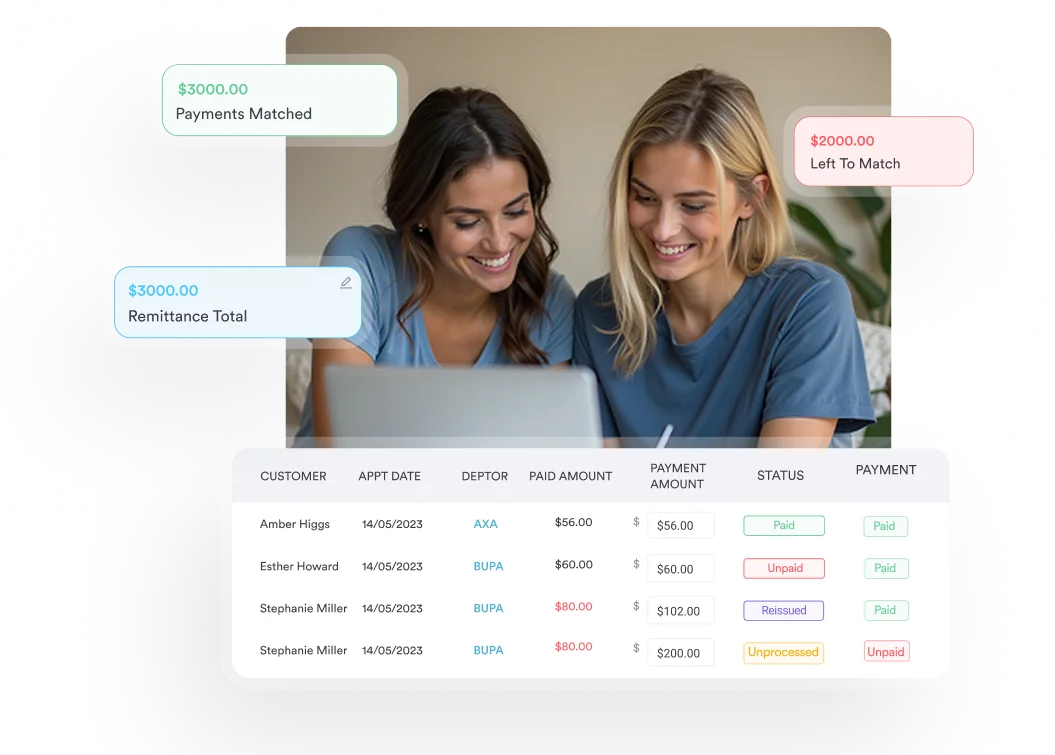

Pabau keeps the procedure note, the authorization code and the insurer claim on one patient record. Your team documents each injection once and bills from that record.

Choosing T7292 is the easy part of the claim. It comes down to a count: two or more injection sites at one session, against one site for T7290. Whether the claim pays depends on the paperwork around that count.
So make the count impossible to miss. Use a note template that names each site, its injectate and dose, and the total. Confirm pre-authorization before the patient arrives, not after the invoice is raised. It costs a few extra minutes per note and spares you the rework of a returned claim.
To see how Pabau keeps the site count, the authorization code and the insurer claim on one record, book a demo.

Billing a single injection instead? CCSD code T7290 covers one trigger point or enthesis injection, with the documentation insurers expect for it.
Need a broader CCSD billing reference? Bupa CCSD codes and fee schedule covers the full range of Bupa-recognized procedure codes, with guidance on submission requirements.
Billing spinal injections too? CCSD code A5770 explains how facet joint injections are coded and documented for UK private insurers.
Ready to streamline how your team manages private patient records and billing? Pabau’s claims management software connects clinical documentation to insurer claim submission in a single workflow.
CCSD code T7292 is the billing code for trigger point or enthesis injections when more than one injection is given in a single session. It covers any combination of trigger point and enthesis sites at the same visit. Injectates such as local anesthetic or corticosteroid both qualify, provided two or more sites are treated.
T7290 applies when a single trigger point or enthesis injection is given in a session. T7292 applies when two or more injection sites are treated at the same visit. The distinction rests on the number of sites injected, not the number of needle passes at one site. Using T7290 for a multi-site session under-codes the claim. Using T7292 for a single-site session risks a denial if the notes do not support it.
Often, yes. Most UK private medical insurers, including Bupa, AXA Health, Aviva and Vitality, may require pre-authorization before injection therapy. Policies vary by insurer and change over time, so confirm the current rule in each insurer’s provider portal before every episode of care. Where an insurer requires a reference, a T7292 claim without one is likely to be rejected.
Dry needling uses no injectate, and CCSD lists it under its own code, Y3320, rather than under T7292. Insurers may still handle it differently, so confirm the code with the specific insurer at the pre-authorization stage before billing.
Common reasons include a missing or invalid pre-authorization reference and a note that does not state the number of injection sites. Others are billing T7290 when T7292 was correct, or billing a non-covered injectate such as platelet-rich plasma. Bundling T7292 with a consultation code the insurer’s rules exclude also leads to denials.
Trigger point injections are most often used for myofascial pain syndrome, cervicogenic headache, and tension-type neck and shoulder pain with identifiable hyperirritable muscle bands. Enthesis injections target conditions such as lateral epicondylalgia (tennis elbow), medial epicondylalgia, plantar fasciitis and rotator cuff enthesopathy. In these, inflammation or degeneration at the tendon-to-bone attachment is the main source of pain.