CPT Code 88346
CPT code 88346 is the billing code for immunofluorescence on a tissue specimen, ...

Last Updated: Nov 26, 2026
T7290 is the CCSD code for trigger point injection/Enthesis - 1 injection. It covers a single injection of a substance into a muscle trigger point or an enthesis, where a tendon or ligament attaches to bone.
The code sits in sub-chapter 3.8.0 Other Procedures of the CCSD schedule used by UK private medical insurers, under reference Fc.115. More than one injection at the same session is billed as T7292.
Let Pabau's smart automation suggest the right codes, reduce claim denials, and keep your practice compliant—effortlessly.
Automate repetitive tasks and focus on what matters most—your patients.
Reduce coding errors and ensure compliance with the latest regulations.
Clean claims, fewer denials, and faster reimbursements.
Powerful insights and reporting to help your practice thrive.
HIPAA compliant SOC 2 certified GDPR-compliant Trusted by 4,000+ clinics worldwide

CCSD code T7290 covers one trigger point or enthesis injection, under CCSD reference Fc.115 in sub-chapter 3.8.0 Other Procedures.
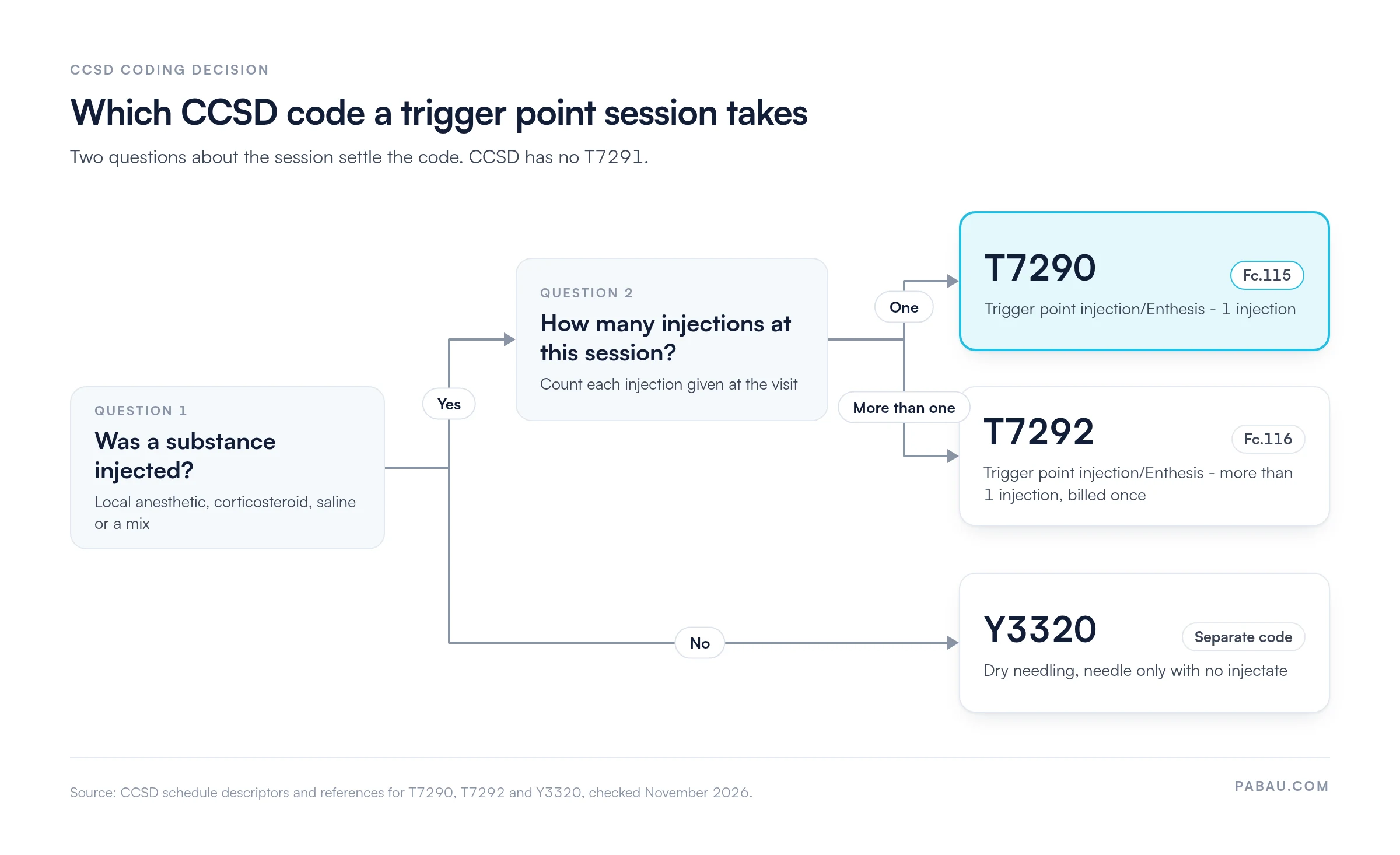
When more than one injection is given at the same session, bill T7292 once. Claiming T7290 twice for one session is a common coding error.
An injected substance is part of the procedure. Dry needling has its own CCSD code, Y3320, so it is never billed as T7290.
The clinical note should record the site, the substance and dose, the indication, the patient’s consent and the practitioner’s details.
Get the insurer’s pre-authorization before treatment, then submit electronically via Healthcode or direct to the insurer.
UK private medical insurers use CCSD code T7290 for a single trigger point or enthesis injection. Insurer schedules such as National Friendly’s CCSD-based schedule of fees list it in the Minor band, with a £131 procedure fee.
The official descriptor reads Trigger point injection/Enthesis – 1 injection. It is published by the Clinical Coding & Schedule Development (CCSD) Group. UK insurers such as Bupa and AXA Health use that schedule to identify procedures on a claim.
Each insurer sets its own band and fee, so check the schedule of the insurer that is paying before you invoice. For the other procedure codes in the schedule, browse our CCSD code library.
The descriptor names two sites, and both are billed under the same code. A trigger point is a hyperirritable spot within a taut band of skeletal muscle that refers pain when pressed. An enthesis is the point where a tendon, ligament or joint capsule attaches to bone. Enthesopathy, which is inflammation or degeneration at that attachment, is the usual reason for an enthesis injection.
A trigger point or enthesis injection is a minimally invasive musculoskeletal procedure. The practitioner finds the target site by palpation or imaging, prepares the skin, and passes a fine needle into the taut band or the attachment. The injectate is then delivered at that site.
Common injectates include local anesthetic (lidocaine or bupivacaine), corticosteroid, normal saline, or a combination. The choice depends on the indication, the practitioner’s scope, and patient factors such as allergies and current medication. Afterward, patients are usually advised to expect some soreness and to adjust their activity for 24 to 48 hours.
Three points matter for billing accuracy under T7290:
The first two points turn code selection into two questions about the session, mapped in the diagram below.
Insurers want to know what condition is being treated before they authorize an injection. Common indications are myofascial pain with identifiable trigger points and enthesopathy at a named bony attachment. Insertional tendinopathy and chronic neck, shoulder or low back pain that hasn’t settled with conservative care are also common reasons to inject. When injections fail to settle a tendinopathy, a percutaneous release of the tendon is billed as code T7010.
Record the diagnosis in the referral, the pre-authorization request and the clinical note in the same terms. The WHO ICD-10 browser holds the codes below, which often describe a T7290 patient:
Insurers pay CCSD codes to practitioners they recognize, most often consultants on the GMC Specialist Register. Before you bill T7290, confirm that the insurer recognizes the treating practitioner for injection procedures.
The difference between T7290 and T7292 is the number of injections given at the same session. Use T7290 for one injection and T7292 for more than one. CCSD has no T7291, so a claim built on that number points to a code that doesn’t exist.
Insurer lists differ too. National Friendly’s schedule lists T7290 but not T7292, so check the paying insurer’s list before you code a multi-injection session. Our guide to CCSD code T7292 covers the multi-injection code in detail.
US coding counts a different unit. CPT bills trigger point injections by the number of muscles treated, so CPT code 20553 covers injections into three or more muscles.
Confirm the descriptor wording against the CCSD technical guide and the insurer’s current schedule before you submit.
Dry needling and trigger point injection target the same structures, taut muscle bands or bony attachment points. They differ in one way that decides the code. Dry needling uses no injectate.
Billing T7290 for a session with no injectate misdescribes the procedure on the claim. Insurers can ask for clinical records to check that a substance was injected. Make sure the note names the substance and dose for every T7290 claim.
UK insurers can ask for clinical records to check any CCSD claim. For T7290, the note must show that an injection was given and that it was clinically indicated. One missing element is enough for an insurer to query the claim or recover a benefit already paid.
Every T7290 clinical note should record:
Pabau, a practice management platform for private practices, keeps these fields in one structured procedure note in its clinical records. Digital consent forms can be completed before the procedure, with the signed form saved to the patient record.
Before your next claims batch, audit ten recent T7290 notes against the six elements above. Where a note lacks the substance name and dose, add a dated addendum before you claim.
Cover conditions vary by insurer and by policy. Confirm each point below with the insurer before treatment.
Most T7290 denials can be prevented. The table below sets out the usual reasons and the fix for each.
The work starts before the injection. UK insurers such as Bupa, AXA Health, Aviva and Vitality generally ask for treatment to be approved in advance. Our guide to Bupa CCSD codes covers how Bupa handles CCSD claims.
In many pain and musculoskeletal practices, the authorization sits in an email and the injection note in another system. The claim is then keyed in by hand. Each handoff is a chance to lose the authorization number or send the wrong code.
Pabau keeps those steps on the patient record. Its paperless claims management sends claims electronically through Healthcode and to Bupa. The authorization code, dates and sessions sit on the patient’s case, with a warning when one is missing.
The result is fewer claims queried for a missing number or a mismatched code. Your team spends less time on rework and more time with patients.

Pabau tracks authorization codes on the patient’s case and sends claims electronically through Healthcode and to Bupa. Your team spends less time chasing missing authorization numbers.

T7290 leaves little to interpret, so a T7290 claim rarely fails on the code itself. It fails when the injection count is wrong or the note never names what was injected.
Fix both at the source. A procedure template that asks for the site, substance, dose and consent makes the T7290 or T7292 choice obvious at the point of care. Capture the authorization number before the appointment, so the claim reaches the insurer complete. Book a demo to see how Pabau tracks authorizations and sends your Healthcode claims from one patient record.

Looking for another CCSD procedure code? CCSD codes lists the procedure codes Pabau covers, chapter by chapter.
Need a full Bupa CCSD billing reference? Bupa CCSD codes covers Bupa’s procedure list and how its claims work.
Billing more than one injection at a session? CCSD code T7292 covers trigger point and enthesis injections when more than one is given.
Coding another injection procedure? CCSD code A5210 explains how to bill a lumbar epidural injection.
Billing other musculoskeletal pain injections? CCSD code A5770 covers how to bill a facet joint injection.
CCSD code T7290 is the UK private medical insurance code for a trigger point or enthesis injection, one injection per session. Consultants use it to bill insurers such as Bupa and AXA Health. It sits in CCSD sub-chapter 3.8.0 Other Procedures, under reference Fc.115.
T7290 covers one injection at a session, and T7292 covers more than one injection at the same session. CCSD has no T7291. Both codes cover trigger point and enthesis injection, and the only difference is the number of injections given.
No. T7290 requires an injected substance, such as local anesthetic, corticosteroid or saline. CCSD lists dry needling under its own code, Y3320. Claiming T7290 for a session with no injectate misdescribes the procedure, and the insurer can query or recover the payment.
The clinical note must record the injection site, the substance and dose, the indication with its ICD-10 diagnosis, and the patient’s consent. It should also name the practitioner and give their GMC number. Insurers can request records to check any T7290 claim, and a missing element can lead to a query or recovery.
It depends on the insurer. CCSD codes are mainly billed by consultants the insurer recognizes, most often doctors on the GMC Specialist Register. Insurers may handle therapists’ treatment under separate arrangements. Ask the insurer whether it recognizes you for injection procedures before you bill T7290.
The most common reasons are two T7290 lines for one session instead of T7292, a note without the substance and dose, and no pre-authorization. An unrecognized practitioner or a policy that doesn’t cover the treatment can also lead to a denial. A structured check before submission prevents each of these.