

HCPCS Code L0472: Hyperextension TLSO billing guide
HCPCS code L0472: Official descriptor and device definition HCPCS code L0472 des...

Last Updated: Nov 5, 2026
CCSD code L7710 is the UK private billing code for creation of a portocaval shunt. The operation joins the portal vein to the inferior vena cava to relieve portal hypertension. It sits in Chapter 11, Major Vessels, and maps to OPCS-4 code L77.1. Surgeons usually offer it when bleeding varices haven't responded to banding, medication or TIPS.
It's a large, closely reviewed surgical claim, so small slips cost time. The CCSD schedule bars XR610, the TIPS procedure, from the same claim as L7710. Insurers also expect pre-authorization and a full operative note before they pay.
Let Pabau's smart automation suggest the right codes, reduce claim denials, and keep your practice compliant—effortlessly.
Automate repetitive tasks and focus on what matters most—your patients.
Reduce coding errors and ensure compliance with the latest regulations.
Clean claims, fewer denials, and faster reimbursements.
Powerful insights and reporting to help your practice thrive.
HIPAA compliant SOC 2 certified GDPR-compliant Trusted by 4,000+ clinics worldwide

CCSD code L7710 covers creation of a portocaval shunt, an open operation linking the portal vein and inferior vena cava.
The code sits in CCSD Chapter 11, Major Vessels, sub-chapter 11.8.0, and follows OPCS-4 code L77.1.
CCSD lists XR610 (TIPS) and L8110 (peritoneo-venous shunt) as unacceptable combinations with L7710.
Insurers expect pre-authorization, a detailed operative note and a recognized consultant before they pay an L7710 claim.
Each insurer decides whether it accepts L7710, so confirm cover and the authorization number before the surgery date.
CCSD code L7710 has one official descriptor, “Creation of portocaval shunt.” The Clinical Coding and Schedule Development (CCSD) Group maintains this code set for UK private medical insurers. The full code entry sits behind a login on the CCSD schedule site.
Within the schedule, L7710 sits in Chapter 11, Major Vessels, under sub-chapter 11.8.0. It follows the OPCS-4 procedure code L77.1. That OPCS-4 category groups the operations linking the portal system to the vena cava or its branches.
The procedure is major open abdominal surgery under general anesthesia. The surgeon joins the portal vein to the inferior vena cava, so blood can bypass a scarred or blocked liver. As a result, pressure in the portal system falls. You can look up neighboring entries in the CCSD code library.
Portal hypertension is the usual reason. Cirrhosis or a blocked vein raises pressure in the portal system. Blood then forces open fragile veins, called varices, in the esophagus and stomach. When those varices bleed, the bleed can be life-threatening.
Today, most patients receive endoscopic banding, medication or a transjugular intrahepatic portosystemic shunt (TIPS) first. An open shunt is generally kept for cases where those options have failed or don’t suit the patient. According to MedlinePlus, it is most often done when TIPS has not worked.
The surgeon chooses the shunt design to suit the patient:
Full diversion lowers pressure reliably. However, it also raises the risk of hepatic encephalopathy, because more blood skips the liver’s filtering. That trade-off is one reason the operative note should always state which design was used.
Two neighboring procedures are flagged on the CCSD code pages themselves. Both were listed as unacceptable combinations with L7710 on January 20, 2010. Other portal shunts belong to different OPCS-4 codes, so they need their own CCSD entry.
The XR610 entry shows the same clash from the other side. Still, CCSD describes its coding principles as advisory guidelines. Each insurer decides whether to apply a given combination rule, so check the payer’s own guidance too.
Here is a common scenario. A TIPS fails, and the patient comes back for an open shunt. If both procedures fall in the same admission, call the insurer before you submit either claim.
An L7710 claim is only as strong as the hospital record behind it. Insurers can ask for the notes, and a vague operative note invites a query. Before you invoice, check that the record holds these items:
Those items pile up across the admission, from the authorization call to the discharge letter. The chart below sorts each one by the stage where it gets captured.
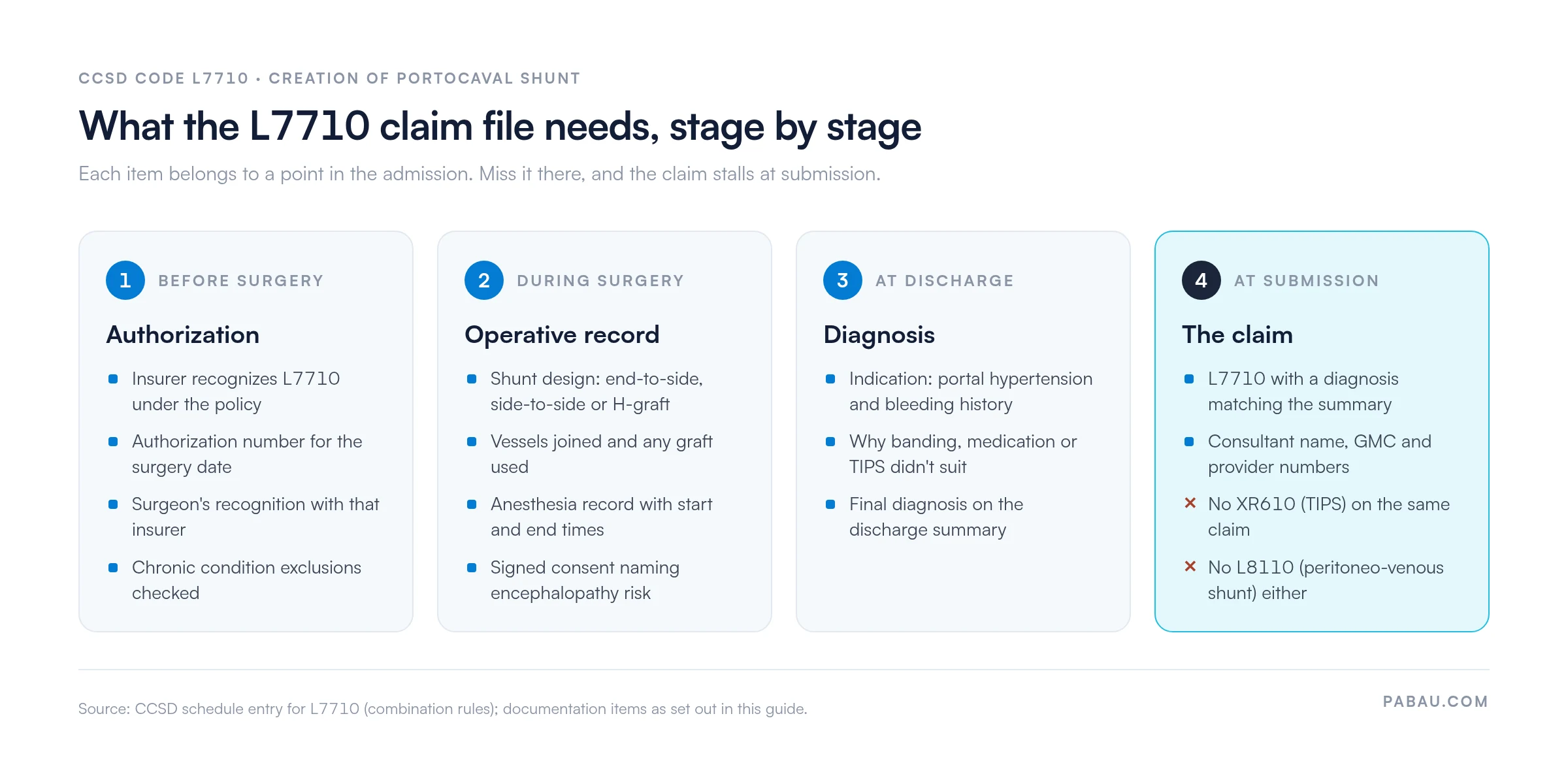
Planned surgery on a private policy almost always needs authorization first. The patient, or the hospital on their behalf, calls the insurer with the code and the planned date. The insurer then issues an authorization number for the episode.
Don’t assume every insurer will accept L7710. Each one decides which CCSD codes it recognizes, and on what terms. Check the policy as well. Many UK policies exclude chronic or pre-existing conditions, and long-standing liver disease can fall under both.
Emergency surgery after an acute bleed is a different story. Private policies are rarely built for emergency admissions, so many of these operations take place in the NHS.
For a closer look at one payer, our guide to Bupa CCSD codes covers its authorization and invoicing steps.
When you call for authorization, give the code, the planned date and the hospital. Then write down the authorization number, the advisor’s name and the time of the call. That note settles most later disputes about what was agreed.
A portocaval shunt admission produces more than one bill. The hospital invoices its own costs, while the surgeon and the anesthetist usually bill their fees separately. Healthcode carries most of these electronic claims to UK insurers. For the surgeon, the route usually runs like this:
Fees differ between insurers. Before you quote the patient a possible shortfall, check the payer’s schedule, such as the Bupa fee schedule.
Take a patient with cirrhosis and recurrent variceal bleeding. Banding has failed twice, and the liver team rules out TIPS. The insurer then authorizes a planned open shunt.
After surgery, the consultant surgeon bills L7710 under that authorization number. The anesthetist sends a separate invoice under their own provider details. Meanwhile, the hospital bills the stay and operating room costs through its own account.
Now suppose the team had placed a TIPS earlier in the same admission. XR610 and L7710 can’t sit on one claim, so the surgeon’s secretary calls the insurer first. A ten-minute call at this point avoids a rejected claim later.
Run through these points before the claim leaves the practice:
Rejected L7710 claims tend to follow a few familiar patterns. Here’s what usually goes wrong, and how to put it right.
On many surgical teams, the authorization number lives in an email and the operative note in another system. A secretary then retypes both into Healthcode. Every retyped digit is a chance for an error.
Pabau, the practice management platform we build, connects directly to Healthcode. Your team sends CCSD-coded claims from the patient record, with the authorization number already attached. Its error-checked claims management holds a claim until required fields, such as membership and authorization numbers, are complete.
Once a claim is sent, the team tracks its status and reconciles payments in the same place. So when an insurer queries an L7710 claim, the record and the claim sit side by side.
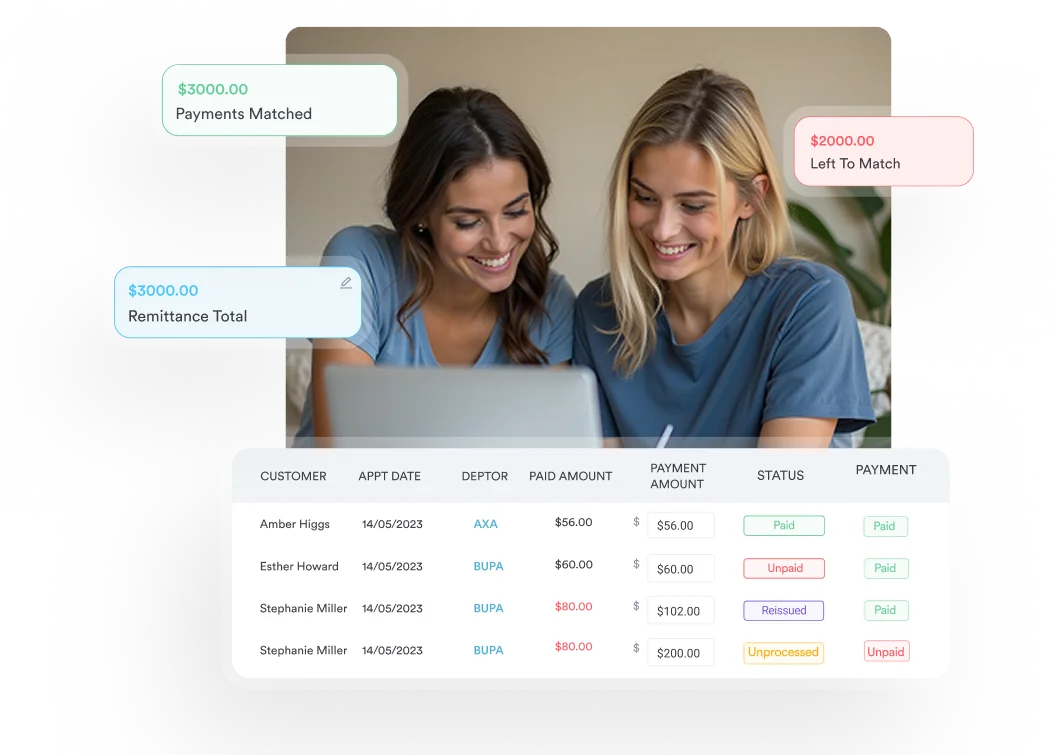

Pabau builds the claim from the patient record and checks required fields, such as the authorization number. Then it tracks every claim to payment.

L7710 is easy to look up and easy to get wrong. The descriptor is narrow, the paperwork is heavy, and the XR610 clash catches teams that also offer TIPS.
So book the authorization call alongside the surgery date. Then dictate the shunt design and the vessels joined before the patient leaves the operating room. Those two habits answer most insurer queries before anyone has to ask them.
If your team bills major vascular surgery often, the record and the claim belong in one place. Book a demo to see how Pabau carries the operative record, the authorization and the Healthcode claim through to payment.

Need the Bupa view of CCSD billing? Bupa CCSD codes walks through authorization and invoicing for Bupa members.
Checking what an insurer pays for surgery? Bupa procedure codes and fee schedule explains how Bupa lists CCSD-coded procedures and fees.
Billing other vascular surgery? CCSD code L7423 covers ligation of an arteriovenous fistula for dialysis.
Handling another major inpatient operation? CCSD code A4010 shows how an extradural hematoma evacuation claim is documented and submitted.
Looking for a different code? The CCSD code library lists every Pabau guide to a CCSD procedure code.
Yes. Both spellings describe the same operation, which joins the portal vein to the inferior vena cava. The CCSD descriptor for L7710 uses “portocaval.”
No. A distal splenorenal shunt joins the splenic vein to the left kidney vein, so it isn’t a portocaval shunt. OPCS-4 gives it a separate code, L77.4, so it needs its own CCSD entry.
It can. A shunt close to the liver can make later transplant surgery harder. Liver units weigh transplant plans before they choose a shunt, and the notes should record that decision.
Insurers expect a diagnosis that explains the portal hypertension. Common examples are K76.6, portal hypertension, and I85.0, esophageal varices with bleeding. The underlying cause, such as cirrhosis, is usually coded too.
No. NHS hospitals record the operation with OPCS-4 code L77.1. CCSD codes exist for billing private medical insurers, so L7710 appears on privately funded claims.
Yes, many private hospitals offer self-pay surgery. Agree a written quote before admission that covers the surgeon, the anesthetist and the hospital stay.



