

CCSD code G5100: Bypass of duodenum billing guide
CCSD code G5100 bills a bypass that leaves the duodenum in place CCSD code G5100...

Last Updated: Oct 16, 2026
G3220 is the CCSD code for revision of gastro-jejunostomy. The surgeon takes down a failed join between the stomach and the jejunum, resects it, and builds a new one. Most revisions follow a Roux-en-Y gastric bypass complicated by stricture, marginal ulcer, leak, or weight regain.
Surgeons bill G3220 to UK private medical insurers such as Bupa, AXA Health, and Aviva, usually after pre-authorization. The CCSD schedule lists it under 11.2.0 Stomach in Chapter 11, with an Xmajor complexity band. Creating the join for the first time is coded separately as G3210.
Let Pabau's smart automation suggest the right codes, reduce claim denials, and keep your practice compliant—effortlessly.
Automate repetitive tasks and focus on what matters most—your patients.
Reduce coding errors and ensure compliance with the latest regulations.
Clean claims, fewer denials, and faster reimbursements.
Powerful insights and reporting to help your practice thrive.
HIPAA compliant SOC 2 certified GDPR-compliant Trusted by 4,000+ clinics worldwide

CCSD Code G3220 describes revision of gastro-jejunostomy, a secondary repair of the surgically created join between the stomach and the jejunum.
G3220 sits in CCSD Chapter 11 under 11.2.0 Stomach with an Xmajor complexity band, while first-time construction is coded G3210.
Medical necessity must be documented against a recognized indication: anastomotic stricture, marginal ulcer, anastomotic leak, or weight regain that meets NICE criteria.
All major UK private medical insurers require pre-authorization before G3220, and a missing one is the most common reason these claims are denied.
Pabau’s claims management software helps private surgical practices track G3220 authorization status and documentation before the claim is submitted.
CCSD Code G3220 covers revision of gastro-jejunostomy. The surgeon revisits and rebuilds the gastrojejunal anastomosis, the join between the stomach pouch and the Roux limb of the jejunum. That join was first created during a Roux-en-Y gastric bypass (RYGB) or a similar upper GI operation.
A revision is distinct from the original operation. The surgeon reopens, resects and reconstructs an anastomosis that already exists, instead of creating it for the first time.
The CCSD schedule lists G3220 in Chapter 11, Abdomen (excl. urinary & reproductive organs), under 11.2.0 Stomach. It carries an Xmajor complexity band. Our index of CCSD codes covers the other procedures in that section.
Every G3220 claim needs a paired ICD-10 diagnosis code, because CCSD codes carry no diagnostic information of their own.
A gastrojejunostomy revision typically proceeds in three operative stages.
Whether the approach is laparoscopic or open, G3220 captures the core operative act of taking down and rebuilding the anastomosis. Check approach-specific coding rules against the current CCSD technical guide. The schedule may allocate separate codes for laparoscopic and open access within this procedure range.
G3220 is performed when a gastrojejunal anastomosis has failed, most often because of one of four clinical indications. Private medical insurers accept the claim only where the operative note and pre-submission documentation establish clear medical necessity.
Every G3220 claim must be paired with one or more ICD-10 diagnosis codes that map directly to the documented indication. Payers cross-check the procedure code against the diagnosis code, and a mismatch is a common denial trigger. The table below lists verified pairings by indication.
Only pair a diagnosis code where the clinical documentation actively supports that indication. Coding a marginal ulcer without endoscopic or histological evidence in the operative note is a documentation mismatch that audit will flag. For weight-regain revisions, the E66.01 guide covers what the obesity diagnosis needs in the record.
G3220 shares the 11.2.0 Stomach section with G3210, the code for a first-time gastro-jejunostomy. Picking the wrong one of the pair is a common miscoding error, particularly under time pressure. The table below sets out the difference.
The operative note decides which code applies, and the diagram below maps what the surgeon did to the right choice.
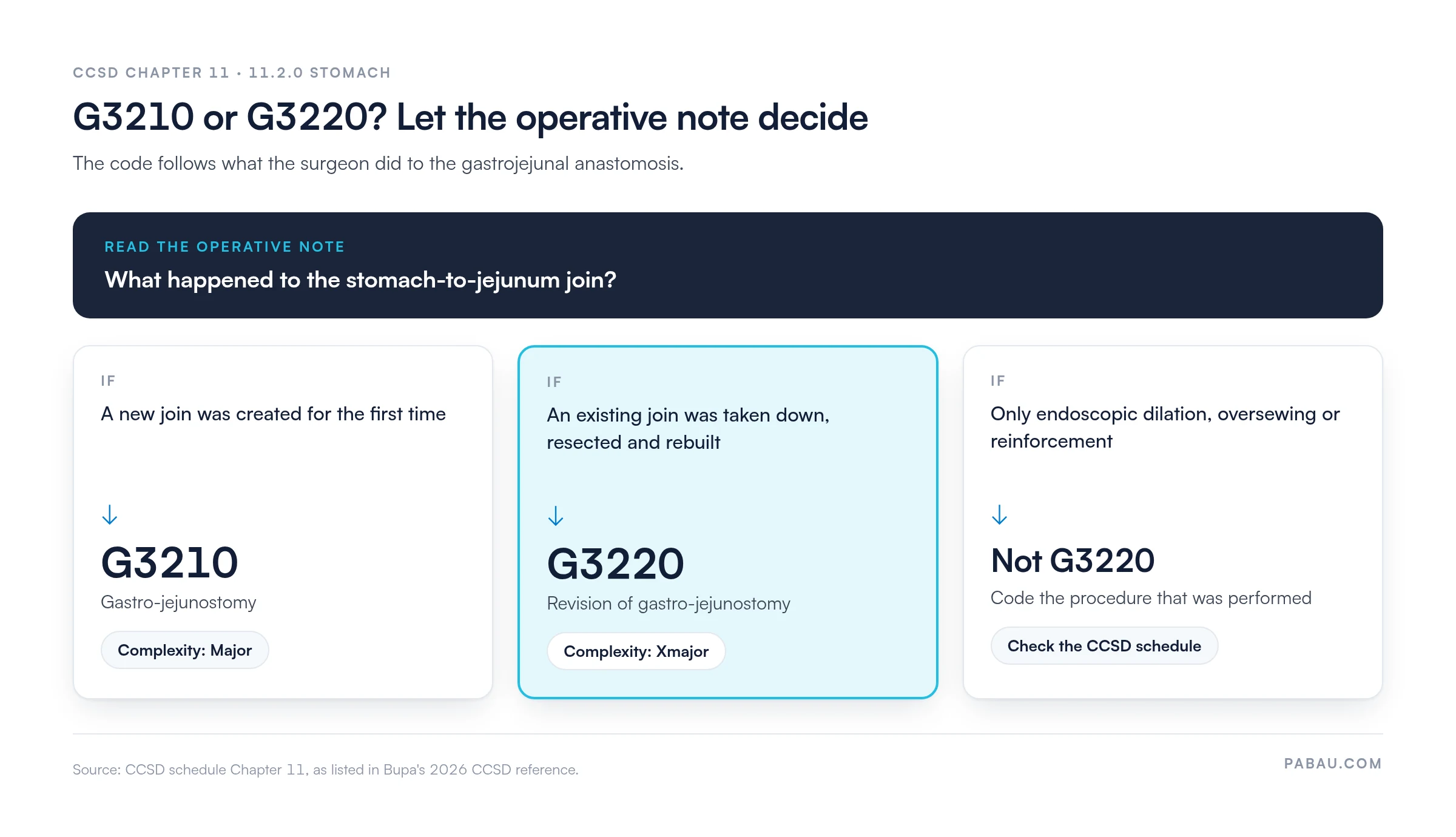
If the operative note describes only endoscopic dilation or minor suture reinforcement without formal takedown, G3220 does not apply. Code the procedure that was performed, using the current CCSD schedule. Payers can query or reject a G3220 claim when the documentation does not show a formal revision.
Check the operative note for the words ‘revision’ or ‘reconstruction’ of the anastomosis before coding G3220. If the surgical report says only ‘dilation’, ‘reinforcement’, or ‘oversewing’, G3220 does not apply. The operative language is what payers audit.
UK private medical insurers expect a complete documentation package before or alongside a G3220 claim. Incomplete records are the second most common reason for denial after missing pre-authorization.
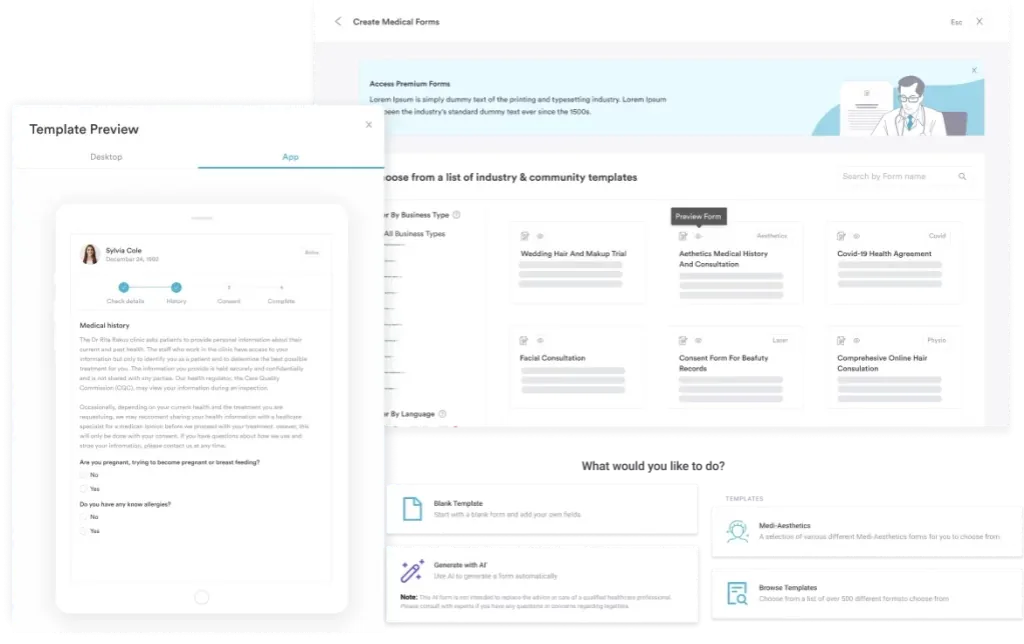
Digital clinical forms let the team capture pre-operative documentation and store it against the patient record before surgery. Nobody then has to reconstruct it from memory after the event.
The operative note must contain each of the following elements for a G3220 claim to withstand audit.
All major UK private medical insurers require pre-authorization for CCSD Code G3220 before the procedure is performed. Submitting without it is the leading preventable denial cause for revisional bariatric procedures. Check the Bupa CCSD procedure codes guidance for Bupa-specific submission requirements.
The table below summarizes pre-authorization expectations across major payers. Always verify current policies directly with each insurer, as timelines and criteria change.
For weight-regain indications, payers routinely ask for evidence that the patient meets the bariatric surgery criteria in NICE guideline NG246.
That evidence includes documented conservative management and review by a multidisciplinary team (MDT). Submit it with the request instead of waiting for the payer to ask.
CCSD Code G3220 denial patterns are consistent across UK private medical insurers, and most are preventable with systematic checks before submission. Pabau’s claims management software lets private surgical practices track authorization status and documentation for each episode before the claim goes out.
G3220 covers the core operative work of revising the gastrojejunostomy: takedown, resection, and reconstruction of the anastomosis, plus standard wound closure. What the code leaves out varies by insurer interpretation and the current CCSD technical rules.
Unbundling rules differ between Bupa, AXA, Aviva, and smaller insurers. Always check the individual insurer’s fee schedule notes before billing additional codes alongside G3220. The CCSD technical guide sets out the framework, and insurer schedules add payer-specific interpretation on top.
CCSD modifier usage follows the rules set out in the CCSD technical guide. For G3220, the modifiers most likely to apply cover anesthesia, assistant surgeon involvement, and repeat procedures.
Confirm with each insurer whether an assistant surgeon fee for G3220 needs separate pre-authorization. Bupa and AXA Health both require advance confirmation that a named assistant will be present. Billing an assistant without prior approval is a consistent denial point in revisional bariatric claims.
A gastro-jejunostomy revision creates more documentation touchpoints than most elective operations. There’s the pre-authorization pack, the operative note, the diagnosis pairing, modifier selection, and follow-up coding. Practices billing several insurers often track each of these across spreadsheets and email threads.
Pabau brings that work into one system. UK private surgical practices use it to keep audit-ready records and check documentation against a billing checklist. It also flags episodes where pre-authorization is still pending before the surgery date is confirmed.
Linking the clinical record to the claim is where most preventable G3220 denials get stopped. The billing team sees a missing leak test result or pre-authorization reference before submission, not after a rejection letter.

Pabau helps private surgical practices track pre-authorization, documentation, and claim status for complex procedures like G3220 in one system. See how it works for your practice.

Build the G3220 claim before the patient goes into surgery. Once the pre-authorization reference, the indication, and the matching ICD-10 code are on file, the operative note is the last piece to add.
That front-loads admin on every revision case. That time is small next to chasing an Xmajor claim that came back for a missing reference or a G3210 mix-up.
Book a demo to see how Pabau tracks pre-authorization and documentation for each revisional bariatric case.

Billing another revisional upper GI operation? CCSD code G2590 covers revision of antireflux procedures, with its own documentation and pre-authorization needs.
CCSD Code G3220 covers revision of gastro-jejunostomy, the secondary operative reconstruction of the surgically created join between the stomach and the jejunum. It applies when the original anastomosis has failed because of a complication such as stricture, marginal ulcer, or leak. The surgeon must formally take down and reconstruct the join.
G3210 covers gastro-jejunostomy, the first-time creation of the join between the stomach and the jejunum, and carries a Major complexity band. G3220 covers revision of an existing gastro-jejunostomy and carries an Xmajor band. Use G3220 only when the operative note shows the anastomosis was formally taken down and rebuilt.
The most common reasons are missing pre-authorization, thin medical necessity documentation, and a diagnosis code that does not pair with G3220 in the payer’s crosswalk. Coding G3210 when G3220 is correct, or the reverse, also triggers denials. So do bundling errors, where the insurer treats separately billed ancillary procedures as included.
K91.89 covers anastomotic stricture or leak, and K28.9 or K28.4 covers a marginal ulcer without or with hemorrhage. For weight regain after bariatric surgery, E66.01 is paired with Z98.84. Only pair a code where the clinical documentation actively supports that specific indication.
Yes, G3220 captures the operative act of revising the gastrojejunostomy regardless of approach. Check the current CCSD schedule for any separate laparoscopic or open codes within this range. If the surgeon converted from laparoscopic to open, note it in the operative report and ask the insurer whether a modifier or additional code applies.
Most UK private medical insurers want a consultant letter on the clinical indication, investigation reports, and a surgical plan. Investigation reports cover endoscopy, imaging, or weight history, plus evidence of failed conservative management where relevant. For weight-regain cases, insurers typically expect evidence that the patient meets the bariatric surgery criteria in NICE guideline NG246.



