

CCSD code G5100: Bypass of duodenum billing guide
CCSD code G5100 bills a bypass that leaves the duodenum in place CCSD code G5100...

Last Updated: Oct 16, 2026
G5810 is the CCSD code for excision of jejunum. The operation removes a diseased segment of the jejunum and rejoins the bowel. Surgeons perform it for a jejunal tumor, a stricture, ischemic bowel or a bleeding lesion. It sits in Chapter 11 of the CCSD schedule, Abdomen, in the jejunum and ileum section.
Bupa grades G5810 as MAJOR 5, and Freedom Health lists it as Major complexity. Laparoscopic, robotic and open tumor resections of the small bowel have their own codes. The approach and indication in the operative note decide whether G5810 belongs on the claim.
Let Pabau's smart automation suggest the right codes, reduce claim denials, and keep your practice compliant—effortlessly.
Automate repetitive tasks and focus on what matters most—your patients.
Reduce coding errors and ensure compliance with the latest regulations.
Clean claims, fewer denials, and faster reimbursements.
Powerful insights and reporting to help your practice thrive.
HIPAA compliant SOC 2 certified GDPR-compliant Trusted by 4,000+ clinics worldwide

CCSD code G5810 covers excision of a segment of jejunum, in the small intestine section of CCSD Chapter 11.
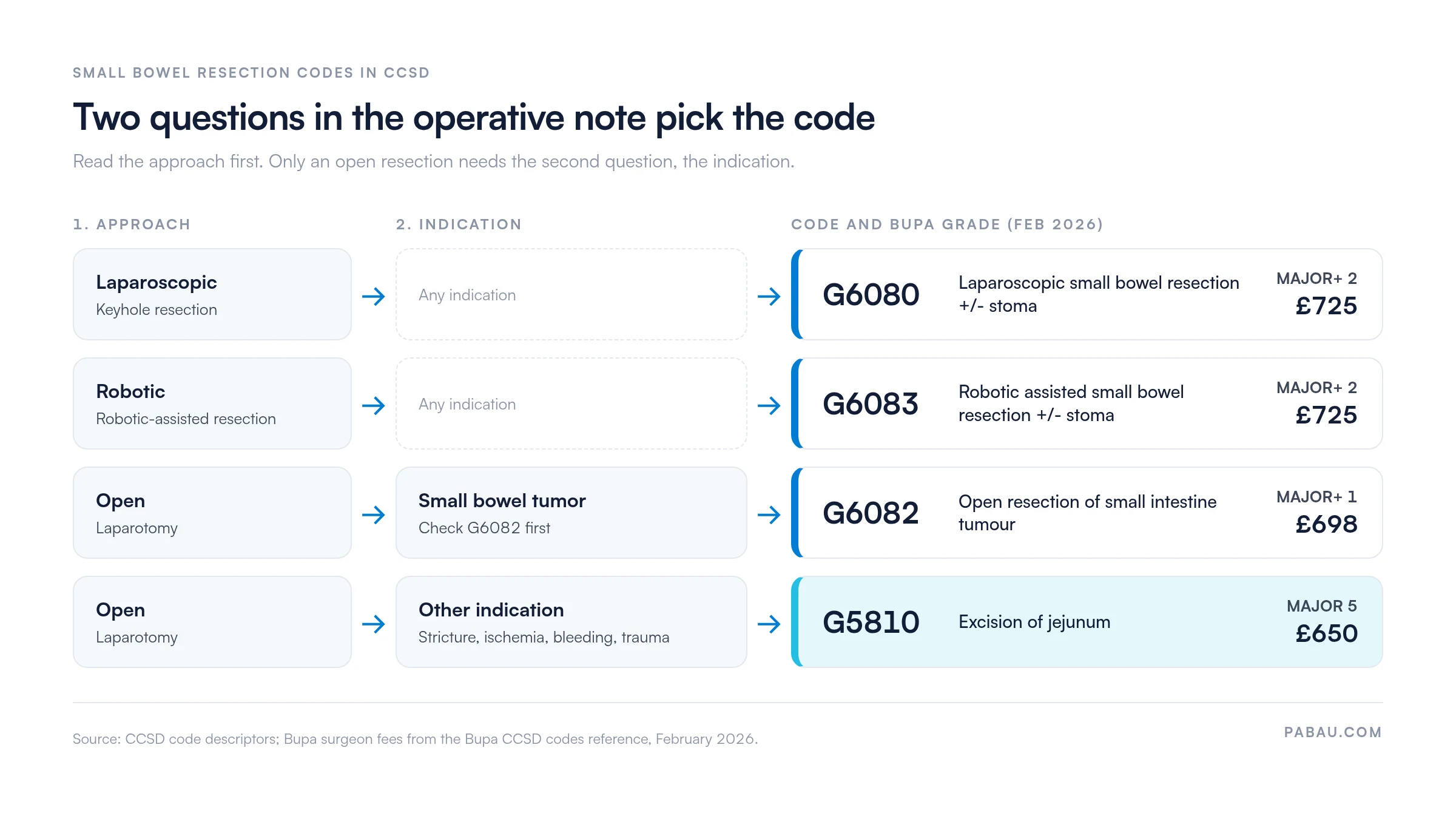
Laparoscopic (G6080), robotic (G6083) and open tumor resections (G6082) have their own codes, so check the approach first.
CCSD lists G5810 as an unacceptable combination with neighboring jejunal procedures, such as gastro-jejunostomy and bypass of jejunum.
Bupa grades G5810 as MAJOR 5 at £650, and Freedom Health’s July 2026 schedule lists a £600 specialist fee.
Secure the insurer’s pre-authorization number before surgery, and keep the operative note and histology ready for queries.
CCSD code G5810 is the code for excision of jejunum. It pays the surgeon for removing a section of the jejunum, the middle part of the small intestine. The healthy ends are then joined back together.
The code sits in Chapter 11 of the CCSD code schedule, Abdomen (excluding urinary and reproductive organs). Within it, G5810 belongs to the jejunum and ileum section. In OPCS-4, the classification NHS hospitals use, the matching category is G58.
Surgeons resect jejunum for a handful of recurring reasons:
Freeing adhesions doesn’t earn a second code. Freedom Health’s Chapter 11 fee schedule treats adhesiolysis as a normal part of abdominal surgery. However, it will consider a higher fee when severe adhesions add significant work, backed by a full medical report.
Several small bowel codes sit next to G5810, and the approach or the indication usually decides between them. The table shows each one with the grade two insurers publish.
Bupa figures come from a Bupa CCSD codes reference dated February 2026. Freedom figures come from its Elite fee schedule, updated July 2026. Both change, so check the current schedule before you quote a patient.
Two checks settle most choices. First, read the approach in the operative note, because laparoscopic and robotic resections have their own codes. Second, look at the indication. An open resection for a small bowel tumor may belong under G6082, and a laparoscopic one under G6080.
The diagram below maps both checks to a code.
CCSD publishes unacceptable combinations, which are pairs of codes that shouldn’t be billed together for one operation.
G5810 appears in these lists against neighboring jejunal procedures. Gastro-jejunostomy (G3210) and revision of gastro-jejunostomy (G3220) are among them. So are bypass of jejunum (G6100) and open resection of small intestine tumour (G6082).
We couldn’t confirm the complete list for G5810. The CCSD schedule sits behind a login. Open the code’s details page there before you add a second procedure.
If the surgeon did a separate procedure that CCSD allows alongside G5810, say so in the operative note. A clear account of the second step gives the insurer’s reviewer a reason to pay both codes.
Insurers pay for what the record supports. For a G5810 claim, that record usually has five parts:
The anesthetist bills a separate fee for the same operation. Their record should show the same date and procedure, so the two claims match when the insurer compares them.
Here’s how a typical elective claim comes together. The case is invented to show the steps.
Change one detail and the code changes too. Had the surgeon done the same resection laparoscopically, the claim would need G6080 instead.
UK private medical insurers expect pre-authorization before planned surgery. Without it, the insurer can refuse the claim and leave the patient with the bill.
For G5810, the insurer will want the procedure code, the diagnosis and the planned date. For major abdominal surgery, some also ask for clinical details or a specialist letter before they approve.
Emergency resections need extra care. Many policies don’t cover emergency admissions, so check the policy wording before you invoice an urgent operation.
Fees need the same attention. Each insurer pays its own schedule for G5810, and a charge above it leaves a shortfall. Tell the patient about any shortfall before surgery, in writing.
Rejected G5810 claims tend to follow six patterns, and each one has a direct fix.
No pre-authorization on file? Ask the insurer whether it will review the claim retrospectively. Explain the clinical reason for the timing.
Wrong code for the approach? If the note says laparoscopic, resubmit under G6080 rather than arguing for G5810.
Combination rejected? Remove the second code, unless the note shows a separate procedure CCSD allows. Then explain it.
Diagnosis questioned? Send the histology report and the consultant’s letter that recommended resection.
Fee above the schedule? The insurer pays its listed fee. Invoice the patient for the shortfall only if they agreed to it beforehand.
Membership details wrong? Check the membership and authorization numbers against the insurer’s letter, then resubmit.
Five minutes here saves weeks of queries later. Tick each item before the claim leaves the practice.
Surgical claims stall when the authorization number, operative note and histology live in different places. A secretary then chases each one every time an insurer queries the claim.
Pabau, the practice management software we build for private practices, keeps those records on one patient file. Its claims management tools submit CCSD-coded claims through Healthcode in the UK. Claim.MD and Tyro Health cover practices billing in the US and Australia.
Before a claim goes out, Pabau checks required fields, such as the membership number and authorization code. Claim status then shows on screen, so your team can see which claims are still waiting. Choosing between G5810 and G6080 stays with your surgeon and coder.
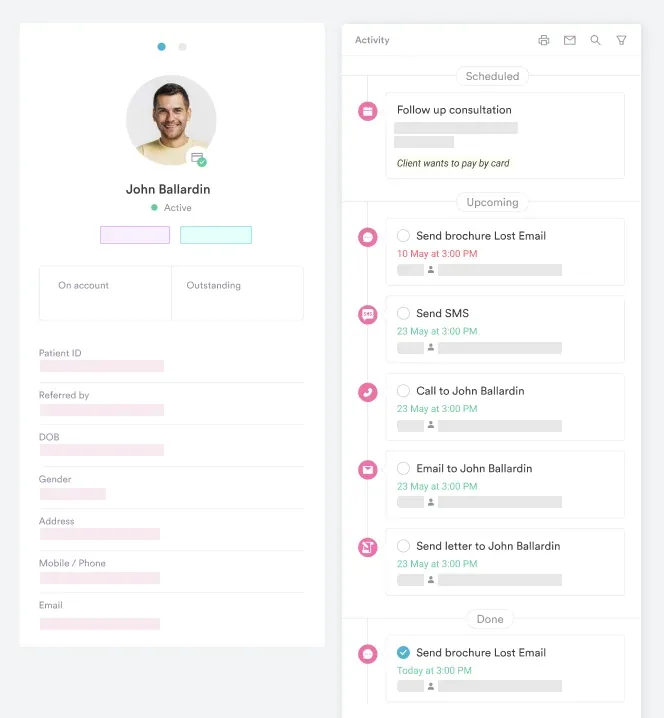

Pabau stores the authorization number, operative note and histology on the patient record, then checks required claim fields before submission. Your team spends less time chasing paperwork.

A G5810 claim is mostly won or lost before the first incision. Confirm the approach and the indication first, because laparoscopic, robotic and tumor resections all have their own codes.
Then make the claim easy to approve. Secure pre-authorization early, file the histology with the operative note, and check combinations in the CCSD schedule. A claim built that way gives the insurer few reasons to send it back.
Book a demo to see how Pabau keeps surgical claims, authorizations and records together for your practice.

Billing a laparoscopic resection instead? CCSD code G6080: Laparoscopic small bowel resection billing guide covers the keyhole alternative to G5810.
Forming a feeding jejunostomy? CCSD code G6000: Open formation of jejunostomy explains the open technique and what insurers ask for.
Revising an earlier gastric bypass join? CCSD code G3220: Revision of gastrojejunostomy sets out the documentation for revision surgery.
Need the full Bupa code list? Bupa CCSD codes collects the schedule by chapter, with categories and fees.
Yes. It’s an abdominal operation under general anesthetic, usually open. Laparoscopic resections code as G6080. Bupa and Freedom Health both place G5810 in their Major bands.
OPCS-4 groups excision of jejunum under category G58. NHS hospital coders use OPCS-4, while UK private insurers use CCSD codes such as G5810.
Most people can when a short segment is removed. The ileum takes over much of the absorption. Larger resections raise the risk of short bowel syndrome, so follow-up matters.
Usually, if the policy covers the condition and the insurer pre-authorizes the operation. Exclusions for pre-existing or chronic conditions, such as Crohn’s disease, can limit cover.
Jejunectomy is the clinical name for removing jejunum, and G5810 is its CCSD code. A laparoscopic small bowel resection still codes as G6080.



