

CCSD code G5100: Bypass of duodenum billing guide
CCSD code G5100 bills a bypass that leaves the duodenum in place CCSD code G5100...

Last Updated: Oct 16, 2026
E4210 is the CCSD code for tracheostomy, the operation that creates an opening through the front of the neck into the trachea. A tube placed through the opening keeps the airway open and allows ventilation or suction below the larynx.
CCSD is the procedure coding schedule used by UK private medical insurers, including Bupa, AXA Health, Aviva and Vitality. Most insurers band E4210 as Intermediate, but fees differ, so check the current schedule. Invoices reach insurers through Healthcode in pounds. CCSD codes take no modifiers, and the anaesthetic and hospital charges are invoiced separately.
Let Pabau's smart automation suggest the right codes, reduce claim denials, and keep your practice compliant—effortlessly.
Automate repetitive tasks and focus on what matters most—your patients.
Reduce coding errors and ensure compliance with the latest regulations.
Clean claims, fewer denials, and faster reimbursements.
Powerful insights and reporting to help your practice thrive.
HIPAA compliant SOC 2 certified GDPR-compliant Trusted by 4,000+ clinics worldwide

CCSD code E4210 covers tracheostomy, the creation of an opening into the trachea with a tube placed to hold the airway open.
Open and percutaneous dilatational tracheostomy both take E4210, while a percutaneous mini-tracheostomy has its own code, E4230.
Most UK private insurers band E4210 as Intermediate but set their own fees, and invoices reach them through Healthcode in pounds.
CCSD codes take no modifiers, and the anaesthetist invoices separately against the insurer’s anaesthetic fee schedule.
Pair the code with a WHO ICD-10 diagnosis that explains the airway need, such as J96.0 or J38.6.
CCSD code E4210 has the official descriptor “Tracheostomy”. It sits in chapter 5 of the schedule, ear, nose and throat, under larynx and trachea. The code pays the consultant for creating the opening through the anterior tracheal wall, placing the tube and securing the airway.
The anaesthetist’s fee and the hospital’s charges for theatre, the bed and the tube are invoiced separately. The surgeon’s invoice carries E4210, and the other parties invoice under their own arrangements with the insurer.
The Clinical Coding and Schedule Development (CCSD) group maintains the code set that UK private medical insurers use, including Bupa, AXA Health, Aviva and Vitality. The group does not set fees. Most insurers band E4210 as Intermediate, but fees differ between them, so check the current schedule of the insurer you are billing. Our guide to Bupa CCSD codes shows how one insurer publishes its bands.
The surgeon makes a midline incision over the trachea, usually between the second and fourth tracheal rings. A cuffed or uncuffed tube then goes into the opening to keep the airway patent.
The operation is most often done for patients who need prolonged mechanical ventilation. It also applies to upper airway obstruction, failed intubation and major head and neck surgery that needs a protected airway. That context helps coders choose the right ICD-10 pairing and notice when a note leaves out the indication.
The E4210 descriptor does not name a technique, so an open or a percutaneous dilatational tracheostomy both take E4210. What changes is the evidence the insurer expects to see in the operation note.
One percutaneous procedure does change the code. A mini-tracheostomy passes a narrow tube through the cricothyroid membrane, and the schedule lists it as E4230 “Mini tracheostomy (percutaneous)”, not E4210.
Insurers can query a percutaneous tracheostomy invoiced from a critical care bed if the note reads like a procedure done by someone else. Stating the technique, the operator and the setting in plain words answers that question before it is asked.
UK insurers pay for treatment that is clinically necessary and covered by the policy. For E4210, the reviewer looks for a clear indication that links the operation to a diagnosis.
Common indications include:
The note must state the indication explicitly. “Patient required tracheostomy” is not enough. A stronger note reads: “Ventilator-dependent for [number] days following traumatic brain injury, with failed extubation on [dates]. Tracheostomy performed to support weaning and protect the airway.”
UK insurers expect each procedure invoice to carry an ICD-10 diagnosis from the WHO classification, not the US ICD-10-CM. The diagnosis tells the insurer why the airway was needed.
Code to the highest specificity the notes support. Where the indication is a cancer, such as laryngeal carcinoma, add the tumour code alongside the airway code. Check each code against the WHO ICD-10 browser before you submit.
E4210 describes the creation of a tracheostomy. Later work on the stoma falls outside it. Tube changes, revision or closure of the stoma, and separate laryngoscopy each need their own code from the current schedule.
A percutaneous mini-tracheostomy is invoiced as E4230, so check the note for the tube type before you pick E4210. The chart below maps each airway procedure in this guide to its code.
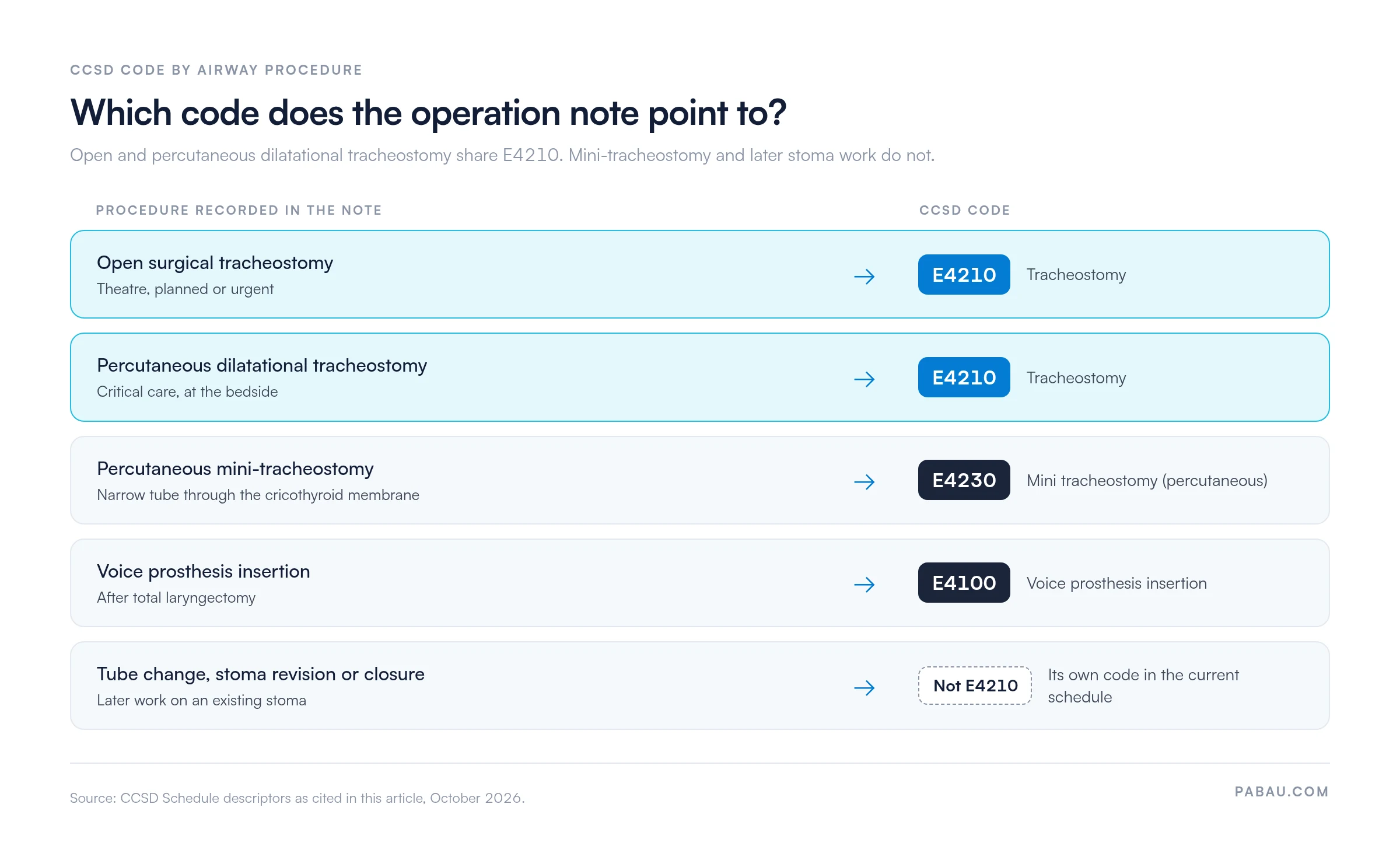
Search the current schedule, or our guide to CCSD procedure codes, for the matching code rather than stretching E4210 to fit. Do not confuse E4210 with CCSD code E4100, which covers insertion of a voice prosthesis after total laryngectomy.
An incomplete operation note is a common reason insurers query or refuse an E4210 invoice. They cannot pay for what the note does not record. Make sure every note covers the following.
A surgical note template with a structured field for each element shows the billing team what is missing before the invoice reaches the insurer.
Before you send an E4210 invoice, check the operation note against the list above. If an element is missing or vague, ask the surgeon for an addendum first. Fixing the note internally is quicker than answering an insurer query.
The anaesthetist invoices separately from the surgeon. Insurers publish anaesthetic fees in their own anaesthetic schedule against the procedure performed, so check that schedule rather than assuming a code. Both invoices should show the same date of service and the same authorisation reference.
Where the tracheostomy is done under local anaesthetic with sedation, confirm with the anaesthetist how it will be invoiced. Make sure the note records the anaesthesia type, so neither invoice is queried.
E4210 covers creating the tracheostomy, not every visit that follows. Each insurer sets its own rules on what aftercare the procedure fee includes, so check them before invoicing follow-up separately.
Record each tube change with the date, tube size, reason and clinician. A change invoiced without a documented reason is likely to be queried.
Another procedure may happen in the same theatre visit, such as a neck dissection. Each one then needs its own CCSD code and a separate description in the note. Insurers apply their own rules to multiple procedures at one session. Confirm how the insurer will treat the combination when you request authorisation.
Many refused E4210 invoices could have been caught before they were sent. The usual causes are:
Claims management software that checks for missing fields before submission stops many of these errors early. It also shows which invoices the insurer is still assessing.
UK insurers expect a planned tracheostomy to be authorised before admission. The patient or the practice quotes the CCSD code and the diagnosis, and the insurer issues an authorisation reference. Keep that reference on the patient record and quote it on every invoice for the episode.
Private medical insurance generally does not cover emergency care, and most emergency airway procedures happen in the NHS. If an urgent tracheostomy takes place in a private hospital, contact the insurer as soon as you can and check the policy terms. Record the time of the airway emergency in the notes, because the insurer will ask for it.
In the WHO ICD-10, J95.0 “Tracheostomy malfunction” is the code for problems at an existing stoma. It includes haemorrhage from the stoma, obstruction of the tracheostomy airway, sepsis of the stoma and tracheo-oesophageal fistula following tracheostomy.
J95.0 has no subcodes in the WHO classification, so the note must describe the specific problem. A return to theatre is coded by the procedure the surgeon performed, with J95.0 as the diagnosis.
A tracheostomy episode touches the referral, the authorisation call, the operation note and the remittance. Pabau, the practice software we build, keeps those pieces on one patient record. Whoever raises the invoice then has the evidence to hand.
Pabau’s claims management sends invoices to Healthcode without leaving the system, which saves the billing team a second round of data entry. Notes and letters attach to the record at the point of care, and claim status stays visible while the insurer assesses it.
For a practice with several ENT consultants, that means fewer invoices sitting unsent while someone hunts for a note.

Pabau helps UK private practices keep operation notes, authorisation references and CCSD-coded invoices on one record, then send them to Healthcode in a few clicks.

CCSD code E4210 is simple to read and easy to get wrong in practice. The code says “Tracheostomy”, but the insurer pays on the strength of the note, the diagnosis and the authorisation behind it.
Three habits keep E4210 invoices moving. State the indication and the technique in the note, and pair the code with a WHO ICD-10 diagnosis that explains the airway need. Then hold the authorisation reference before the theatre date and quote it on every invoice.
Pabau keeps the clinical record and the insurer invoice in the same place, so ENT teams spend less time rebuilding evidence for a query. To see how it handles CCSD coding and Healthcode submission, book a demo.

Need the wider CCSD picture? CCSD procedure codes explains how the UK schedule is organised and how practices bill against it.
Billing Bupa patients? Bupa CCSD codes sets out how Bupa bands procedures and what its published fees mean for your invoices.
Losing money to refused invoices? Denial management in healthcare covers the checks and appeal routines that keep surgical billing moving.
CCSD code E4210 covers tracheostomy, the creation of an opening into the trachea with a tube placed to keep the airway open. It pays the consultant for the operation. The anaesthetic and the hospital charges are invoiced separately.
No, not between open and percutaneous dilatational tracheostomy. The E4210 descriptor does not name a technique, and CCSD codes take no modifiers. A percutaneous mini-tracheostomy is different and takes its own code, E4230. The operation note should still state the technique, so the insurer can follow what was done.
Common pairings from the WHO ICD-10 are J96.0 for acute respiratory failure and J38.6 for stenosis of the larynx. J39.0 covers a deep neck abscess. Z93.0, tracheostomy status, belongs on follow-up invoices rather than the first one.
The usual causes are an incomplete operation note, a vague indication, a diagnosis that does not match it and a missing authorisation reference. Most of these can be caught with a check before the invoice goes through Healthcode.
Yes. The anaesthetist invoices separately, using the fee the insurer publishes in its anaesthetic schedule for the procedure. Both invoices should carry the same date of service and authorisation reference.
Most insurers band E4210 as Intermediate, including Bupa, Freedom Health and National Friendly. Fees differ by insurer, and the CCSD group does not set them. Check the current schedule of the insurer you are billing, as schedules are reissued.



