CCSD code F3070: Suture of palate billing guide
CCSD code F3070 covers stitching a wound in the palate CCSD code F3070 is the co...

Last Updated: Oct 12, 2026
E3810 is the CCSD code for injection into larynx. Consultants use it to bill a UK private medical insurer for a laryngeal injection, such as a vocal cord injection. It sits in Chapter 5, Ear, nose and throat, under section 5.7.0 Larynx and Trachea.
The code is easy to pick and easy to lose on a claim. The CCSD lists laryngectomy and reconstruction codes as unacceptable combinations with E3810, and it sets no fee. The sections below follow the claim from pre-auth to payment.
Let Pabau's smart automation suggest the right codes, reduce claim denials, and keep your practice compliant—effortlessly.
Automate repetitive tasks and focus on what matters most—your patients.
Reduce coding errors and ensure compliance with the latest regulations.
Clean claims, fewer denials, and faster reimbursements.
Powerful insights and reporting to help your practice thrive.
HIPAA compliant SOC 2 certified GDPR-compliant Trusted by 4,000+ clinics worldwide

E3810 is the CCSD code for injection into larynx, listed in Chapter 5 (Ear, nose and throat) under section 5.7.0 Larynx and Trachea.
Most major UK insurers use the CCSD schedule, but confirm E3810 is in each insurer’s own schedule before booking.
E3810 can’t be billed with laryngectomy or laryngeal reconstruction codes, which the CCSD lists as unacceptable combinations.
The CCSD schedule sets no fee, so payment follows each insurer’s fee schedule and the consultant’s own fee.
Pabau, the practice software we build, supports CCSD code selection and Healthcode submission for UK private practices.
CCSD code E3810 is the code a consultant uses to bill a UK private medical insurer for an injection into the larynx. Its official descriptor is “Injection into larynx.” It sits in Chapter 5, Ear, nose and throat, under section 5.7.0 Larynx and Trachea. The code joined the schedule on January 20, 2010.
The CCSD schedule is maintained by the Clinical Coding & Schedule Development (CCSD) Group. Insurers match each claim line against it, so the descriptor is what they read when deciding whether to pay. Our CCSD code guides cover the other codes in the schedule.
Consultants moving from the NHS often expect an NHS procedure to map neatly onto a CCSD code. The schedule is stricter than that. E3810 describes one act, the injection, and it carries its own rules about which codes can share the claim.
E3810 covers the laryngeal injection itself. The work around it is billed by other people, or under other codes:
That last rule causes the most trouble. The CCSD names E2910, E2920, E2930, E2940, E2970, E2140, E2150 and E3100 among the codes E3810 can’t be billed with. When the injection happens during one of those operations, it doesn’t go on the claim as a separate line. E2140, a stomach pull-up reconstruction, is one example from that list.
Billing the pair anyway counts as over-coding. Insurers can claw that payment back later, and repeated errors can trigger a contract review.
Picking the wrong line is the easiest rejection to prevent. These are the codes most often confused with E3810:
When in doubt, the CCSD Technical Guide (October 2025) is the reference for combination rules and the scope of each code.
Insurers check CCSD claims against the clinical notes. An E3810 claim with no record confirming the injection will be queried or rejected. The General Medical Council (GMC) requires contemporaneous records, and insurers treat them as the evidence for payment.
Keep these in the record for every E3810 claim:
Missing paperwork is one of the most common reasons insurers query a claim. Store the note and consent form against the billing record. Then the file is complete when the claim goes out, rather than pieced together after a query arrives.
Audit your procedure note template for every E-series code you bill. Check each field against the insurer’s provider guidelines. A 15-minute review now can save weeks of chasing a queried claim.
Pre-authorization (pre-auth) rules vary by insurer, by policy tier and sometimes by hospital. Skip it when the insurer requires it, and the claim usually goes unpaid. Most insurers won’t apply an authorization retrospectively, so check pre-auth status before every procedure.
The table shows general pre-auth patterns for ENT procedures at major UK insurers. Rules change with each policy year, so confirm them on the insurer’s provider portal first:
Record the pre-auth reference in the patient record and on the Healthcode submission. An insurer can’t honor an approval it can’t trace.
The CCSD schedule sets no fees, for E3810 or any other code. The CCSD Group maintains the codes and their descriptors, and it doesn’t decide what insurers pay. Fees come from each insurer’s own fee schedule and from the consultant’s own fee.
An E3810 episode usually produces separate charges:
Insurers such as Cigna, Healix and Bupa publish the most they’ll pay for each CCSD code. Check the current Cigna UK fee schedule and Healix fee schedule before invoicing. If the insurer’s limit sits below your fee, tell the patient about the shortfall before the procedure.
Our guide to the Bupa fee schedule shows how one insurer sets its limits by code.
Most major UK insurers use the CCSD schedule, but each one decides which codes it includes. So confirm E3810 is in the insurer’s own schedule before booking, for example through Bupa’s code search. Cover also depends on the patient’s policy, network restrictions and the insurer’s clinical criteria.
For Bupa patients, our Bupa CCSD codes guide covers recognition, accepted codes and the clinical evidence Bupa expects.
Healthcode is the main electronic billing platform for UK private healthcare, and most insurers receive CCSD claims through it. The diagram below follows an E3810 claim through five checkpoints, and shows what stops it at each one.
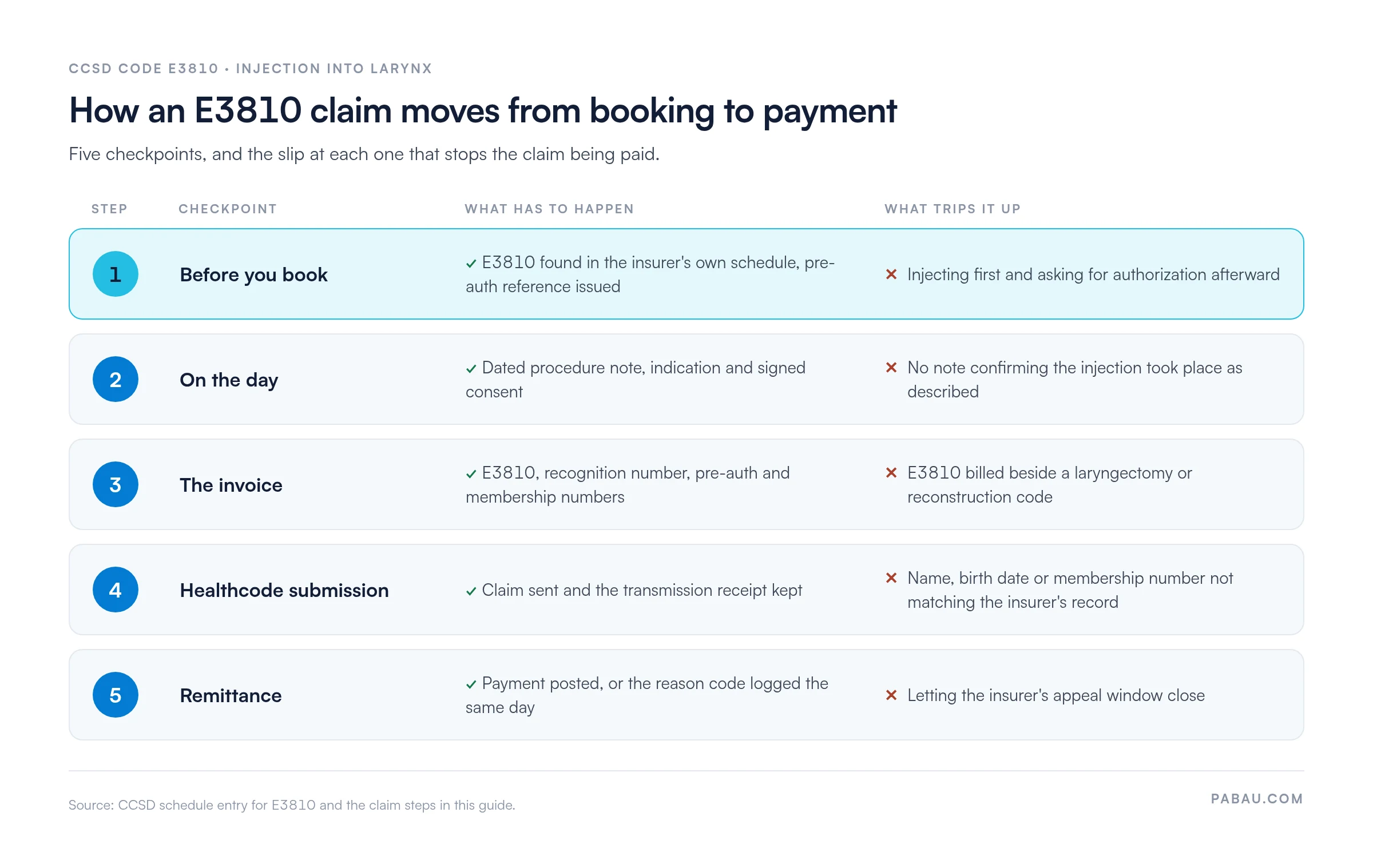
Here’s the submission itself, step by step:
Run this check on the invoice before it leaves the practice. Each point heads off one of the rejection reasons in the next section.
E3810 rejections fall into four groups. Name the group first, and the fix usually follows:
Lodge appeals within the insurer’s stated window, because a missed deadline closes the claim. Log the reason code from the remittance as soon as it arrives. Then assign someone to resubmit that same day.
Run a monthly rejection audit across the CCSD codes your practice bills, grouped by reason code. Repeated documentation rejections usually point to a missing field in the note template. Fix the template once, and that rejection stops coming back.
Coding from a printed schedule and retyping claims into a portal is slow, and each retype invites an error. Good billing software keeps the code, the pre-auth reference and the clinical note in one record. It should also stop a claim going out with a required field left blank.
Pabau’s claims software for consultants supports CCSD code selection and Healthcode submission for UK private practices. The procedure note and consent form sit in the same patient record as the invoice, so staff can review them before submitting.
Every subscription includes every feature, so a solo consultant and a multi-consultant practice work from the same tools. If you’re still comparing options, our roundup of UK medical billing software sets Pabau beside the alternatives.

Pabau supports CCSD code selection and Healthcode submission, with notes and invoices in one patient record. See how it handles private ENT billing.

E3810 is one of the simpler CCSD codes to choose, and one of the easier claims to lose. The descriptor is plain. The risk sits in the admin around it: a missing pre-auth, a thin note, or a laryngectomy code on the same claim.
So build the checks into booking rather than the appeal. Confirm the insurer lists E3810 and get the pre-auth before the patient is booked. Then run the six-point check before every submission, and the claim has nothing left to query.
Want CCSD coding and Healthcode submission working from one patient record? Book a demo to see how Pabau handles a private ENT claim from booking to payment.

Billing a larger laryngeal operation? CCSD code E2140 covers stomach pull-up reconstruction, one of the codes E3810 cannot be billed with.
Working on other throat surgery claims? CCSD code E1910 explains how to bill total pharyngectomy and what insurers check on the claim.
Need Bupa’s submission rules? Bupa CCSD codes covers recognition, accepted codes and the evidence Bupa expects.
Checking what Bupa will pay? Bupa procedure codes and fee schedule lists Bupa’s fee limits by CCSD code.
Choosing billing software? Best medical billing software in the UK compares the tools UK private practices use to code and submit claims.
In most cases, yes. Injection laryngoplasty, where filler is placed in the vocal cord, is an injection into the larynx. So is botulinum toxin given for spasmodic dysphonia. The exception is an injection given during a laryngectomy or reconstruction, which isn’t billed as a separate line.
Yes. Many laryngeal injections are done awake in clinic under local anesthetic, while others take place in theatre under a general anesthetic. The setting doesn’t change the code. It does change the claim, because a general anesthetic adds the anesthetist’s invoice and a hospital stay adds a facility fee.
No. NHS hospitals record procedures with OPCS-4 codes, while CCSD codes exist for private medical insurance billing. If a patient leaves an NHS waiting list for private treatment, the private claim uses E3810.
The patient can still go ahead and pay for the injection themselves. Agree the fee in writing before the procedure, and record that the insurer declined cover. That protects the practice if the patient later disputes the bill.