

CCSD code G5100: Bypass of duodenum billing guide
CCSD code G5100 bills a bypass that leaves the duodenum in place CCSD code G5100...

Last Updated: Oct 16, 2026
E1460 is the CCSD code for trephining of frontal sinus and bilateral, an external operation to drain the frontal sinus. The surgeon makes a small opening through the bone near the inner end of the eyebrow, then drains and irrigates the sinus. One code covers trephining on one side or both.
CCSD is the procedure coding schedule used by UK private medical insurers, and invoices reach them through Healthcode. Each insurer sets its own complexity band and fee for E1460. CCSD has no modifiers. The nearest alternatives E1450, E1470 and E1480 cover different frontal sinus approaches.
Let Pabau's smart automation suggest the right codes, reduce claim denials, and keep your practice compliant—effortlessly.
Automate repetitive tasks and focus on what matters most—your patients.
Reduce coding errors and ensure compliance with the latest regulations.
Clean claims, fewer denials, and faster reimbursements.
Powerful insights and reporting to help your practice thrive.
HIPAA compliant SOC 2 certified GDPR-compliant Trusted by 4,000+ clinics worldwide

CCSD code E1460 covers trephining of the frontal sinus through a small external opening, on one side or both.
CCSD is the UK private medical insurance coding schedule, and invoices reach insurers through Healthcode.
The words “and bilateral” in the descriptor mean one code covers a unilateral or a bilateral operation.
CCSD has no modifiers, so E1460 goes on the invoice once with no laterality suffix.
The nearest alternatives E1450, E1470 and E1480 sit in section 5.5, Nasal sinuses, and use a different approach.
Pair the invoice with a WHO ICD-10 code such as J01.1 or J32.1, not a US ICD-10-CM code.
CCSD code E1460 is the UK private billing code for trephining of the frontal sinus. The official descriptor reads “Trephining of frontal sinus and bilateral”. It sits in chapter 5 of the CCSD schedule, Ear, nose and throat, under section 5.5, Nasal sinuses.
CCSD stands for Clinical Coding and Schedule Development. The group publishes the procedure code schedule that UK private medical insurers bill against, and maintains it at ccsd.org.uk. Its members include Bupa, AXA Health, Aviva and Vitality, alongside the main private hospital groups.
CCSD owns the codes and their narratives, not the fees. Each insurer sets its own complexity band and fee for E1460, then publishes both in its own schedule of procedures. Invoices travel to the insurer through Healthcode, the clearing house that carries most UK private medical billing. Our guide to CCSD procedure codes explains how the schedule is organised.
Frontal sinus trephining, also called trephination, is an external operation to drain the frontal sinus. The surgeon makes a short incision near the inner end of the eyebrow. A small opening is then drilled through the bone, usually through the floor of the sinus.
Through that opening the surgeon drains pus or retained mucus and irrigates the sinus with saline. A small cannula or drain may be left in place for further washouts after the operation. Mini-trephine kits do the same job through a smaller opening.
The approach differs from endoscopic sinus surgery, which reaches the frontal sinus from inside the nose. Surgeons often combine the two, irrigating from above while they work on the frontal recess from below.
In CCSD descriptors, the words “and bilateral” mean one code covers the procedure on either side or on both. E1460 therefore applies whether the surgeon trephines the left frontal sinus, the right, or both in the same sitting.
There is no separate unilateral code for frontal sinus trephining. CCSD also has no modifiers, so the invoice never carries a laterality suffix or a bilateral flag. The table below shows how common scenarios are billed.
Record which side or sides were operated on in the operation note anyway. Insurers audit the invoice against the clinical record, and a clear note answers the question before it is asked.
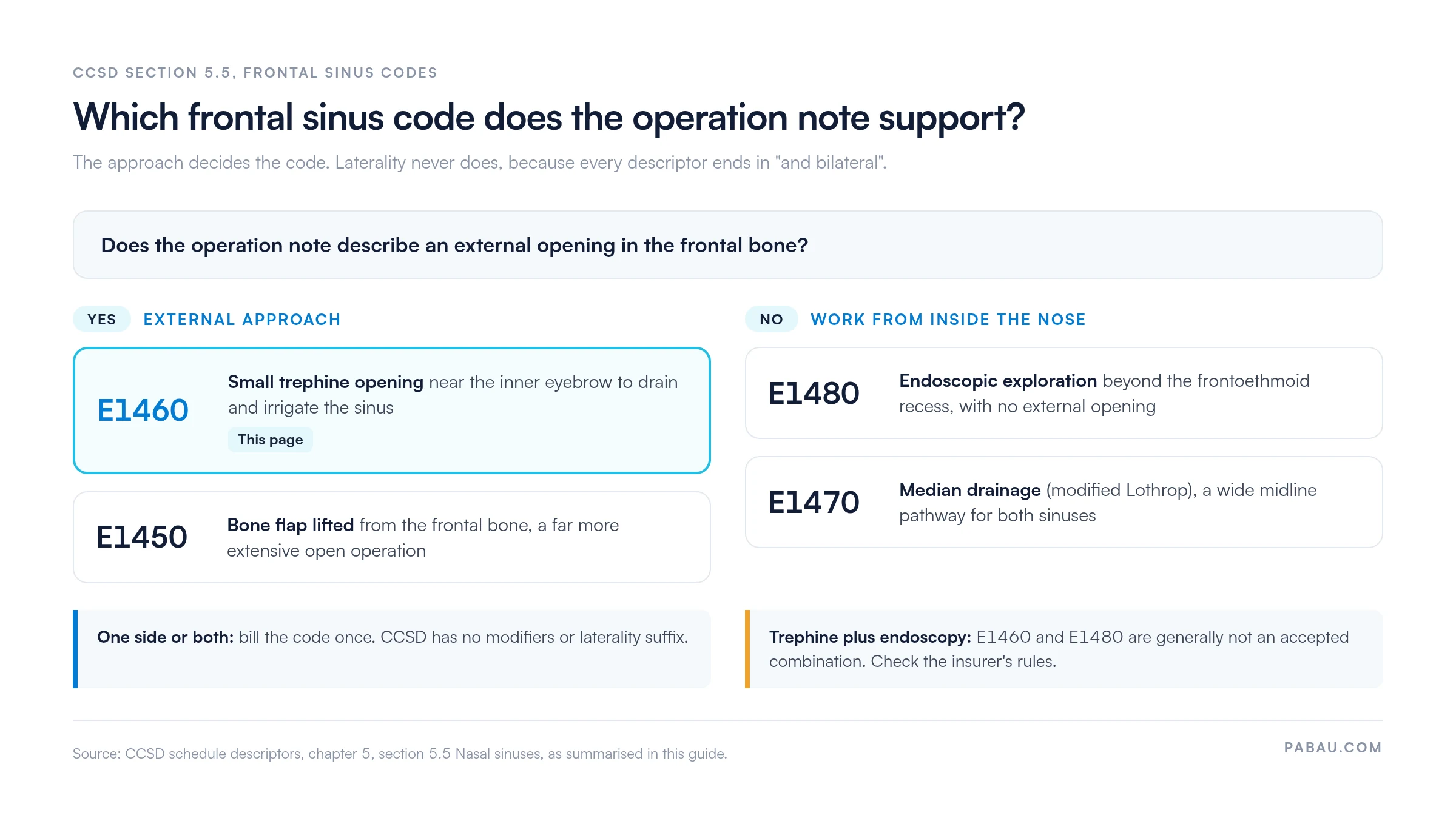
E1460 is one of several frontal sinus procedures in section 5.5; the closest alternatives are E1450, E1470 and E1480. All four descriptors end in “and bilateral”, so laterality never changes the code. The approach and the extent of surgery do.
Match the code to the approach in the operation note. A note that describes endoscopic work with no external incision does not support E1460, however the episode was booked. Where trephining and endoscopic surgery happen in the same operation, E1460 and E1480 are generally an unacceptable combination. Bill the single code the note supports, and check the insurer’s rules. The chart below follows the same logic.
UK insurers expect an ICD-10 diagnosis on the invoice, and a mismatch between procedure and diagnosis is a common reason for a query. UK insurers expect codes from the WHO ICD-10 classification, not the American ICD-10-CM. Codes copied from a US reference site may not validate.
Lead with the sinusitis code and add any complication after it, not in its place. American subdivisions such as J01.10 belong to ICD-10-CM and should not appear on a UK invoice.
UK insurers expect a planned E1460 operation to be authorised before admission. The patient usually calls the insurer, quotes the CCSD code and the ICD-10 code, and receives an authorisation reference. An invoice without that reference is held or refused until the practice supplies it.
Trephining is often urgent, so the operation may come before the paperwork. Each insurer runs its own process for emergency admissions. Contact the insurer as soon as the patient is admitted, and record the reference it issues.
Ask each insurer you bill how it handles emergency sinus admissions before you need it. Trephining for complicated sinusitis rarely waits for a planned authorisation call. Knowing the notification rule in advance keeps a clinically sound invoice from being held.
Insurers auditing ENT invoices look for a record that matches the code billed. For E1460, the operation note has to describe an external trephine, not endoscopic work alone.
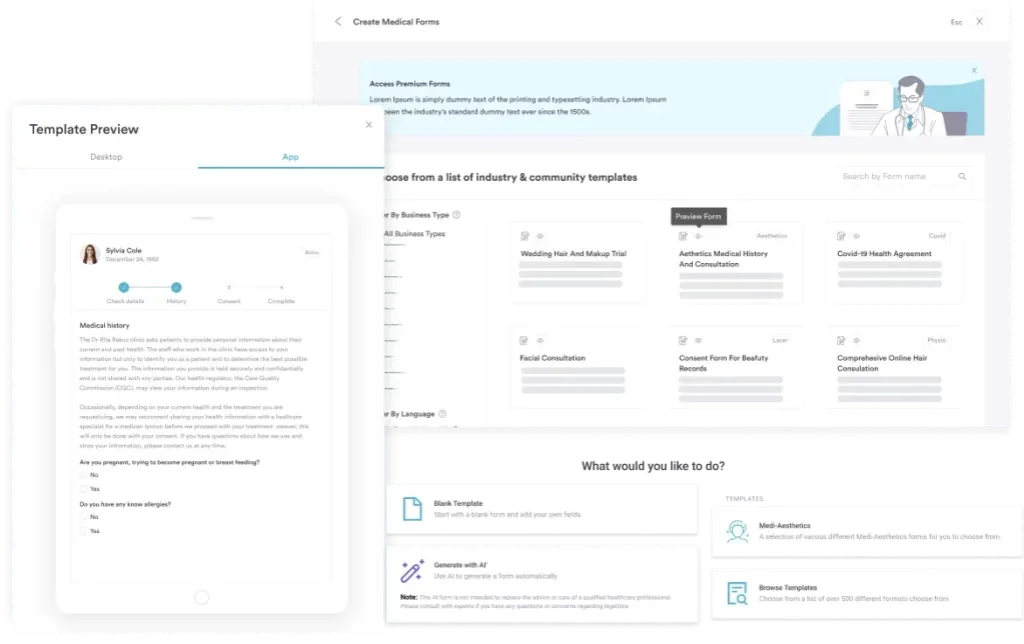
Capture the operation note on a digital form at the point of care. That removes the scramble for paperwork when the invoice is raised days later.
E1460 invoices fail for a short and predictable list of reasons. Each one is caught by a check before submission rather than an appeal afterwards.
A settled routine from clinic to remittance prevents most E1460 problems. The steps below describe how a UK ENT practice bills the procedure to a private medical insurer.
Billing one E1460 episode touches the clinic letter, the scan report, the authorisation call, the operation note and the remittance. Pabau, the practice management platform we build, holds those pieces against one patient record. The person raising the invoice is not rebuilding the episode from memory.
Pabau’s claims management software sends invoices to Healthcode without leaving the system, which spares the billing team a second round of data entry. Claim status stays visible as the insurer works through it.
Digital forms let the consultant complete a structured operation note at the point of care. For a practice running several ENT consultants, that means fewer invoices waiting while someone hunts for a note.

Pabau helps UK ENT practices capture operation notes, track authorisation references, and send CCSD-coded invoices to Healthcode with the right records attached.

CCSD code E1460 covers one defined operation: trephining of the frontal sinus through a small external opening. The descriptor’s “and bilateral” settles the most common question, because one code covers one side or both.
Clean invoicing follows from that. Bill E1460 once, with no modifier, and pick E1450, E1470 or E1480 when the approach is different. Pair it with a WHO ICD-10 sinusitis code, and hold the authorisation reference and the operation note before the invoice goes out.
Pabau keeps the clinical record and the insurer invoice in the same place, so ENT teams spend less time rebuilding evidence for a query. To see how it handles CCSD coding and Healthcode submission, book a demo with the team.

Need the wider CCSD picture? CCSD procedure codes explains how the UK schedule is organised and how practices bill against it.
Was the frontal sinus reached endoscopically? CCSD code E1480 covers endoscopic exploration beyond the frontoethmoid recess and how to bill it.
Did the surgeon open the frontoethmoid area externally? CCSD code E1410 explains billing for external frontoethmoidectomy.
Billing Bupa patients? Bupa CCSD codes sets out how Bupa bands procedures and what its published fees mean for your invoices.
Losing money to refused invoices? Denial management in healthcare covers the checks and appeal routines that keep surgical billing moving.
CCSD code E1460 covers trephining of the frontal sinus, an external operation to drain and irrigate it. The surgeon makes a small opening through the bone near the inner end of the eyebrow. The code applies to one frontal sinus or both, and UK private insurers pay it through Healthcode.
Both. The descriptor ends in the words “and bilateral”, which in CCSD means one code covers either side or both sides. Bill E1460 once for the operation, whether the surgeon opened one sinus or two in the same sitting.
No. CCSD does not use modifiers, so there is no bilateral flag or laterality suffix to add. Record the side or sides in the operation note instead, because insurers audit the invoice against the clinical record.
All four are frontal sinus codes in CCSD section 5.5, Nasal sinuses. E1450 is a bone flap to the frontal sinus, an open operation. E1470 is median drainage, the modified Lothrop procedure. E1480 is endoscopic exploration beyond the frontoethmoid recess. E1460 is the small external trephine.
J01.1, acute frontal sinusitis, and J32.1, chronic frontal sinusitis, are the usual primary codes. Add G06.0 for an intracranial abscess or M86.6 for chronic osteomyelitis when the record supports it. Use WHO ICD-10 codes, not American ICD-10-CM codes such as J01.10.



