

HCPCS code E0198: Water pressure pad billing guide
HCPCS code E0198 is a water pad for a standard mattress HCPCS code E0198 is the ...

Last Updated: Oct 13, 2026
C5480 is the CCSD code for removal of silicone oil. It applies when a vitreoretinal surgeon extracts silicone oil from the eye as the sole or primary purpose of the operative episode. The code covers oil aspiration, intraoperative retinal inspection, and any fluid-air or fluid-gas exchange performed as part of the removal.
C5480 is a principal procedure code, so it can lead a claim on its own. Concurrent procedures such as retinal laser, membrane peel or cataract extraction are coded separately. UK private medical insurers reimburse against the CCSD schedule. NHS trusts use OPCS-4 codes instead.
Let Pabau's smart automation suggest the right codes, reduce claim denials, and keep your practice compliant—effortlessly.
Automate repetitive tasks and focus on what matters most—your patients.
Reduce coding errors and ensure compliance with the latest regulations.
Clean claims, fewer denials, and faster reimbursements.
Powerful insights and reporting to help your practice thrive.
HIPAA compliant SOC 2 certified GDPR-compliant Trusted by 4,000+ clinics worldwide

CCSD code C5480 covers silicone oil removal as a standalone billable procedure in the UK private medical insurance schedule, not NHS billing.
Clinical indications include stable retinal reattachment, oil emulsification, raised intraocular pressure, and corneal decompensation, usually 3 to 6 months after insertion.
Concurrent procedures such as retinal laser, membrane peel, or cataract extraction are not included in C5480 and must be coded separately.
Pabau, practice management software, stores insurer and policy details on the patient record and tracks each C5480 claim’s status through to payment.
CCSD code C5480 represents removal of silicone oil. The Clinical Coding and Schedule Development Group assigns that official descriptor and maintains the schedule that UK private medical insurers use. The code sits in the vitreoretinal section of the CCSD ophthalmology chapter. It applies when a vitreoretinal surgeon extracts silicone oil as the sole or primary purpose of the operative episode.
Only the private sector uses CCSD codes. NHS trusts use OPCS-4 procedure codes and HRG tariffs instead. Bupa, AXA Health, Aviva and Vitality Health all reimburse against CCSD schedules. Coders can check the CCSD code lookup on Bupa’s portal for the current descriptor and any insurer notes attached to C5480.
The code is not a supplementary or add-on code. It stands alone as a principal procedure code, so it can lead a claim without a parent vitrectomy code listed first. The operative documentation has to confirm that oil removal was the primary purpose of the procedure.
Surgeons perform silicone oil removal under local or general anaesthesia, usually in a day-case ophthalmic theatre. The procedure follows a pars plana approach. The surgeon creates three sclerotomy ports, introduces the infusion cannula, then aspirates the oil under direct visualisation. Removal uses either passive drainage or an active extraction system.
Once the oil is clear, the surgeon inspects the retina for residual detachment, peripheral breaks, or emulsified oil droplets in the anterior segment. The surgeon may perform a fluid-air or fluid-gas exchange as part of the removal if needed to stabilise the eye during closure. Typical operative duration is 30 to 60 minutes. Coding the procedure correctly depends on what else the surgeon performs in the same sitting, not on the duration of the case.
The primary trigger for removal is confirmation that the retina has stayed securely reattached for a sufficient period. The Royal College of Ophthalmologists notes that timing varies by case complexity. The clinical literature commonly cites 3 to 6 months after insertion as typical for uncomplicated retinal detachment repairs. Removing the oil earlier risks re-detachment. Leaving it in longer than needed raises the risk of secondary complications.
Other established clinical indications include:
Coders must read the operative report carefully before assuming that C5480 covers every element of the procedure. The table below summarises what the code includes and excludes.
Any procedure listed in the right column requires its own CCSD code and a corresponding entry in the operative report explaining why the surgeon performed it. Missing this step is a common trigger for claim adjustment or partial payment.
The CCSD ophthalmology chapter contains several vitreoretinal procedure codes that billing staff regularly confuse with C5480. Selecting the wrong one is the most common source of avoidable claim denials in this specialty. Checking the descriptor against the wider CCSD codes list before submission settles most of these cases.
A detachment repaired without entering the eye falls outside this group. A scleral buckle with no vitrectomy is conventional retinal surgery, coded C5432, because the surgical route picks the code rather than the diagnosis.
Verify current code descriptors against the CCSD Group’s official schedule before submitting any claim. The CCSD Group updates descriptors annually each October.
Before coding any vitreoretinal claim, print the operative note and highlight every discrete procedure performed. Assign a CCSD code to each highlighted item separately, then check each insurer’s fee schedule for bundling restrictions. Disputes almost always trace back to a procedure the surgeon performed but the coder never coded, or coded without a supporting operative note entry.
A patient may return with a re-detachment and have a full pars plana vitrectomy (PPV) in the same sitting as oil removal. C5480 is then not automatically billable as an additional code. What matters is whether the removal was a trivial step inside a larger procedure. If it took independent skill and time, it is a clinically distinct element.
UK private medical insurers do not operate the formal global surgical period that US Medicare uses. Some PMI contracts still include post-operative bundles that can absorb C5480. That applies where removal falls within a defined window after the original tamponade insertion claim. Confirm the insurer’s policy before submitting a combined claim, and review those unbundling rules each year as schedules change.
General approach when concurrent procedures occur:
The summary below sets out which code leads in each scenario, including the insertion case where C5480 does not apply.
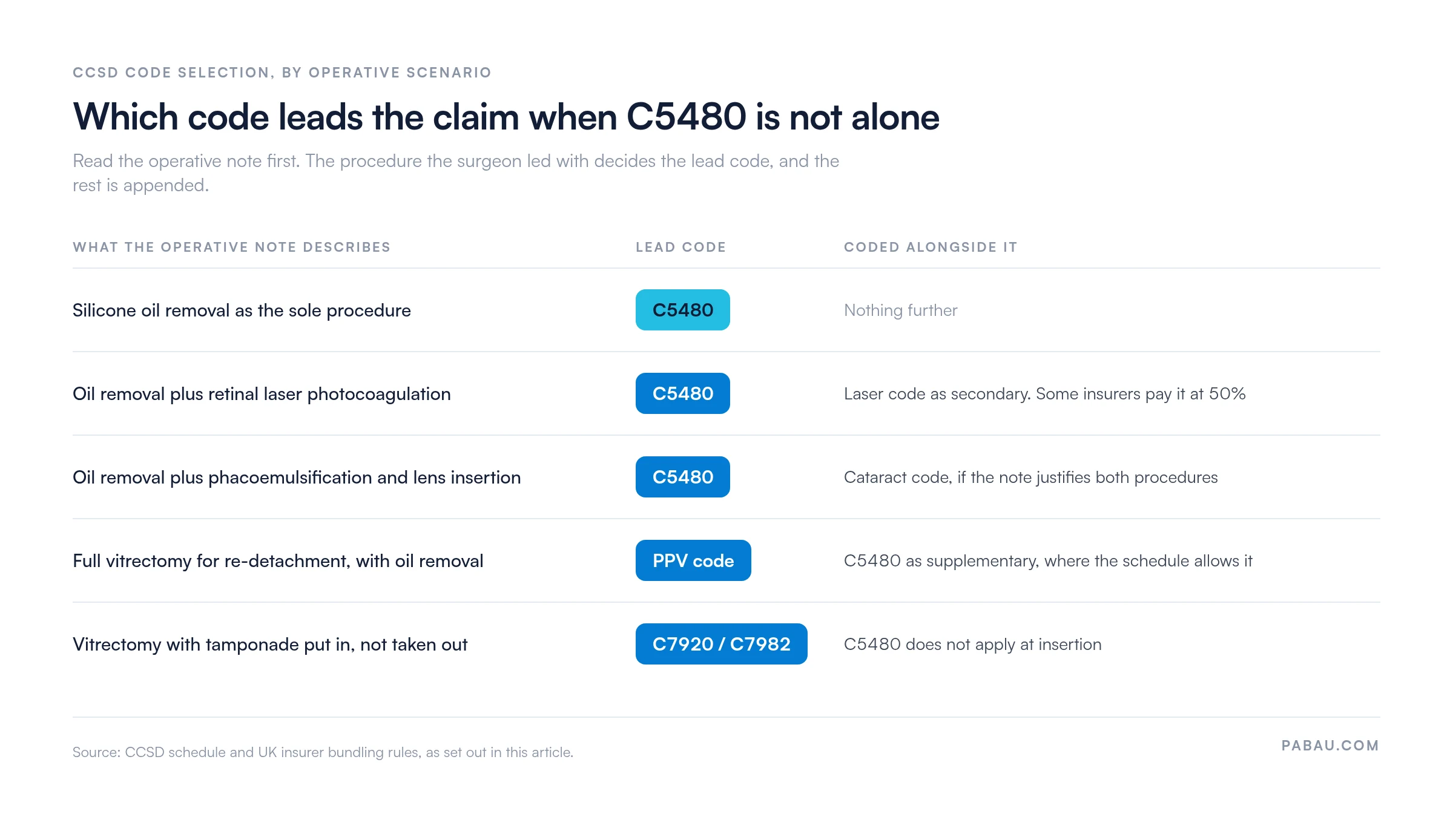
UK private medical insurers require pre-authorisation before elective ophthalmic surgery in almost every case. Requirements vary by insurer, but the core documentation set for C5480 is consistent across Bupa, AXA Health, Aviva and Vitality Health.
Standard pre-authorisation requirements include:
The Vitality fee finder and comparable insurer tools set out procedure-specific requirements. Never submit a C5480 claim without a valid authorisation reference number. Late or missing pre-auth is the leading cause of non-payment for elective vitreoretinal procedures.
The operative report is the primary audit document for any C5480 claim. Digital patient intake and consent forms keep the surrounding paperwork complete, but the note itself depends on what the surgeon records intraoperatively. Make sure your operative note template captures every element below.

Missing laterality and absent tamponade confirmation are the two most frequently cited documentation deficiencies in denied C5480 claims.
Systematic denial management begins with understanding which reasons appear repeatedly on C5480 remittances. The list below reflects patterns that UK private practice billing teams consistently report.
Practices billing several insurers benefit from a payer-specific rules matrix, refreshed at the start of each fee schedule year.
A denied C5480 claim is not automatically a lost claim. Most UK private medical insurers operate a formal appeal process. Well-documented appeals succeed more often than many billing teams expect. Speed and consistency decide the outcome.
Build a denial log specific to CCSD ophthalmology claims. Record the insurer, the denial reason code, and the resolution for every C5480 rejection. After three months you will have a pattern map showing which insurers most frequently deny on laterality, tamponade confirmation, or bundling grounds. Use it to create payer-specific checklist prompts before each submission.
Most private ophthalmology practices keep authorisation references and claim outcomes in a spreadsheet beside the theatre list. A stalled C5480 claim then goes unnoticed until month-end reconciliation, which is often past the insurer’s appeal window.
Pabau’s claims management software holds each patient’s insurer and policy details on their record and validates the authorisation code when the billing team raises a claim. Claim status then moves through pending, submitted, processing, paid or error, so the billing team can see where every vitreoretinal claim sits.
The operative note still has to say what the surgeon did, and a coder still has to read it. What changes is the time spent hunting for a policy number or an authorisation reference at submission.


Pabau stores each patient’s insurer and policy details on their record, validates the authorisation code, and tracks claim status from submitted through to paid. Billing teams see where a vitreoretinal claim has stalled without opening a spreadsheet.

C5480 is clinically simple and administratively fragile. Three causes recur: a missing authorisation reference, an operative note that never names silicone oil, and a concurrent procedure nobody coded.
Move those checks forward into the theatre booking routine rather than leaving them for billing week. A vitreoretinal list produces few enough C5480 claims that one wrong submission moves the month’s figures. Book a demo to see how Pabau keeps authorisation details and claim status on the patient record.

Need a complete overview of CCSD codes for private practice? Bupa CCSD procedure codes covers the schedule structure, how Bupa applies codes, and what billing staff need to check before submission.
Need the fee side of a UK private claim? Bupa procedure codes and fee schedule explains how procedures are priced and where to check benefit limits before you submit.
Want to understand the full denial cycle for private ophthalmology claims? Denial management in healthcare walks through the end-to-end process from root-cause analysis to appeal submission.
CCSD code C5480 covers removal of silicone oil from the vitreous cavity as a standalone procedure. It sits in the UK private medical insurance billing schedule. The code includes oil aspiration or active extraction, intraoperative retinal inspection, and any fluid-air or fluid-gas exchange performed as part of the removal. It does not include concurrent retinal laser, membrane peel, or cataract extraction, which require separate codes.
Yes. C5480 is a standalone principal procedure code, not a supplementary or add-on code. It can lead a claim without a parent vitrectomy code, provided the operative documentation confirms that oil removal was the primary purpose. Where removal happens alongside a full pars plana vitrectomy for re-detachment, the PPV code usually leads. Coders may then append C5480 as a secondary code, subject to insurer bundling rules.
Surgeons usually remove silicone oil once the retina has stayed reattached for 3 to 6 months. Exact timing varies by case complexity and surgeon judgement. Surgeons consider earlier removal where the patient develops significant oil emulsification or raised intraocular pressure unresponsive to drops. Cataract formation and corneal decompensation attributable to the tamponade are also triggers.
C7920 and C7982 cause the most confusion, because both cover vitrectomy with internal tamponade inserted rather than removed. C7982 adds dissection or excision of epiretinal membrane. Full PPV codes for re-detachment are the other common mix-up, and they should lead the claim where a complete vitrectomy accompanies removal. Billing teams sometimes leave off retinal laser supplementary codes entirely, which underpays the episode.



