

HCPCS code E0198: Water pressure pad billing guide
HCPCS code E0198 is a water pad for a standard mattress HCPCS code E0198 is the ...

Last Updated: Oct 13, 2026
CCSD code C5432 covers conventional retinal surgery, the buckle-based repair of a detached retina. The official descriptor says the operation may include scleral buckling, injection of gas, drainage and retinopexy. All four sit inside the one code, so none of them goes on the claim as an extra line.
The surgical route decides the code. A repair done from outside the eye with a buckle belongs here, while a vitrectomy repair is coded elsewhere in Chapter 4. Most of these cases are urgent, so the authorization and the operative note have to match. The sections below show how to keep both in step.
Let Pabau's smart automation suggest the right codes, reduce claim denials, and keep your practice compliant—effortlessly.
Automate repetitive tasks and focus on what matters most—your patients.
Reduce coding errors and ensure compliance with the latest regulations.
Clean claims, fewer denials, and faster reimbursements.
Powerful insights and reporting to help your practice thrive.
HIPAA compliant SOC 2 certified GDPR-compliant Trusted by 4,000+ clinics worldwide

CCSD code C5432 bills conventional retinal surgery, the buckle-based repair of a detached retina, to UK private medical insurers.
Drainage, gas injection and retinopexy done in the same sitting are part of C5432, so they don’t go on the claim as extra lines.
A retina repaired through a vitrectomy takes a vitrectomy code instead, which is why the operative note decides the code.
Pre-authorization rules vary by insurer and policy, and an urgent repair still needs the insurer told as soon as possible.
The CCSD Group doesn’t set fees, so check each insurer’s own schedule for what C5432 pays.
CCSD code C5432 is the code a consultant ophthalmologist uses to bill conventional retinal surgery to a UK private medical insurer (PMI). In practice, that means repairing a detached retina with a scleral buckle. The buckle is a silicone band or sponge stitched to the outside of the eye wall.
The official descriptor reads “Conventional retinal surgery (may include scleral buckling, injection of gas, drainage and retinopexy).” The code sits in Chapter 4, Eye and orbital contents, among the retina procedures.
The CCSD schedule is run by the Clinical Coding and Schedule Development Group, whose members include Aviva, AXA Health, Bupa and VitalityHealth. NHS trusts record the same operation in OPCS-4, so C5432 only appears on private claims.
The schedule isn’t freely searchable, so confirm the current wording on your insurer’s provider portal. Our reference to Bupa CCSD codes covers the wider code families consultants bill.
The “may include” list in the descriptor is the part billers lean on most. Drainage of subretinal fluid, a gas bubble and retinopexy done in the same sitting all belong to C5432. Adding any of them as a second line will usually read as unbundling.
Other work around the operation follows its own route, as the table shows.
Unbundling rules are set out in the CCSD Technical Guide, and the major PMIs apply them. A line that should have been bundled can trigger a review, and the insurer can recoup money already paid.
A detached retina can be repaired in more than one way, and each route bills differently. The code comes from what the surgeon did, and only the operative note records that. The chart below walks through the four routes billers meet most often.
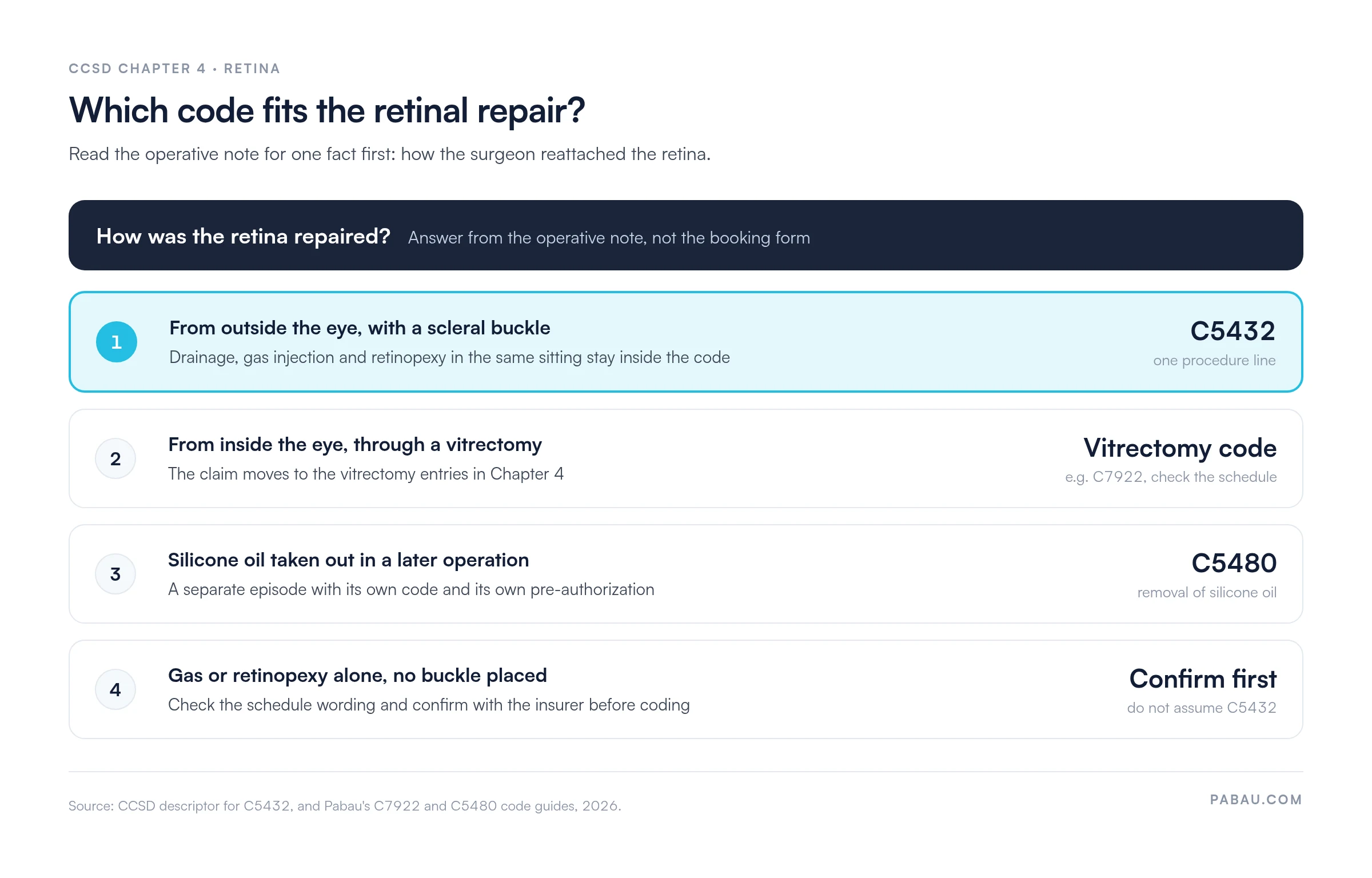
When the note and the descriptor don’t line up cleanly, browse the full CCSD code library for the neighboring retina entries.
If a buckle and a vitrectomy happen in the same sitting, don’t guess. Read the multiple-procedure rules in the Technical Guide, then confirm with the insurer before adding a second code line. Record the clinical reason for each step in the operative note.
Take an illustrative case. A patient has a retinal detachment caused by a single tear. The consultant places a buckle, drains subretinal fluid, injects gas and seals the tear with cryotherapy.
That’s four surgical steps, yet the surgeon’s claim carries one procedure line: C5432. The anesthetist sends a separate claim under their own code. The hospital bills its own charges, such as theatre time and consumables, on a separate account.
Now change one detail. Suppose the surgeon repaired the same retina through a vitrectomy. The diagnosis is identical, but C5432 is now the wrong code.
Insurers read the operative note when they assess or audit a C5432 claim. So the note should describe the operation in words that match the descriptor. A reviewer should be able to tick off each step.
Check your insurer’s provider handbook for extras, since Bupa, AXA Health and Freedom Health Insurance each publish their own requirements. As a minimum, the note should cover these points:
The Medical Protection Society and the Medical Defence Union both advise keeping clinical records for at least eight years. If a note can’t be produced at audit, the insurer can recoup claims it has already paid.
Retinal detachment is often operated on urgently, which squeezes the usual pre-authorization window. Insurers still expect to hear about the surgery, and their rules vary by policy type.
For a same-day repair, contact the insurer as early as you can and use its route for urgent cases. Write down who you spoke to and the reference they gave.
An authorization covers a specific procedure, date and policy. If the date moves, or the route changes from buckle to vitrectomy, get the authorization updated before you claim.
Healthcode is the main electronic billing gateway for CCSD claims to UK private medical insurers. It routes each claim to the right PMI and returns electronic remittances. A standard C5432 submission runs in eight steps.
A CCSD modifier changes how the payer interprets the procedure code. The wrong modifier, or a missing one, leaves the claim out of step with the operative note.
Modifier rules sit in the CCSD Technical Guide. A modifier the guide doesn’t permit for a code is a compliance risk, so check the current version before you submit.
The CCSD Group sets codes and descriptors, not fees. Each PMI sets its own reimbursement rate for C5432, and some negotiated rates are never published.
A gap fee applies when the consultant charges more than the insurer pays. Patients must be told about gap fees in advance. The Competition and Markets Authority (CMA) has set fee transparency rules for private healthcare, and ignoring them carries regulatory risk.
To see how one insurer structures its rates, read our guide to Bupa fee schedules.
Each common rejection below has a fix before submission and a route if it happens anyway.
Build pre-authorization tracking into booking, not just billing. Once a claim is ready to send, a missing authorization number can’t be fully fixed. Flag the requirement when you schedule the patient, and store the number against the appointment.
Five minutes here saves weeks of rework later.
Billing a retinal repair by hand means keying the same facts three times. The booking holds the policy details, the note holds the procedure, and the claim needs both. Each re-entry is a chance for a wrong digit or a lost reference.
Pabau, the practice management and billing platform we build, keeps those facts on one patient record. It integrates with Healthcode, so your team can record C5432 against the procedure and submit the claim from the same place.
Keeping authorization and coding details on the record can help reduce documentation-related rejections. For groups with several consultants or sites, claims software for consultants brings every consultant’s claims into one view.

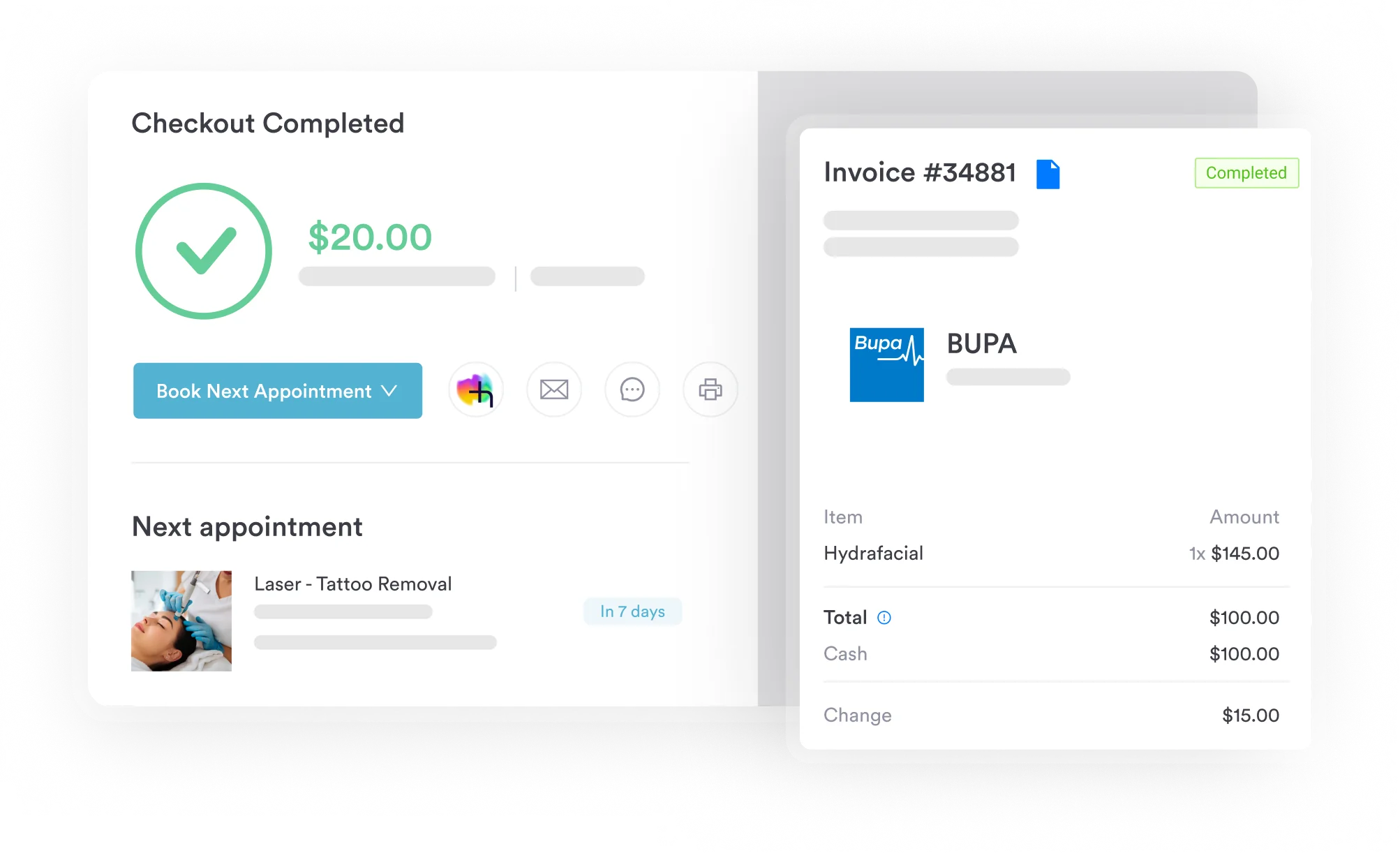

Pabau keeps the policy details, operative note and CCSD code on one patient record. Claims go to Healthcode once the required fields are complete.

Code C5432 from the operative note, and code it once. If the note describes a buckle, the drainage, gas and retinopexy ride on that single line. If it describes a vitrectomy, C5432 is the wrong code, however similar the diagnosis looks.
On urgent cases, timing is the bigger risk. Retinal repairs move fast, so the authorization has to keep pace with the surgery the note records.
Book a demo to see how Pabau keeps authorization numbers, operative notes and CCSD codes together for your retinal surgery claims.

Billing the vitrectomy instead? CCSD code C7922 covers pars plana vitrectomy claims and their pre-authorization steps.
Removing silicone oil after a repair? CCSD code C5480 explains when oil removal is billed as its own episode.
Coding cataract surgery too? CCSD code C7520 covers phacoemulsification of the lens with an implant.
Billing orbital surgery? CCSD code C0620 walks through drainage of the orbit for private claims.
Need the wider Bupa code set? Bupa CCSD codes lists the procedure codes Bupa recognizes across specialties.
No. CCSD codes bill UK private medical insurers, while NHS trusts record operations in OPCS-4. The two systems describe similar procedures, but one code can’t stand in for the other on a claim.
It depends on the detachment the surgeon recorded. A detachment caused by a tear is usually coded H33.0, retinal detachment with retinal break. Always match the diagnosis written in the note.
Scleral buckling stitches a silicone band or sponge to the outside of the eye wall. The buckle pushes the wall inward against the detached retina, so the tear can seal.
Sometimes, but check first. Combined operations fall under the multiple-procedure rules in the CCSD Technical Guide, and insurers apply them differently. Confirm with the insurer and record the reason for each step.
The CCSD Group revises the schedule and its Technical Guide from time to time, and the current guide dates from October 2025. Recheck the C5432 descriptor on your insurer’s portal before you claim.



