

HCPCS Code Q4175: Billing, coverage, and documentation guide
HCPCS Code Q4175: Code Description and Product Identity HCPCS Code Q4175 is the ...

Last Updated: Nov 20, 2026
C2220 is the CCSD code for biopsy of lesion of eyelid, in Chapter 4 under Eyebrow and lid. It covers taking a tissue sample from an upper or lower lid lesion so histopathology can confirm the diagnosis.
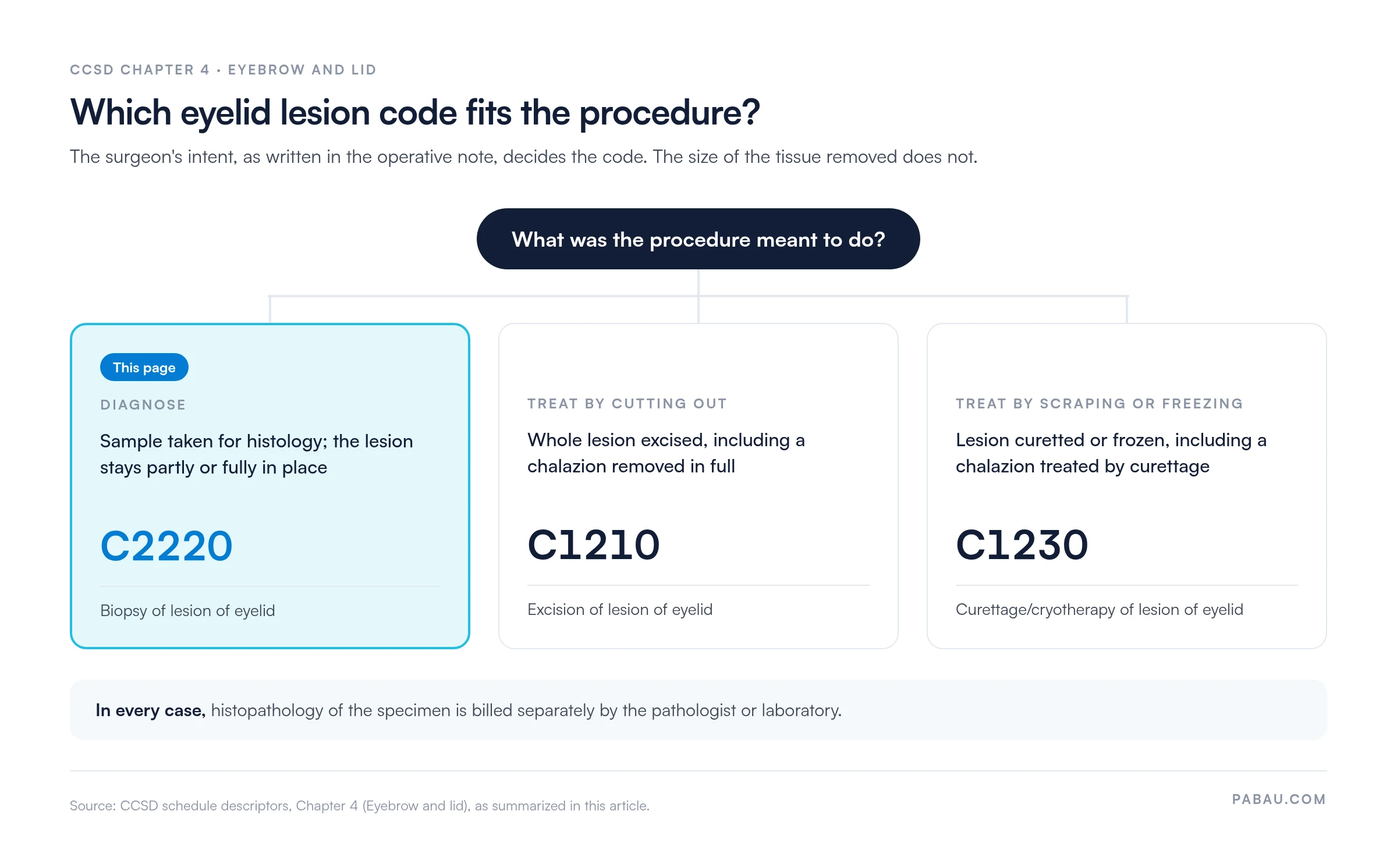
The clinical intent decides the code. If the surgeon removes the whole lesion to treat it, the procedure bills as C1210, and curettage or cryotherapy bills as C1230. The laboratory bills its analysis separately, and UK private medical insurers expect pre-authorization.
Let Pabau's smart automation suggest the right codes, reduce claim denials, and keep your practice compliant—effortlessly.
Automate repetitive tasks and focus on what matters most—your patients.
Reduce coding errors and ensure compliance with the latest regulations.
Clean claims, fewer denials, and faster reimbursements.
Powerful insights and reporting to help your practice thrive.
HIPAA compliant SOC 2 certified GDPR-compliant Trusted by 4,000+ clinics worldwide

CCSD code C2220 covers a biopsy of an eyelid lesion in UK private practice and is not part of NHS OPCS-4 coding.
The code pays for the surgeon’s operative work only, so the laboratory bills histopathology of the specimen as a separate charge.
Clinical intent decides the code: a diagnostic sample is C2220, a full excision is C1210, and curettage or cryotherapy is C1230.
A missing pre-authorization reference is the most avoidable denial, because most UK private insurers will not authorize the procedure after the event.
Pabau, the practice management platform we build, flags a missing authorization on the patient’s case and sends UK claims through Healthcode and BUPA.
CCSD Code C2220 is the Committee of Coding and Schedule Descriptors procedure code for the biopsy of a lesion of the eyelid. The official descriptor is “Biopsy of lesion of eyelid.” The CCSD, whose members represent Bupa, AXA Health, Aviva and Vitality, publishes the UK private healthcare coding schedule.
The code applies only to procedures billed through private medical insurance or self-pay in the United Kingdom.
The code captures the full surgical episode of taking a tissue sample from an eyelid lesion for diagnostic purposes.
It covers patient preparation, local anesthetic and the biopsy itself, whether incisional, excisional or punch. Wound closure and specimen handling are included up to the point the sample leaves the operating field. It does not extend to laboratory analysis of the specimen.
C2220 sits in Chapter 4 of the schedule, Eye and orbital contents, under Eyebrow and lid. The same chapter covers the orbit behind the lid, where removal of a foreign body is billed as C0640. Consultant ophthalmologists and oculoplastic surgeons use it most. Dermatologists in private secondary care may also use it when an eyelid biopsy forms part of a consultant-led episode.
Its neighbors in that chapter cover excision, curettage and grafting of the same lid, and they share the same documentation pattern. For codes in other chapters, see our full list of CCSD procedure codes. Circumcision, for example, sits in chapter 12 under code N3030.
An eyelid lesion biopsy is a minor surgical procedure performed under local anesthesia in an outpatient setting. General anesthesia is reserved for exceptional cases, such as a pediatric patient or a lesion in a location where local infiltration is contraindicated.
Three biopsy techniques may be used depending on lesion size, location, and clinical suspicion:
Whatever the technique, the operative note must record five details:
The documentation section below lists what the wider record needs.
CCSD Code C2220 is appropriate whenever a formal tissue biopsy of an eyelid lesion is performed to establish or confirm a histological diagnosis. Both benign and malignant lesions may justify the code, provided the clinical decision to biopsy rather than observe or excise has been documented.
Common lesion types that appropriately trigger a C2220 billing event include:
A chalazion (meibomian gland cyst) is not coded as C2220 when no formal biopsy goes to histopathology. A chalazion treated by curettage bills as C1230, and one excised in full bills as C1210. If the clinician also samples tissue because of atypical features, C2220 covers the biopsy component.
Understanding bundling rules prevents over-billing, under-billing, and claim rejection. The table below summarizes what is in-scope for C2220 and what must be coded or billed separately.
Always check the individual insurer’s current fee schedule before submitting. Bundling conventions vary between Bupa, AXA Health, Aviva, and Vitality, and what one insurer bundles another may allow as a separate charge. Never rely on a single payer’s rules as a universal standard.
Selecting the wrong adjacent code is one of the most common coding errors in oculoplastic billing. The table below shows the codes most frequently confused with C2220 and the key differentiator for each.
Critical distinction: Clinical intent separates C2220 from C1210, whatever the size of the tissue removed. If the surgeon set out to remove the lesion and histopathology only confirms it, C1210 is correct. If the goal was diagnosis and the lesion was not fully cleared, C2220 applies.
Curettage or cryotherapy of the lesion is C1230. Insurers check the operative note against the code, so a mismatch is a frequent denial trigger. The diagram below maps each intent to its code.
Check adjacent code numbers against the current CCSD schedule before submitting, because the schedule is updated periodically. Our Bupa CCSD code guide shows how these codes map to an insurer fee schedule.
A clean C2220 claim depends on a complete operative note and a well-structured patient record. Insurers increasingly audit surgical claims against submitted documentation, and vague or incomplete notes are a primary rejection trigger.
The operative note for a C2220 procedure must include all of the following:
Beyond the operative note, the patient record should hold the outpatient letter that documents the decision to biopsy rather than excise. It also needs the insurer’s pre-authorization reference and, where applicable, the referring GP or specialist letter.
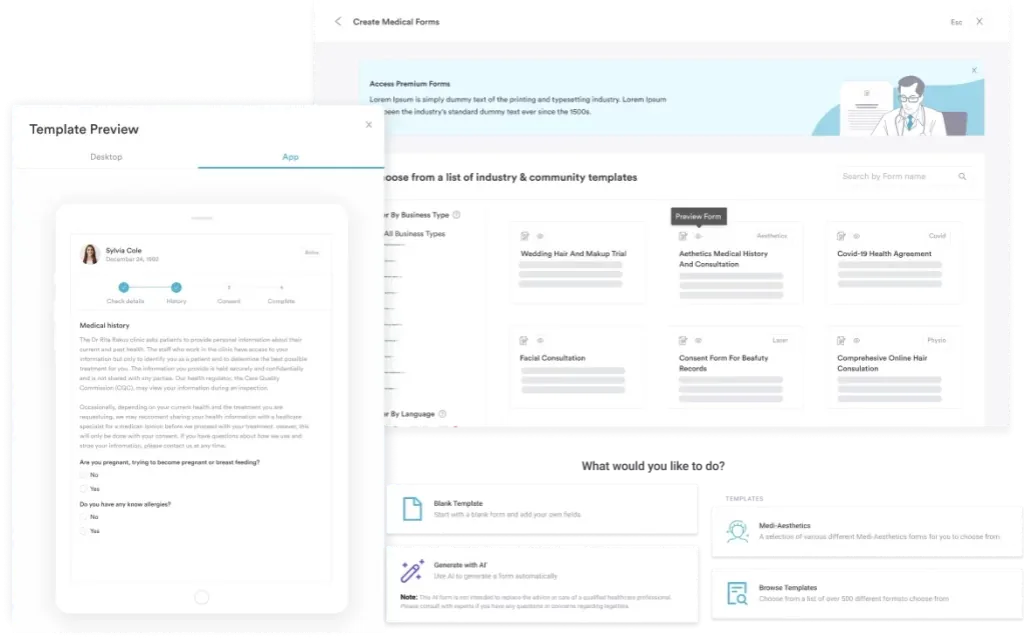
Digital clinical forms keep these records structured, timestamped and retrievable during an audit. GMC and ICO guidance governs how long surgical notes are kept. Practices should keep operative notes for at least eight years for adult patients.
All major UK private medical insurers require pre-authorization for surgical procedures, including CCSD Code C2220. Submitting a claim without an authorization reference number is the single most avoidable reason for denial. Pre-authorization must be obtained before the procedure takes place; retrospective authorization requests are routinely refused or result in reduced settlement.
The table below summarizes the pre-authorization approach for the principal UK private insurers. Because insurer policies change, always verify requirements directly with each insurer’s provider portal before the procedure.
Histopathology of the biopsy specimen is not bundled within CCSD Code C2220. The surgical code covers only the work of the operating consultant, up to and including dispatch of the labeled specimen. Laboratory work is a separate charge, whether standard histology, immunohistochemistry or frozen-section analysis. The pathologist or laboratory bills it under the applicable pathology CCSD code.
Three common billing configurations arise in practice:
Confirm the insurer’s position on histopathology billing in advance. Some plans require the laboratory to bill directly; others allow the consultant to consolidate charges. Submitting a histopathology charge within the C2220 invoice when the insurer expects separate billing is a denial trigger.
Knowing the most frequent denial reasons for CCSD Code C2220 makes it possible to prevent most of them before submission. The list below draws on standard UK private practice billing experience; individual insurer denial patterns may vary.
A pre-submission check for the authorization reference and a complete operative note, run before the invoice leaves the practice, prevents most first-contact denials.
A C2220 claim fails at three points: the code chosen against the operative note, the pre-authorization reference, and the submission itself. In a practice that bills from spreadsheets and insurer portals, each one is a manual check.
Pabau records the authorization code, dates and sessions on the patient’s case and warns the team when an authorization is missing. Claims then go to UK insurers electronically through Healthcode and BUPA, using Pabau’s claims management software.
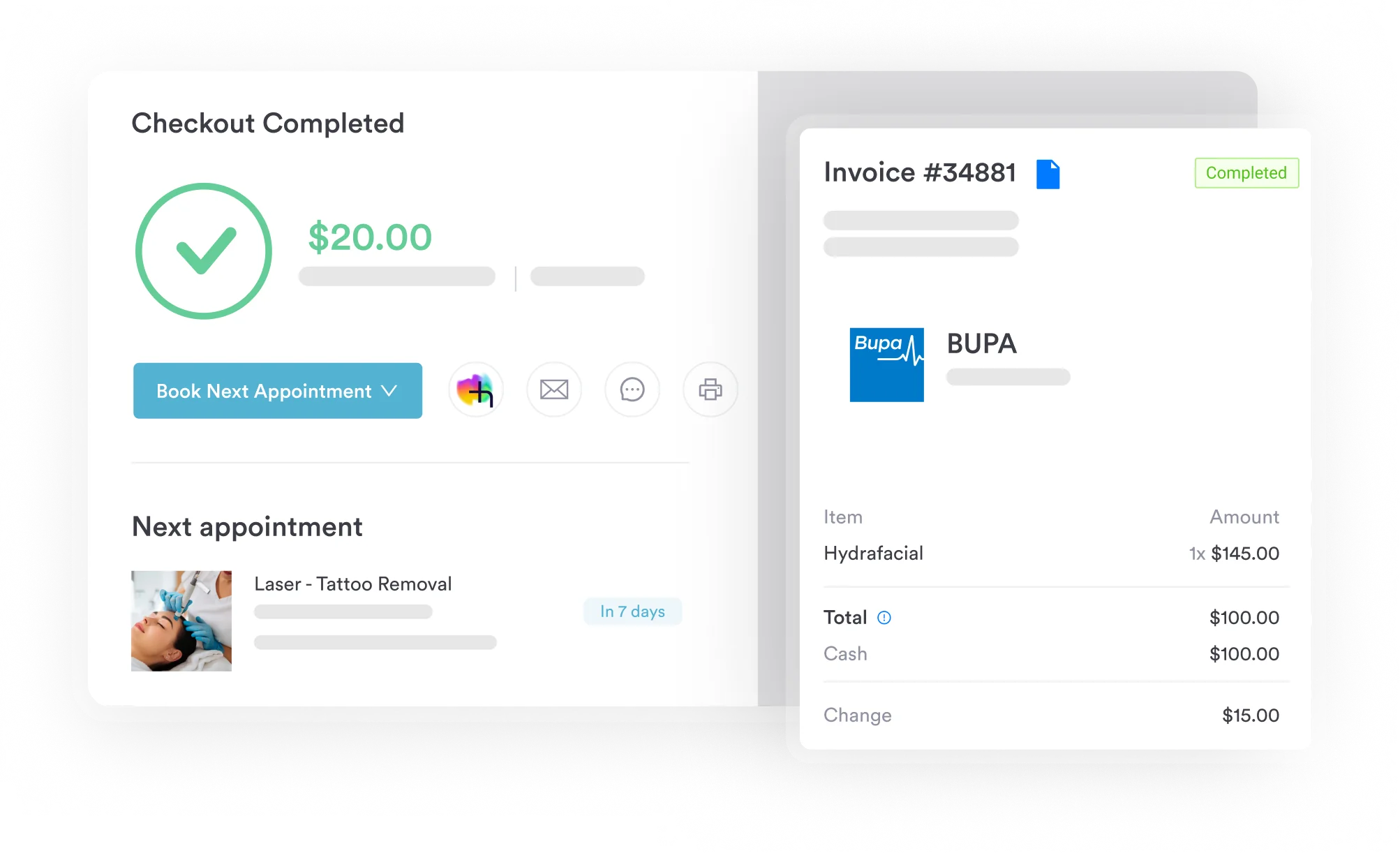
For a practice with several consultants, the operative note, the authorization and the claim sit on one patient record. Billing staff can see whether a C2220 claim is ready without checking each insurer’s portal by hand.

Pabau tracks pre-authorization codes on the patient’s case and warns you when one is missing. UK claims then go to insurers through Healthcode and BUPA.

Code C2220 only when the operative note shows a diagnostic sample. When the procedure set out to treat the lesion, use C1210 or C1230 instead. That one decision, written down before the claim goes out, removes the most common reason insurers query an eyelid biopsy.
The rest is routine: secure the authorization first and let the laboratory bill histology on its own invoice. Practices that build these checks into booking spend less time on resubmissions. Book a demo to see how Pabau keeps authorizations and C2220 claims in one place.

Need a full Bupa billing reference? Bupa CCSD procedure code guide covers Bupa’s fee structure, code submission rules, and pre-authorization conventions across the full CCSD schedule.
Was the whole lesion removed? CCSD code C1210 covers excision of a lesion of the eyelid, including a chalazion excised in full.
Treated by curettage or freezing? CCSD code C1230 covers curettage or cryotherapy of an eyelid lesion.
Closing the defect with a graft? CCSD code C1420 explains how an eyelid skin graft is coded and billed.
CCSD Code C2220 covers the biopsy of a lesion of the eyelid in UK private healthcare. It pays for the surgeon’s work from local anesthetic through sampling and wound closure to specimen dispatch. It does not include histopathology fees, anesthetist charges, or separate consultation attendances.
C2220 is used when the primary clinical intent is diagnosis through tissue sampling, with the lesion remaining partially or fully in situ. C1210 (excision of lesion of eyelid) applies when the primary intent is complete removal of the lesion, with histopathology as a confirmatory step. The operative note must clearly reflect which intent drove the clinical decision.
No. Histopathology is not bundled within C2220 and must be billed separately by the pathologist or laboratory under the applicable pathology code. Some insurers require the laboratory to submit its own invoice; others allow the consultant to consolidate charges. Confirm the insurer’s preferred arrangement before submitting.
Yes. All major UK private medical insurers, including Bupa, AXA Health, Aviva, and Vitality Health, require pre-authorization for surgical procedures including C2220. Authorization must be obtained before the procedure takes place; retrospective requests are routinely refused. Always record the authorization reference number in the patient record and include it on the invoice.
A chalazion treated by curettage, with no formal biopsy sent for histopathology, is coded C1230. One excised in full is coded C1210. C2220 applies only when the clinician also takes a tissue sample because atypical features could indicate malignancy.
The most common reason is a missing pre-authorization reference on the invoice. Others include an operative note that describes excision under a biopsy code, or one missing the lid site. Histopathology bundled into the C2220 invoice is another. Each of these is preventable through structured pre-submission checking.





