CCSD code F4400: Parotid gland excision billing guide
What CCSD code F4400 covers CCSD code F4400 is the UK private billing code for e...

Last Updated: Oct 9, 2026
C1210 is the CCSD code for excision of lesion of eyelid, in Chapter 4 under Eyebrow and lid. It covers cutting a lesion out of the upper or lower lid in full. Chalazia, naevi and basal cell carcinomas are typical, usually removed as a day case under local anaesthetic.
The surgical method decides the code. Curettage or cryotherapy of an eyelid lesion bills as C1230, and a biopsy that only samples it is C2220. A skin graft to close the defect is coded separately as C1420. UK private medical insurers expect pre-authorisation and, in most cases, a histology report.
Let Pabau's smart automation suggest the right codes, reduce claim denials, and keep your practice compliant—effortlessly.
Automate repetitive tasks and focus on what matters most—your patients.
Reduce coding errors and ensure compliance with the latest regulations.
Clean claims, fewer denials, and faster reimbursements.
Powerful insights and reporting to help your practice thrive.
HIPAA compliant SOC 2 certified GDPR-compliant Trusted by 4,000+ clinics worldwide

CCSD Code C1210 covers cutting an eyelid lesion out in full. Curettage or cryotherapy is C1230, and a biopsy is C2220.
Document medical necessity, because UK PMI policies often exclude cosmetic-only presentations.
Insurers usually require pre-authorisation before the surgeon performs the procedure.
Claims management in Pabau, the practice software we build, submits CCSD-coded claims, attaches operative notes and tracks each claim’s status.
CCSD Code C1210 is the procedure code for excision of a lesion of the eyelid in the UK private healthcare schedule. The Clinical Coding and Schedule Development (CCSD) Group maintains that schedule. The major UK private medical insurers (PMI) use it, including Bupa, AXA Health, Vitality and Aviva.
C1210 sits in Chapter 4, Eye and orbital contents, under the Eyebrow and lid category of the CCSD code schedule. The NHS records the same operation in OPCS-4, while private providers bill PMI against CCSD codes. The schedule’s technical guide sets out how its codes are applied.
The critical word in C1210’s descriptor is “excision.” This means complete surgical removal of the lesion with a defined margin, with intent to extirpate it fully. However, a shave biopsy, punch biopsy, or incisional biopsy (where the surgeon takes only a sample for histological analysis) does not fall under C1210. If the operative intent was sampling, the biopsy code C2220 applies instead.
Excision of a lesion of the eyelid is most commonly performed under local anaesthesia as a day-case procedure. The operative sequence stays broadly the same for every lesion type:
Common lesion types under CCSD Code C1210 include chalazia (meibomian cysts), xanthelasma palpebrarum, benign naevi, sebaceous cysts, skin tags, and basal cell carcinoma (BCC). Lesion type also affects both the indication documentation and the histopathology requirement.
Private medical insurers reimburse C1210 only when the excision serves a medical, rather than purely cosmetic, purpose. The distinction is not always obvious at referral, so the clinical indication must be explicit in the pre-authorisation request and operative note.
Documenting functional impairment is the clinician’s strongest tool for supporting a CCSD Code C1210 claim. Visual field restriction from a heavy or overhanging lesion, corneal irritation from lash misdirection, and recurrent infection requiring antibiotics all count as functional impairment. In addition, photographs with a ruler, formal visual field testing where relevant, and letters from an optometrist or GP all strengthen the pre-authorisation submission.
Several CCSD codes sit close to C1210, and coders often confuse them with it. Selecting the wrong code is one of the most frequent reasons an insurer returns a claim. For that reason, the table below lists the codes coders confuse most often in the C-series for Bupa CCSD procedure codes and other UK PMI schedules.
The method decides between C1210 and C1230. C1230 is the curettage or cryotherapy alternative to cutting the lesion out. So a chalazion excised in full bills as C1210, while one treated by curettage bills as C1230.
Site matters as much as method. For example, you code a lesion at the corner of the eye, where the upper and lower lids meet, to the canthus as C1110. The diagram below maps each operation to its code.
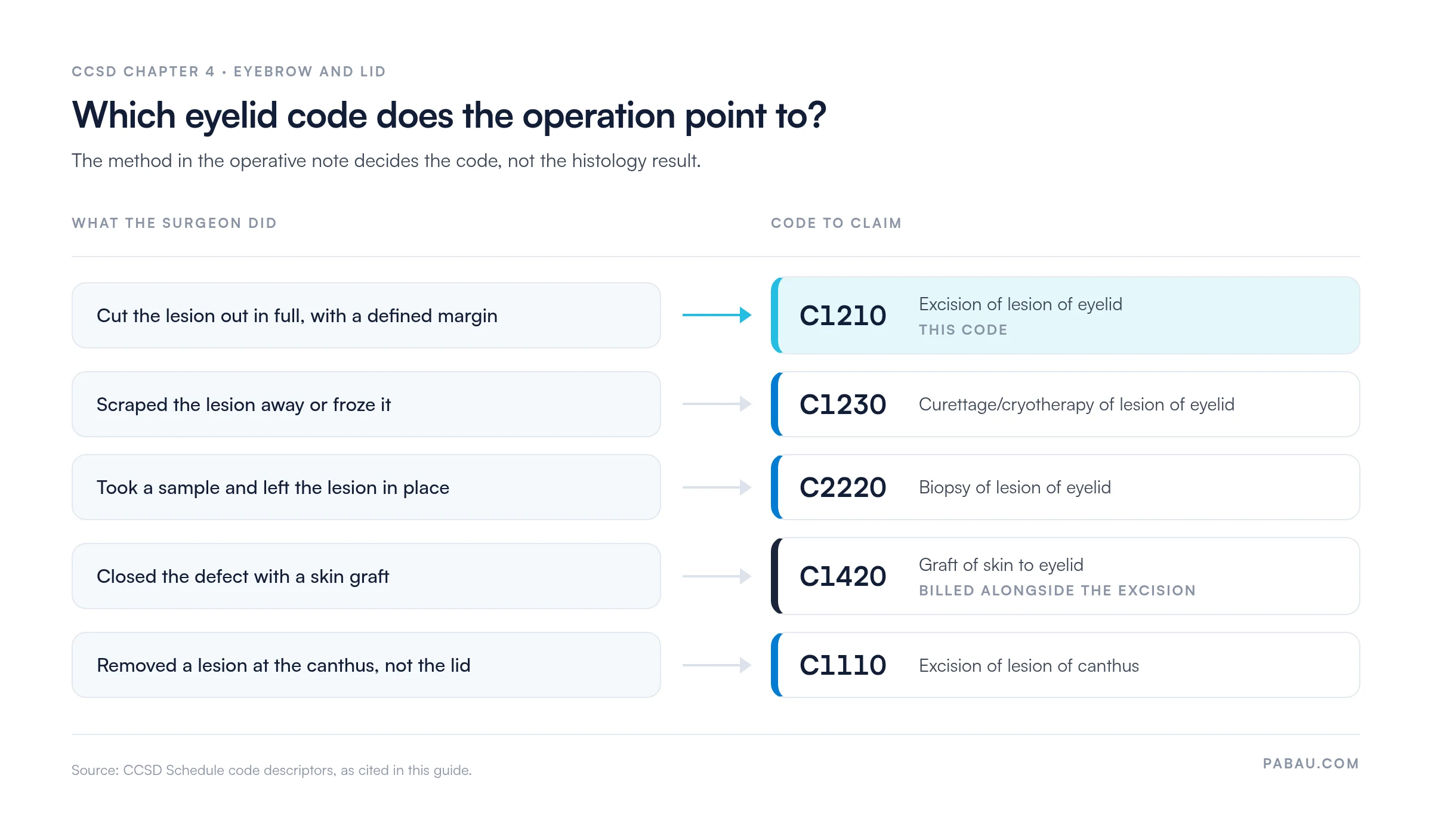
The distinction rests on operative intent at the time of the procedure. If the surgeon set out to remove the lesion in its entirety, C1210 applies regardless of the lesion’s size or whether adequate margins were achieved. In contrast, if the surgeon took only a representative sample for histology and left the rest in situ, C2220 applies.
Coders sometimes apply C1210 retrospectively when histology returns a benign result, assuming the whole lesion was removed. That logic does not hold, because intent and operative description drive code selection, not pathological outcome.
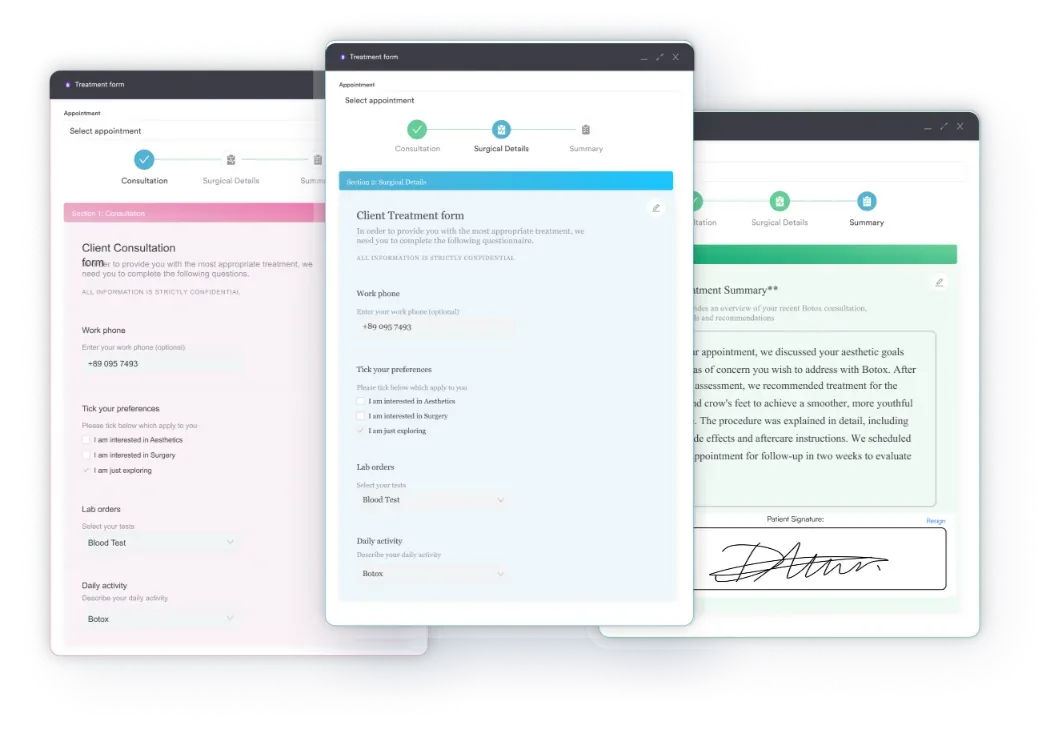
Robust documentation is the strongest protection against a C1210 claim denial. UK private medical insurers often audit eyelid procedure claims, and incomplete records are the main correctable cause of non-payment. Digital consent and operative forms attach to the claim at submission, so nobody has to chase them afterwards.
Every C1210 claim submission should include:
Flag every C1210 case for histopathology at the point of booking, not at the time of excision. If that decision waits for the operative note, the claim can reach the insurer with no histology request. Insurers read that as missing clinical justification.
Bupa, AXA Health, Vitality Health, and Aviva usually require pre-authorisation for C1210 before the procedure takes place. Each insurer applies its own criteria, and these change often. Check the current requirements on the relevant insurer portal rather than relying on past experience. In general, insurers expect:
Most PMI policies contain an explicit cosmetic exclusion clause. Xanthelasma removal and skin tag excision for appearance alone will not get pre-authorisation. However, where the lesion impairs function, the referral letter should quantify it. Cite visual field restriction on formal testing, for example, or corneal exposure risk that slit-lamp examination reveals.
Claim denials for CCSD Code C1210 cluster around a small number of recurring issues. Checking each claim for missing fields before submission, rather than after a denial arrives, prevents most of them.
C1210 covers the excision procedure itself. Insurers may allow several related services alongside it, subject to their own bundling rules.
Anaesthesia codes: C1210 generally includes local anaesthesia from the operating surgeon, so you cannot bill it separately. However, if a separate anaesthetist attends, they bill an anaesthesia attendance code on their own account, not alongside C1210 on the surgeon’s invoice.
Histopathology processing: some CCSD schedules include a separate code for the pathologist’s examination of the excised specimen. The pathology laboratory or the pathologist bills this separately. Therefore, the operating surgeon does not claim a histopathology fee alongside C1210.
Reconstruction codes: where primary closure is not possible, bill a skin graft as C1420 in addition to C1210. A local flap takes its own reconstruction code. Document the reason for reconstruction in the operative note. Insurers may query the combination, so a note explaining the defect size and closure technique resolves most such queries.
Bilateral procedures: whether bilateral eyelid excision (both eyes, same session) can be billed as two units of C1210 varies by insurer. Some apply a bilateral modifier or a percentage reduction to the second side. Verify with the specific insurer before submitting a bilateral claim.
Histopathological examination of the excised eyelid specimen serves two purposes: clinical (confirming or excluding malignancy) and billing (satisfying insurer documentation requirements). When malignancy cannot be excluded clinically, sending the specimen to histology is both medically necessary and commercially prudent.
The operative note should record the specimen and how the surgeon oriented it, for example with a suture at the superior margin. It should also name the fixative, usually 10% formalin, and the receiving laboratory. In addition, the histopathology request form should include the clinical history, suspected diagnosis and any previous biopsy results.
Retain a copy of both the request form and the returned histology report in the patient record. Then, when you submit the C1210 claim, attach the report as a supporting document. In fact, several UK PMI policies treat a missing histology report for a suspected malignancy as grounds to decline the claim entirely.
A C1210 claim follows the same sequence for every insurer. Confirm the code against the Bupa code search portal or the relevant insurer schedule before you start. Errors usually arise from missing fields or documents, not from the submission platform itself.
Record submission dates and insurer response timelines in the patient record. They also protect the practice if the insurer disputes or returns a claim after the standard review period.
Build a standard C1210 submission checklist into your practice workflow. It should confirm that staff record the pre-auth reference, the surgeon completes the operative note the same day, and staff send and log the specimen. Finally, attach the histology report before the claim goes out. A single missed step is the most common reason an insurer returns a reimbursable claim.
A C1210 claim draws on documents created weeks apart: the consent form, the operative note, the pre-authorisation reference and the histology report. When they sit in separate places, the claim waits until someone collects them.
In Pabau, your team completes the consent and treatment forms in the patient record. You can add the histology report to the same record when it returns. Claims management then sends the CCSD-coded claim to Healthcode with those documents attached.
After submission, each claim’s status stays visible to your team. As a result, your team spots a returned C1210 claim early, corrects it and resubmits it within the insurer’s appeal window.

Pabau’s claims management sends CCSD-coded claims to Healthcode with the operative note and histology report attached. It then tracks each claim’s status, so your team spots returned claims early.

The decision that protects a C1210 claim happens in theatre, not at the billing desk. So code what the surgeon set out to do. Excision is C1210, curettage or cryotherapy is C1230, and sampling is C2220.
Two habits cover most of the rest. First, write the functional impairment into the referral before pre-authorisation. Second, send every specimen to histology when malignancy can’t be ruled out. The trade-off is a little more paperwork up front for far fewer returned claims later.
Pabau’s claims management attaches the operative note and histology report to each C1210 claim and tracks it after submission. Book a demo to see how it handles CCSD-coded claims for your practice.

Treating an eyelid lesion by curettage or cryotherapy? CCSD code C1230 explains the documentation and pre-authorisation for the non-excision route.
Closing the defect with a skin graft? CCSD code C1420 covers how the eyelid graft is billed alongside the excision.
Removing a lesion at the corner of the eye? CCSD code C1110 covers excision of a lesion of the canthus.
Need a complete guide to Bupa procedure codes? Bupa CCSD procedure codes covers the full Bupa coding schedule and how to navigate Bupa’s pre-authorisation requirements.
Want to reduce claim rejection rates across your private practice? Pabau claims management submits CCSD-coded claims, attaches supporting documents and tracks each claim’s status.
CCSD Code C1210 is the UK private healthcare procedure code for excision of a lesion of the eyelid. It covers cutting a discrete lesion out of the eyelid in full. Code a biopsy as C2220 and curettage or cryotherapy as C1230. In addition, code reconstruction after excision, such as a skin graft (C1420), separately.
The method decides how you code chalazion treatment. Excising the cyst in full is C1210, while treating it by curettage is C1230, the code for curettage or cryotherapy of an eyelid lesion. So the operative note should name the method, which lets the insurer match it to the code.
Most UK private medical insurers expect a histopathology report when the excised lesion could plausibly be malignant. However, some insurers do not mandate histology for a clinically obvious benign lesion such as a simple skin tag. Even so, the safest policy is to send every excised eyelid specimen to histology and attach the report to the claim. A missing report for a lesion with any malignant features is a common, avoidable reason for denial.
The most common reason is a cosmetic exclusion, which insurers apply when the note does not document functional impairment. Others are a missing pre-authorisation reference, an operative note that does not describe excision, and a missing histopathology report. Unbundling errors also recur, where the claim combines add-on codes in a way the insurer’s schedule does not permit. A standard pre-submission checklist catches each of these.