
Pabau Engage inbox

Pabau Engage is here: every patient conversation in one inbox.

Learn more
Book a demo Book a demo
☰
CCSD Code

CCSD code C0640 – Foreign body removal from the eye socket


Code Definition

C0640 is the CCSD code for removal of foreign body from orbit. It covers surgery to take out an object lodged in the eye socket, outside the eyeball, under general or local anesthesia.

It is a Major procedure in chapter 4 of the CCSD schedule. An object inside the globe, the eyelid, the conjunctiva or the cornea takes a different code. The imaging report and operative note must therefore place the foreign body in the orbit.

Group
4 Eye and orbital contents
Category
Globe And Orbit
Complexity band
Major
Code also known as
orbital foreign body removal, intraorbital foreign body surgery, orbit foreign body extraction
Save time. Improve accuracy. Get paid faster.
Automate coding with Pabau

Let Pabau's smart automation suggest the right codes, reduce claim denials, and keep your practice compliant—effortlessly.

  • AI-powered code suggestions
  • Real-time compliance checks
  • Faster claims, fewer denials
Why practices choose Pabau
Save hours every week

Automate repetitive tasks and focus on what matters most—your patients.

Improve accuracy

Reduce coding errors and ensure compliance with the latest regulations.

Get paid faster

Clean claims, fewer denials, and faster reimbursements.

Grow with confidence

Powerful insights and reporting to help your practice thrive.

HIPAA compliant SOC 2 certified GDPR-compliant Trusted by 4,000+ clinics worldwide

Key takeaways

Key takeaways

CCSD Code C0640 covers removal of a foreign body from the orbital cavity, not from the globe, eyelid, conjunctiva or cornea.

CT is the standard pre-operative scan, and MRI is generally avoided when a metallic foreign body is suspected.

UK private medical insurers expect pre-authorization for elective C0640 procedures, and an emergency case needs prompt retrospective notification.

The operative note decides the claim, so it must name the orbital location, the approach and the foreign body material.

Pabau’s claims management software tracks each pre-authorization on the case and sends UK claims through Healthcode and Bupa.

CCSD Code C0640: Definition and clinical scope

CCSD Code C0640 is the CCSD code for removal of a foreign body from the orbit. It sits in chapter 4 of the CCSD schedule, the procedure code set UK private medical insurers use for claims. The orbit is the bony cavity that houses the eyeball, the extraocular muscles, the lacrimal gland, the optic nerve and orbital fat.

A foreign body in this space sits outside the globe itself. It may lie anteriorly near the orbital rim, or posteriorly deep within the intraconal or extraconal fat. The code applies whenever a surgeon removes the object from that region, under general or local anesthesia.

C0640 does not cover removal from inside the globe, the eyelid margin or the conjunctival surface. Each of those sites has its own CCSD code. Confirming the orbital location is the central coding decision on every claim.

What orbital foreign body removal involves

Intraorbital foreign body removal follows a structured surgical pathway. The steps below reflect standard practice in a UK private hospital setting.

  1. Pre-operative imaging: CT of the orbit is the standard scan. It localizes the foreign body, characterizes its material (metallic, organic or inert) and maps how close it sits to the optic nerve and globe. MRI is generally avoided when a metallic foreign body is suspected, because ferromagnetic fragments can move in the magnetic field.
  2. Anesthetic choice: Most cases use general anesthesia, particularly for posterior or deeply embedded foreign bodies. Anterior, superficial objects may be reachable under local anesthesia, with or without sedation. The anesthetic record must be kept, and the anesthetist bills separately under the relevant anesthesia code.
  3. Surgical approach: An anterior approach uses a skin or conjunctival incision near the orbital rim to reach the anterior orbit. A deeper approach, such as a lateral orbitotomy, is used for objects in the posterior intraconal space. The operative note must record the approach, because it shapes the complexity of the claim.
  4. Foreign body extraction: The surgeon dissects through orbital fat, taking care to spare the optic nerve and extraocular muscles. Metallic fragments may need a magnet-assisted technique. Organic material such as wood or plant matter is fully excised, because retained fragments carry a risk of infection.
  5. Closure and discharge: The orbit is irrigated, hemostasis is achieved and the wound is closed in layers. A discharge summary that links the operative findings to the pre-operative imaging supports the claim.

Clinical indications: When is C0640 appropriate?

C0640 is appropriate when imaging confirms a foreign body within the orbital cavity and surgical removal is clinically indicated. Common presentations include:

  • Traumatic penetrating injury with a retained metallic fragment (BB pellet, wire or shrapnel) in the orbit
  • Organic foreign body (wood splinter or plant material) causing, or at risk of causing, orbital cellulitis
  • Symptomatic inert foreign body (plastic or glass) causing diplopia, proptosis or pressure on the optic nerve
  • Incidentally discovered foreign body on imaging that is enlarging, migrating or producing an inflammatory reaction
  • Emergency presentation after an open globe injury where an orbital component is separately identified

Asymptomatic, well-tolerated inert foreign bodies are sometimes observed rather than removed. When removal is elected in an asymptomatic case, the insurer needs pre-authorization, and the supporting documents must state the clinical rationale.

What C0640 covers and what it excludes

The anatomical boundary of C0640 is the orbital cavity. The table below shows what falls inside and outside the code’s scope, and which neighboring CCSD code applies instead. For insurer-specific coding, our guide to Bupa CCSD codes covers how Bupa applies the schedule.

ScenarioCovered by C0640?Notes
Foreign body in bony orbital cavity (extraconal or intraconal fat)YesCore scope of C0640.
Foreign body within the globe (intraocular)NoUse the intraocular foreign body removal code (CCSD schedule, vitreoretinal section)
Foreign body in the eyelidNoUse the appropriate lid foreign body or excision code
Foreign body on the conjunctival surface or subconjunctival spaceNoUse the conjunctival foreign body removal code
Foreign body on the corneaNoUse the corneal foreign body removal code
Orbital abscess drainage secondary to organic foreign bodyNo: C0620 cannot be billed with C0640CCSD lists C0620 as an unacceptable combination with C0640. Code the procedure that was performed and confirm with the payer.

Neighboring CCSD codes and how to distinguish them

Several CCSD codes cover foreign body removal from structures next to the orbit. The table below lists the codes most often confused with C0640 and the detail that separates each one.

CCSD code areaAnatomical siteKey differentiator
C0640Orbital cavity (extra- and intraconal)Foreign body is OUTSIDE the globe, confirmed in orbital fat or at the orbital apex
Intraocular foreign body removal (vitreoretinal)Globe interior (vitreous, retina)Foreign body is INSIDE the globe; requires vitreoretinal surgical technique
Eyelid foreign body / excisionEyelid margin or tarsal plateForeign body is in the lid tissue, not the orbital cavity behind it
Conjunctival foreign body removalConjunctival surface or sub-Tenon’s spaceForeign body is on or under the conjunctiva, accessible without orbital dissection
Corneal foreign body removalCorneal epithelium or stromaForeign body is in the corneal layers; typically performed under slit-lamp with no orbital dissection

Other procedures on the orbit carry their own codes as well. Drainage of orbit is billed as C0620, and exploration of the orbit as a sole procedure as C0650. CCSD lists C0620 as an unacceptable combination with C0640, so the two codes are not billed together.

Practical rule: If the operative note describes dissection through orbital fat, extraconal or intraconal, C0640 is correct. If it describes a slit-lamp or lid procedure with no orbital fat dissection, a different code applies, as the decision table below sets out.
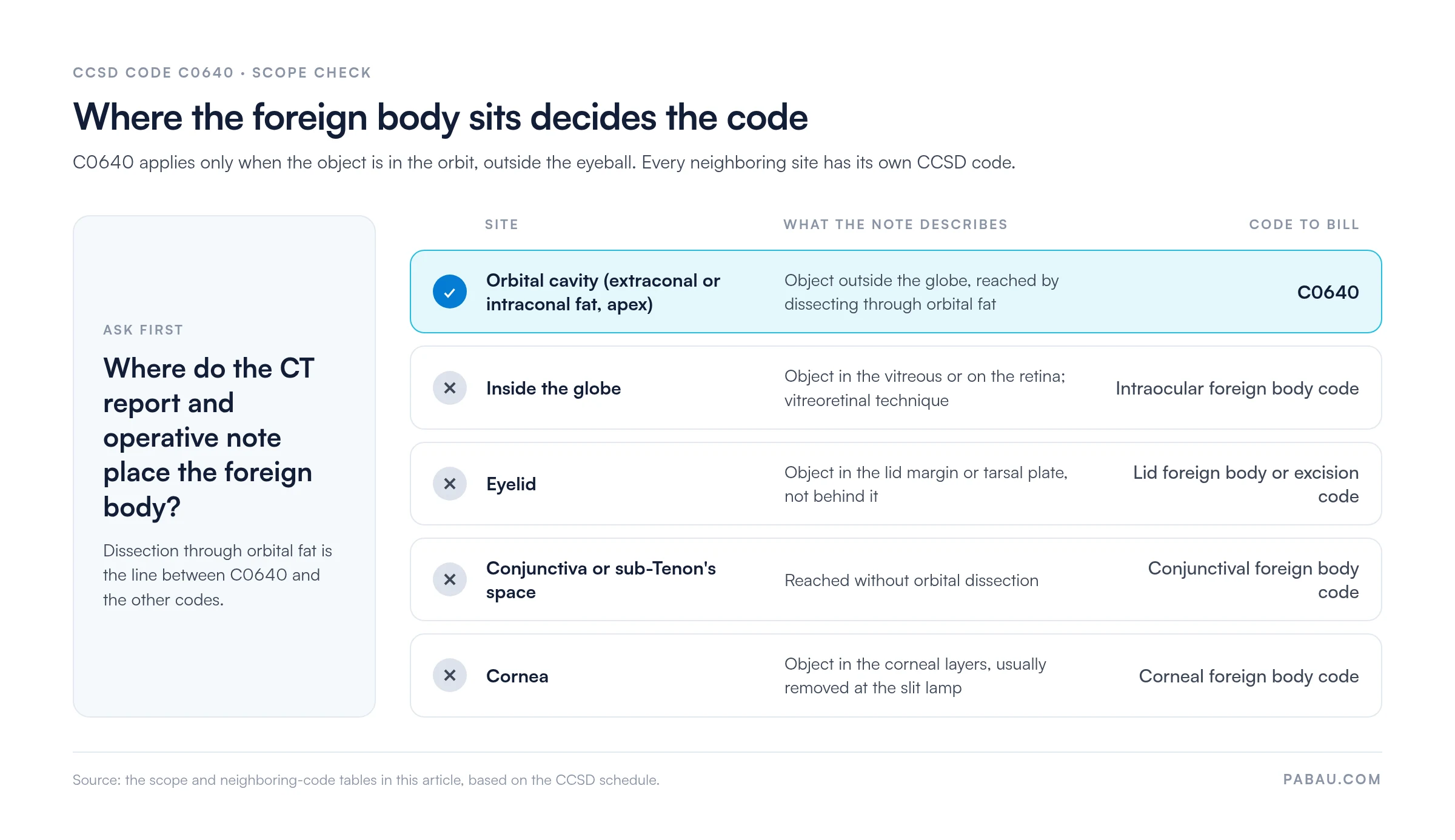
Decision table for CCSD code C0640: a foreign body in the orbital cavity (extraconal or intraconal fat, apex) is billed as C0640; inside the globe, eyelid, conjunctiva or sub-Tenon's space, and cornea each take their own foreign body removal code
The foreign body’s site, as placed by the CT report and operative note, decides whether C0640 or a neighboring code applies. Built from the scope tables above, based on the CCSD schedule.

Documentation requirements for billing C0640

A complete C0640 claim needs documentation across five areas. Missing any one of them raises the risk of denial.

  • Imaging report: A CT orbit report, or rarely a plain X-ray, that places the foreign body in the orbital cavity. It must rule out the globe and nearby soft tissue. The report should name the orbital space, such as “right extraconal orbital fat”, and describe the material where it can be identified.
  • Operative note: It must state the approach (anterior, lateral orbitotomy or another route) and confirm that dissection entered the orbital cavity. It must also describe the material and size, and confirm complete removal or a deliberate partial removal with the reason.
  • Anesthetic record: The type of anesthesia (general or local) and the anesthetist’s details. Insurers need it for separate anesthesia billing and to validate procedure complexity.
  • ICD-10 diagnosis code: Linked on the claim and matched to the clinical scenario (see the ICD-10 pairing table below).
  • Referral letter: A consultant referral confirming the clinical indication, and whether the procedure was planned electively or done as an emergency, with the reason.

A digital operative note template that prompts for each of these fields keeps the record complete at the point of care. Reconstructing a missing detail at claim submission is slower and less reliable. Structured notes also support the audit trail UK GDPR expects for patient data.
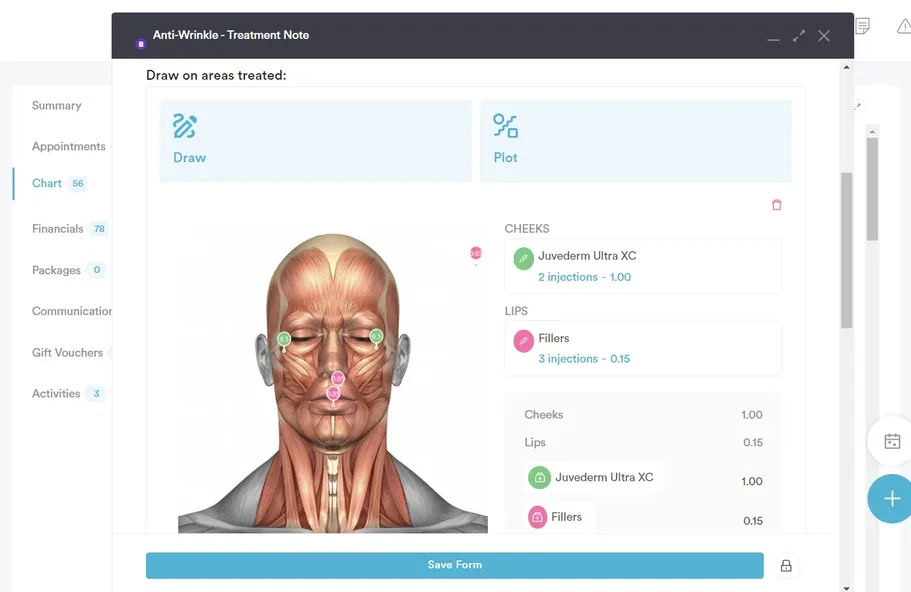
Pabau treatment note with a drawable anatomy diagram and structured fields
Pabau’s treatment notes pair structured fields with a drawable diagram, so the surgeon can record the approach and the foreign body’s position in one note.

Pre-authorization: What UK payers require before approving C0640

Major UK private medical insurers require pre-authorization for elective CCSD Code C0640 procedures. When an emergency case could not be pre-authorized, the insurer must be notified within its stated window, typically 24 to 48 hours after the procedure. Check each insurer’s current provider guide before submitting, because these requirements change.

InsurerPre-auth required?Evidence typically requestedReference
BupaYes (elective surgical procedures)Imaging report, consultant letter with ICD-10 diagnosis, CCSD codeBupa code search
AXA HealthYes (surgical procedures)Specialist referral, imaging, diagnosis codeAXA Health procedure codes
AvivaYes (elective surgery)Referral letter, imaging confirming orbital (not ocular) locationAviva fee schedule
HealixYesClinical justification, CCSD code with supporting diagnosisHealix fee schedule
Vitality HealthYesReferral and imaging documentation. Vitality’s online fee finder confirms the coverage tierVitality provider portal

How to submit CCSD Code C0640 on Healthcode

Healthcode is the electronic claims platform used by most UK private medical insurers. A C0640 claim needs several fields completed accurately before it is sent.

  1. Select C0640 as the procedure code. Enter it in the CCSD procedure field, never as a free-text description. Healthcode validates codes against the schedule and returns unrecognized formats as errors.
  2. Attach the ICD-10 diagnosis code. The diagnosis code (see the ICD-10 pairing table below) must match the presentation in the referral letter and imaging report. A mismatch between the procedure code and the ICD-10 code often triggers a manual review.
  3. Add anesthesia codes where they apply. If the anesthetist bills separately, confirm which CCSD anesthesia code they are submitting, so the same service is not billed twice. If the surgeon gave a local anesthetic personally, add the relevant code and note it in the operative record.
  4. Apply modifiers if required. For a bilateral procedure, check the insurer’s bilateral billing policy before billing both sides under one code. Some insurers require a modifier, and others want a separate pre-authorization for the second orbit. A planned second-stage removal typically needs a fresh pre-authorization, even when the first stage was approved.
  5. Upload supporting documentation. Attach the imaging report and operative note as PDFs within the Healthcode submission. Bupa and AXA Health commonly ask for these up front on surgical claims above a threshold fee.
  6. Submit and track. Note the Healthcode reference number and watch for Electronic Remittance Advice responses. Act on any payer query or partial payment within 14 days, so the claim does not age into a write-off.

The CCSD technical guide (October 2025) sets out the code structure and business rules that apply to Healthcode submissions.

Common claim denials for C0640 and how to avoid them

The table below lists the most frequent reasons C0640 claims are denied and the fix for each. The patterns reflect general UK private medical insurance billing. Neither CCSD nor individual payers publish denial rates for C0640.

Denial reasonRoot causeCorrective action
Wrong anatomical codeGlobe or eyelid code submitted instead of orbital codeRecheck the operative note to confirm dissection entered the orbital cavity. Resubmit C0640 with the corrected code and a brief appeal letter citing the operative note.
Missing pre-authorizationElective procedure submitted without prior approvalFor emergency cases, submit the retrospective notification with the clinical rationale. For elective cases, an appeal is unlikely to succeed, so obtain pre-authorization before the next procedure.
Insufficient operative noteNote does not confirm location, approach, or complete removalSupplement with a clinical addendum signed and dated by the surgeon. Submit as part of a formal appeal with the original claim reference.
ICD-10 mismatchDiagnosis code does not align with C0640 procedureReview the ICD-10 pairing table below. Resubmit with the correct diagnosis code and confirm it matches the referral letter.
Duplicate billingC0640 submitted alongside a related code that bundles the procedureCheck the CCSD schedule and payer-specific bundling rules before adding secondary codes. Remove the bundled code and resubmit.

A missing pre-authorization is the hardest of these denials to reverse. An insurer rarely approves elective surgery after the event, so the fix belongs before the operating date.

Pro Tip

Before submitting a C0640 claim, run a three-point check on the operative note. First, confirm the word ‘orbit’ or ‘orbital’ appears in the description of the dissection site. Second, confirm the note places the foreign body outside the globe. Third, confirm it names the approach, anterior or lateral. These three details answer a payer’s first questions on manual review.

ICD-10 diagnosis codes to pair with C0640

CCSD Code C0640 is always submitted alongside a valid ICD-10 diagnosis code, and our ICD-10 code library lists each one in full. The table below shows the codes most often used for orbital foreign body presentations. Some UK private insurers cross-check the ICD-10 code against C0640 automatically, so a mismatched code can trigger a manual review or a denial.

ICD-10 codeDescriptionUse when…
H05.5Retained (old) foreign body following penetrating wound of orbitPost-traumatic retained orbital foreign body, the most common pairing with C0640
S01.1xOpen wound of eyelid and periocular areaAcute penetrating injury with orbital component, emergency setting
H05.3Deformity of orbitWhen the foreign body has caused orbital deformity or proptosis as the presenting feature
H05.1Chronic inflammatory disorders of orbitOrganic foreign body (wood, vegetable) causing chronic orbital cellulitis or abscess
T15.1Foreign body in conjunctival sacThe foreign body is in the conjunctival sac, not the orbital cavity. Do not pair with C0640

Always verify ICD-10 codes against the current NHS Classifications Browser or the insurer’s own code lookup before submission. T15.1 appears in the table as a counterexample. Coding a conjunctival foreign body as an orbital one and billing C0640 is both a billing error and an inaccurate record.

How Pabau prevents avoidable C0640 claim denials

Every denial reason in the table above starts in the paperwork. A missing pre-authorization, an operative note without the approach and an ICD-10 code nobody cross-checked are workflow problems. A structured system catches each one before the claim is submitted.

Pabau, a practice management platform, includes claims software for surgeons that tracks each pre-authorization on the patient’s case. It records the authorization code, dates and sessions, and warns the team when one is missing. Elective C0640 cases then reach the operating list with approval confirmed.
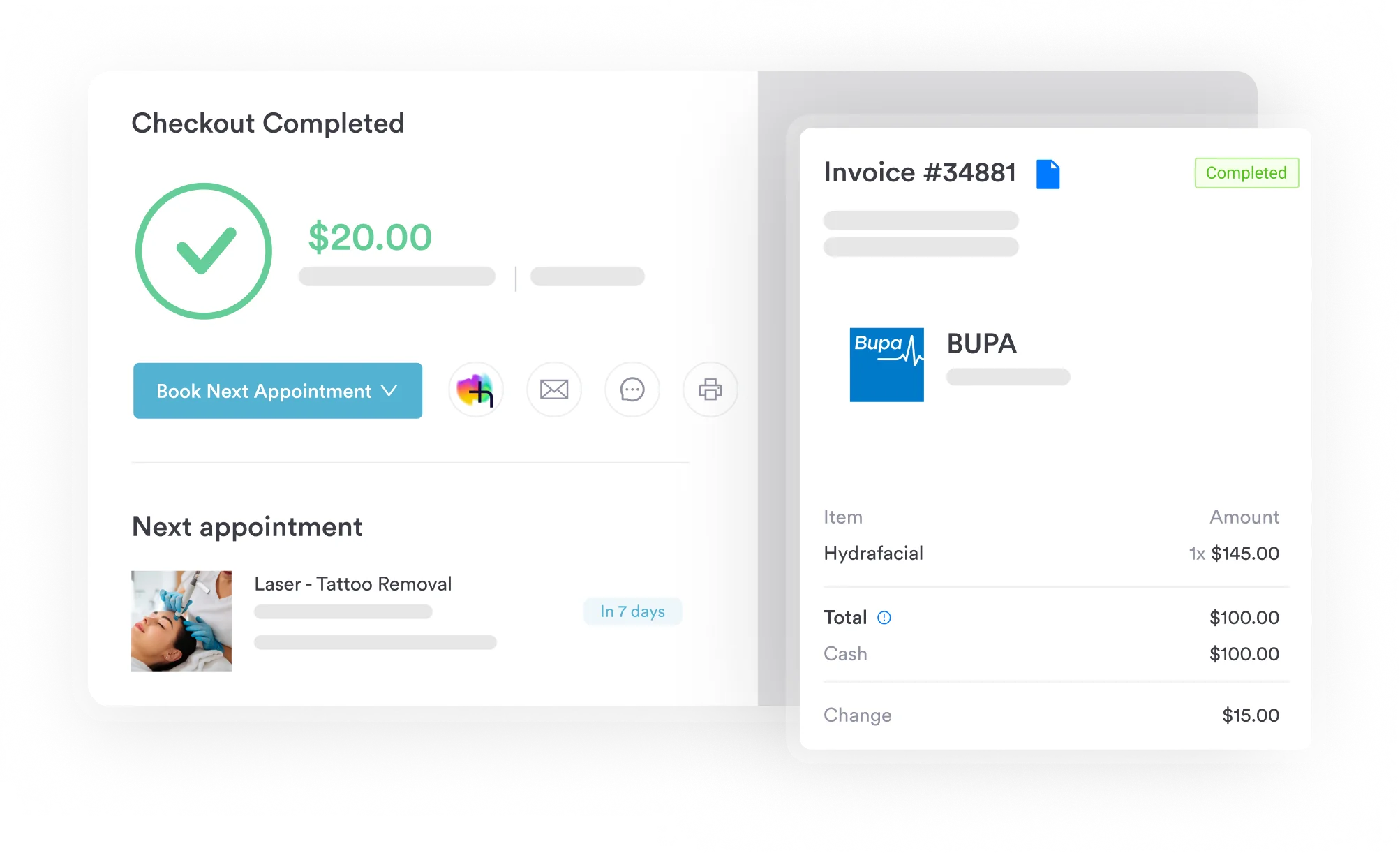
Automate claims through Healthcode
Pabau’s checkout raises an invoice against the patient’s insurer, so a C0640 claim goes to Bupa or Healthcode without being re-keyed.

Treatment note templates with required fields prompt the surgeon to record the approach, location and material before the note is closed. UK claims then go to insurers through Healthcode and Bupa from the same system, which cuts the transcription errors that cause ICD-10 mismatches.

Get C0640 claims paid the first time

Pabau tracks pre-authorizations on each case and sends UK claims through Healthcode and Bupa, so orbital surgery claims go out complete.

Pabau practice management software for UK private practices

Conclusion

Most C0640 billing problems come down to one boundary: the line between the orbital cavity and the structures around it. Before submitting, confirm that the CT report and the operative note both place the foreign body in the orbit, in the same words.

Do that, and pre-authorization, ICD-10 pairing and Healthcode submission become routine checks. Skip it, and even a well-documented case can be paid under the wrong code or queried months later. Book a demo to see how Pabau keeps orbital surgery claims complete from referral to remittance.

Continue your research

Continue your research

Need a full Bupa CCSD code reference? Bupa CCSD codes covers the Bupa-recognized procedure codes and how UK private practices use them.

Billing decompression rather than removal? CCSD Code C0630 explains how decompression of the orbit is coded and documented.

Took a biopsy from an orbital lesion? CCSD Code C0610 covers biopsy of a lesion of the orbit and the records insurers expect.

Checking how Bupa prices CCSD codes? Bupa procedure codes fee schedule explains how Bupa sets fees for CCSD-coded procedures.

Frequently asked questions

What does CCSD Code C0640 cover?

CCSD Code C0640 covers surgical removal of a foreign body from the orbital cavity, the bony space around the eyeball. It applies when the object is confirmed in the orbital fat or at the orbital apex. Objects in the globe, eyelid or conjunctiva take other codes. UK private medical insurers use the code to reimburse the procedure.

What is the difference between a foreign body in the orbit and in the eye?

A foreign body in the orbit sits in the bony cavity around the eyeball, within the orbital fat outside the globe. An intraocular foreign body is inside the globe, in the vitreous or against the retina. The two are surgically distinct. C0640 covers the orbital location, and a separate CCSD vitreoretinal code covers removal from within the globe.

Is imaging required before billing C0640?

Yes, payers expect a pre-operative CT scan as supporting documentation. MRI is generally avoided when a metallic foreign body is suspected. The imaging report must place the foreign body in the orbital cavity, not the globe or periorbital soft tissue, to support the C0640 code.

Which UK private insurers require pre-authorization for C0640?

Bupa, AXA Health, Aviva, Healix and Vitality Health all expect pre-authorization for elective C0640 procedures. For an emergency case that could not be pre-authorized, most insurers want retrospective notification within 24 to 48 hours. Check each insurer’s current provider guide, because requirements and timelines vary by policy.

Can C0640 be billed alongside anesthesia codes?

Yes. When an anesthetist gives a general anesthetic, the anesthetist bills separately under the relevant CCSD anesthesia code, and the surgeon bills C0640. When the operating surgeon gives a local anesthetic personally, the relevant local anesthesia code may be added to the same claim. Confirm with each insurer whether that local anesthetic is included in the procedure fee.

How should bilateral or staged C0640 procedures be billed?

For a bilateral case, check each insurer’s bilateral billing policy before submission. Some require a modifier, and others want a separate pre-authorization for the second orbit. A planned second-stage removal of a residual foreign body typically needs a new pre-authorization, even when the first was approved. Most UK private medical insurers treat the second stage as a fresh elective procedure.


Tanja Lepcheska
Content Writer

Tanja is a Senior Content Writer who has a skill to turn complex med spa topics into easy, engaging reads that actually make sense. She loves helping clinic owners feel confident about growing their business. When she’s not writing, you’ll probably find her rewatching her favorite romantic movies, working on a new crochet project, or rearranging her home decor “just one more time.”
×

