CPT code 93503: Swan-Ganz catheter billing and modifiers
CPT code 93503: Official descriptor and procedure overview In the AMA CPT code s...

Last Updated: Oct 23, 2026
CCSD code C3920 covers cauterisation, including cryotherapy, to a lesion on the conjunctiva. It sits in Chapter 4, Eye and orbital contents, under the Conjunctiva category, with a Minor 2 complexity band.
Ophthalmologists use it when they destroy a lesion with cautery or freezing. Excision or biopsy of the same lesion takes C3910 instead, so the operating note must name the technique used. A note that describes a different technique invites a query from the insurer.
Let Pabau's smart automation suggest the right codes, reduce claim denials, and keep your practice compliant—effortlessly.
Automate repetitive tasks and focus on what matters most—your patients.
Reduce coding errors and ensure compliance with the latest regulations.
Clean claims, fewer denials, and faster reimbursements.
Powerful insights and reporting to help your practice thrive.
HIPAA compliant SOC 2 certified GDPR-compliant Trusted by 4,000+ clinics worldwide

CCSD code C3920 covers cauterisation, including cryotherapy, of a conjunctival lesion in Chapter 4, Eye and orbital contents.
The technique decides the code. Destroying the lesion is C3920, while cutting it out or sampling it is C3910.
The operating note must name the technique, the eye treated and the lesion’s position, or the claim invites a query.
Confirm cover and pre-authorization with the insurer before the procedure, even though C3920 carries a Minor 2 band.
Healthcode is the standard route for sending C3920 claims to UK private medical insurers.
CCSD code C3920 is the procedure code for cauterisation, including cryotherapy, to a conjunctival lesion. UK private medical insurers read it as one clear message. A lesion on the conjunctiva was destroyed in place.
The code sits in Chapter 4 of the CCSD schedule, Eye and orbital contents, under the Conjunctiva category. It carries a Minor 2 complexity band, which fits a short procedure often done under local anesthetic. To look up a neighboring eye code, use our searchable CCSD codes list.
C3920 describes what the surgeon did, not why. Many insurers also ask for an ICD-10 diagnosis, so record what the lesion was alongside the code.
Think of C3920 as the destruction code for the conjunctiva. It applies when the ophthalmologist removes a lesion by burning or freezing it, rather than cutting it away.
C3920 covers:
C3920 does not cover:
That last exclusion comes up often. When the lesion sits on the eyelid skin instead of the conjunctiva, curettage or cryotherapy bills as C1230.
Unsure which side of the line a case falls on? Read the operating note before you build the claim. The technique recorded there decides the code, not the booking.
The three conjunctival lesion codes treat the same structure in different ways. Choosing between them comes down to what the surgeon physically did. Drainage sits outside this group. When the surgeon punctures a conjunctival cyst and lets the fluid out, leaving the wall in place, the claim belongs under C4100.
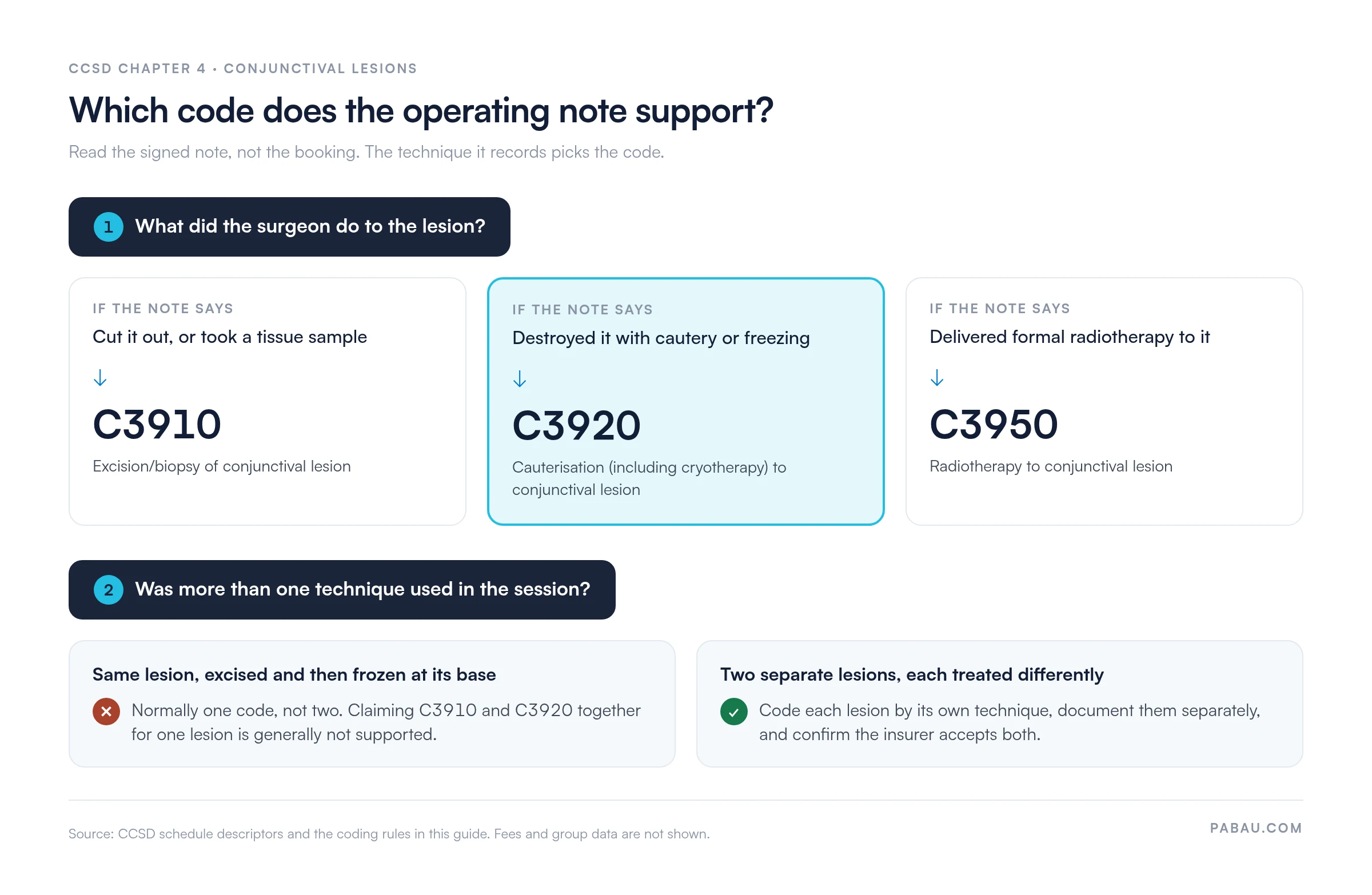
Combined procedures need extra care. Claiming C3910 and C3920 for the same lesion in one session is generally not supported.
Two separate lesions, each treated differently and documented as such, are a different case. Check the insurer’s rules before you claim both. Radiotherapy follows its own route under C3950. The same exclusivity rule applies outside the eye chapter, where nasal septum cautery under E0380 comes off a claim that already carries a septoplasty.
Insurers rarely question a minor eye procedure that is documented well. They do query a note that leaves the technique vague, or one that reads like an excision.
Record these points in every C3920 operating note:
A template helps most in a busy list. Every surgeon records the same points, so the billing team never has to chase a missing detail.
A Minor 2 band does not remove the need for approval. Most UK private medical insurers expect the patient to contact them before treatment.
Before the appointment, confirm three points with the patient’s insurer:
Each major insurer publishes a lookup tool for its codes or fees. Use these to check C3920 before you book.
Rules change, so check at the time of booking rather than trusting last year’s answer. For one insurer’s approach in depth, see our guide to Bupa CCSD codes.
Healthcode is the main electronic route for CCSD claims to UK private medical insurers. A clean submission follows the same order every time.
Healthcode returns an acknowledgment once the claim arrives. A rejection usually names the field at fault, so correct it and resubmit the same week.
Here is the technique rule in practice. A patient attends with two conjunctival lesions in the right eye.
The surgeon excises the larger lesion and sends it to histology. The smaller one, a recurrence, is treated with cryotherapy.
The note describes each lesion separately, with its position, size and technique. The claim then lists C3910 for the excision and C3920 for the cryotherapy.
Before submission, the practice confirms the insurer accepts both codes together and that the authorization covers both. Had the surgeon excised one lesion and then frozen its base, the claim would normally carry one code, not two. The decision path below sets the single-lesion and two-lesion cases side by side.
Most denials trace back to admin slips, such as a missing authorization or a mistyped membership number. The table shows the usual causes and the fix for each.
Two minutes here saves a rejection later. Tick off each point before the claim leaves the practice.
A few errors come up again and again with this code. Each one has a simple fix.
Coding from the booking. The appointment may say “lesion removal”, but the plan can change once the surgeon examines the eye. Always code from the signed note.
Looking for a separate cryotherapy code. The descriptor already includes cryotherapy. Freezing a conjunctival lesion is still C3920.
Treating the band as a price. Minor 2 describes complexity. Your fee comes from your agreement with each insurer.
Leaving out the diagnosis. The code shows what was done. Without a diagnosis, the insurer cannot see why it was needed.
Many practices still type claims by hand from the operating note. That is where membership numbers get mistyped and authorization references go missing.
Pabau’s claims management software builds the claim from the patient record instead. The CCSD code, patient details and insurer information carry across. The claim cannot be sent until its required fields are complete.
In the UK, claims go to insurers through Pabau’s Healthcode integration, with claim status tracked in one place. The same software submits claims through Claim.MD in the US and Tyro Health in Australia.
Your surgeon and coder still choose the code. Pabau then carries it to the insurer with every required field filled in.

Pabau pre-fills claims from the patient record, checks required fields before sending, and submits CCSD claims through Healthcode. See how it fits your ophthalmology practice.

C3920 is one of the simpler codes in the eye chapter, provided the note and the code agree. If the surgeon destroyed the lesion with cautery or freezing, C3920 is right. If tissue was cut out or sampled, the claim belongs under C3910.
Put your effort into two steps, the operating note and the authorization check. Together they prevent most of the rework that follows a minor eye procedure claim.
If your team still re-keys claims by hand, fix that step next. Book a demo to see how Pabau turns a signed operating note into a complete Healthcode claim.

Removing the lesion instead of destroying it? CCSD code C3910 covers excision and biopsy of a conjunctival lesion.
Treating the lesion with radiation? CCSD code C3950 explains how radiotherapy to a conjunctival lesion is billed.
Billing other eye procedures? CCSD code C0620 walks through drainage of the orbit from the same chapter.
Billing Bupa patients? Bupa CCSD codes explains how Bupa uses the schedule and checks codes.
Yes. The C3920 descriptor names cryotherapy alongside cautery, so freezing a conjunctival lesion is billed under C3920. There is no separate conjunctival cryotherapy code to look for.
Not for the same lesion in the same session, as a rule. Two separate lesions, one excised and one cauterized, can justify both codes. Document each lesion clearly and confirm the insurer accepts the combination first.
A repeat procedure on a later date is a new claim. Check that the original authorization covers it, or ask the insurer for a new one before treatment.
No. C3920 records the procedure. Where the insurer asks for one, add an ICD-10 code that describes the lesion.
No. The band reflects procedure complexity. Each insurer sets its own fee, so check your agreement or the insurer’s fee tool.